

Cruise Ship Dry Dock: What It Means for Your Trip
The advice to book a newly refurbished cruise ship sounds sensible: fresh cabins, updated restaurants, and a ship that's just received attention. But newly refurbished isn't automatically the lower-risk booking. A ship returning from an ambitious rebuild may offer more uncertainty than an older vessel sailing its normal schedule.
The useful question isn't whether your ship has been to dry dock. It's what workers are changing, when the ship returns, and whether the things you're paying for will be ready. Those details help you distinguish necessary maintenance from a transformation that could affect your vacation.
Table of Contents
- Why Cruise Ships Leave the Water
- The Work Done Below the Waterline
- How to Find a Dry Dock Schedule
- Yards and Fleets Behind Recent Dry Docks
- Timeline and Keep-or-Move Test for Your Sailing
- Confirm and Pack Before You Sail
Why Cruise Ships Leave the Water
A cruise ship dry dock is a shipyard stay that gives workers access to the parts normally underwater. In a traditional graving dock, the ship enters a basin, workers position it above support blocks, and the water is pumped out. Think of it as a car lift for a floating hotel, not evidence that the ship has broken down.
Cruise ship dry dock types at a glance
| Docking type | Typical duration | Reported cost | What guests notice |
|---|---|---|---|
| Routine technical dry dock | About 2–3 weeks | No standalone routine-project price established by the cited overview | Hull, machinery, and coatings receive attention; public rooms may look much as they did before |
| Major refit or conversion | Commonly 5–7 weeks | About $50 million to more than $100 million per ship | Cabins, venues, and technical systems may be rebuilt during the same outage |
The duration and major-project cost benchmarks sit within an industry that recorded approximately $3 billion or more in cruise dry-dock activity during 2024, according to the Cruise Industry News dry-dock overview. Treat those benchmarks as categories, not promises about your particular ship.
Why carpets and hull repairs happen together
A cruise line can't sell an ordinary passenger voyage while its ship is sitting on blocks. It therefore has a strong reason to combine underwater inspections, mechanical repairs, technology installation, and hotel improvements in the same withdrawal from service.
That explains an otherwise confusing announcement. A cruise line might promote a new restaurant and refreshed suites while saying little about the sea valves, protective coatings, or structural inspections happening underneath. The restaurant is easier to market, but it doesn't necessarily explain why the docking was scheduled.
Combining projects also creates coordination problems. Electricians may need access above a ceiling before decorators can close it, while equipment deliveries compete with contractors moving through service corridors. A finished-looking lounge doesn't tell you whether every related system has been tested.
Practical rule: Judge the scope of the work, not the enthusiasm of the refurbishment announcement.
What the bill does and doesn't tell you
A major project's price can include cabin rebuilding, public-space changes, engineering upgrades, design, and installation. It isn't a measure of how much nicer your particular stateroom will feel, nor does a large budget guarantee an effortless reopening.
Vessel size, labor availability, yard capacity, and unexpected repair findings all affect the job. A technical docking can be demanding without creating any obvious new attraction for passengers.
Before assessing your booking, label the project routine technical maintenance, major modernization, or scope not yet confirmed. That last category is more useful than assuming that refurbished means completely rebuilt.
The Work Done Below the Waterline
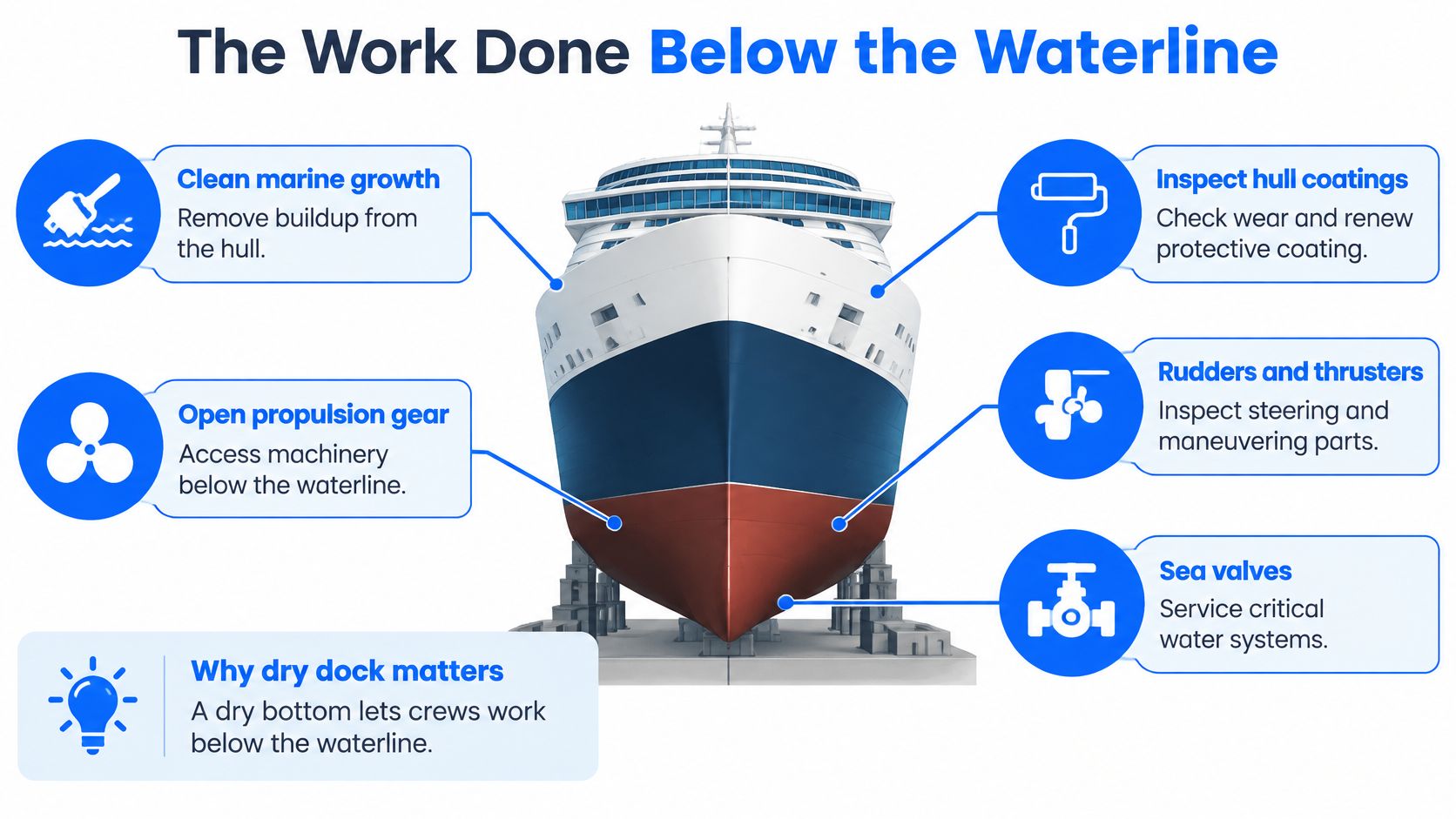
Once the hull is dry, workers can inspect surfaces and equipment that are difficult to reach properly while the ship is afloat. They remove marine growth, assess protective coatings, and examine propulsion and steering components.
The work is easier to understand when you separate the different systems beneath the passenger decks.
A clean hull is only the starting point
Marine growth makes a hull less smooth, increasing resistance as the ship moves through water. Damaged coatings can expose steel to corrosion, so cleaning and repainting are engineering tasks rather than cosmetic polishing.
Workers also inspect propellers, rudders, thrusters, sea chests, and shell-door areas. Sea chests are recesses associated with seawater intake systems; their condition and the valves serving those systems matter even though passengers never see them.
Structural inspectors look for pitting, fractures, deformation, and questionable previous repairs. They compare the ship's steel plating and reinforcing members with its scantlings plan, the approved structural dimensions, rather than deciding that a repair looks sound.
The inspection clocks aren't interchangeable
Different regulatory frameworks explain why a simple statement such as ships dry dock every few years can be misleading. The applicable requirements depend on the vessel and the approved survey arrangements.
How often cruise hulls must be examined
| Rule | Interval | What must be accessible |
|---|---|---|
| U.S. Coast Guard dry-dock and internal structural exam | Generally every 12 months, unless an approved underwater-survey alternative applies, under 46 CFR Part 71, Subpart 71.50 | Structural areas for examination, with the scantlings plan available to support assessment of plating, stiffeners, corrosion, fractures, and previous repairs |
| IMO outside-bottom inspection | At least two dry-dock bottom inspections within five years, with no more than 36 months between bottom inspections, under the IMO Harmonized System of Survey and Certification guidelines,%202023%20(Secretary-General).pdf) | Bottom and appendages, including coatings, propeller, rudder, thrusters, sea chests, and shell-door areas |
For applicable Coast Guard examinations, the operator must also coordinate with the Officer in Charge, Marine Inspection. An approved underwater survey is a defined alternative, not permission to substitute any casual diver inspection.
A dry bottom gives workers access that a diver can't fully reproduce. They can prepare surfaces, open equipment, measure suspect steel, and carry out repairs without underwater visibility constraints.
The work schedule needs room for findings, too. If thickness measurements reveal steel that needs replacing, inspectors may need to examine the completed repair before the ship returns to service. Hotel renovations share the outage, but they aren't why the hull needs to leave the water.
How to Find a Dry Dock Schedule
Start with the ship's exact name, not just the cruise line. Fleet-wide refurbishment campaigns can involve different projects on different vessels, and a general announcement won't establish what happens before your sailing.
Build a dated record
- Search the cruise line's newsroom. Combine the ship name with dry dock, refurbishment, refit, and wet dock. Record the announced work, yard, and return-to-service date. A wet dock means work while afloat, so don't assume every refit announcement includes underwater access.
- Check trade coverage. Cruise Industry News publishes docking and deployment coverage that can identify projects missing from consumer advertising. Use the publication date to distinguish an original plan from a later update.
- Look for the yard's announcement. Search the ship name alongside Grand Bahama, Malta, or the named European or Asian facility. A yard notice can corroborate the location and scope, though an arrival announcement doesn't guarantee the departure date.
- Compare actual calendar dates. Put the planned yard exit beside your embarkation date and count the days between them. A return advertised for spring is too vague to assess a particular departure.
- Ask the cruise line narrow questions. Is the work technical only, or does it involve rebuilding guest spaces? Which venues and cabin categories are affected? Is your departure the first passenger sailing afterward? Send the questions in writing so the answers remain usable.
- Treat forums as leads. A passenger discussion may alert you to a change, but confirm it against a dated cruise-line response or yard notice before changing travel arrangements.
Resolve gaps rather than filling them with guesses
A gap in the booking calendar isn't proof of dry dock. It might reflect a charter, a repositioning movement, or inventory the line hasn't released. Likewise, the absence of an advertisement doesn't establish that no technical work is planned.
Schedules can change when contractors find additional steel repairs, equipment arrives late, or labor takes longer than expected. A ship may also change yards, making an older announcement incomplete rather than entirely wrong.
Save the date of each announcement alongside the date it describes. An old schedule can look current when it's copied into a new discussion.
Finish with a compact note containing ship, yard, docking start, planned return, and guest-area work. Add a separate uncertainty flag wherever the cruise line hasn't answered clearly. That gives you something concrete to evaluate instead of a collection of reassuring headlines.
Yards and Fleets Behind Recent Dry Docks
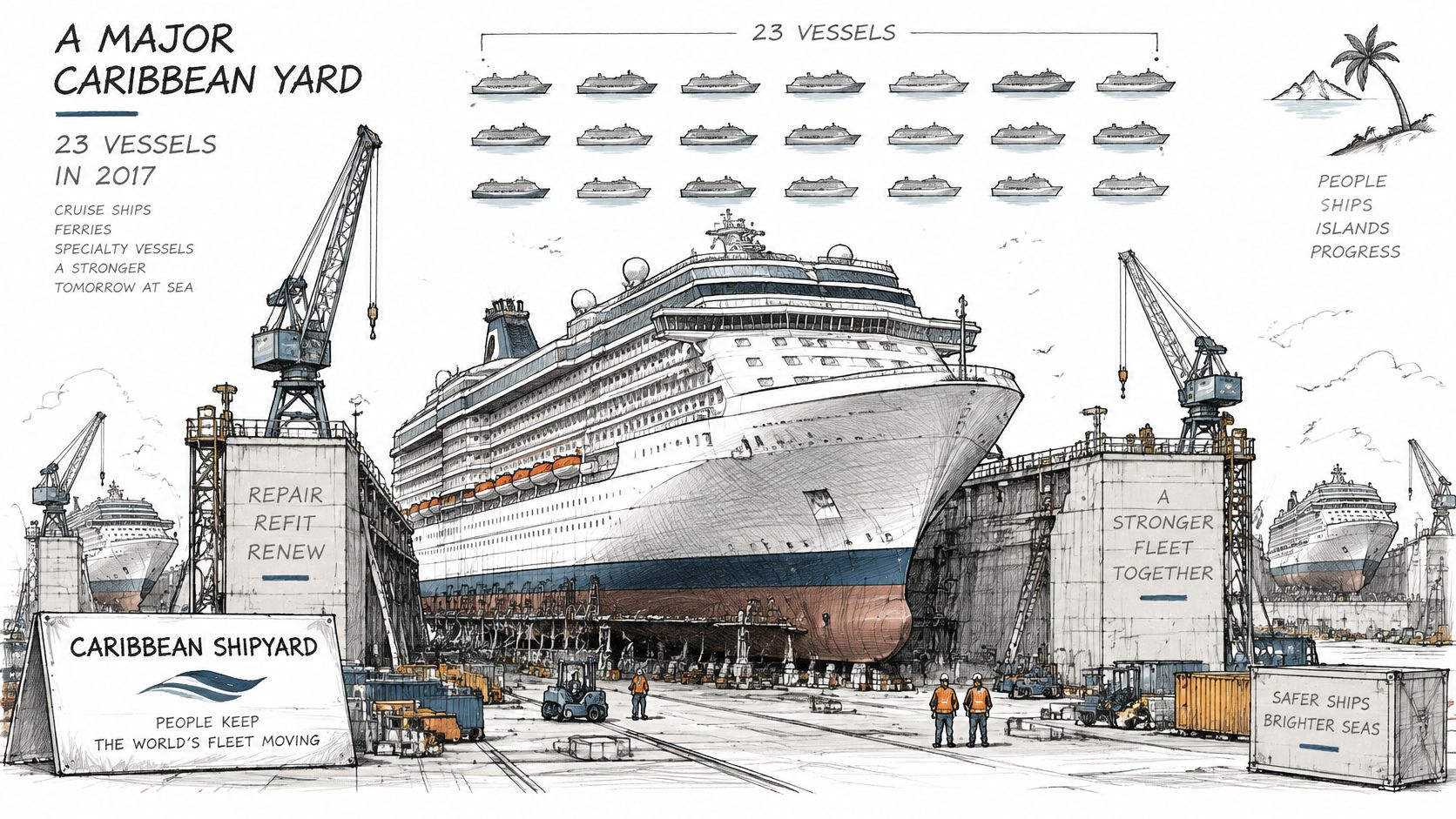
Dry docking is ordinary fleet management carried out in specialized maritime facilities. Grand Bahama Shipyard reported handling 23 cruise vessels during 2017, according to its announcement published by The Maritime Executive. That's a single Caribbean yard's throughput, not an industry-wide total.
The illustration shows the basic arrangement of a ship supported above a working dock floor.
A yard appointment can be part of a fleet program
Operators may concentrate work in a familiar hub rather than choose a different facility for each ship. Cruise Industry News reported that MSC Cruises scheduled six vessels for dry dock in 2024, all planned for Malta. That historical schedule illustrates how docking belongs to fleet planning, not just an isolated ship announcement.
Dock dimensions, lifting and support arrangements, contractor expertise, and equipment access all constrain the choice of facility. A yard suitable for a smaller premium ship isn't automatically suitable for a much larger vessel, and an available slot isn't necessarily the right slot for a particular conversion.
Consider contrasting hypothetical projects. A midsize ship arrives for inspections, coating work, and machinery servicing, then returns with its familiar layout. Another arrives with cabin rebuilding and a new venue added to the engineering list.
Both are dry docks. Only the latter requires passengers to assess whether substantially changed guest spaces will be ready.
For a different historical perspective on the relationship between a vessel's origins and its later cruise identity, the USS Norway cruise ship history provides useful context. A ship's age alone doesn't describe the scope of a particular yard visit.
The video offers another view of the scale of shipyard work.
Everything coming aboard has an outbound counterpart
A modernization is also a material-handling operation. Contractors remove furniture, carpets, mattresses, and galley or laundry equipment while moving replacement fittings, steel, and cables aboard through limited access routes.
The Cruise Times explanation of dry-docking costs and logistics describes the importance of material movements and recycling alongside technical work. Don't turn a general recycling statement into a claim that every removed item from your ship was recycled.
- Reusable items need a documented destination.
- Recyclable materials need sorting and a suitable receiving facility.
- Hazardous maintenance waste needs separate handling rather than inclusion in a general furniture-disposal claim.
Those movements help explain why a refit involves more than the visible installation work. Your schedule note should describe the actual project, not merely the famous yard handling it.
Timeline and Keep-or-Move Test for Your Sailing
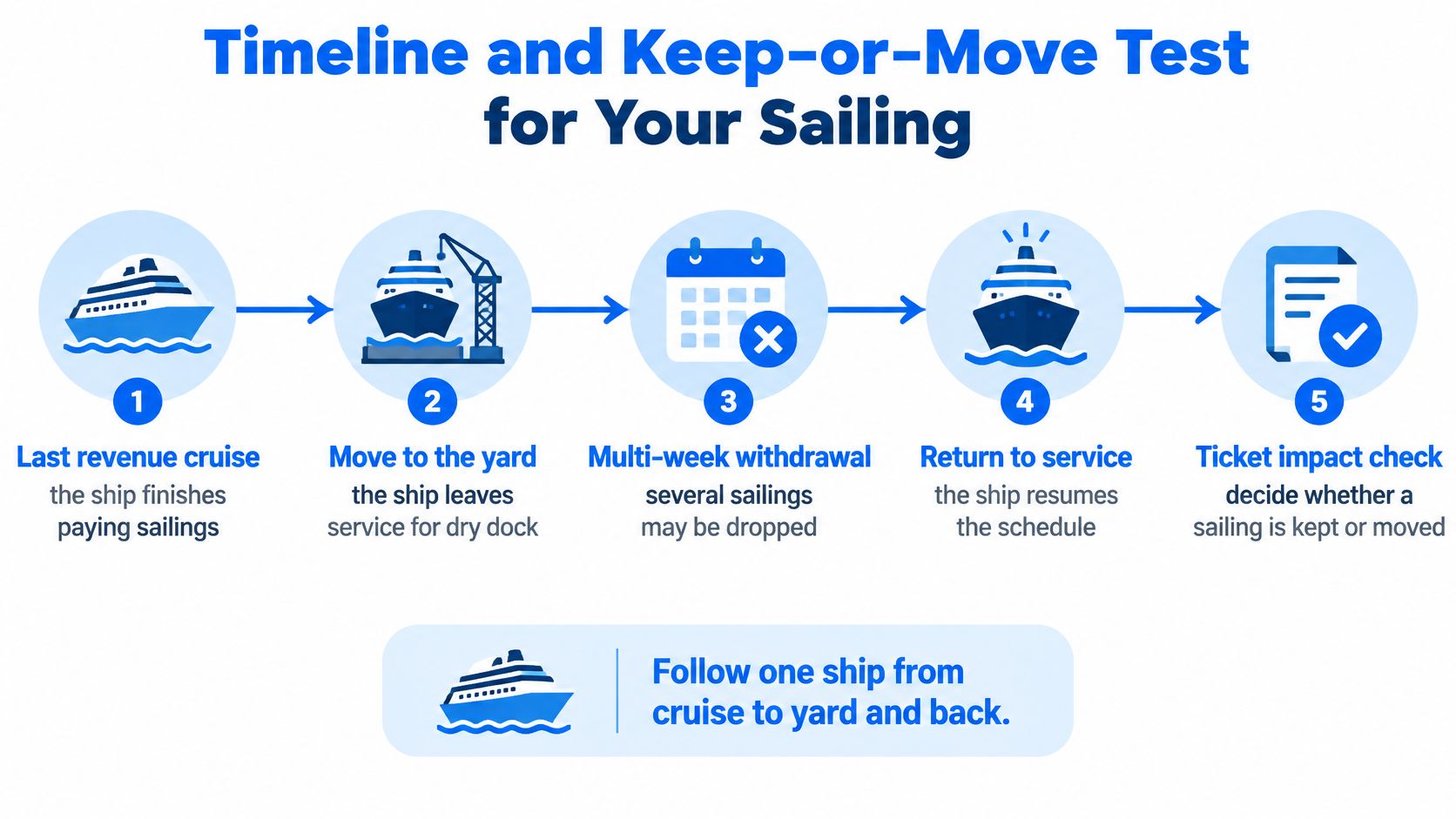
Follow a hypothetical ship from its final passenger arrival to its reopening. Guests disembark, the vessel moves to the yard, contractors take control of work areas, and the line withdraws the ship from its normal passenger schedule.
The dates around that withdrawal matter differently depending on where your ticket sits.
Before the yard and after the handover
On the last cruise before docking, ask whether preparatory work will affect passenger areas. Contractors might need to stage materials or begin permitted work, but don't assume that will happen just because dry dock follows your voyage.
During the withdrawal, the line must coordinate more than repairs. The ship's next operating region, port commitments, crew movements, and passenger schedule all need to fit its return.
After the yard hands the vessel back, the question becomes whether the passenger operation is ready. A cabin can have new furniture while still needing attention to a drain, temperature control, or a finishing detail. A restaurant can look complete but remain unavailable to diners.
The Cruise Critic guide to cruising before or after dry dock identifies possible construction noise, closed venues, unfinished cabins, plumbing or heating problems, itinerary changes, and rare cancellations; it recommends waiting at least a month after dry dock for travelers seeking less uncertainty. That's a conservative preference, not a universal prohibition.
A completed engineering inspection and a fully available vacation experience answer different questions. Ask about both without treating unfinished décor as proof of an unsafe vessel.
Apply the questions in order
Use the answers to make a booking decision, rather than collecting them as interesting background.
- Classify the project. Is this primarily technical maintenance, or are contractors rebuilding cabins and public rooms? If the line won't specify, don't treat the uncertainty as reassurance.
- Identify your essential spaces. Check your cabin category, booked dining venue, pool or children's facilities, and any accessibility route you rely on. A closed specialty restaurant may be optional for one traveler and central to another's plans.
- Measure the buffer. Ask for the planned yard departure and the return to passenger service separately. Time between those milestones may serve different purposes, so don't assume every non-passenger day is spare contingency.
- Establish your sailing's position. Is it the first voyage back, or will the ship already have carried passengers? This matters more than whether the brochure labels the vessel refreshed.
- Get the remedy in writing. Ask what happens if your cabin changes or a paid venue remains closed. Save the applicable booking terms and distinguish a specific commitment from a general customer-service assurance.
Make one decision based on your priorities
Keep the booking when the work is principally technical, your essential guest areas are untouched, and the line gives clear answers about availability. That doesn't eliminate ordinary travel risk, but it gives you no reason to reject a ship merely because maintenance occurred.
Consider moving the date when your voyage is the first after a major rebuild and your cabin or must-use venues remain unconfirmed. Written confirmation improves your information; it doesn't guarantee that a project can't slip.
Your tolerance matters, too. A flexible repeat cruiser may accept a substitute restaurant, while someone celebrating a milestone or relying on a particular accessible route may reasonably choose a later sailing.
Don't mix unrelated risks into a vague feeling that a cruise is risky. If weather exposure also affects your dates, assess it separately using the cruise hurricane season guide. A favorable refit schedule doesn't resolve weather concerns, just as a calm-season itinerary doesn't confirm that your booked cabin is ready.
Confirm and Pack Before You Sail
A cabin can look refreshed and still have unresolved details. Before departure, check the ship page, booking messages, and itinerary for updates, then ask the cruise line to confirm any outstanding cabin or venue information in writing.
Save the reply with your confirmation and any prepaid dining or activity reservations. If something differs onboard, a dated answer about your booking is more useful than a general refurbishment advertisement.
Pack for the cabin you might actually use
A compact fan, a drying line, and vertical storage can make a cramped or stuffy cabin easier to manage. They cannot fix defective ventilation, leaking plumbing, or an unfinished room, so report those problems to guest services.
For cabin comfort, the Rechargeable Cruise Fan with Magnetic Hook to Hang on Cruise Walls & Ceilings is a compact rechargeable option with a magnetic hook and multi-speed control. Nordmoose's cruise clothesline is made for drying swimwear, towels, and small clothing items inside your cabin. Its organizers help keep daily essentials off limited counter space.
- Check mounting surfaces. Make sure the intended spot suits magnetic accessories, and keep them clear of sprinklers, detectors, and ventilation openings.
- Protect clear routes. Keep drying lines away from cabin doorways and nighttime paths to the bathroom.
- Avoid door damage. Some cruise lines restrict over-the-door hooks. Nordmoose recommends magnetic mounting where suitable.
- Pack with purpose. Use this cruise ship packing list to choose useful cabin gear without filling your suitcase with items you may not need.
Don't pack around a booking problem
Accessories can improve personal comfort, but they cannot replace a booked restaurant, accessible cabin, or itinerary. If the cruise line cannot confirm a detail that matters to you, reconsider the date rather than relying on fresh paint to resolve the uncertainty.
Before leaving home, confirm your cabin and booked venues, then pack for practical comfort. A refurbishment label alone cannot tell you what will be ready for your sailing.
Nordmoose sells magnetic cruise fans, cabin organizers, cruise night lights, seasickness patches, and a cruise clothesline. Once your post-dry-dock sailing plans are clear, browse Nordmoose for compact cabin gear suited to limited space.