

Cruise Hurricane Season Guide: What Smart Sailors Do
More than 75% of tropical activity in the 2025 Atlantic season occurred in August, September, and October, according to an industry recap cited by Norwegian Cruise Line's hurricane-season guidance. That changes how you should think about a cruise hurricane season. The risk isn't spread evenly across six identical months. The official season is long, but the most weather-sensitive part of the calendar is concentrated around late summer and early autumn.
That distinction matters when you're choosing a sailing, buying insurance, planning flights, or deciding how much itinerary flexibility you can tolerate. A storm may cause a ship to skip a port, reverse its route, add sea days, delay embarkation, or change an airport and hotel plan. Those outcomes are manageable when you understand the mechanics before you board.
Table of Contents
- When Hurricane Season Actually Happens at Sea
- Reading the Numbers Behind an Average Storm Season
- How Cruise Lines Reroute When a Storm Forms
- Refunds, Credits, and Travel Insurance Compared
- Booking Strategies Around the Peak Months
- Ship Safety and What to Pack for Storm Season
- Your Quick-Reference Hurricane Season Plan
When Hurricane Season Actually Happens at Sea
The Atlantic hurricane season officially runs from June 1 through November 30, according to Cruise Critic's hurricane-season overview. The historical peak usually falls from mid-August through mid-September, while the Western Caribbean can face increased risk into early November.
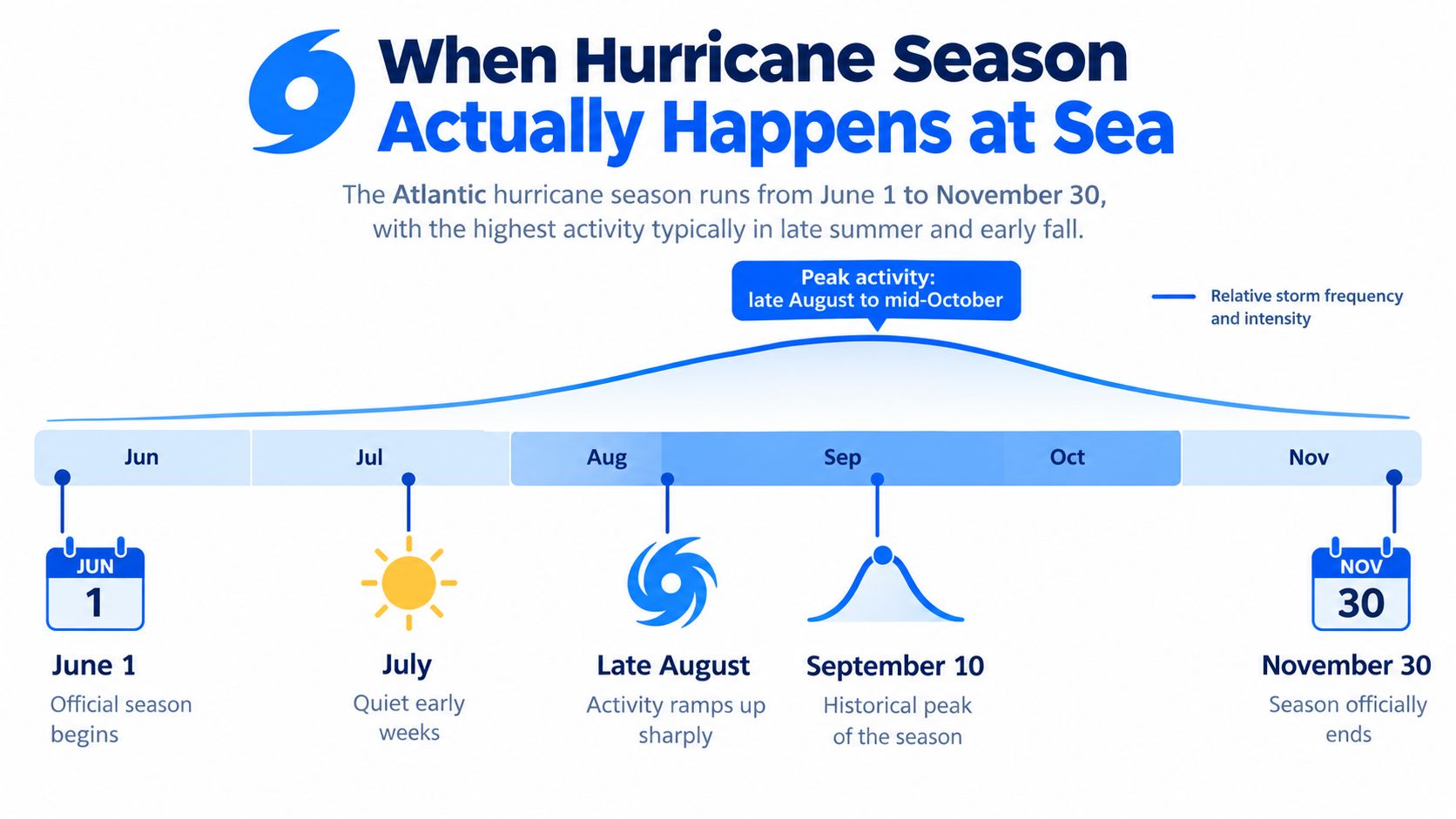
Think of the season as a calendar with different operating conditions rather than a single six-month warning label.
- June and early July: The season has opened, but activity is often quieter. Systems can develop in the Gulf, Caribbean, or farther east in the Atlantic.
- Late July and August: Tropical activity begins to build, and cruise planners should pay closer attention to the Eastern Caribbean, Bahamas, Florida, and Gulf routes.
- September: This is usually the most weather-sensitive month for Caribbean bookings because the seasonal peak is nearby.
- October: Risk remains meaningful, particularly for the Western Caribbean and Gulf of Mexico, although the pattern can vary by location.
- November: The official season remains open through the end of the month, but early June and late November are often treated as shoulder periods with lower historical storm odds than the peak.
Storms commonly form in three broad areas. Some develop in the eastern Atlantic and travel west, some organize in the Caribbean, and others strengthen in the Gulf of Mexico. The formation area affects which itineraries may need attention, but it doesn't tell you exactly what a ship will do. The captain and shoreside operations team respond to the storm's projected track, wind field, sea conditions, port status, and the ship's position.
Practical rule: A date on the official season calendar tells you when to stay alert. It doesn't tell you that every sailing date carries the same weather exposure.
A mid-July Southern Caribbean sailing and a late-September Bahamas itinerary shouldn't be evaluated as equivalent choices. The Southern Caribbean can sometimes offer a different exposure profile from northern routes, while a Bahamas trip places the ship closer to areas that may be affected by Atlantic systems moving toward Florida or the U.S. East Coast. Neither route is guaranteed to avoid disruption.
Cruise lines can move ships away from a storm, which is one reason a cruise may continue when a land vacation would be canceled. The trade-off is flexibility. You may enjoy the ship but miss a planned island, spend more time at sea, or arrive home later than expected.
Reading the Numbers Behind an Average Storm Season
An average Atlantic hurricane season produces about 14 named storms, 7 hurricanes, and 3 major hurricanes. These are long-term averages, not a forecast for your ship or sailing date. The risk is also concentrated rather than evenly spread across the official six-month season. In 2025, one cruise-industry recap reported 13 named storms, 5 hurricanes, and 4 major hurricanes, with more than 75% of tropical activity occurring in August, September, and October.
That distribution matters when you book. Early June and late November can function as shoulder windows, while the concentrated August-to-October peak calls for more flexibility around ports, flights, and cabin plans. A quieter season can still produce a disruptive storm near your itinerary, just as a busier season may leave your sailing untouched.
| Metric | Long-term average | Recent-year comparison |
|---|---|---|
| Named storms | About 14 | 2021: 21 / 2022: 14 / 2023: 20 |
| Hurricanes | About 7 | 2021: 7 / 2022: 8 / 2023: 7 |
| Major hurricanes | About 3 | 2021: 4 / 2022: 2 / 2023: 3 |
The useful booking question is, “What flexibility do I want if conditions change?” Seasonal outlooks describe broad probabilities. They cannot determine whether a ship leaving Miami will reach a particular port on a particular date.
Climate patterns shape the background conditions. La Niña generally favors more Atlantic activity, while El Niño tends to suppress activity through increased wind shear, as described in Norwegian Cruise Line's explanation of hurricane-season planning. Use that context when choosing a booking window, then check route-specific forecasts before departure.
Storm counts also leave out intensity and duration. Accumulated Cyclone Energy, or ACE, combines those factors, so a season with fewer systems can still create difficult conditions if several remain strong for an extended period.
For cruisers, the practical sequence is straightforward:
- Use the seasonal outlook to decide how much booking flexibility you want.
- Check the itinerary and homeport for likely exposure.
- Use short-range official forecasts before departure.
- Prepare your cabin for schedule changes, including extra medication, chargers, and essential items in your carry-on.
- Treat any seasonal forecast as context, never as a promise about your cruise.
How Cruise Lines Reroute When a Storm Forms
A ship doesn't wait until a hurricane is visible from the balcony before changing course. Shoreside meteorologists, fleet operations staff, the captain, and port agents monitor the system and coordinate as the projected path develops.
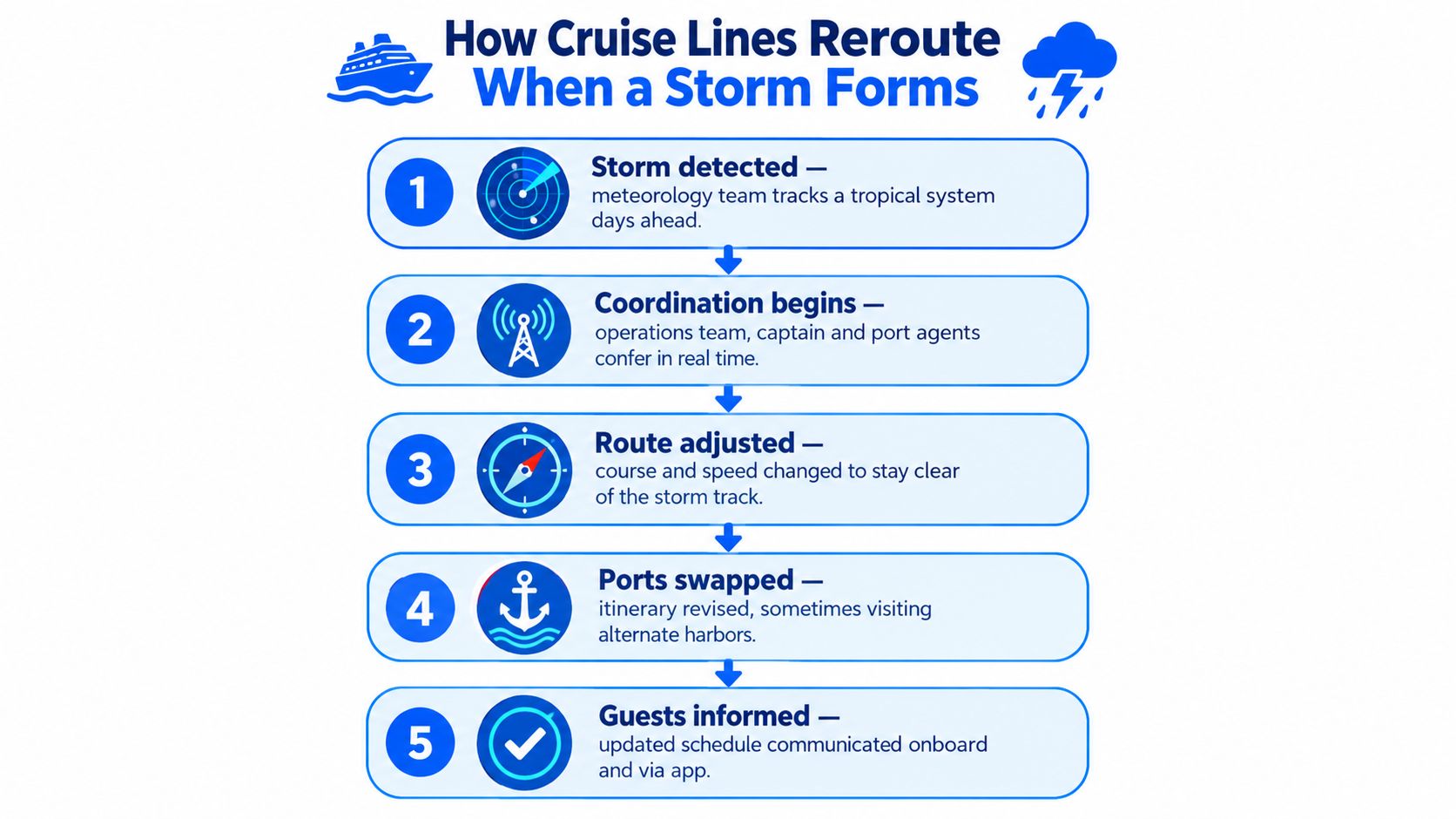
The response usually unfolds through several decisions.
First, the line protects the ship's operating area
Suppose your Western Caribbean itinerary includes Cozumel, Costa Maya, and Roatan. A developing hurricane threatens the route between the ship and those ports. The captain may change speed or direction, keep the ship in safer waters, and wait for better information before committing to a replacement schedule.
The ship might skip one port and add a sea day. It might exchange a threatened call for Ocho Rios or Grand Cayman if the weather, port availability, and sailing time make that practical. If the storm's movement affects the whole region, the ship could reverse the order of calls or abandon the original sequence altogether.
The key point is that a missed port isn't automatically a failed cruise. The ship may still provide the sailing, accommodation, meals, and onboard services, while the itinerary changes for safety.
Then, the captain and port teams adjust the details
A cruise line may assess the storm several days before the closest approach, refine the route as forecasts change, and make a final operational decision much nearer to the affected port. The exact timing isn't a public universal schedule, so passengers shouldn't assume that a decision made at one interval will apply to every storm.
The captain has final authority over navigation and safety at sea. Port authorities also control whether a harbor can accept or release ships. If a port closes, the line can't proceed with the original plan because passengers expected that stop.
Cruise lines often communicate changes through the onboard announcement system, the mobile app, cabin letters, or direct messages. A public press release may not appear early because forecasts, port decisions, and safe alternatives can change quickly.
The first itinerary you receive is a plan. During a storm threat, the captain needs room to replace it with a safer plan.
A homeport problem is different
A storm near a port of call may mean one missed destination. A storm near the embarkation or debarkation port can affect the entire sailing. Travel Tourister's guidance on hurricane-related cruise and flight disruption identifies major gateways such as Miami, Fort Lauderdale, Port Canaveral, Galveston, and Tampa as locations that require close monitoring because temporary port closures can affect sailing schedules and ground-air connections.
If you're preparing for altered cabin logistics, a Magnetic Cruise Door Organizer can keep toiletries, shoes, sunscreen, chargers, or documents in visible mesh pockets on a metal cabin wall or door. The product uses three anti-scratch magnets, includes over-the-door hooks for suitable non-cruise uses, and has 15 pockets, but you should check your cruise line's door rules before using hooks.
Refunds, Credits, and Travel Insurance Compared
A storm change doesn't automatically create a refund. Your financial outcome depends on what changed, what the cruise line offered, the terms of your booking, and the coverage you purchased.
| Scenario | Cruise line policy | Travel insurance policy |
|---|---|---|
| One port is skipped | May provide an onboard adjustment or no monetary compensation, depending on the line's terms | May cover eligible prepaid, nonrefundable losses if the policy treats the event as a covered interruption |
| The itinerary changes substantially | May offer a future cruise credit, partial refund, or other remedy under the line's published policy | May cover additional eligible expenses or unused trip costs, subject to limits and exclusions |
| The sailing is canceled | The line may offer rebooking, a credit, or a refund under its cancellation notice | A covered cancellation may reimburse eligible prepaid costs, but only under the policy's conditions |
| Flights or hotels are disrupted | The cruise line may not cover independently booked arrangements | A policy may cover delay, interruption, lodging, meals, or transportation when the cause and documentation qualify |
| You simply no longer want to travel | Usually not covered by weather protection | Standard cancellation coverage may not apply; Cancel For Any Reason can broaden flexibility if purchased and used according to its terms |
Cruise-line protection and third-party insurance solve different problems. A cruise line controls the sailing and may offer a remedy when it cancels or materially changes the voyage. An insurer evaluates your claim against a contract, which may cover medical needs, interruptions, delays, missed connections, or qualifying cancellations beyond the cruise fare itself.
Read the trigger, not the headline
Look for the exact event that activates protection. A named storm in the region may not be enough. A policy might require a port closure, carrier cancellation, a covered delay, or an official warning that prevents reasonable travel.
Check whether the policy covers:
- Nonrefundable deposits: Some booking amounts may remain outside a claim unless the cancellation reason qualifies.
- Independent airfare: Flights booked separately can create a larger exposure if the cruise changes.
- Prepaid excursions: A missed port doesn't guarantee reimbursement for every excursion unless the provider or policy terms apply.
- Hotels and transfers: A delayed embarkation may create expenses that cruise-line protection doesn't address.
- Cancel For Any Reason: CFAR can provide broader cancellation flexibility, but it commonly has eligibility rules, deadlines, and reimbursement limits.
Buy coverage early enough to preserve the benefits you want. Some weather-related provisions depend on when you purchase the policy relative to your initial trip payment or when a storm receives an official name. Keep the booking confirmation, receipts, airline notices, port communications, and proof of refunds.
Don't cancel because a forecast looks uncomfortable and assume insurance will pay. First identify the covered event, then contact the cruise line or insurer using the instructions in your documents.
Booking Strategies Around the Peak Months
A family booking a late-August sailing has three choices. It can accept the possibility of a reroute and focus on a flexible plan, move to a shoulder period, or choose a destination that isn't as exposed to Atlantic systems. The right choice depends less on fear than on how expensive a change would be for that family.
The official season runs from June through November, but historical activity is concentrated around the peak described earlier. Early June and late November can offer a different balance of price and weather exposure, while peak-period dates may appeal to travelers who prioritize fare value and can tolerate itinerary changes.
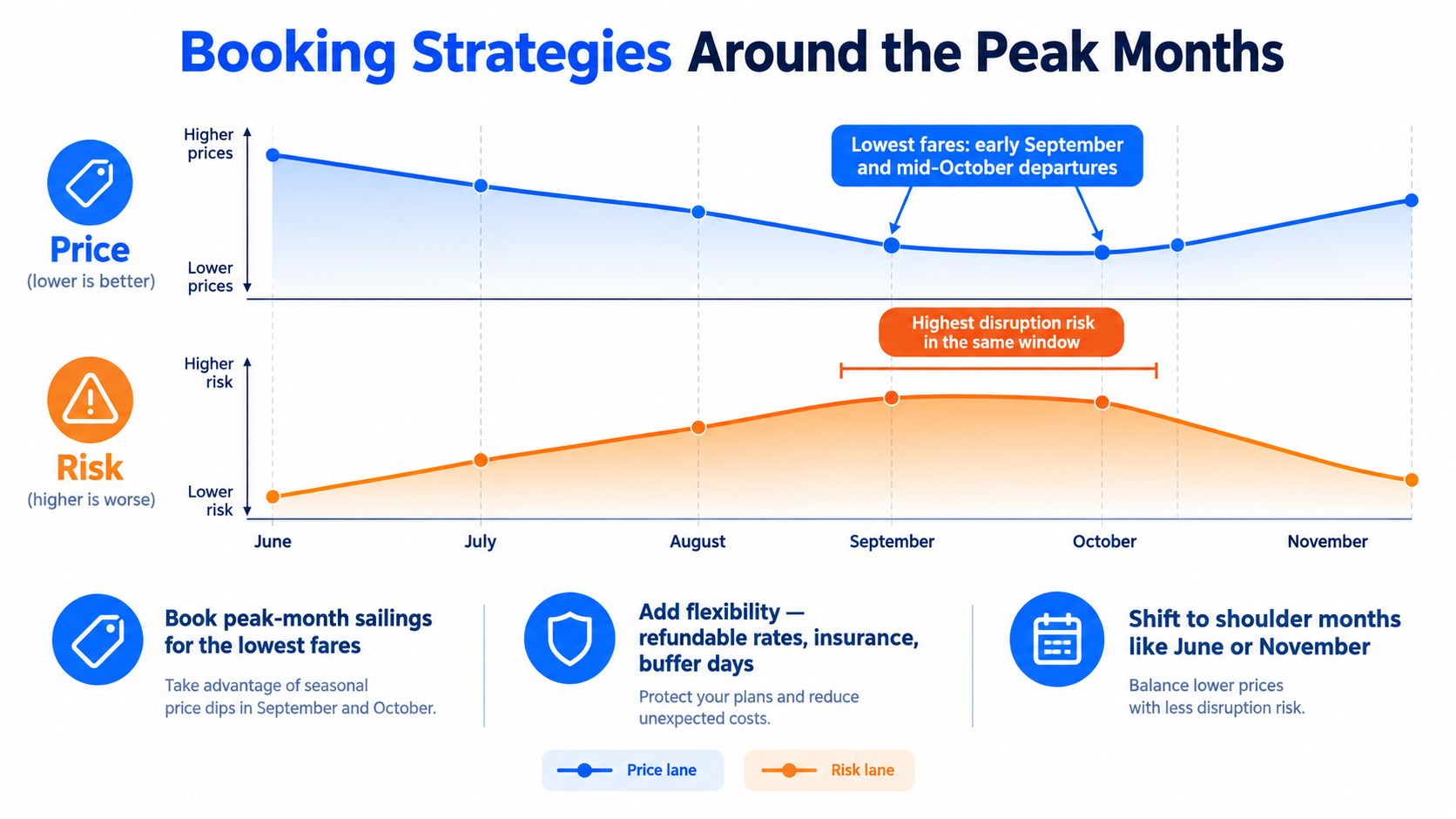
Build flexibility into the reservation
Choose a fare that explains its cancellation and change terms clearly. A lower fare can be attractive, but it may be less forgiving if your plans change before the cruise line changes anything.
Keep the booking details together:
- Deposit terms: Know what happens if you cancel before final payment.
- Air arrangements: Avoid a tight same-day flight connection when the homeport could close.
- Hotel buffer: Consider arriving before embarkation when missing the ship would be costly.
- Insurance deadline: Purchase coverage early if you want hurricane, interruption, or CFAR benefits.
- Port expectations: Treat every destination as a possibility, not an absolute promise.
A travel advisor can be useful when a port, flight, or hotel needs to change because the advisor may help coordinate several reservations together. Direct booking can work well too, provided you understand who handles each part of the trip.
If you prefer to reduce Atlantic exposure, consider a repositioning itinerary that avoids the Caribbean. A Southern Caribbean route may offer a different risk profile, but it still requires monitoring. Some Western Caribbean routes may be adjusted northward, while longer itineraries may provide more room for sea-day substitutions.
Use the cruise ship cabin sizes guide when comparing cabins, especially if a weather change could keep your family onboard for more time than expected. Space, storage, and a comfortable place to rest matter more when outdoor plans and port days change.
Before departure, check the official forecast for your route, watch for tropical systems being monitored, and review your cruise line's notification settings. Don't make a last-minute cancellation decision from a single model map. Confirm the line's instructions, your insurance terms, and your transportation options first.
Ship Safety and What to Pack for Storm Season
A modern cruise ship is designed to manage changing sea conditions, but passengers still need to follow instructions. The muster drill isn't a formality to ignore. It teaches you where to go, how to reach the assembly station, and what the crew expects if an emergency occurs.
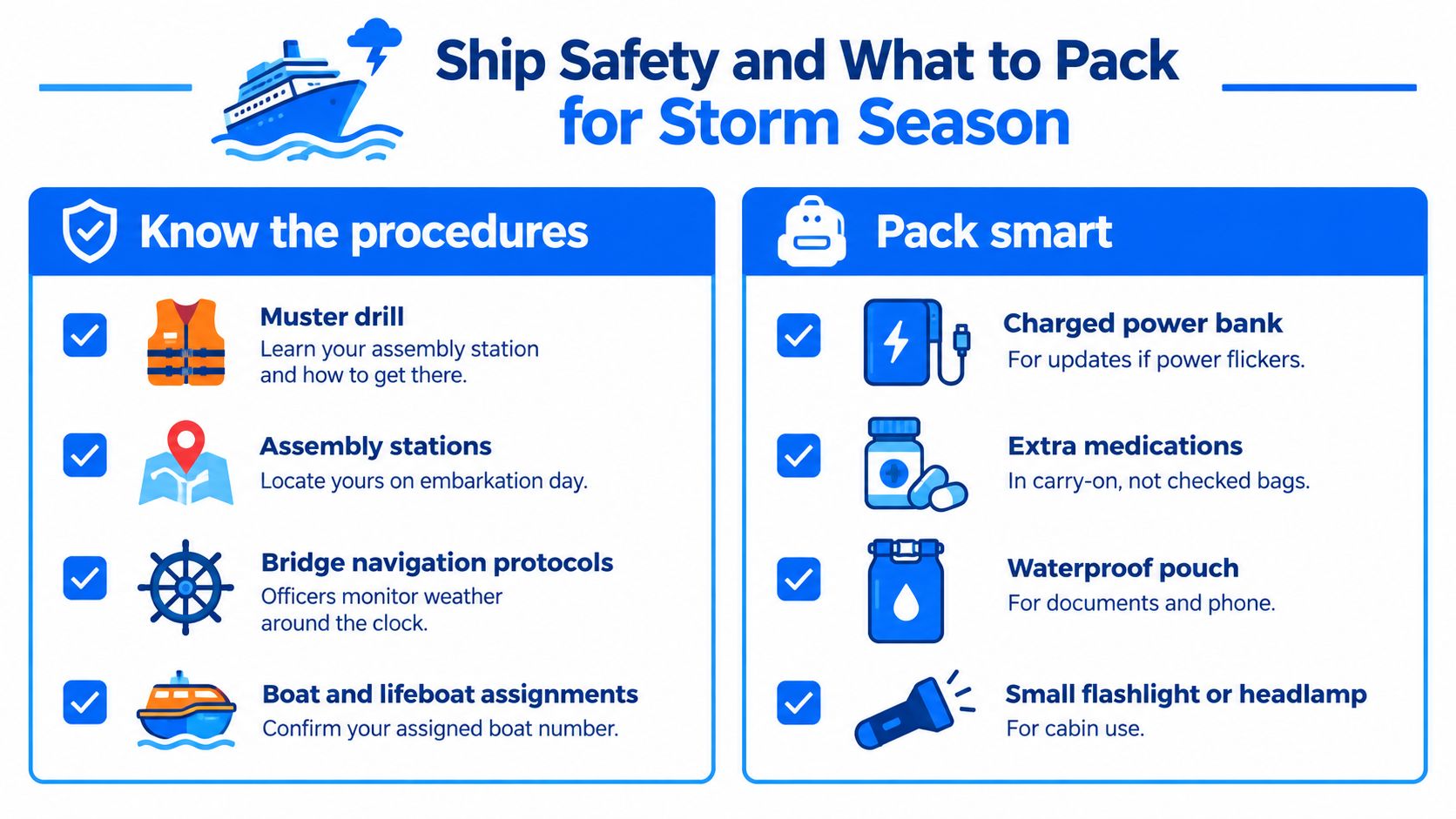
Bridge officers monitor weather, navigation data, traffic, and sea conditions around the clock. Captains may use weather-routing software, satellite information, stabilizers, and propulsion systems to keep the ship away from the worst conditions. Those systems support the crew's decisions, but passengers still need to listen to announcements and follow restricted-area instructions.
Make the cabin ready before the weather changes
If the ship expects rougher seas, loose objects can become annoying or unsafe. Put toiletries in closed containers, keep phones and chargers in one place, and avoid leaving shoes or bags where someone could trip in low light.
Pack a small storm-season kit:
- Motion-sickness treatment: Bring the remedy you already know works for you, and carry it in your hand luggage.
- Power bank: Keep a charged battery available for updates if outlets are inconvenient or power flickers.
- Waterproof pouch: Protect passports, identification, medication lists, and your phone from spray or spills.
- Document copies: Store copies in secure cloud storage and keep a paper backup.
- Small flashlight: A compact light or headlamp can help with cabin movement at night.
- Flexible layers: A reroute can change the temperature and clothing you need at the next port.
- Simple snacks: Shelf-stable food can help if dining hours or movement around the ship changes.
Pack medication in your carry-on rather than checked luggage. Keep important documents and contact details accessible, not buried in a suitcase that may be stored away.
Expect operational changes onboard
The captain may close pools, limit outdoor decks, alter dining schedules, or cancel an excursion. You might notice more motion, vibration, wind noise, or changes in elevator and balcony access. These decisions can feel inconvenient, but they help the crew maintain safe operations while the ship moves through or around changing conditions.
Monitor the cruise line's app and announcements. For official storm information, use the National Hurricane Center rather than relying only on social media. Weather apps such as Windy can help you visualize conditions, but the ship's operational instructions take priority.
For cabin storage and practical packing ideas, the cruise ship essentials collection can help you organize a compact checklist. Keep a family communication plan too. Decide where everyone will meet if mobile service disappears, write down cabin and ship contacts, and tell a relative on shore how itinerary changes will be shared.
Your Quick-Reference Hurricane Season Plan
Use this calendar as a decision aid, not a promise. Prices vary by sailing, cabin, itinerary, and demand, while weather risk depends on the route and the storm pattern that develops.
| Month | Historical weather profile | Booking approach | Crowd and price expectation |
|---|---|---|---|
| June | Season open, generally outside the main peak | Consider for a shoulder-period balance | Compare fares and school-holiday demand |
| July | Activity can build, with route-specific variation | Favor flexible bookings and sensible transportation buffers | Review the complete trip cost, not only the cruise fare |
| August | Activity approaches the more sensitive part of the season | Book only if you can accept changes | Flexibility becomes more valuable |
| September | Usually the most weather-sensitive period | Prioritize insurance, refundable terms, and backup plans | Lower fares may come with greater disruption tolerance |
| October | Risk remains important, especially for Western Caribbean routes | Compare route alternatives and port flexibility | Evaluate whether a shoulder date suits your priorities |
| November | Season ends on November 30, with late November often outside the core peak | Consider for a shoulder-period option | Check route, weather, and holiday timing together |
Seven actions before you sail
- Choose the route first. Identify whether your itinerary includes the Bahamas, Caribbean, Gulf, Bermuda, or the U.S. East Coast.
- Read every weather term. Confirm what the cruise line offers after a port change, delayed departure, or cancellation.
- Buy suitable insurance early. Check hurricane, interruption, delay, medical, and CFAR provisions before the relevant deadline.
- Protect your transportation plan. Leave practical time between your arrival and embarkation, and save airline and hotel policies.
- Turn on notifications. Enable cruise-line app alerts and check official weather information as departure approaches.
- Pack for a changed itinerary. Bring medication, documents, layers, motion support, a power bank, and a waterproof phone pouch.
- Accept the port trade-off. A safe cruise may include a skipped destination, a replacement port, or an extra sea day.
If you're prone to motion sickness, review practical preparation in what to do for seasickness on a cruise. The best hurricane-season plan doesn't eliminate uncertainty. It makes the likely decisions easier when the itinerary changes.
Cruising during the Atlantic season rewards preparation rather than avoidance. Choose your dates with the concentrated peak in mind, protect the expensive parts of the trip, and board expecting the captain to put safety ahead of the original port list.
Nordmoose offers cruise-focused accessories for compact cabins, including magnetic organizers, rechargeable cabin tools, motion-comfort products, and other practical essentials. Visit Nordmoose before your sailing to organize the small items that become more important when weather changes your plans.