

Cruise Ship Cabin Sizes: A Practical Guide for 2026
You're standing in a cruise-ship hallway with your luggage beside you, comparing two cabin doors that look identical from the outside. One room may cost more because it includes a window or balcony, while another may give you more practical floor space, better storage, or a quieter location. The question isn't, “How many square feet is it?” It's whether the room will work for the way you'll sleep, dress, move, and relax during the voyage.
Cruise ship cabin sizes are compact by design. Mainstream inside cabins average about 167 square feet, oceanview cabins about 180 square feet, and balcony cabins about 197 square feet, according to a detailed guide to cruise cabin dimensions. Those figures provide useful context, but they don't tell the whole story. Layout efficiency, storage volume, bathroom placement, bed position, and cabin location often determine comfort more than the headline number.
Table of Contents
- What Cruise Ship Cabin Sizes Really Mean for Your Trip
- Inside, Oceanview, Balcony, and Suite Categories Explained
- How Cabin Sizes Differ Between Major Cruise Lines
- How to Read Deck Plans and Pick a Smart Cabin Spot
- When a Smaller Cabin Beats a Bigger One
- Packing and Setup Tips for Any Cabin Size
- Choosing the Right Cabin for Your Travel Style
What Cruise Ship Cabin Sizes Really Mean for Your Trip
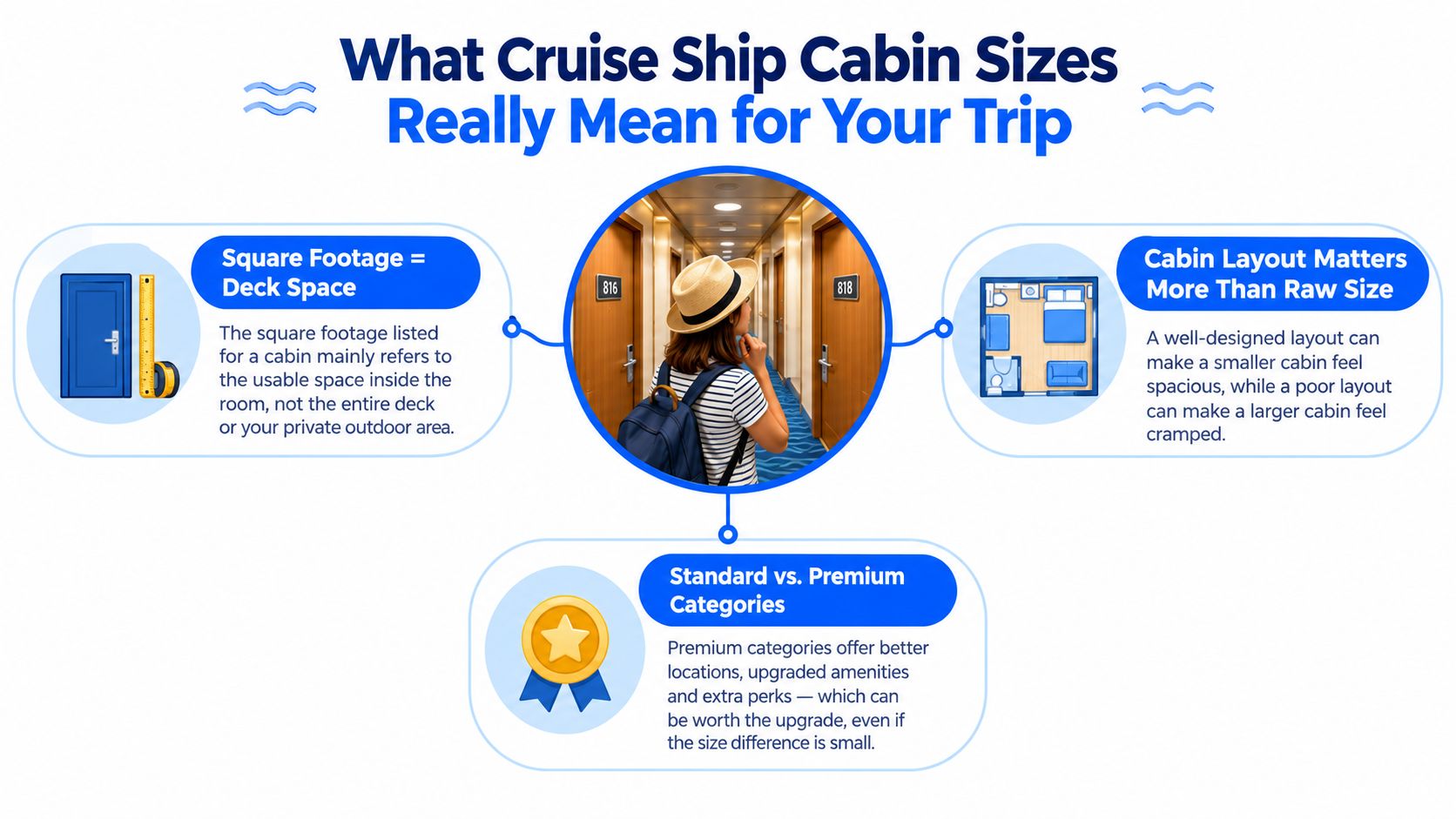
Square footage is only the starting point
You open the door to a cabin advertised at 160 square feet and expect a clear, open room. Instead, part of that area belongs to the bed, sofa, wardrobes, bathroom, and the narrow space near the entrance. Cruise lines measure the deck area inside the walls, so the published figure describes the whole cabin, not the floor you can use freely.
That difference shapes daily comfort. A 160-square-foot room with a direct route from the door to the balcony may feel easier to use than one with the same area broken up by furniture. A bed placed across the main walking route creates more friction than a bed set against the far wall.
Think in three layers
A practical comparison uses three layers:
- Raw dimensions: The published interior area, including fixed furniture and the bathroom.
- Storage volume: Closets, drawers, shelves, space beneath the bed, and usable wall area.
- Circulation space: The floor you can cross without turning sideways or colliding with the bed.
Circulation space often decides whether two people can get ready at the same time. You may accept a smaller closet if the route to the bathroom stays clear. Extra floor area helps less when a sofa, desk, or badly placed bed interrupts movement.
Practical rule: Study the cabin diagram, not only the category name. Similar measurements can support very different routines.
Cabins can vary widely within one category. Some inside cabins are as small as 120 square feet, while some oceanview cabins reach about 220 square feet, according to the cruise cabin size comparison from Emma Cruises. The category label therefore gives only part of the answer. The specific cabin number and deck plan show how that area is arranged.
A useful analogy is hotel room planning. A hotel room may devote more space to a broad entry or bathroom, while a cruise cabin must fit a narrow, standardized ship structure. Designers respond with compact furniture, convertible beds, vertical storage, and modular bathrooms. The right choice is not automatically the cabin with the largest figure. It is the room whose usable space supports how you sleep, dress, store belongings, and relax.
Inside, Oceanview, Balcony, and Suite Categories Explained
A cabin upgrade can change your morning, your storage routine, or where you spend quiet time at sea. It does not always add the same kind of comfort. Cruise lines use categories to describe price, privacy, natural light, outdoor access, and living space, but each ship arranges those features differently.
The four main categories
Inside cabins have no exterior window. They are often the most economical choice for travelers who spend much of the day at meals, shows, pools, or shore excursions. Mainstream inside cabins commonly measure roughly 120 to 180 square feet, with some large ships listing interiors around 149 square feet. The room can work well when you mainly need an efficient place to sleep, shower, and store belongings. Without daylight, however, it may be harder to judge the time in the morning.
Oceanview cabins add natural light through a porthole or window. On some ships, the interior ranges from roughly 179 to 272 square feet. The window's position matters as much as the floor area. A large window can make a compact room feel brighter, much like adding a lamp to a small room, without creating more space for luggage or movement.
Balcony cabins combine indoor accommodation with private outdoor space. Some examples offer around 182 square feet indoors plus a separate balcony of about 50 square feet. Other public guides list interiors around 172 to 205 square feet, with balconies ranging from 44 to 82 square feet. Check the listing carefully to see whether the balcony is measured separately from the cabin interior, as shown in the Mundy Cruising guide to cruise ship cabin sizes. A balcony may add a useful sitting area, but it does not replace indoor floor space when two people are dressing or unpacking.
Suites have the widest range of layouts and sizes. Industry comparisons place many suites and penthouses from about 250 square feet to more than 1,400 square feet, with some ships offering suites of up to 5,000 square feet, according to the Frommer's cabin-selection guide. The practical gain may be a separate sitting area, a larger bathroom, more storage, or clearer separation between sleeping and living zones. That separation can matter more than a large number on the deck plan, especially when several passengers share the room.
| Category | Interior Sq Ft | Window/Balcony | Defining Feature |
|---|---|---|---|
| Inside | About 120 to 180 | No exterior window | Value and efficient sleeping space |
| Oceanview | About 179 to 272 on some ships | Window or porthole | Natural light and outside views |
| Balcony | About 172 to 205 interior on some ships | Separate balcony, often about 44 to 82 square feet | Private outdoor area |
| Suite | About 250 square feet upward, with wide variation | Window or balcony, depending on suite | Larger living zones and expanded amenities |
Small accessories can also protect usable space. A compact Magnetic Clothesline for Cruise Ship Cabin uses rubber-coated magnets and a retractable line, so swimwear can dry on a metal cabin panel without covering the bed or chair.
Why the category bands exist
Shipbuilders repeat cabin modules because standardized bathrooms, beds, wardrobes, and plumbing connections make large vessels more efficient to design and operate. The result is a useful category expectation, not a promise that every cabin with the same label has identical dimensions.
The balcony deserves its own check. A shallow veranda may suit morning coffee but offer little room to stretch out. A deeper balcony can change how often you use the outdoor area. The best upgrade is the one that improves your daily routine, not merely the one that adds a new label to your booking. Judge the category by what you will do there, then compare the cabin's interior area, layout, and separate outdoor space.
How Cabin Sizes Differ Between Major Cruise Lines
A 160-square-foot cabin can feel comfortable with a clear walkway, while a larger room can feel cramped when the bed, sofa, and wardrobe interrupt each other. Cruise lines do not use one universal cabin blueprint. Interior proportions, bathroom modules, furniture placement, and balcony depth vary by ship, so compare a specific vessel and cabin category rather than relying on the brand name alone.
Public comparisons place standard cabins on some Norwegian Cruise Line and Royal Caribbean ships around 120 to 160 square feet, while comparable Celebrity cabins may measure around 170 to 175 square feet, and Carnival or Holland America cabins may reach 185 square feet or more, according to Frommer's cruise cabin guide. The difference matters most when three or four people share the room, but floor area is only part of the calculation. A smaller cabin with an open path from the door to the balcony can work better than a larger room where furniture blocks movement.
| Cruise Line | Interior Sq Ft | Balcony Sq Ft | Typical Layout Note |
|---|---|---|---|
| Royal Caribbean | About 160 to 187 on Icon Class interiors | About 200 to 250 for balcony cabins on Icon Class | Newer ships offer varied layouts across classes |
| Carnival | About 185 or more on some comparable cabins | Varies by ship | Often emphasizes practical standard-room layouts |
| Norwegian | About 120 to 160 on some standard cabins | Varies by ship and class | Compact categories can sit beside much larger premium rooms |
| Celebrity | About 170 to 175 on some comparable cabins | Varies by ship | Premium positioning can bring more generous standard dimensions |
| Holland America | About 185 or more on some comparable cabins | Varies by ship | Standard rooms may provide more interior area on selected ships |
Royal Caribbean shows why a brand-wide average can mislead. Icon Class interiors are listed at roughly 160 to 187 square feet, with balcony cabins around 200 to 250 square feet. Oasis Class interiors are about 170 to 180 square feet, while balcony cabins are about 180 to 220 square feet. A “Royal Caribbean balcony” therefore does not identify one fixed amount of usable space. The ship class, cabin design, and balcony shape still matter.
Why newer ships can feel inconsistent
New ships often separate their inventory into sharper tiers. A recent ship-introduction overview lists one 2026 debut with about 1,230 balcony cabins among 1,760 total cabins, while another new vessel has 95 cabins ranging from 500 to 9,975 square feet. The Iglu Cruise overview of new ships illustrates how a vessel can offer many balcony rooms alongside exceptionally large premium accommodations without enlarging every standard cabin.
That split affects the everyday experience. A ship may promote spacious suites while keeping entry-level interiors compact. Check the exact interior dimensions, bed configuration, balcony depth, and furniture arrangement before assuming a newer vessel will feel roomier. The useful upgrade is the one that gives you clearer movement, better storage, or outdoor space you will use.
How to Read Deck Plans and Pick a Smart Cabin Spot
A deck plan is more than a map of doors. It's a compact set of clues about bed placement, connecting doors, accessible features, view obstructions, public-space noise, and walking routes. Learning the symbols can prevent a disappointing booking even when the cabin's advertised size looks attractive.
Start with the legend
Open the official deck plan and locate its symbol key before looking at individual rooms. Cruise lines use their own visual systems, but common markings include filled squares for beds, triangles for obstructed views, and dotted lines for connecting doors.
- Filled squares: Often show twin beds that can convert into a queen-style arrangement. Confirm the exact configuration with the cruise line if bed placement matters.
- Triangles: Commonly indicate an obstructed view. Lifeboats, tender equipment, structural supports, or an overhanging deck may block part of the sightline.
- Sofa and bunk symbols: Identify rooms designed for additional passengers. A sofa bed or Pullman berth can change the usable floor area once deployed.
- Dotted connecting-door lines: Signal a door between neighboring cabins. That feature helps families stay close, but it may also transmit more hallway or neighboring-room sound.
Read the ship from the outside inward
Find the compass rose, then identify the bow, stern, port side, and starboard side. Check whether the cabin is forward, aft, or amidships, and note what sits above and below it. Cabins on lower decks can feel steadier in rough water, while upper-deck rooms may place you closer to pools, restaurants, or observation areas.
Look for elevators, stairwells, theaters, nightclubs, lounges, galleys, laundry rooms, and crew-service areas. A cabin beside an elevator may shorten walks, but it can expose you to conversation and door movement. A room under a pool deck may face furniture movement or activity overhead. A cabin beside a theater or lounge may be convenient during the evening and noisy after performances.
Booking habit: Trace the route from your cabin to the venues you'll use most. Convenience is useful, but adjacency to a busy public space can outweigh the benefit of a shorter walk.
Balcony views require another check. A lifeboat can obscure an oceanview, an overhanging deck can shade a balcony, and a forward-facing cabin may experience more wind. Don't judge a room by its category alone. Compare neighboring cabins, the deck above, the deck below, and the direction the balcony faces.
Finish with a repeatable filter: choose your preferred deck, remove rooms with connecting doors if you want maximum quiet, inspect obstruction symbols, then compare the remaining cabins by interior area and walking distance. This process turns cruise ship cabin sizes into a practical decision rather than a marketing label.
When a Smaller Cabin Beats a Bigger One
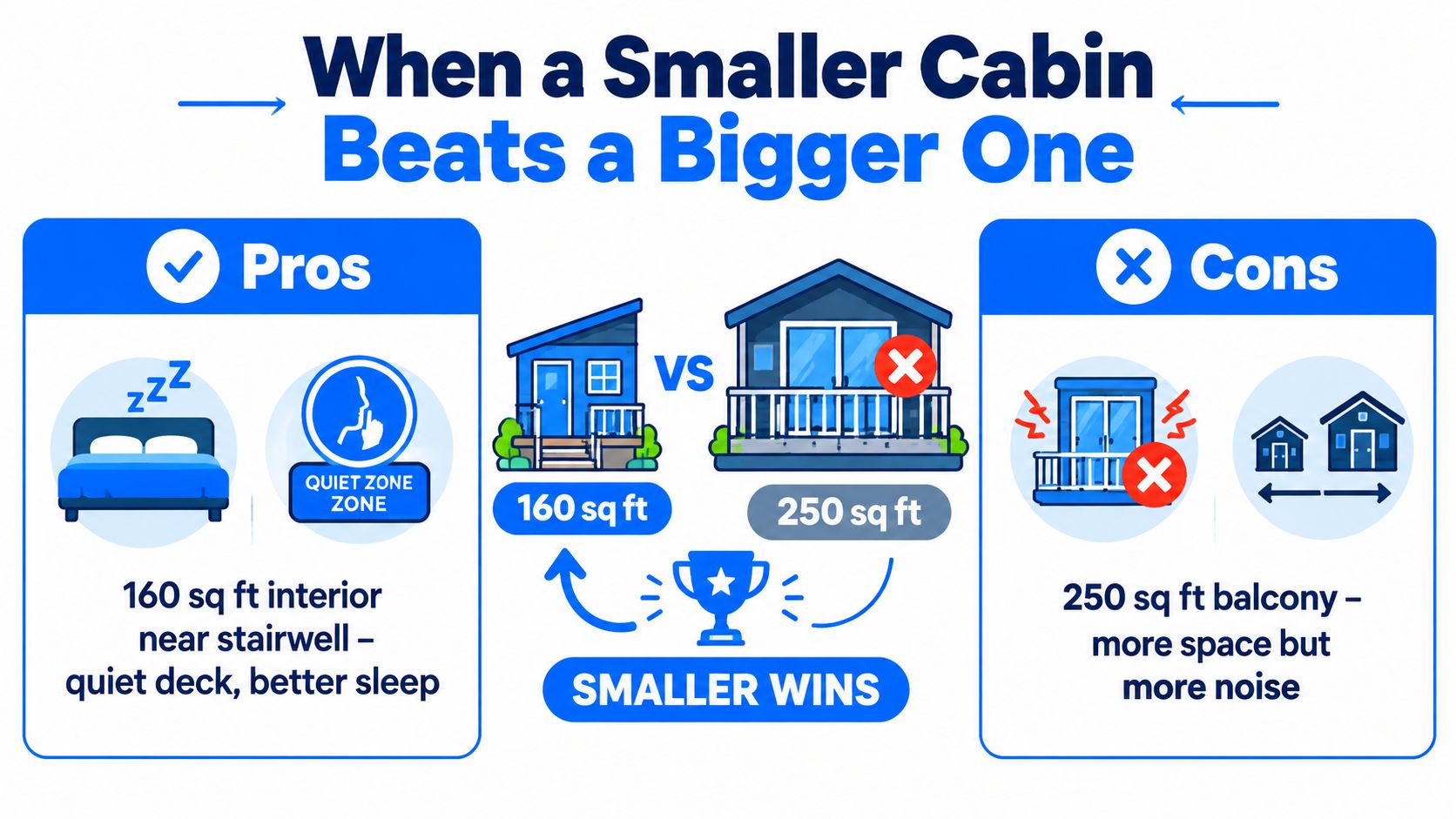
A larger cabin can feel more comfortable, yet its extra floor area cannot fix a noisy or inconvenient location. A compact room in a quiet part of the ship may support better sleep than a much larger balcony cabin beside a busy public deck.
Consider two hypothetical choices: a 160-square-foot interior cabin near a quiet stairwell and a 250-square-foot balcony cabin directly below a lively pool area. The balcony cabin offers more room and private outdoor access. The smaller cabin may still be the better daily fit if overhead activity continues late into the night. Square footage describes the size of the box. Layout, traffic, and noise determine how much of that box feels usable.
Location can outweigh category
Motion gives travelers another reason to compare cabins by position rather than size alone. A compact cabin amidships can feel calmer than a larger suite toward the stern when the sea becomes unsettled. Travelers who are sensitive to movement may value steadiness more than a separate sitting room.
Noise follows a similar pattern. Suite areas may sit near elevators, premium lounges, or busy corridors, so a large cabin there can receive more foot traffic than a smaller room away from major venues. Review the deck plan for what sits outside the cabin door and directly above the ceiling, then consider whether those spaces match your sleep schedule.
For ways to make a smaller room work more efficiently, use these small-space storage solutions for cruise cabins. The goal is to keep a clear route between the bed, bathroom, and entrance, rather than fill every available surface with belongings.
Spend the upgrade where you'll feel it
A balcony earns its extra cost when you expect to use it for quiet breakfasts, scenic arrivals, or private time outdoors. It may matter less if your itinerary keeps you ashore or you prefer public decks and onboard activities. An oceanview cabin can provide natural light without requiring a private outdoor area.
Before paying for more space, ask:
- Will I use the added feature? A balcony helps most when you regularly step outside.
- Does the location support sleep? Check public spaces above, below, and nearby.
- What else matters on this itinerary? A lower category may leave more room for excursions, dining, or onboard experiences.
Choose the cabin that removes your biggest source of discomfort. That may be a balcony, but it may also be quiet, stability, or an uncluttered path from the bed to the bathroom.
Packing and Setup Tips for Any Cabin Size
Small cabins reward preparation because clutter spreads quickly across the desk, sofa, and bed. The most useful packing strategy is to protect the room's circulation space from the first day.
Unpack without taking over the room
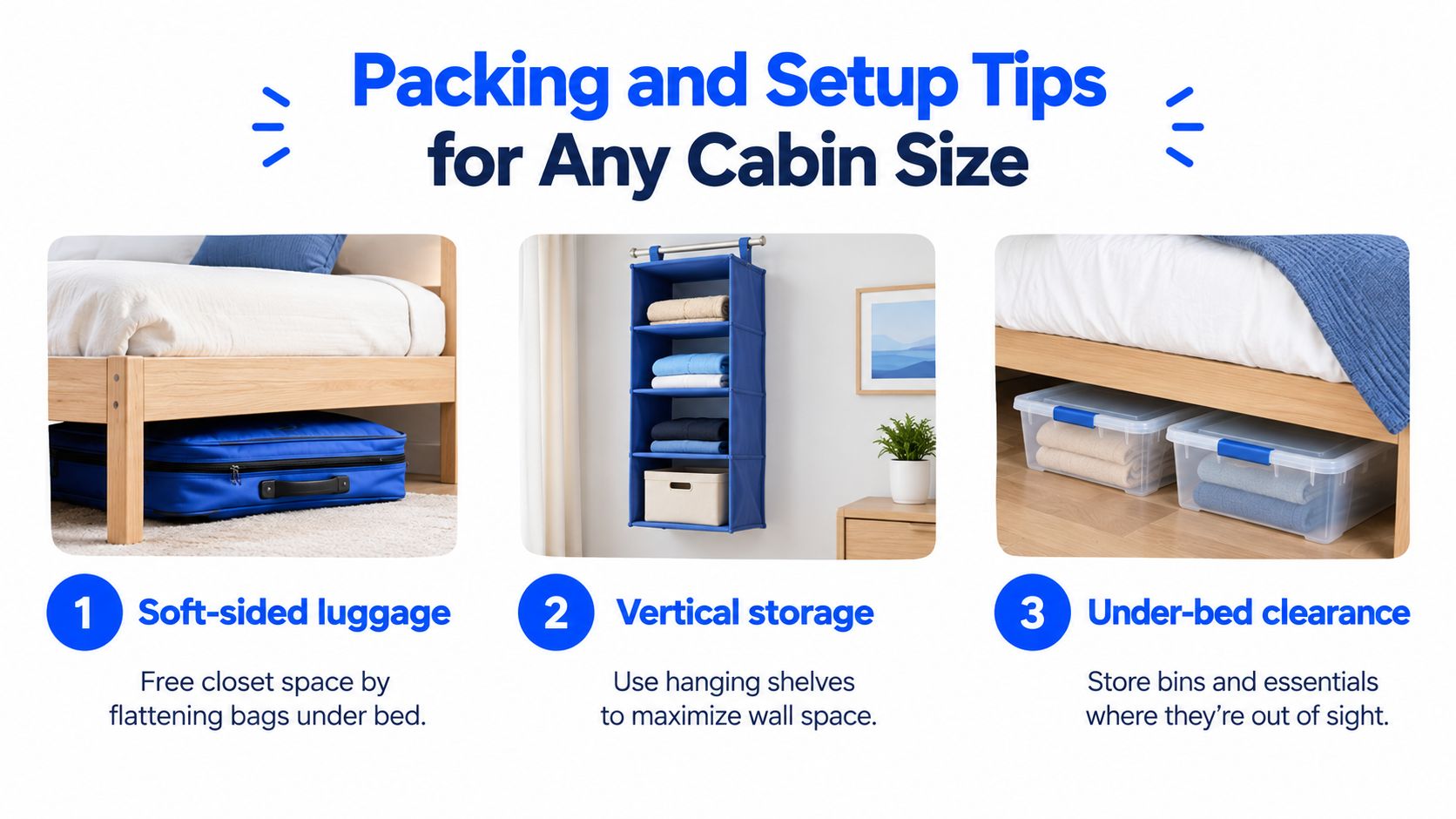
Choose soft-sided luggage that can flatten beneath the bed after unpacking. Hard cases may protect contents well, but they can be harder to slide into limited under-bed clearance. Keep one small bag available for daily use rather than reopening a full suitcase whenever you need sunscreen or a charging cable.
Packing cubes help separate clothing by type and make drawers easier to manage. Stack them vertically where possible instead of creating a single flat layer that forces you to unpack everything. Keep frequently used items near the front of a drawer or in a small organizer.
The easiest cabin to live in is the one where every daily item has a visible home.
Use the walls, doors, and overlooked spaces
Cruise cabins often have limited hooks and counter space, so vertical storage can make a noticeable difference. Magnetic hooks can hold hats, lanyards, light jackets, or reusable bags on suitable metal surfaces. Check the cruise line's rules before bringing any accessory, and avoid attaching items to surfaces that could be damaged.
An over-the-door shoe organizer can hold toiletries, chargers, swimsuits, and small accessories. In the bathroom, a compact magnetic or suction caddy can keep personal items away from the sink edge. These solutions are especially useful when several travelers share one bathroom.
Create a setup that supports movement
Keep the area beside the bed clear for nighttime movement. Place a reusable tote near the door for items you'll carry to the pool or shore, and use a power strip with USB ports only if it complies with your cruise line's current safety rules. Electrical policies vary, so confirm before packing one. A practical cruise ship essentials checklist can help you review permitted accessories.
For wet swimwear or lightweight garments, a compact retractable clothesline can create drying space without covering a chair or bed. Use it only where the cruise line permits and never block the cabin's safety equipment or access routes. On a balcony, follow the ship's rules closely, since hanging items over railings is generally restricted for safety reasons.
Choosing the Right Cabin for Your Travel Style
The best cabin category depends on your travel party, itinerary, time spent onboard, sensitivity to motion, and budget. Start with your routine rather than the room label. Do you mainly need a place to sleep, or will the cabin function as a private retreat throughout the voyage?
Match the room to the traveler
Solo travelers and budget-focused cruisers often find an inside cabin practical. If you'll spend most days at shows, restaurants, pools, and ports, paying for a window or balcony may add less value than expected. Focus on a quiet location, an efficient layout, and enough storage for your belongings.
Couples should decide whether the balcony will become part of the trip. Scenic itineraries can make private outdoor space especially appealing, but the usable interior area and veranda depth still need inspection. A balcony that adds fresh air without improving movement may not solve the problem you're trying to fix.
Families should prioritize bed configuration, connecting-door availability, bathroom practicality, and location. A larger room can help, but a well-positioned pair of connecting cabins may create a more functional arrangement than one crowded cabin. Confirm the exact sleeping setup before booking, especially when a sofa bed or Pullman berth is involved.
Longer-itinerary travelers may benefit more from a suite or a room with a separate sitting zone. Extra storage and a clearer division between sleeping and relaxing can reduce cabin fatigue when you're spending more time onboard. The upgrade makes the most sense when you'll use those zones.
Use this final checklist
Before selecting a room, answer these questions:
- Travel style: Will you sleep, shower, and leave, or spend extended time in the cabin?
- Itinerary: Are scenic sea days central to the experience?
- Party size: Does everyone have a realistic bed and storage arrangement?
- Location: Is the room away from busy venues, machinery, and heavy foot traffic?
- Motion: Would a mid-ship position matter more than extra floor space?
- Setup: Can you keep luggage, clothing, chargers, and wet items organized?
- Equipment: Have you checked the ship's rules for electrical accessories in this cruise ship electrical outlets guide?
Cruise ship cabin sizes give you a useful starting point, but usable space is the decision metric. Read the plan, inspect the layout, consider the location, and choose the feature you'll use every day instead of automatically selecting the largest available category.
Nordmoose offers compact cruise accessories designed around limited storage, metal cabin surfaces, nighttime movement, and drying space. Visit Nordmoose to explore practical options for organizing your stateroom before you sail.