

Cruise Ship Packing List: Printable Checklist for 2026
About 35.7 million passengers were expected to take a cruise globally in 2024, according to CLIA figures cited by J.P. Morgan Research. That many people means a lot of first sailings where the bag that matters is the one you can still hold after you hand the rest to the pier. A cruise ship packing list that dumps everything into one checked suitcase fails the moment cabin delivery runs late. I would build the list as a pier-to-cabin survival kit first, then match bag counts to the line you booked.
Table of Contents
- Printable Cruise Ship Packing List by Category
- How to Build a Two-Stage Packing Plan
- Clothing Quantities for 3, 5 and 7 Day Sailings
- Luggage Limits by Cruise Line and Embarkation Day
- Cabin Gear That Earns Its Space in a Small Stateroom
- Run the Final Check Before You Leave for the Port
Printable Cruise Ship Packing List by Category
AAA projected 19 million Americans to cruise in 2025. A large share of that group is packing for a first or second sailing and wants one list they can tick, not a pile of blog tips. Sort by category, then by where the item travels. The carry-on column is the kit that has to last from the terminal until the stateroom is stocked.
| Category | Items to pack | Where to pack |
|---|---|---|
| Documents and money | Passport or travel documents, government ID, printed itinerary, cruise documents, copy of travel insurance, some cash | Carry-on |
| Medication | Prescriptions in original labeled bottles, two to three extra days of doses, medical notes | Carry-on |
| Chargers and electronics | Phone and camera chargers, power bank, plug-in adapter if the line allows it | Carry-on |
| Clothing | Swimwear, walking shoes, one evening outfit, one change of clothes, daytime outfits | Change of clothes in carry-on, rest in checked bag |
| Toiletries | Toothbrush, deodorant, sunscreen, contact solution, travel-size shampoo and lotion | Carry-on |
| Cabin comfort gear | Magnetic fan, magnetic organizer, night light, magnetic clothesline | Checked bag or carry-on, depending on space |
| Sea-day and port gear | Sun hat, polarized sunglasses, refillable water bottle, lightweight day bag | Day bag |
| Health and motion | Motion-sickness patches, pain relievers, plasters, hand sanitizer | Carry-on |
What the table can't decide for you
Cash is for tips and small port purchases, not a full vacation budget. Keep it in the same pouch as the passport so you aren't opening a checked bag at the gangway. Extra medication days cover a missed connection or a late disembarkation, and original labels are what the medical desk will ask to see.
Sunscreen in that toiletry row should be reef-safe if you have a beach port. Polarized sunglasses and a sun hat live in the day bag, not buried under evening shoes. A plug-in adapter only goes in if that line allows the accessory. Airline rules don't settle it.
Print this table in the week before you leave and tick each row as the item goes into a bag. A checked box on paper beats a mental list at 5 a.m. on embarkation day.
Cabin magnets only earn a spot if you have already confirmed a metal wall. If the carry-on is already full of documents, medicine, and one outfit, those extras ride in the checked bag.
How to Build a Two-Stage Packing Plan
A checked bag may reach your stateroom after dinner on embarkation day. Keep the items needed to get through the pier-to-cabin stretch in a separate carry-on, and use a two-stage plan to decide what goes in each bag. CLIA's cruise FAQs recommend starting with a destination-and-ship checklist, then dividing your packing between carry-on and checked luggage.
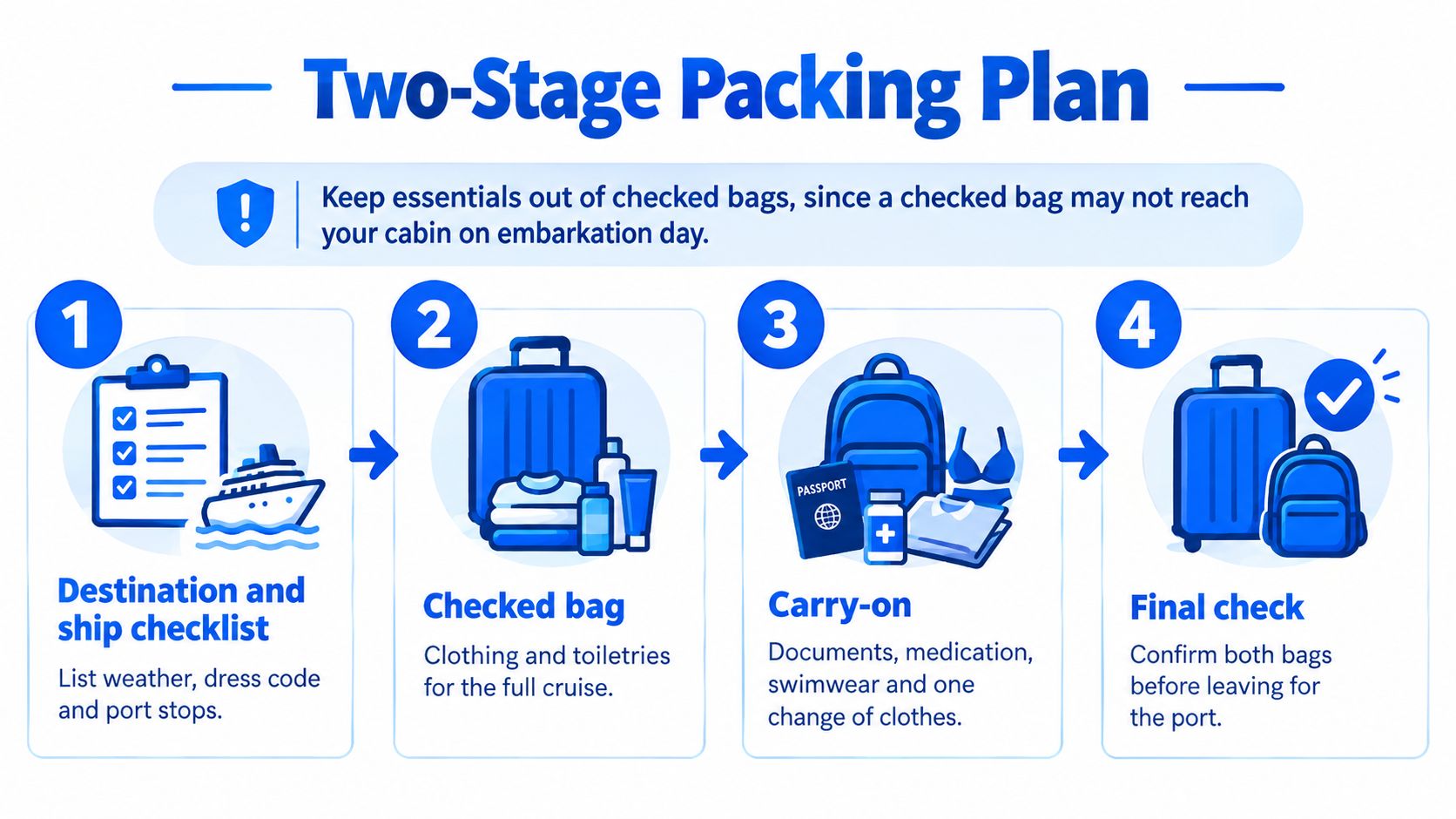
Use the diagram as a quick overview, then work through these steps before you close your bags:
- Make a checklist for this itinerary and ship, not just a general list for home. Weather, port stops, and dress codes affect what you need, including whether to plan for rain or a formal night.
- Check the cruise line's current rules before packing alcohol, beverages, power accessories, drones, electrical appliances, or medical equipment. Policies vary by line, and airline rules do not tell you what the ship allows.
- Assign each item to carry-on or checked luggage before packing. This avoids burying something you need early in the sailing beneath the rest of your clothes.
- Pack the carry-on as your pier-to-cabin kit. Choose items you would need if checked luggage arrived after dinner, rather than treating the carry-on as overflow for the main suitcase.
- For clothing quantities and outfit combinations, use the guidance in the next section. Keep dinner-dress nights in mind: pack for the dress code your line requires, rather than adding extra outfits without a reason.
- Put the remaining items in checked bags and follow that cruise line's size and weight limits. Photograph each bag's contents and its tags before handing it over, so you have a record if a bag goes missing.
- Leave fire and heat hazards at home. Candles, fireworks, heating appliances, and weapons may be rejected at security screening.
Practical rule: Before leaving for the port, check that travel documents and medication are with you, not in checked luggage. Choose quick-dry tops where they suit your plans; they can be reworn after washing, so you can pack fewer extras without relying on another full outfit.
Clothing Quantities for 3, 5 and 7 Day Sailings
A seven-day sailing does not require seven daytime outfits. Five interchangeable sets cover repeat wear, while the extra room goes to swimwear and the clothes needed for evenings. The quantities below are a starting point; adjust the evening column to the dress codes your cruise line requires.
| Item | 3-day | 5-day | 7-day |
|---|---|---|---|
| Daytime tops and bottoms (interchangeable) | 3 | 4 | 5 |
| Swimwear | 2 | 2 | 3 |
| Evening outfits (one per formal night) | 1 | 2 | 2 |
| Underwear and socks | 4 | 6 | 8 |
| Pajamas | 2 | 2 | 3 |
| Light layer or cardigan | 1 | 1 | 2 |
| Walking shoes | 1 pair | 1 pair | 1 pair plus one backup |
| Lightweight day bag | 1 | 1 | 1 |
Three rules that move the counts
Match evening clothes to the nights the line requires. One outfit covers a three-day sailing with one dressier night; longer sailings may call for two. If the other evenings are smart casual, a third formal look adds bulk without filling a dress-code need. Use this guide to what to wear on a cruise to choose an outfit that fits the ship's expectations. A themed or vacation-style event calls for one additional outfit for that event.
On sailings of six days or longer, plan for laundry before adding more shirts. A self-service machine or paid laundry service mid-cruise can reduce how many daytime tops you need to pack. For wet swimwear, a quick-dry cover-up can dry in one cabin night, while a small magnetic clothesline gives swimwear or a light layer somewhere to hang instead of draping it over a chair.
For two people sharing a stateroom, increase swimwear and sleepwear before formalwear. Two travelers may need more changes in those categories, but the evening count depends on the ship's dressy nights, not the number of people. Keep the table's counts as a baseline, then add outfits only for events that require them.
Wear the bulkiest layer and walking shoes in transit to save suitcase space. Keep the lightweight day bag accessible in the carry-on, so it is ready for the pier and the first hours aboard, even if checked luggage has not reached the cabin.
Luggage Limits by Cruise Line and Embarkation Day
Luggage rules vary by cruise line, so count and weigh bags against the line's limit before leaving home. A carry-on is more than a place for valuables: it is your pier-to-cabin kit if checked luggage arrives after the first dinner seating. Carnival's prohibited-items guidance is a useful reminder to check the cruise line's rules rather than relying on airline limits.
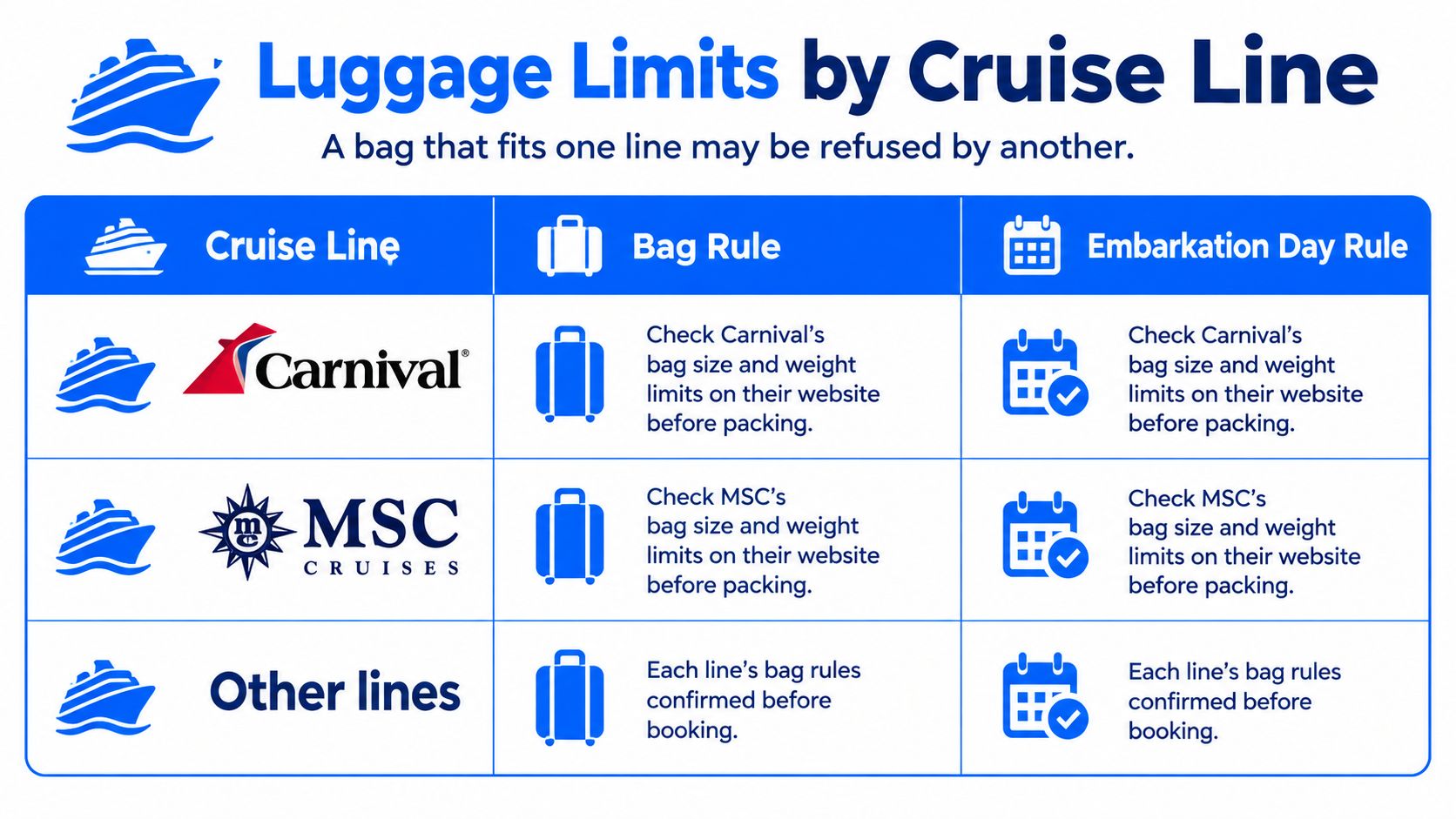
| Cruise line | Bag size and weight | Bags per person | Cabin total |
|---|---|---|---|
| Carnival | 50 lb; 16 x 24 in when laid flat | 1 for 3–5 days; 2 for 6 days or longer | No separate cabin cap in that rule |
| MSC | No size or weight cap stated with the piece rule | 2 suitcases plus 2 hand-luggage pieces | 100 kg or 8 pieces |
| Royal Caribbean | Check the line's current luggage rules | Check the line's current luggage rules | Check the line's current luggage rules |
| Norwegian Cruise Line | Check the line's current luggage rules | Check the line's current luggage rules | Check the line's current luggage rules |
| Celebrity Cruises | Check the line's current luggage rules | Check the line's current luggage rules | Check the line's current luggage rules |
Carnival limits each bag to 50 pounds and 16 by 24 inches when laid flat, and recommends one bag per person on cruises of 3–5 days and two on cruises of six days or longer. MSC allows two suitcases and two hand-luggage pieces per person, with a cabin limit of 100 kilograms or eight pieces. These rules use different measures: two passengers bringing the longer-cruise Carnival allowance could exceed MSC's cabin cap if their bags are heavy. Check Royal Caribbean, Norwegian Cruise Line, and Celebrity Cruises directly before packing, since the figures above do not establish their limits.
The hours between the pier and the cabin
A checked bag may arrive after the first dinner seating, leaving you without it for several hours. Keep medication, swimwear, a change of clothes, and any mobility aid you need in your carry-on. If you have a dressy event on the first night, pack that outfit there too.
Fewer compliant bags are easier to manage than an overstuffed carry-on, especially when walking through a crowded terminal with a roller bag. Weigh and count each piece against your cruise line's rules, and photograph the contents and bag tags before handing luggage over. Write the cabin number on each tag so staff can identify the destination without relying on a last name. For a quick check of restricted items, read what you can take on a cruise, then confirm the rules with your cruise line.
Cabin Gear That Earns Its Space in a Small Stateroom
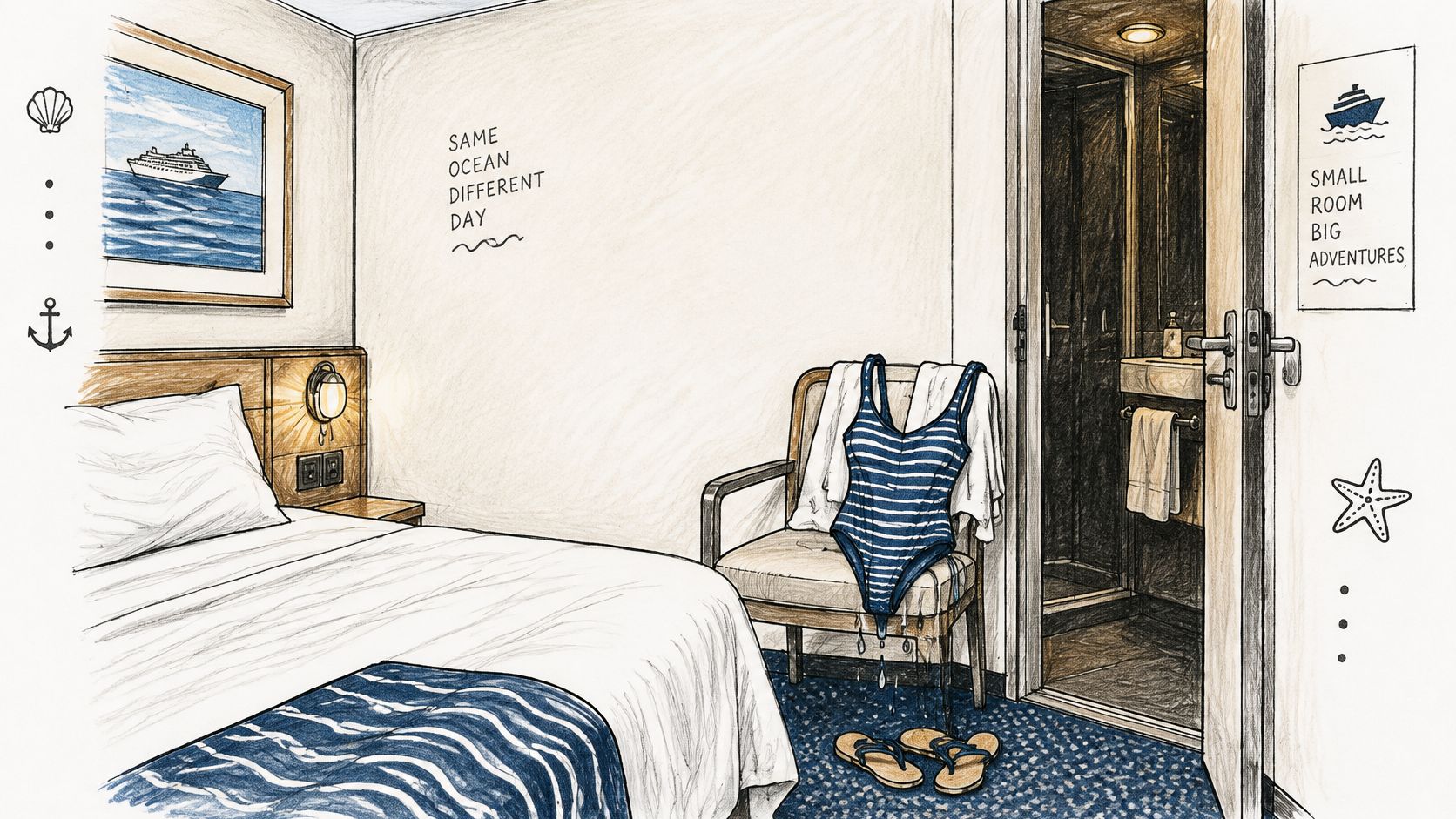
A swimsuit left on the only chair, a crowded sink, and a dark path to the bathroom can make a small cabin harder to use. Choose gear for a specific problem, and check the table's packing considerations before setting aside space for it.
| Cabin problem | Item to bring | Check before packing |
|---|---|---|
| Warm or stuffy cabin | Magnetic cruise fan with multi-speed control | Confirm a metal mounting surface is available and plan to recharge it |
| Counter clutter | Magnetic cabin organizer | Check for a suitable metal surface near the sink or door and space for toiletries and chargers |
| Dark bathroom trips at night | Rechargeable magnetic night light | Choose a spot at the bathroom doorway or along the path to the bed |
| Wet swimwear with no drying spot | Magnetic clothesline | Check for metal panels and room to pack the line |
| Motion sensitivity at sea | Non-drowsy motion-sickness patches | Try one at home before sailing and keep it in the carry-on |
| Lithium battery items | Fan and rechargeable night light | Confirm the cruise line's rules for batteries and power accessories |
A Magnetic Cruise Fan with Remote Control offers magnetic mounting on a metal surface, remote operation, and multi-speed control. It can help with a warm cabin without taking up counter space, but it still needs a suitable place to attach and charging access. An organizer can move toiletries, sunglasses, and chargers off the sink. Place a rechargeable magnetic night light where it guides the walk to the bathroom; it is not a substitute for a reading light.
A magnetic clothesline gives swimwear a place to dry instead of leaving it on a chair or bed. Cruise-line rules for clotheslines can differ, so check the policy before packing one. For a cabin where toiletries and chargers compete for a narrow counter, these small-space storage solutions can help you decide whether an organizer earns its room in the bag.
Keep non-drowsy motion-sickness patches in your carry-on so they are accessible on the first sea day, and try one at home beforehand. Cabin gear should solve a practical problem without adding another item that needs a place, a charge, or approval.
Run the Final Check Before You Leave for the Port
Check every bag the night before, then make one last pass at home before leaving for the port. A curbside check leaves little time to move an item from the wrong bag.
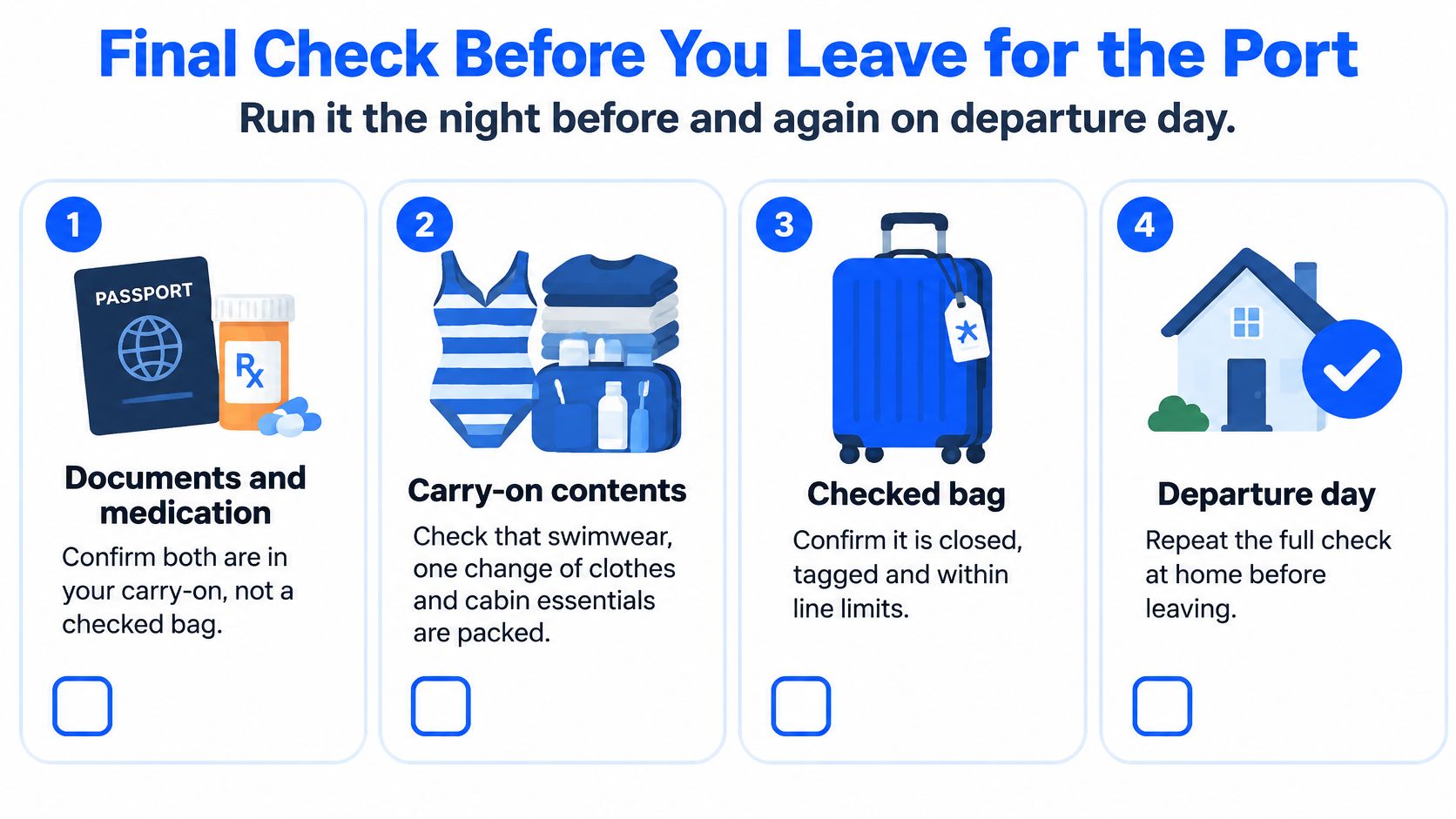
- Confirm documents and medication are in the carry-on. You may not have access to checked luggage during embarkation.
- Check the carry-on's weight against your cruise line's rules, then confirm a change of clothes, chargers, and the day bag are inside. If it exceeds the terminal limit, you may have to repack while boarding.
- Remove prohibited items. Candles, fireworks, heating appliances, and weapons can be refused at screening, leaving you without them for the trip.
- Check that every bag tag shows the correct cabin number. Save photos of your bag contents and tags on your phone.
- If you are carrying alcohol, beverages, or a drone, check your cruise line's current rules the night before. Policies can include boarding exceptions, so confirm what applies to your sailing.
A personal checklist can catch items a category list misses. Add specific rows for a prescription or hobby kit, and keep the paper in your carry-on. The carry-on is your pier-to-cabin kit: pack what you need before checked bags arrive, while keeping its weight within your line's limits.
A short walk-through of the handoff can make the final check easier to follow.
Nordmoose makes magnetic, rechargeable cabin gear for warm staterooms, tight counters, wet swimwear, and night walks. Pack it after the documents and medication, and choose items that solve a cabin problem without taking up counter space. Browse Nordmoose and match each item to a metal wall before packing.