

USS Norway Cruise Ship History Facts and Status Explained
The “USS Norway cruise ship” was SS Norway, the former SS France, and it doesn't sail today. She was withdrawn after a boiler explosion in May 2003 and scrapped in 2008.
Why, then, do search results still make SS Norway look like a ship you might book? The problem starts with the name. “USS” identifies a United States Navy vessel, while this ship's correct historical prefix was SS, meaning steamship. She also carried two major identities, first as SS France, then as SS Norway after Norwegian Cruise Line transformed her for cruise service.
Table of Contents
- Introduction Why So Many Search USS Norway Cruise Ship
- From SS France to SS Norway How the Icon Was Born
- Size Speed and Specs That Made Norway a Giant
- Ocean Liner Versus Modern Cruise Ship Design Explained
- Service Life Highlights and Why the Ship Stopped Sailing
- What SS Norway Teaches Todays Cruisers About Cabin Comfort
- Key Takeaways and How to Research Historic Cruise Ships Accurately
Introduction Why So Many Search USS Norway Cruise Ship
Why do search results make the USS Norway cruise ship sound like a vessel you could still book? The phrase blends a familiar search pattern with a real ship whose name changed during its career. Old photographs, specifications, and passenger memories remain easy to find, while pages about different periods often appear together without a clear timeline.
Correct identification: SS Norway was the former SS France, not a current USS vessel, and she no longer exists as an operating cruise ship.
The confusion becomes easier to resolve once the names are placed on the same hull. SS France describes her original career as a French ocean liner. SS Norway identifies her later life after Norwegian Cruise Line converted her for cruise service. Her final phase was retirement, followed by scrapping. Reading those names as separate ships can make it seem as though Norway remains available for bookings.
Her history has three distinct phases:
- France: A French ocean liner launched in 1960 and placed into service in 1962.
- Norway: A major conversion after Norwegian Cruise Line bought her in 1979.
- Retirement: Withdrawal after a boiler explosion in May 2003, followed by lay-up and scrapping in 2008, as documented in the historical account of SS France's final disposition).
The practical answer is straightforward. You cannot reserve SS Norway today, visit her as a functioning museum ship, or compare her with a current Norwegian Cruise Line itinerary. Her importance now is historical. She represents a transition between two approaches to passenger travel, adapting an ocean liner for leisure cruising before purpose-built cruise ships became the standard.
That background also explains why her images and specifications can look surprisingly current. At 1,037 feet, or 315.67 meters, she was enormous for her era, and the conversion made her a landmark in cruise history. Length alone, however, does not explain how she handled at sea, how passengers experienced her cabins, or why maintaining her design eventually became difficult. Those questions require separating the ship's original liner role from the cruise features added later.
From SS France to SS Norway How the Icon Was Born
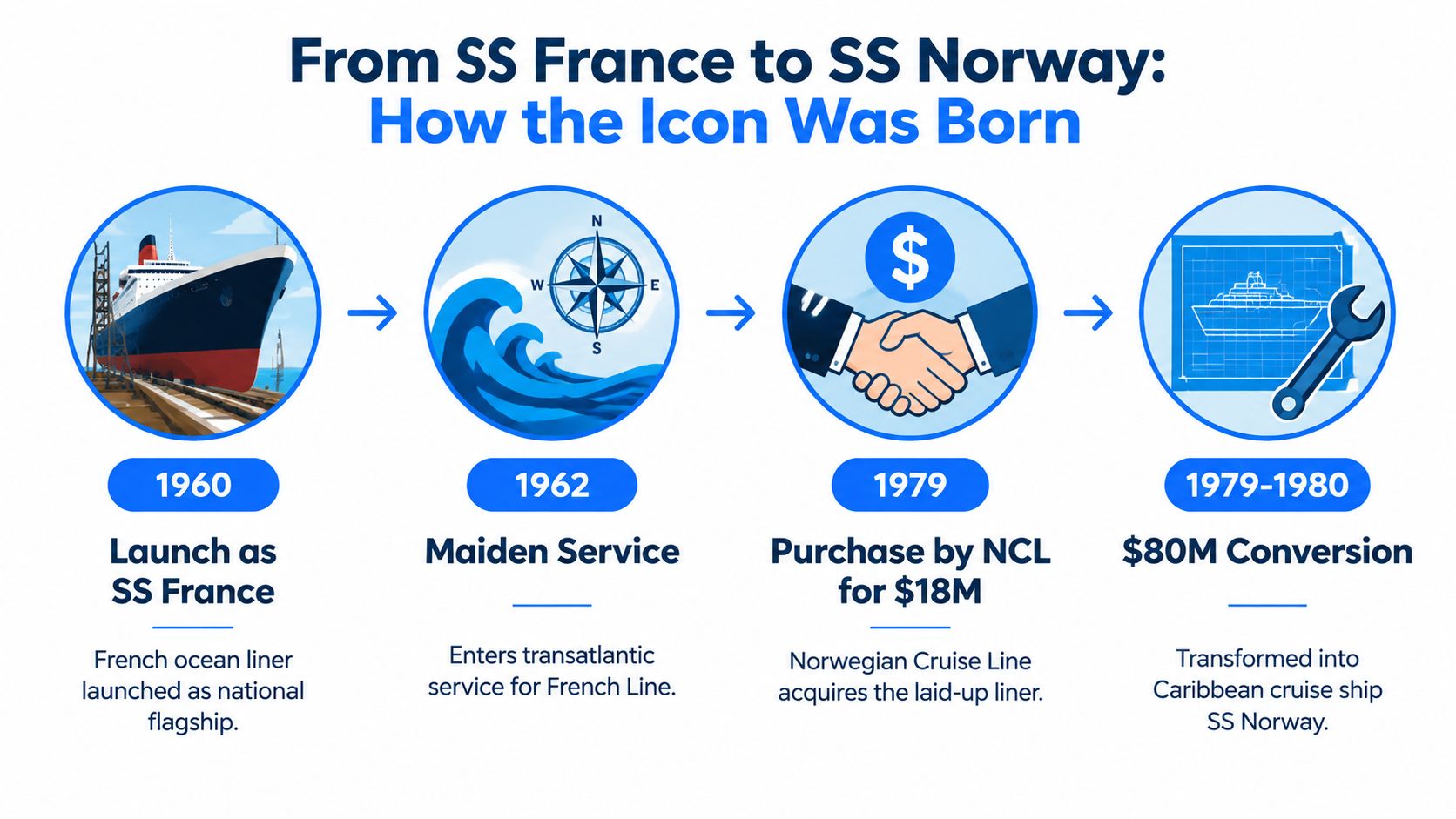
Why does one ship appear under several names? The answer begins with SS France, a French ocean liner launched in 1960 and placed into service in 1962. Her original assignment was to cross the Atlantic, not to function mainly as a floating resort between warm-weather ports.
That purpose shaped the hull, machinery, and interior arrangement. An ocean liner needed to maintain dependable passages across open water, including conditions less central to a leisure ship built around port calls, dining, and onboard activities. Her design was therefore the maritime equivalent of a long-distance vehicle, built first to travel reliably rather than to make the ship itself the entire holiday.
Norwegian Cruise Line bought the available liner in 1979 for $18 million. The company then completed an $80 million conversion, renaming her Norway in 1980, according to this account of SS Norway's transformation from SS France.
Why the conversion mattered
The project involved far more than fresh paint or a few renovated public rooms. NCL adapted a vessel created for one kind of passenger travel into a ship designed for cruising, where time spent onboard mattered as much as the journey between ports.
That change gave passengers an unusual experience for the period. The ship could serve as the destination itself, with her scale supporting larger public spaces and a stronger entertainment identity. In practical terms, the conversion helped show how a cruise ship could be an attraction rather than just transportation.
The two names describe different roles. SS France identifies the liner's origin and original purpose. SS Norway identifies the cruise-era reinvention that made her famous among vacation passengers.
This distinction also explains why search results can confuse first-time cruisers. Someone searching for “USS Norway” may find current-looking photographs, old specifications, or cruise discussions and assume the ship still sails. “USS” is also a common search error, since the vessel was a civilian passenger ship, not a United States Navy vessel. Norway is a historical identity now, not a ship available for bookings.
A record-setting presence
At roughly 52,000 tons, SS Norway was then the largest passenger ship converted into a cruise ship. She measured 1,037 feet, or 315.67 meters, and remained the longest passenger liner in the world for 42 years from her maiden voyage, according to the same historical account of the ship.
Those qualities made her more than a renamed liner. She became a visible bridge between the ocean-liner age and the developing cruise industry. Passengers boarded because the ship's history, size, and onboard experience were part of the appeal.
The three phases are easiest to remember in order: France was the original liner, Norway was the converted cruise ship, and scrapped describes her final status. Keeping those phases separate prevents historical photographs from being mistaken for evidence that she still operates.
Size Speed and Specs That Made Norway a Giant
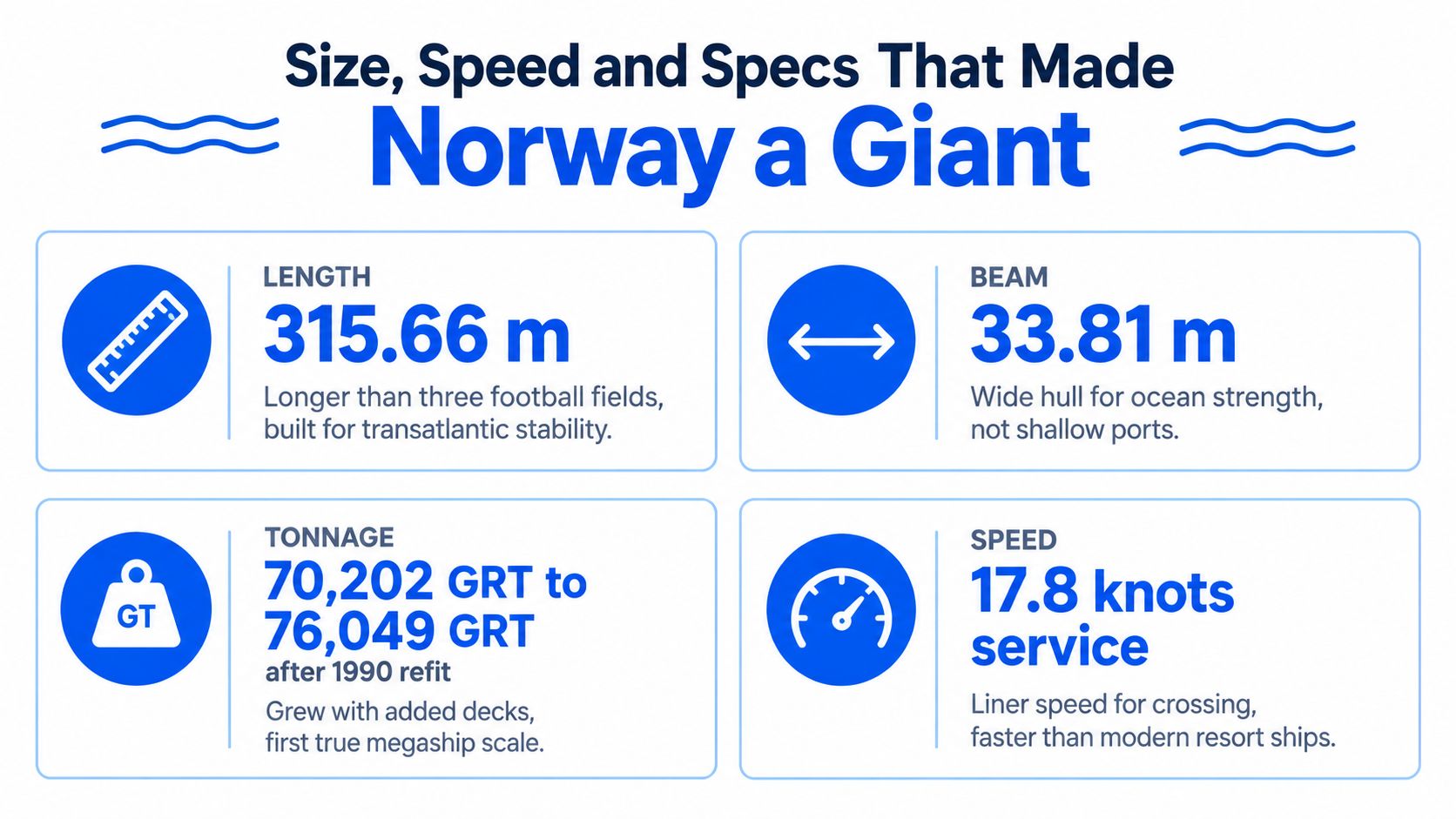
What do SS Norway's measurements reveal beyond a list of numbers? They show how a former ocean liner's proportions shaped its speed, handling, and usefulness as a cruise ship. Her maximum length was 315.66 meters, or 1,035 feet, and her beam, meaning the width across the hull, was about 33.81 meters, or 110.15 feet, according to the SS Norway technical quick facts.
Length gave the ship a long footprint in the water. The narrower beam preserved the proportions associated with an ocean liner, closer to a long-distance touring vehicle than a broad, box-shaped resort. That form favored forward progress and seakeeping rather than placing the greatest possible interior volume near the waterline.
Reading the tonnage figures
Tonnage describes volume or carrying capacity, not the ship's everyday weight. Gross register tonnage, or GRT, measures enclosed internal volume. Net tonnage uses a different calculation tied to usable spaces, while deadweight tonnage covers capacity for cargo, fuel, supplies, and related loads.
After conversion, SS Norway had 70,202 GRT, 38,573 NRT, and 15,330 TDW. A 1990 refit raised the reported figures to 76,049 GRT and 45,886 NRT, as recorded in the ship's technical specifications.
| Specification | What it tells a passenger |
|---|---|
| 315.66 m maximum length | A very long hull with significant berth and maneuvering demands |
| 33.81 m beam | The ship's approximate width across the hull |
| 70,202 GRT after conversion | The scale of enclosed interior volume |
| 76,049 GRT after the 1990 refit | Increased measured volume after later changes |
| 17.8-knot service speed | The approximate speed used for regular operation |
| 25-knot maximum speed | The ship's stated top speed capability |
Speed and port practicality
SS Norway's service speed was about 17.8 knots, and her maximum speed was 25 knots. Those figures fit her liner background. She retained the speed capacity for longer ocean passages, instead of serving only as a vessel for short movements between nearby resort ports.
Her proportions also affected where and how she could operate. A long, narrow hull can support ocean routing, but it makes berth geometry, turning radius, and port-side maneuvering more demanding. Reaching a harbor is only one part of the task. The ship must also align with a berth and turn within the available basin.
For that reason, large does not automatically mean more practical. SS Norway's dimensions made her a historic giant, while also tying her to the operating priorities of an earlier liner era. The figures explain both her appeal and the limits that shaped her later cruise career.
Ocean Liner Versus Modern Cruise Ship Design Explained
Why does SS Norway feel different from a modern cruise ship, even though both carry passengers on sea holidays? The answer begins with the ship's first life as an ocean liner. She was built for regular Atlantic crossings, then adapted for cruising, so her design preserves priorities that a purpose-built resort ship would approach differently.
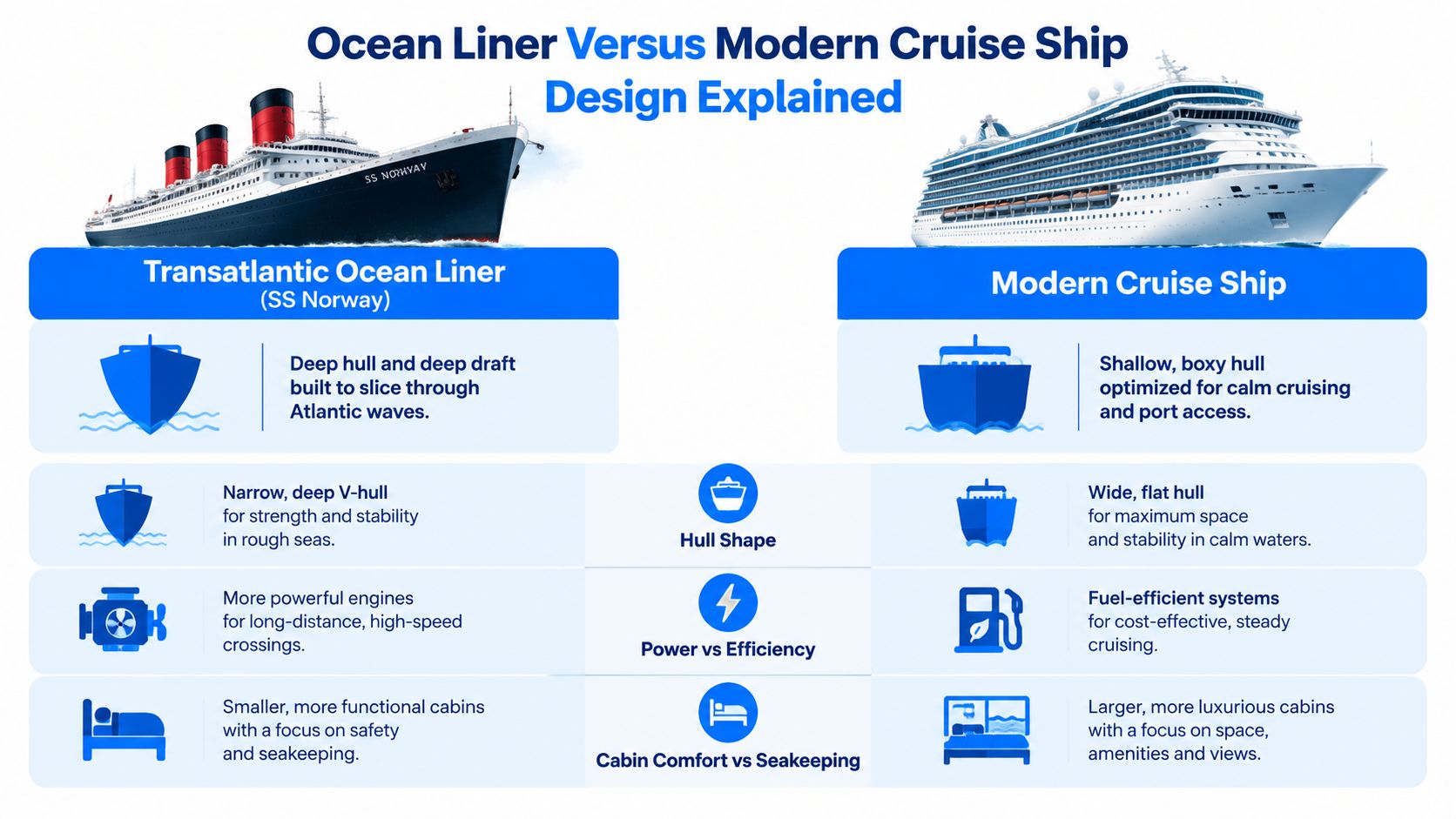
An ocean liner must handle exposed water, maintain dependable passage times, and remain structurally capable through changing conditions. Its designers therefore focus on hull strength, seakeeping, propulsion, and efficient movement across long routes. A modern cruise ship also requires safety and seaworthiness, but its layout gives greater attention to cabins, restaurants, theaters, pools, retail areas, crew spaces, energy use, and access to a broader mix of ports.
The hull changes the experience
SS Norway's deep hull and unusually deep draft came from her liner origin. More of the vessel sat below the water, a little like a building with a deeper foundation. That arrangement could contribute to a steady feel in open ocean conditions, while also limiting access to shallow approaches and smaller harbors.
A modern cruise ship usually begins with a different question: how can the vessel organize a large hotel at sea? Designers arrange passenger cabins, dining rooms, theaters, pools, shops, and crew facilities across many decks. The result can feel like a floating resort, whereas SS Norway retained the stronger presence of a ship built to cross an ocean.
| Design question | SS Norway as a converted liner | Modern purpose-built cruise ship |
|---|---|---|
| Primary heritage | Transatlantic transportation | Leisure cruising |
| Hull logic | Deep hull for ocean passage | More emphasis on hotel volume and port flexibility |
| Passenger impression | A powerful, historic liner presence | A planned resort environment |
| Conversion challenge | Existing structure limits redesign | Layout begins with cruise operations in mind |
Why the design was difficult to repeat
Conversion produced a memorable ship, but it also meant adapting a structure created for another job. Her original proportions, machinery spaces, circulation routes, and deep draft formed part of her identity. Those same features made efficient modernization harder because designers had to fit cruise functions into an existing framework.
The conversion cost more than $100 million. That figure shows the scale of the project, described in the background on Norwegian Cruise Line's development. The result was a landmark rather than a simple model that later cruise lines could copy.
The comparison helps explain why modern search results can confuse first-time cruisers. SS Norway's photographs and cruise-era descriptions remain easy to find, but they describe an earlier phase of the ship's life. She began as France, became Norway, and was later scrapped, so the design lesson survives even though the vessel does not sail today.
For passengers, the practical distinction is straightforward. A liner-derived ship may feel more purposeful in open water, while a cruise-built ship may provide a layout better suited to resort-style living and varied port access. Neither design guarantees a better voyage. Each reflects a different purpose.
If ship motion affects your plans, this guide to preventing seasickness on a cruise offers practical preparation advice.
Service Life Highlights and Why the Ship Stopped Sailing
Could a photograph of SS Norway make a retired ship look available for booking? Yes, especially when an old cruise article, an undated caption, and a modern fleet page appear together in search results. The information may be accurate, yet the page can still leave out the ship's final status.
SS Norway's cruise career made her an important NCL flagship and a symbol of the industry's shift toward larger onboard experiences. Her appeal came from pairing a famous ocean-liner hull with a cruise operation that made entertainment and life aboard central to the voyage.
The ship passed through three distinct phases: France, Norway, and scrapped remains. Separating those phases works like reading three chapters of one biography. The first explains her liner origins, the second covers her cruise identity, and the third confirms why she cannot appear on a current itinerary.
The final operating timeline
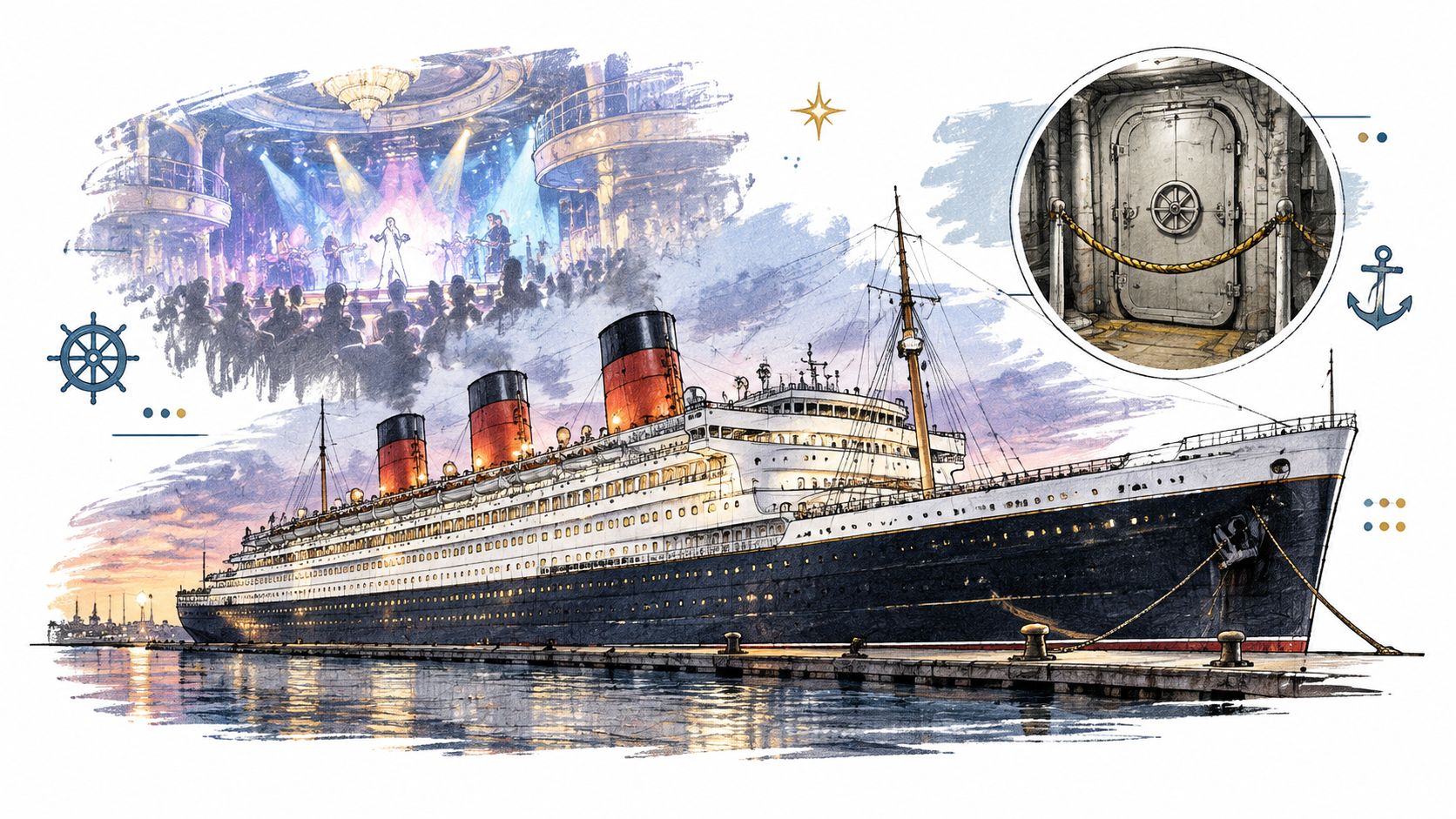
The decisive event came in May 2003, when a boiler explosion led to the ship's withdrawal from service. She was then laid up, which means she was removed from active operation and kept out of regular passenger service rather than continuing to sail.
Her story ended with scrapping in 2008, according to the record of SS France and SS Norway's final years). This answers a question that historical summaries often leave unstated. SS Norway is not inactive while awaiting restoration. The original vessel no longer survives as a usable cruise ship.
How to verify old cruise-ship pages
Use three checks before treating a nostalgic article as current:
- Publication context: Identify whether the page describes a past sailing, a historical profile, or a current itinerary.
- Fleet status: Look for the ship's final disposition, not only its last reported location.
- Name history: Confirm whether the page concerns SS France, SS Norway, or another ship with a similar name.
Practical rule: A ship profile is not a booking page. Verify the vessel's current operating status separately.
If motion affects your travel plans, a practical guide to preventing seasickness on a cruise can help you prepare for the conditions at sea.
SS Norway remains historically important because her conversion showed how a major liner could become a cruise destination in its own right. Her photographs and cruise-era stories still circulate, but the vessel itself belongs to maritime history, not today's sailing fleet.
What SS Norway Teaches Todays Cruisers About Cabin Comfort
What can SS Norway teach passengers about cabin comfort when the ship itself no longer sails? Her liner structure came from an earlier design era. Modern cruise ships must balance compact staterooms with hotel-style ventilation, moisture control, lighting, and storage. Comparing the two helps explain why a ship can feel spacious in character yet demanding in daily cabin use.
Cabin comfort depends on more than room size. Independent research on a large sailing cruise ship recorded cabin relative humidity at about 68.2 ± 5.3%, above the ASHRAE comfort range, according to the published indoor-air-quality study). The study does not describe SS Norway, but its findings show why a modern cabin may feel warm, damp, or stuffy even with complex HVAC equipment. It also reported ventilation rates ranging from 35.5 to 69 liters per second per person, depending on cabin type. Room class, occupancy, moisture, airflow delivery, and personal sensitivity can therefore shape two passengers' different impressions of the same vessel.
Airflow varies by cabin type
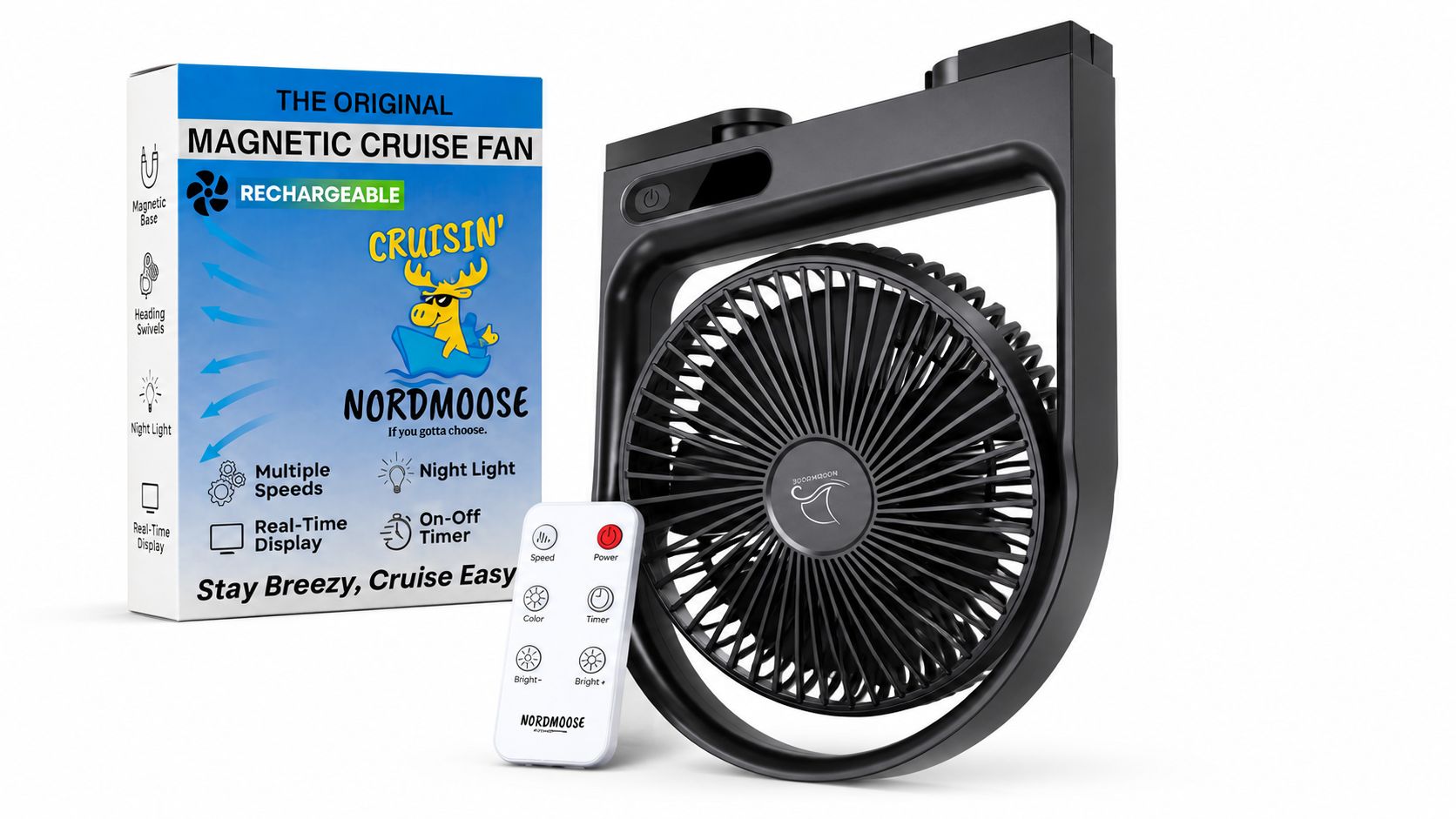
A cabin fan does not replace the ship's ventilation system. It can provide personal airflow in a compact room, especially when the air feels still or one passenger wants more circulation than another. This distinction matters because shared HVAC controls cannot always satisfy everyone in a cabin.
Cruise rooms also offer limited desk and floor space. Any accessory should pack easily, stay clear of walkways, and avoid taking over the bedside area. A slim magnetic design may work when the cabin has a suitable metal surface and the ship allows it. The Magnetic Cruise Fan with Remote Control is described as an ultra-slim, rechargeable, seven-blade fan with a timer, remote control, adjustable airflow direction, six speeds, and a multi-color night light.
Comfort includes storage and nighttime movement
Air is only one part of the experience. Chargers, toiletries, clothing, and travel documents quickly compete for the same small surfaces. Vertical organization can keep daily items within reach, while leaving clearer paths for nighttime movement. Passengers should check ship rules before attaching anything to walls or fixtures.
These small-space storage solutions for cruises offer ideas for arranging a compact stateroom. SS Norway's liner design explains her historical character. Modern passengers often judge comfort through quieter details, including airflow, storage, lighting, and how easily two people can share one room.
Key Takeaways and How to Research Historic Cruise Ships Accurately
Why do search results still describe SS Norway as if she might be sailing today? The phrase “uss norway cruise ship” combines a military prefix with a civilian ship's later name. Treat it as a search clue, then verify the vessel's identity, service history, and final status.
Use this sequence for SS Norway and other historic ships:
- Check the prefix. “USS” identifies a United States Navy vessel. SS Norway was a civilian steamship, and Norway was her cruise-era name.
- Trace the first identity. She began as SS France, a French ocean liner launched in 1960 and placed in service in 1962.
- Follow the change in role. Norwegian Cruise Line bought her in 1979, converted her for cruise service, and renamed her Norway in 1980.
- Verify the final phase. A boiler explosion in May 2003 preceded her withdrawal and lay-up. She was scrapped in 2008.
- Separate history from availability. A ship can remain influential after it has left the active fleet.
That three-part timeline, France, Norway, scrapping, prevents a common research error. Photos, deck plans, and nostalgic articles may show a ship's cruise years without indicating that the vessel still operates.
How to read nostalgic ship coverage
Historical coverage often focuses on atmosphere, scale, interiors, or passenger memories. Those details explain why a ship mattered. They do not answer whether you can book a voyage on it now. For present availability, check an operating cruise line's fleet pages, current booking systems, port records, or maritime references that clearly identify a vessel's status.
SS Norway's importance lies in the transition she represents. Her liner design carried long-distance maritime traditions into the expanding cruise market, while her conversion showed both the appeal and limits of adapting an older hull to changing passenger expectations. Modern cruise ships inherit some of that lesson: comfort depends not only on size, but also on how space, movement, and shared facilities are arranged.
For practical preparation ideas, browse these cruise essentials resources. Apply the same method to other celebrated ships: record each name change, verify the dates, and confirm whether the vessel is operating, preserved, laid up, or scrapped.
Nordmoose also offers compact cruise-cabin accessories, including magnetic organizers, rechargeable lighting, clotheslines, and cabin fans designed for limited space and metal surfaces. Review Nordmoose for options before a voyage.