

Cadiz Cruise Port Guide: Terminals, Transport and Tips
The usual advice about Cadiz cruise port is that you can step off the ship and walk straight into town. That's useful only after you know where your ship is berthed. The terminal exit, baggage arrangements and route into the historic centre matter more than the city name on your itinerary.
Start with a berth lookup, not an excursion booking. Once you've matched your ship to its terminal, you can choose whether to walk, take a taxi or join a tour without building the day around an assumed starting point.
Table of Contents
- Which Berth and Terminal Your Ship Uses
- Facilities at the Two Cadiz Cruise Terminals
- Embarkation, Disembarkation and Busy-Day Timing
- Getting from the Cadiz Cruise Terminal into Town
- Top Shore Excursions from Cadiz
- Safety, Heat and Timing Tips in Cadiz
- Pre-Arrival Checklist for Cadiz
Which Berth and Terminal Your Ship Uses
Alfonso XIII and Ciudad are the working berth names to look for. Alfonso XIII serves the main turnaround terminal, while Ciudad uses the smaller Ciudad Quay terminal. Don't confuse the size of a terminal building with the length of the berth outside it. A larger passenger hall doesn't automatically mean a longer docking face.
The following berth dimensions are listed in Endesa's description of the port's cruise infrastructure. Published specifications can differ by berth segment, tidal reference and terminal approach, so these are planning references, not a guarantee of where your ship will dock.
Cadiz cruise berths compared
| Berth | Length | Depth | Area | Terminal |
|---|---|---|---|---|
| Ciudad berth | 316 m | 9 m | 18,535 m² | Ciudad Quay terminal |
| Alfonso XIII berth | 180 m | 10 m | 12,550 m² | Alfonso XIII terminal |
Berth assignment involves draft, maneuvering clearance and usable quay length, not just passenger count. Even if you've visited Cádiz on the same ship before, don't assume you'll leave through the same terminal exit.
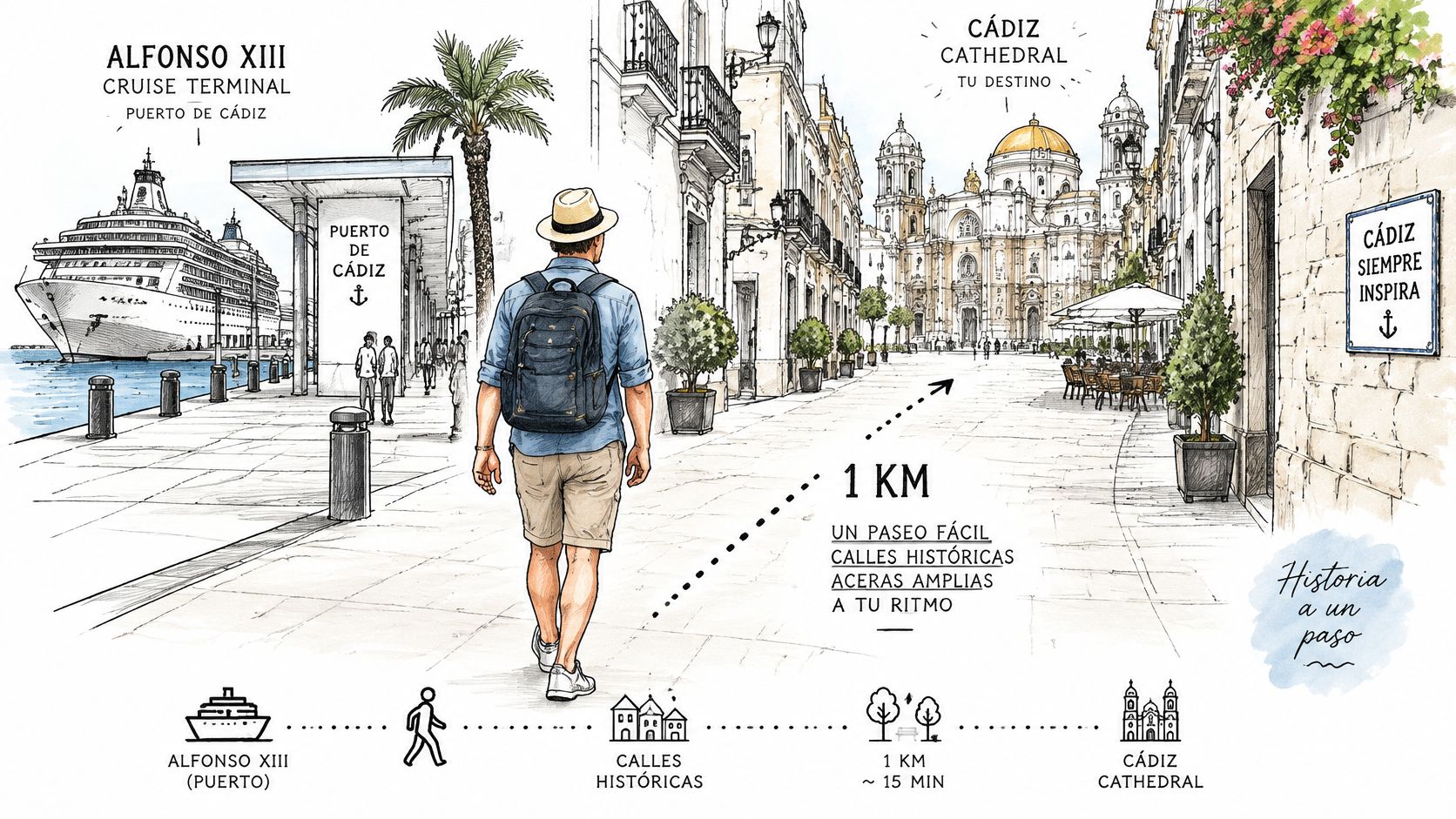
For walkers, the important distinction is where that exit meets the city. Alfonso XIII is roughly 1 km from the cathedral, while Ciudad Quay opens toward Plaza de San Juan de Dios, according to the Port Authority's cruise and passenger facilities description. Ciudad therefore needs its own walking route, not directions copied from an Alfonso XIII itinerary.
Find the berth before choosing the route
- Open the daily program. Check the cruise app, printed itinerary or ship's port-call notice for the docking information.
- Record the actual name. Look for Alfonso XIII, Ciudad or a specific alternative quay, rather than stopping at Cádiz.
- Save the terminal entrance. Put the passenger entrance in your phone map, not a general pin for the Port of the Bay of Cádiz.
- Resolve missing information onboard. Ask guest services or the shore-excursion desk which exit passengers will use and whether any transfer is required.
A map's walking estimate is useful only after you've selected that exit. It won't necessarily account for the ship-to-terminal movement, controlled access or the time needed to get everyone ashore.
Practical rule: Treat the berth name as your starting address. The city name alone isn't enough to plan a port day.
If you're at Alfonso XIII, build the outing around its established passenger facilities and city approach. If you're at Ciudad, establish the exit route and transport arrangements before disembarking. For any other assignment, get fresh directions rather than forcing it into either plan.
Facilities at the Two Cadiz Cruise Terminals
Passenger hall size tells you less than baggage hall size when bags are the bottleneck. The Cruise Cádiz terminal description lists these facilities at Alfonso XIII and Ciudad Quay.
Terminal facilities at Alfonso XIII and Ciudad Quay
| Facility | Alfonso XIII | Ciudad Quay |
|---|---|---|
| Terminal space | 1,447 m² | 372 m² |
| Check-in desks | 12 | Not specified in the published description |
| Baggage hall | 600 m² | 50 m² |
| Security arches | 4 | 3 |
| Security scanners | 5 | 3 |
The baggage hall figures show where space can tighten. Passengers collecting bags, identifying belongings and gathering their groups all use the same area. Move away from the collection flow before opening a suitcase or repacking.
Keep medication and travel documents in your hand luggage, along with anything you need before cabin delivery. Cruise paperwork should not go inside a bag you plan to surrender.
What the facilities mean on the day
Published check-in desk and scanner counts do not show how many positions will be operating for a particular sailing. Arrive within your assigned window, and avoid the busiest screening period if your schedule allows.
Alfonso XIII lists baggage storage, tourist information and Wi-Fi. Confirm storage hours and collection arrangements before relying on them.
Ciudad Quay's smaller passenger area leaves less room to wait. Prepare before you arrive:
- Sort phone access beforehand. Download directions you may need rather than relying on a terminal connection.
- Keep hand luggage manageable. A single day bag is easier to screen and carry than several loose items.
- Settle late-day bag arrangements. If you have an excursion after final disembarkation, establish whether luggage travels with the tour, stays with the cruise line or needs separate storage.
- Choose a meeting point away from the doors. Keep entrances clear for passengers and baggage.
At either terminal, arrive prepared and within your assigned window. An early arrival does not guarantee faster boarding.
Embarkation, Disembarkation and Busy-Day Timing
Separate turnaround procedures from an ordinary port visit. Passengers starting or finishing a cruise may need check-in and baggage processing. Passengers stepping ashore for the day generally follow the ship's clearance, identification and return-screening instructions instead.
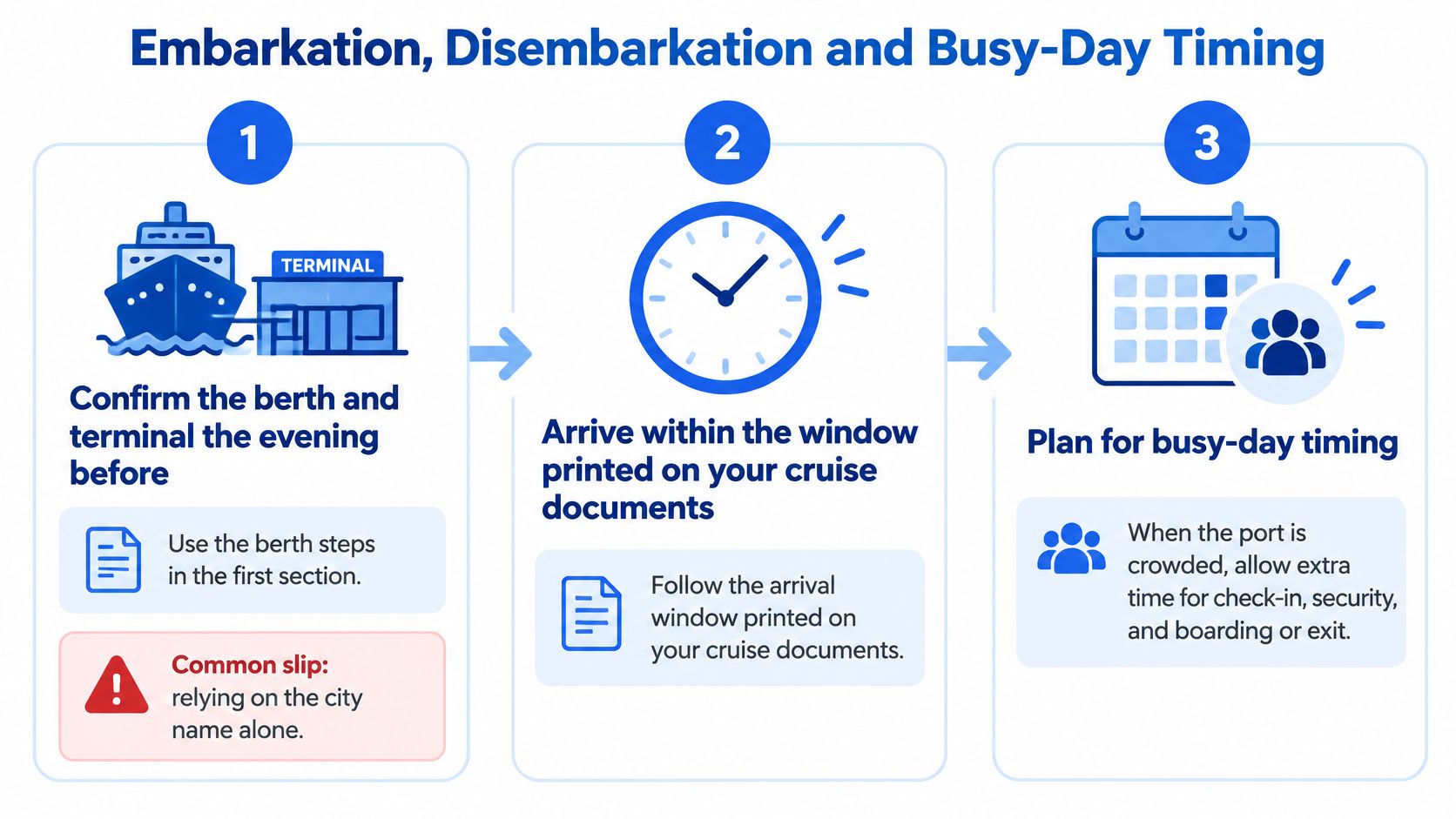
Use this sequence to organize the terminal part of the day.
Starting your cruise
- Confirm the terminal the evening before. Give your driver the passenger terminal name, not just the port. The common mistake is reaching the waterfront without knowing which controlled entrance serves your sailing.
- Follow the arrival window on your cruise documents. If your flight or hotel checkout leaves a gap, arrange somewhere suitable to wait rather than assuming the terminal can accommodate you early. Turning up before your slot may mean spending longer with your bags.
- Prepare for the instructed screening order. Keep your booking documents, identification and phone accessible, then follow staff directions about trays and bags. Don't begin searching through a packed backpack when you reach the screening position.
- Use the designated luggage handover. Check that each label matches your sailing and cabin, photograph the tag and keep the receipt if one is issued. Don't leave a case beside a queue and assume someone will collect it.
- Complete check-in and follow boarding instructions. Baggage acceptance, document checks and permission to board are separate stages. A completed check-in doesn't mean you should move past a holding point without being called.
For a family or group, nominate someone to retain the shared booking details, but make sure each adult can access their own identification. If people become separated in the queue, nobody should be left unable to complete a check.
Finishing your cruise or leaving for an excursion
- Collect and identify luggage carefully. Follow the ship's tag-color, number or group system where used, and inspect the name label before taking a similar-looking case. Move out of the collection lane before checking onward travel details.
- Locate the actual excursion meeting point. A tour may assemble onboard, beside the terminal or at a vehicle pickup area. Don't walk into town because the excursion description says Cádiz and assume the guide will find you.
For an ordinary port call, wait for the ship's clearance announcement before heading to the gangway. If you've booked an independent guide, send them the confirmed terminal and agree what happens if passengers are released later than expected.
Judge congestion from the day's schedule
The Port Authority recorded 344 cruise calls in 2025, up 3.3% from 2024, according to its annual cruise-call announcement. That annual total doesn't tell you how crowded your particular arrival will be.
Ask whether other ships are processing passengers at the same time and whether your sailing is turning around. Those answers are more useful than assuming every call involves the same queues.
Leave some of your available time uncommitted. A plan that uses every moment ashore has no room for a slow gangway, a misplaced bag or a delayed vehicle.
When overlapping movements are expected, avoid booking an independent pickup immediately after the advertised docking time. For the return, move your city departure earlier rather than relying on the terminal being quiet.
Getting from the Cadiz Cruise Terminal into Town
Your berth sets the route into Cádiz. Check the ship's assigned berth and passenger exit first, then compare the walk, baggage arrangements and services there before choosing how to reach town.
Walk and services by berth
| Berth | Walk to cathedral | Baggage handling | Services |
|---|---|---|---|
| Alfonso XIII berth | Allow about 15–20 minutes from the confirmed passenger exit; check your map route | Baggage hall and storage available | Tourist information and Wi-Fi |
| Ciudad berth | Allow about 20–25 minutes via the Plaza de San Juan de Dios side; check your map route | Smaller baggage hall; confirm storage separately | Ask the terminal desk: “Is there step-free access from this passenger exit to the taxi pickup point?” |
Treat those walk times as route-planning estimates, not fixed transfer times. The exit you use, walking pace and stops affect the total.
Choose transport by effort, not habit
Walking suits travelers comfortable with the estimated outward and return route. Carry only what you want for the day; luggage makes the same walk more demanding.
A taxi can be the simpler option with suitcases, tired children or limited walking tolerance. Ask where to join the authorized taxi queue and show the driver your destination. If you need an accessible vehicle, ask specifically about step-free boarding and wheelchair space before setting off.
Consider a local bus or organized shuttle only after checking its stop, operating arrangements and return point. Transport can differ sharply by berth: compare the ship-to-city connection in this Split cruise port transport guide with the route from your confirmed Cádiz exit before choosing.
For a visual sense of the route into town, see the Cádiz overview below.
Before leaving the terminal area, identify the taxi rank, nearest toilets and step-free exit. Save the terminal entrance for your return, not just the town drop-off point.
Top Shore Excursions from Cadiz
Your ship's berth sets the starting point for every excursion. Before choosing a destination, confirm the terminal your ship uses, then check the walk or transfer from that berth, where bags can be left, and what services are available. That single lookup helps you judge whether the time ashore suits a short city walk or an out-of-town trip.
| Option | Best for | Approximate travel from the terminal |
|---|---|---|
| Cathedral and old town | First visit and history | About 10–20 minutes on foot, depending on the berth and terminal exit |
| Torre Tavira and Roman theatre | Viewpoint and history | About 15–25 minutes on foot; allow extra time between stops |
| Mercado Central and Barrio de la Viña | Food and local streets | About 15–25 minutes on foot |
| La Caleta beach | A break by the water | About 20–35 minutes on foot |
| Jerez day trip | Wine and Andalusian culture | Roughly 30–45 minutes by road, before time at the destination |
| Seville day trip | Major city sights | Roughly 1 hour 15 minutes to 1 hour 45 minutes by road, before time at the destination |
Times are planning estimates, not a substitute for checking the route from your ship's actual berth. Traffic and the precise pickup point can affect out-of-town transfers.
Keep a first visit compact
The cathedral and nearby old town make a practical first visit. Start with street-level sightseeing, then choose whether an interior visit or climb suits the group. Stairs can change the pace of the day, so match the plan to the travelers who want to take them.
The Roman theatre adds a history stop; Torre Tavira offers a viewpoint. Check each attraction's access and admission arrangements before setting the order. For a less scheduled outing, combine Mercado Central with a walk through Barrio de la Viña. If the market is a priority, check its trading arrangements; the surrounding streets still offer a route if individual stalls are closed.
La Caleta suits travelers looking for time by the water. Give it a place in the route rather than adding it after a long walk, and include time to change and dry off if swimming.
Leave the city only with a workable transfer plan
Choose Jerez for a focused wine or cultural outing. Confirm whether the tour includes tastings, admissions and transport, and how much time is planned at the destination.
Seville needs a firm plan for the journey as well as the sights. Confirm the pickup location, expected return and what happens if the transfer is delayed. Like Florence, Seville's pickup and return logistics should set your timing before the sights do. The cruise port guide to Florence explains why berth and destination logistics belong in the plan from the outset.
Choose backward from boarding: subtract the return journey and a contingency from the ship's all-aboard time, then fit the sightseeing into what remains.
For a short call, stay in Cádiz and choose a compact cluster of stops. A longer call may allow a beach visit or an excursion inland, but the berth and transfer time still determine how much of the destination you can enjoy.
Safety, Heat and Timing Tips in Cadiz
In Cádiz, the berth and time of day shape how much walking feels manageable. The route from the terminal into the old town can leave you exposed to sun, while narrow streets offer more shade than open squares. If your call falls in warm weather, plan outdoor stretches for earlier or later hours where your schedule allows, and pause indoors or in shaded streets during the hottest part of the day.
Protect your walking capacity
Set a realistic walking pace before leaving the terminal. Narrow streets and uneven paving can slow progress for people using sticks, wheelchairs or pushchairs. Check access to the specific attraction as well as the route to its entrance, particularly for towers and other high viewpoints.
Fill a water bottle before leaving the terminal. Carry it on the old-town route, and stop for a break before anyone in your group feels exhausted.
- Keep belongings secure. Wear your day bag zipped and close to your body in busy terminal exits and old-town squares. Keep your phone off café tables while checking directions.
- Carry required documents. Keep the cruise card and any identification required by the ship in an inside pocket. Follow the cruise line's instructions about original documents.
- Agree on regrouping points. Choose a place to meet if someone stops to browse or take photographs, and stay together at crossings.
- Use confirmed transport. If you need a taxi, use a confirmed rank or ask terminal staff for help rather than searching unfamiliar streets.
Shorten the outing if someone becomes tired or overheated. The sights can wait; comfort and a straightforward route back matter more than fitting in another stop.
Pre-Arrival Checklist for Cadiz
A useful port-day bag is organized, not overfilled. Pack a small pouch with a charging cable, power bank, earbuds and a modest amount of euro cash for incidental purchases. Keep prescription medication in its labeled packaging, protected from heat and moisture.
Download an offline map while the ship's connection is available. Mark your intended sightseeing stops and the confirmed passenger entrance, then take screenshots of bookings that might otherwise require mobile reception. Don't rely on a map application remembering a route you never saved.
Separate cabin items from shore items
Cabin comfort equipment doesn't need to travel around Cádiz with you. Our Magnetic Fan for Cruise Ship Cabin is cordless and rechargeable, with a magnetic base for suitable metal surfaces, so it belongs in your cabin setup rather than the sightseeing bag.
Use the cruise ship packing list to separate what you need onboard from what you'll carry ashore. That distinction makes terminal handling easier and saves you from carrying spare equipment you won't use.
Finish the plan before leaving the ship
- Save reservations locally. Keep tickets and meeting instructions accessible without a live connection.
- Agree on the outing's priority. Choose the sight or experience nobody wants to miss, then leave lesser stops optional.
- Check the weather before dressing. Pack the sun protection or light layer the day requires, not everything you brought on the cruise.
- Resolve the starting point. Confirm the berth and passenger exit before committing to a walking route or pickup.
Confirm the berth tonight. That single check establishes which terminal you'll use, where the day begins and whether your chosen transport makes sense.
Nordmoose offers compact cruise accessories for cabin organization, airflow and everyday travel essentials. Visit Nordmoose to choose practical additions to your packing list, then keep your Cádiz shore bag light and your terminal details ready.