

Split Cruise Port: Docking & Tendering Guide
You've checked your cruise app, but the port notice still hasn't told you whether you'll step straight onto a pier or wait for a tender boat. That uncertainty matters more in Split than the map suggests. The Old Town sits beside the harbor, but your actual route ashore depends on your assigned berth, the day's port traffic, and how your ship organizes disembarkation.
A calm Split port day starts with a simple habit: plan around the ship's live instructions, not the assumption that every passenger walks directly into the city. Once you know whether you're docking or tendering, you can set a sensible return time, choose an itinerary that fits, and enjoy the waterfront without watching the clock every few minutes.
Table of Contents
- What to Expect When Your Ship Arrives
- Understanding Split Port Itineraries
- Docking vs Tendering in Split
- Reading Berth Logistics and Shore Access
- Crowding Patterns and Peak Ship Days
- Shore-Time Strategies for Every Traveler Type
- Pre-Cruise Planning Checklist
What to Expect When Your Ship Arrives
You may wake to an announcement, the low sound of harbor activity, and a view of Split's waterfront coming into focus. Before you grab your day bag, listen for the key detail: has the ship tied up, or is it anchoring offshore? That answer determines whether you'll head to a gangway or join the tender process.
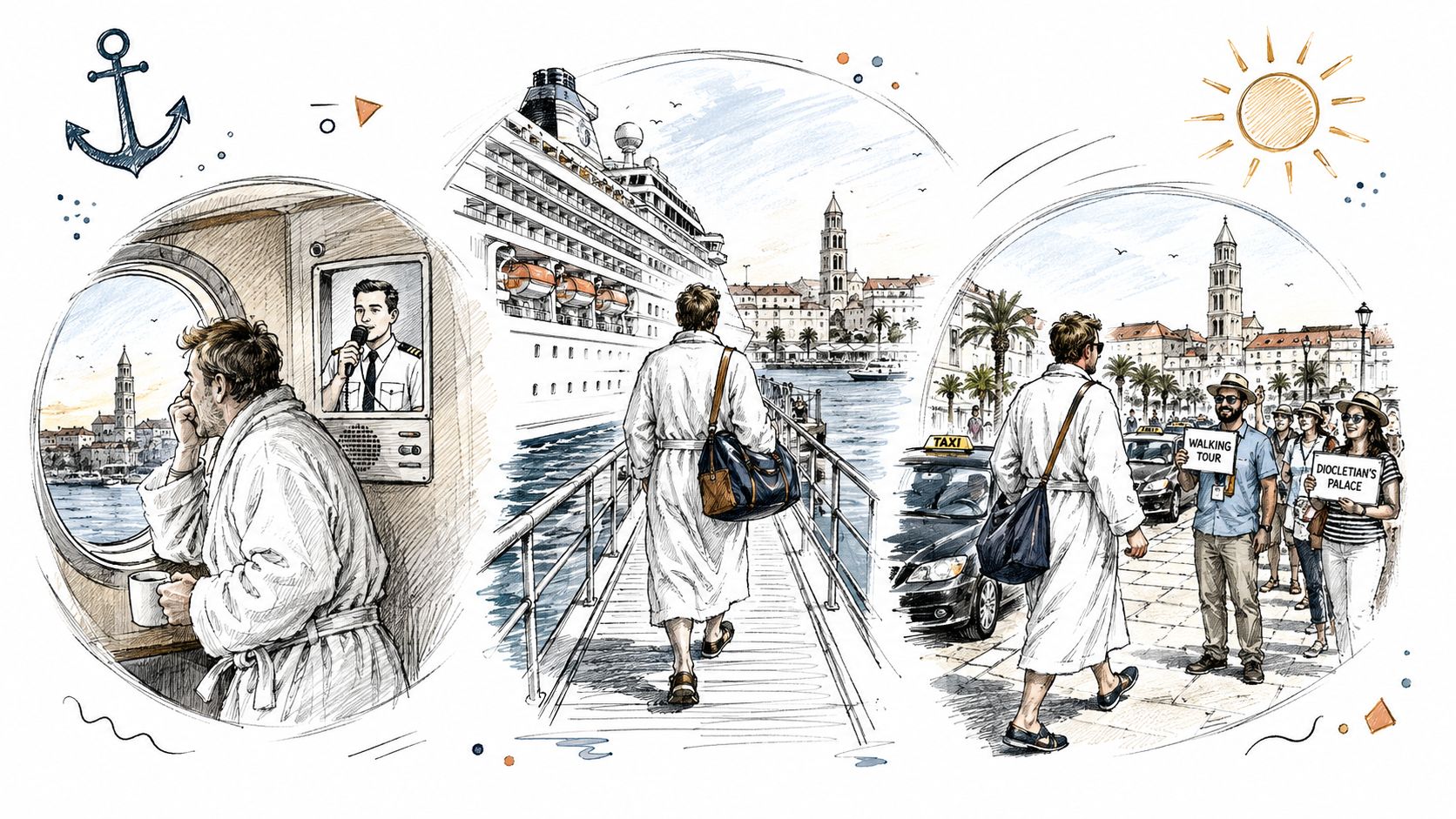
Your first decisions happen onboard
Start by checking the ship's daily program or app for the assigned berth, disembarkation instructions, and all-aboard time. If the notice is unclear, ask guest services before you leave the cabin. Don't rely on an old itinerary or a general port guide to confirm today's arrangements.
Then decide how quickly you need to be ready. If the ship is docked, you'll wait for clearance and the gangway announcement. If it's tendering, follow the ship's instructions about when to collect a tender ticket or report to the boarding area. Breakfast can be relaxed if you have time, but on a busy morning it helps to eat before the first wave of passengers heads to the gangway.
Pack your day bag while you're still in the cabin. Keep your phone, identification, any medication, water, and the ship's contact details together. A compact bag is easier to manage in a queue or on a tender than loose items in your hands.
From the announcement to the gangway
The first half-hour can include ship clearance, gathering in a designated lounge, waiting for a tender, or walking through the passenger terminal. Your ship's crew will direct the process. Leave elevators clear when you can, especially if passengers with mobility needs are waiting, and avoid heading to the gangway before your group is called.
Before stepping ashore: Confirm the return location as well as the departure route. The place you land may not be the exact spot where you expect to reboard.
Once you're off the ship, pause long enough to orient yourself. Check the quay or landing point, identify the route back, and note the time. That small reset makes the rest of the day feel less rushed.
Understanding Split Port Itineraries
Your itinerary pairs Split with Dubrovnik, Kotor or Hvar, and you're deciding which stop deserves a longer excursion. Start with the shape of the sailing: a Croatian loop keeps your visits focused on the Adriatic, while a broader Mediterranean voyage may place Split between a historic city call and an island destination.
The hours printed beside Split are the outer frame of your visit. Usable shore time fits inside that frame, after arrival procedures and before the required return time. Berth allocation, possible tendering and the concentration of ships on a busy day can change that window more than the distance to the Old Town.
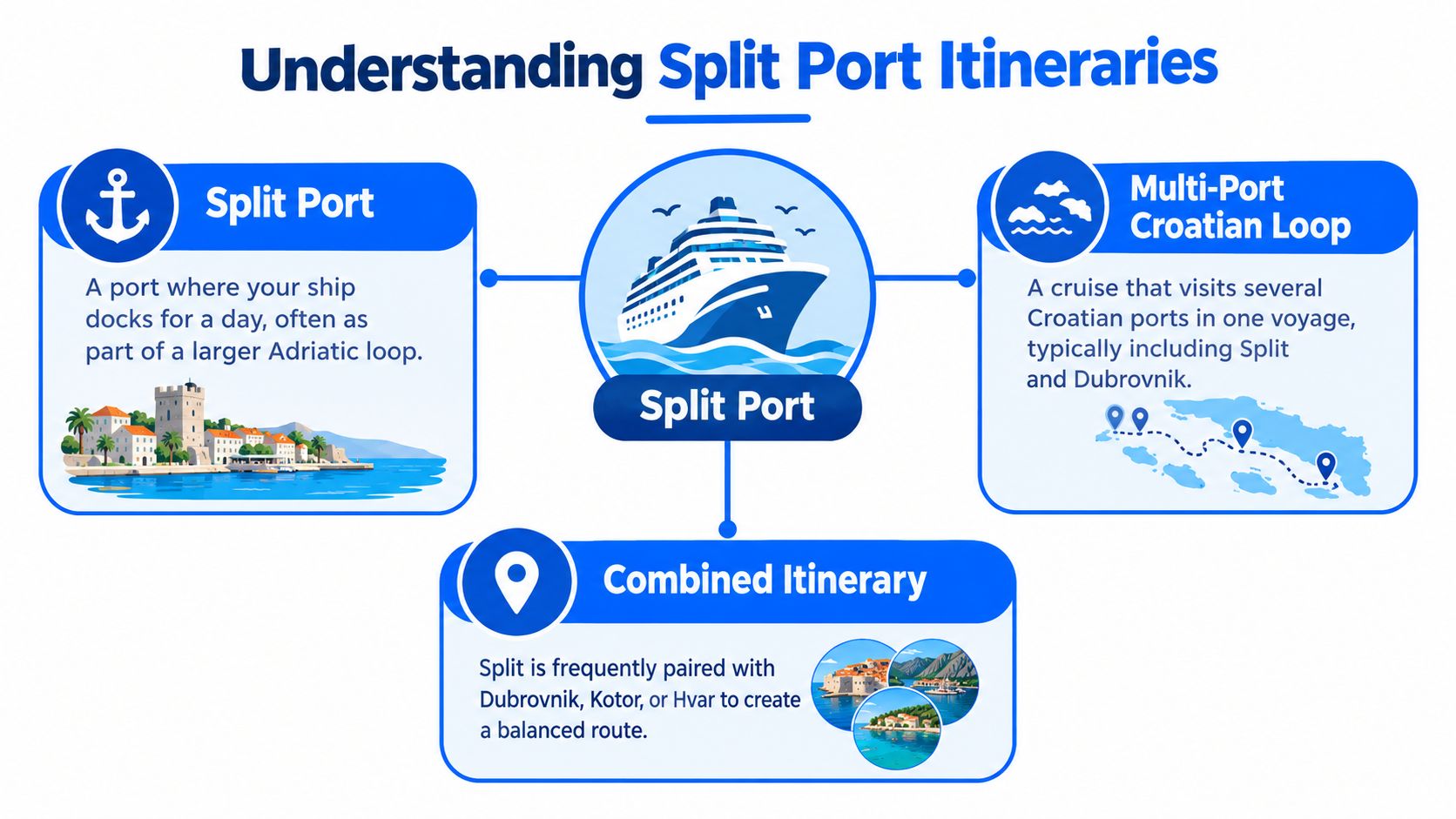
Read the shape of your sailing
Look at the stops around Split as well as the call itself. Several consecutive port days mean repeated departures, excursions and return deadlines; a sea day leaves you onboard without a shore schedule to manage. That rhythm can help you decide whether Split suits an ambitious outing or a gentler city visit. Your sailing documents provide the scheduled arrival and departure, while the onboard daily notice confirms the operating arrangements.
Allow some flexibility within those advertised hours.
Split shares its harbor with ferries and other passenger services. In 2018, total passenger traffic reached approximately 5.4 million, including 307,148 cruise passengers carried by 260 cruise ships, with cruise passengers representing about 5.7% of the total, according to this analysis of Split port traffic. Those figures describe the port's mixed role, rather than predicting the crowds on your particular visit. A scheduled call alone cannot confirm your berth or guarantee a quick start ashore.
Overnight stays versus a day call
An overnight stay offers a longer window and may allow an evening visit after the daytime rush. Check the overnight schedule in your booking confirmation against the daily program onboard, especially before arranging activities that depend on late access.
For a day call, build your outing around the time available after disembarkation, travel ashore and the return buffer. If you're comparing a ship-organized tour with an independent visit, this guide to planning cruise excursions explains the trade-offs. Choose an outing that leaves room for the arrival process to take longer than expected.
This video offers a visual introduction to the city and harbor:
Docking vs Tendering in Split
When a ship docks, it ties up at a berth and passengers leave by gangway. When it tenders, it anchors offshore and transfers passengers to shore in smaller boats. The view of the harbor might look similar from your balcony, but the steps and timing are different.
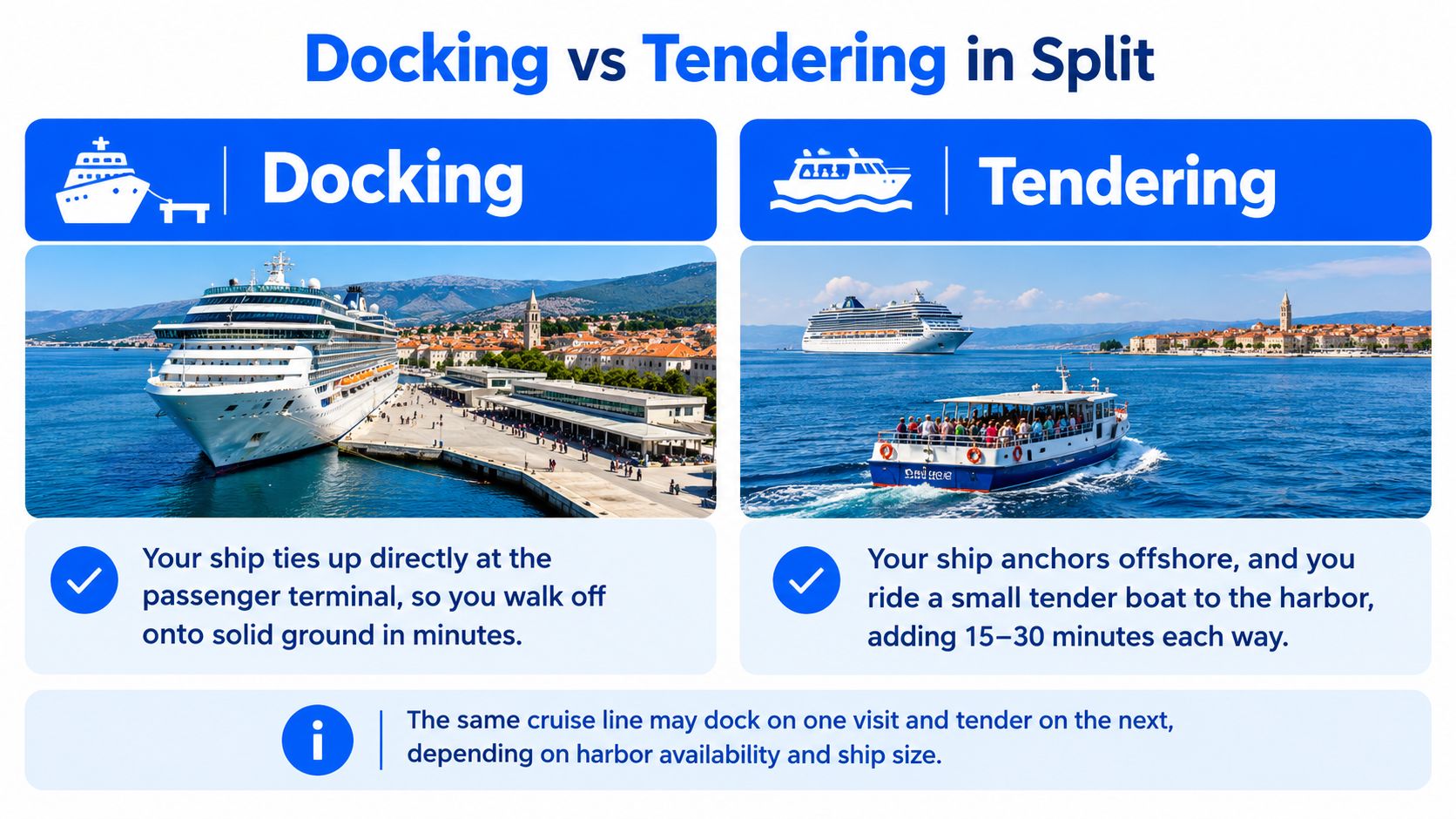
What docking changes
A direct berth usually makes the start of the day easier to understand: wait for clearance, follow signs or crew directions, and walk onto the quay. But “docked” doesn't automatically mean “at the Old Town entrance.” Split has multiple working berths and a busy harbor, so you still need to confirm your assigned quay and how you'll travel from it.
Split's port has an operational shoreline of approximately 3,643 meters across 27 berths, and it can accommodate ships up to about 320 meters long with drafts up to 10.5 meters. Its two principal cruise berths are approximately 265 and 245 meters long, with the capacity to handle a 320-meter and a 270-meter vessel at the same time, according to this study of Split port infrastructure. The port also serves ferries and regional passenger traffic, so berth availability and passenger movement can affect the experience.
What tendering changes
A tender adds a transfer between your ship and the shore. You'll need to follow the ship's boarding process, wait for a boat, and then do the same in reverse when returning. The planning guidance for Split flags that tendering can add roughly 30–45 minutes in each direction. Build that into your shore plan rather than treating the tender as a quick walk to the quay.
Don't assume your cruise line always uses the same method. Harbor availability and ship size can change the arrangement between visits. Read the port notice closely for wording such as “at anchor,” “tender required,” or a named quay. If the notice only says “Split,” ask guest services which landing point you should use and whether a tender ticket is needed.
A short walk on the map doesn't protect you from a long queue at the tender landing. Keep your return plan conservative.
Before heading into town, identify the correct return landing stage and take note of how the boarding area is marked. Returning to a nearby but incorrect pier can cost valuable time. If the ship's instructions change during the day, follow the updated notice rather than relying on what you saw earlier.
Reading Berth Logistics and Shore Access
The most helpful port detail isn't just the name “Split.” It's the assigned quay and the route from that quay to the Old Town. A central arrival may put you close to the Riva waterfront, while another berth or an anchor-and-tender arrangement can add a transfer before your walk begins.
Check the notice, then check the route
Look at your daily cruise program or app the night before arrival, and check again after the ship reaches port. Find the berth name, whether you'll dock or tender, and any instructions about shuttle buses or meeting points. If those details aren't clear, ask guest services or the port agent to confirm the actual passenger exit and return point.
Once ashore, locate the Riva, Split's waterfront promenade, and use it as your orientation line. The historic centre and Diocletian's Palace are close to the harbor area, but "close" doesn't mean every passenger's walk will be equally straightforward. You may need to work your way around terminal activity, parked vehicles, luggage, or ferry passengers before reaching a clear pedestrian route.
Don't mistake proximity for predictability
Split's passenger port handles ferries, regional services, and cruise operations. Its berth layout means ship size alone doesn't tell you whether a call will be convenient; simultaneous berth use, maneuvering space, and the flow of other port traffic matter too. The port infrastructure analysis notes that cruise operations share space with other passenger activity, making advance coordination important for passenger transfers and landside movement.
If you're meeting a tour, confirm the exact meeting point instead of assuming it's beside the gangway. For a taxi or shuttle, find out where vehicles are permitted to collect passengers and whether you need to walk to a designated pickup area. If a port notice seems vague, ask a specific question: “Which quay will passengers use, and where is the return point?”
For a traveler with a short call, a few minutes spent confirming the route can prevent a longer detour later. Allow extra time when the harbor feels busy, and follow signs and crew directions rather than trying to cut through vehicle or luggage areas. Your port-day plan should start with the exit you will use, not an idealized line on a map.
Crowding Patterns and Peak Ship Days
Split doesn't feel equally busy on every cruise day. A schedule listing a small number of ships can still mean a crowded Old Town if the vessels bring large passenger groups at once. For visitors, the useful signal is passengers per call and overlapping arrival times, not just how many ships are visible.
One listed Friday had about 8,399 passengers and crew from two ships, compared with a 120-day Friday average of 1,761 and a Monday average of 546, according to the Split cruise-port schedule. Treat those figures as an example of how sharply daily demand can vary, not as a promise about the day you'll visit.
What larger calls mean on the ground
A long-term analysis found that the average number of cruise passengers per call rose from approximately 475 to 1,273, while the number of annual calls showed no significant trend after 2008. The same analysis of passenger loads per call points to a practical pattern: passenger surges can grow even when ship-call totals don't rise in parallel.
That concentration affects ordinary choices. A busy arrival window can mean more people moving along the waterfront, waiting for transport, and entering popular parts of the historic centre. If your schedule is flexible, consider visiting the Old Town earlier, eating outside the busiest rush, or choosing a quieter waterfront break while tour groups are moving through the central lanes.
| Scenario | Ships | Passengers and Crew | Crowding Impact |
|---|---|---|---|
| Listed high-load Friday | 2 | About 8,399 | Expect concentrated movement around arrivals and popular shore routes |
| Friday reference average | Not specified | About 1,761 | A lower comparison point, not a guarantee of light crowds |
| Monday reference average | Not specified | About 546 | A lower listed average; check the live schedule before deciding |
Turn the schedule into a simple forecast
Check the ship schedule before arrival, then look at the timing as well as the passenger estimates. If several large groups are likely to reach the waterfront together, make the palace your first stop or choose a route that avoids repeated crossings of the busiest areas. If you prefer a quieter pace, stay near the waterfront until the initial wave has moved inland.
Don't decide on an inland excursion solely because you're worried about crowds. Leaving town adds transport and return-time considerations of its own. For a short call, a relaxed in-town plan may be safer and more rewarding than an ambitious trip that depends on several moving parts. Use the schedule as a planning clue, then adapt to what you see once ashore.
Shore-Time Strategies for Every Traveler Type
Your best plan depends on how much uncertainty you're comfortable with. Independent travelers may want to avoid a group tour, families need room for pauses, and visitors with limited mobility often benefit from keeping the route simple. All three can enjoy Split more by choosing a plan that respects the ship's return process.

Independent cruisers
If you're going ashore on your own, check the berth and return point before setting off. Start with the waterfront and Old Town while your energy and time are fresh; add an inland outing only if your port window, transport arrangements, and return margin make it realistic. For a tender day, avoid leaving your return until the final boat or the busiest boarding period.
Bring only what you need. A packable beach tote can help keep day essentials together without adding a bulky bag. Keep your phone charged enough to check ship updates and transport information.
Families
With children, plan a flexible morning rather than a checklist of sights. A waterfront breakfast or snack stop can be a gentle start, followed by a short Old Town loop and a break before deciding whether to continue. Keep water, snacks, and any comfort items within easy reach so you aren't forced to search for them in a crowd.
If you're tendering, ask the crew about boarding arrangements and whether the tender is suitable for your group's needs. Don't count on being able to board at the last moment with a tired child, stroller, or multiple bags. Return early enough to handle a queue calmly.
Travelers with mobility needs
Ask the cruise line in advance about tender accessibility and the specific berth. A gangway, tender boat, cobbled lane, and busy curb each create different challenges, so request practical details rather than relying on a general statement that the port is walkable. If tendering is difficult or boarding conditions don't feel safe, speak with the ship's staff before leaving.
Choose a compact itinerary with seating breaks and a clear route back. Skip optional detours if crowds or surfaces make progress tiring, and confirm transport arrangements before committing to an attraction farther away. Your plan should preserve energy for the return as carefully as it preserves time.
Pre-Cruise Planning Checklist
Your Old Town route may be ready while your landing point remains uncertain. Split's working-harbor role, described in the Split passenger-traffic analysis, makes shore access the starting point for planning. A berth assignment works like a departure gate: check the latest ship information before committing to transport.
The night before your call, check each item:
- Confirm the berth type: Check whether you'll dock or tender, which quay or landing point you'll use, and whether arrangements remain provisional.
- Pack a small day bag: Keep shore-day items together so you can leave when your group is called.
- Arrange transport ahead: If booking a taxi or inland excursion, confirm where to meet and what happens if disembarkation is delayed.
- Protect your return margin: Follow the ship's all-aboard deadline. A personal target of 45 minutes before scheduled sailaway is only suitable if it also precedes that deadline.
- Choose a Plan B: Keep a nearby café or short waterfront stop as an alternative if delayed shore access leaves less sightseeing time.
- Make the morning comfortable: A Rechargeable Cruise Fan with Magnetic Hook to Hang on Cruise Walls & Ceilings is a compact, rechargeable airflow option for a cabin, with timer and multiple speed settings on selected models.
These tips for first-time cruisers cover broader preparation. Budget return-transfer time before sightseeing time.
Nordmoose offers compact cruise-cabin accessories, including rechargeable fans and magnetic organizers for limited stateroom space. Choose gear around your cabin and shore-day needs.