

Cruise Port for Florence: Livorno, Transfers and Timing
Florence has no cruise port, so your ship docks at Livorno about 80-95 km away, and the train from Livorno Centrale to Florence Santa Maria Novella takes about 80-100 minutes before you add any transfers. That's the fact most itinerary pages bury, and it's why the popular advice to just hop off and see Florence is wrong for a lot of port days. You don't have a walk-off city. You've got a secure commercial berth, a shuttle, a station transfer, and a regional train, then the same chain in reverse against a fixed all-aboard time. Plan the full door-to-door trip, not the train leg, and you'll know whether Florence is a good use of your day or an expensive rush.
Table of Contents
- Why Livorno Is the Cruise Port for Florence
- Door-to-Door Transfer Chain From Ship to Florence
- How Much Time You Really Get in Florence
- Ship Excursion or Independent Train Compared
- Luggage, Timing and Access Checks for Port Day
- Decide Whether Florence Fits Your Port Day
Why Livorno Is the Cruise Port for Florence
Your ship isn't docking in Florence, no matter what the itinerary headline implies. Florence is inland and has no seaport. Cruise lines sell the call as Florence because that's the destination you want, but the ship berths at Livorno, and Livorno is a working commercial port, not a city-centre terminal where you step off into sightseeing.
The numbers that govern your day are straightforward. Livorno is the principal cruise gateway marketed as the port for Florence, with Florence lying approximately 80-95 kilometers inland and a typical rail journey of about 80-100 minutes to Florence Santa Maria Novella. Use about 90 km as your working reference if you need one figure. That distance alone tells you this is a full-day excursion, not a morning wander.
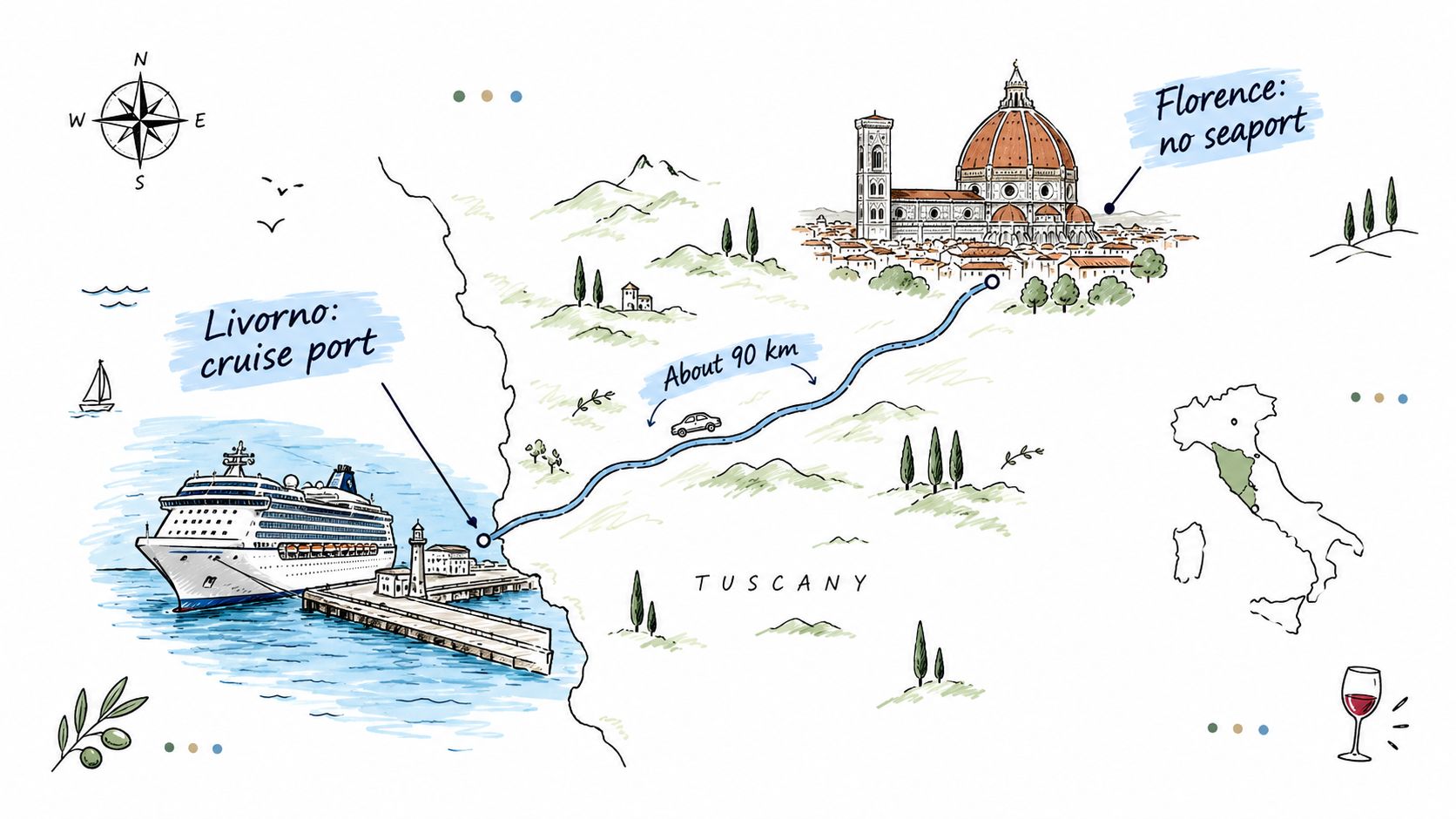
A real cruise port, not a tender stop
Livorno handles serious volume, so expect real port operations, queues, and shuttle logistics rather than a quiet pier. Recent port reporting records Livorno handling 864,133 cruise passengers in 2024, and the port already exceeded 1 million passengers in 2012. On a multi-ship day, that scale is exactly why you can't assume you'll be on the first shuttle or the first train.
Don't confuse that scale with convenience. A busy port means more excursion coaches, more independent travelers aiming for the same morning trains, and more pressure on the same station links. If you're comparing this call with a walkable Adriatic stop like the experience at Split cruise port, the contrast matters. Livorno's job is regional access to Tuscany. Your job is managing the transfer.
Pisa is closer, but it isn't Florence
Pisa gives you a legitimate fallback when Florence doesn't fit. It's a much shorter rail hop, so you keep most of your day for sightseeing instead of transit. Treat it as a different destination with its own payoff, not as a consolation version of Florence and not as a quick add-on you can squeeze in without recalculating your return.
Carry these three facts into every decision that follows:
- Port name: Livorno, not Florence
- Distance to Florence: About 80-95 km inland
- Rail time to Florence Santa Maria Novella: About 80-100 minutes, before transfers
Door-to-Door Transfer Chain From Ship to Florence
Do this in order, and don't skip a leg when you estimate your arrival. Every handoff is a place where you can lose time, and the return direction is less forgiving because the ship won't wait for an independent traveler.
The visual below maps the first part of the chain, from disembarkation through the restricted berth to onward travel.
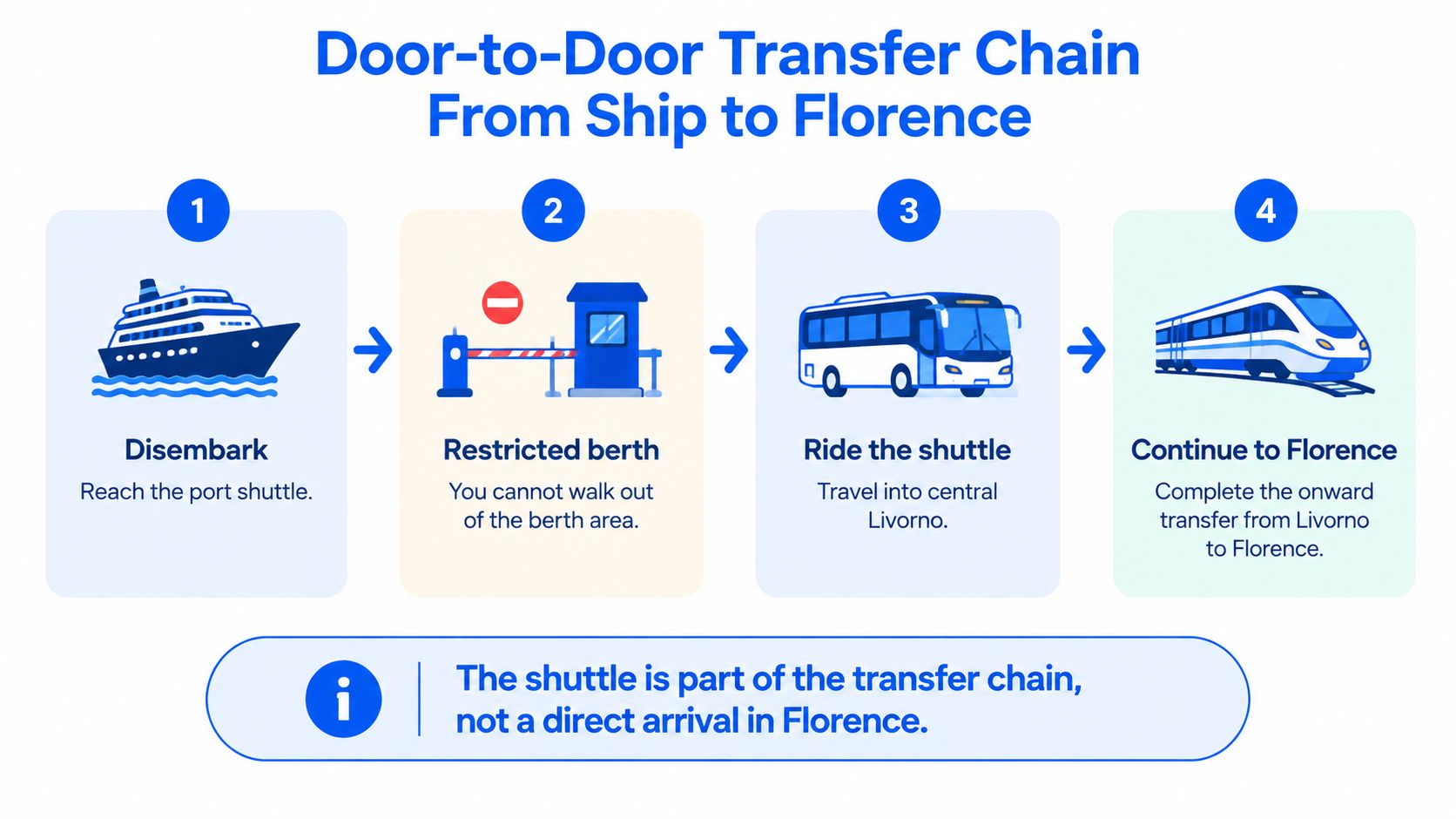
The five legs in travel order
1. Ship to port shuttle. You disembark into a restricted commercial area. You generally can't walk out of it on foot, so your first task is finding and boarding the correct shuttle. If you're late off the ship, you're already behind before you've left the port.
2. Shuttle into Livorno, then to Livorno Centrale. The shuttle gets you into the city's transport network, but don't assume it drops you at the station door. You may still need a taxi or local bus for the final link. This is the leg people forget when they quote train times to each other over breakfast.
3. Regional train to Firenze Santa Maria Novella. The port is a secure commercial area about 90 km from Florence where passengers generally must use a shuttle, and the train takes roughly 72 minutes on the fastest services and about 80 minutes on typical services. Board the right train, validate or activate your ticket as required, and note the return departure you'll target before you even sit down.
4. Station waiting time. Ticket machines, platform changes, and a just-missed departure all live here. Waiting isn't wasted planning, it's part of the trip time whether you budget for it or not.
5. Santa Maria Novella to the centre. You still need to get from the station to the sights you've booked. Add that walk or taxi ride to your arrival estimate, especially if your first entry is timed.
Where each leg fails
| Leg | What Happens | Typical Time | Watch For |
|---|---|---|---|
| Ship to port shuttle | Disembark and board the shuttle, since walking out of the berth is not allowed | 15-30 min (planning estimate) | Queues at peak arrival times |
| Shuttle to Livorno Centrale | Port shuttle or taxi into the city transport network | 10-15 min | Shuttle may be full; have a taxi fallback |
| Livorno Centrale to Firenze Santa Maria Novella | Regional train | 72-100 min | Fastest service about 72 min, typical about 80 min |
| Station to city centre | Walk or taxi | 15-20 min | Assistance may be needed for luggage or mobility |
| Station waiting time | Buffer before departure | 10-30 min | Ticket queues and platform changes |
| Total one way | Full chain from ship to city | 100-140 min | Depends on connections |
| Total round trip | Both directions | 200-280 min | Add buffer before the return ship deadline |
This video gives you a useful sense of the route before you're trying to read departure boards under time pressure.
Practical rule: Book your return train in your head before you book your first museum slot. The return deadline controls the whole day.
How Much Time You Really Get in Florence
Start with subtraction, not with a sightseeing list. Take your advertised port call, remove round-trip transit of about 3.3-4.7 hours as a planning estimate, then remove a 30-60 minute return buffer for delays and queues. What's left is your Florence time. If that remainder disappoints you on paper, it'll feel worse on the day.
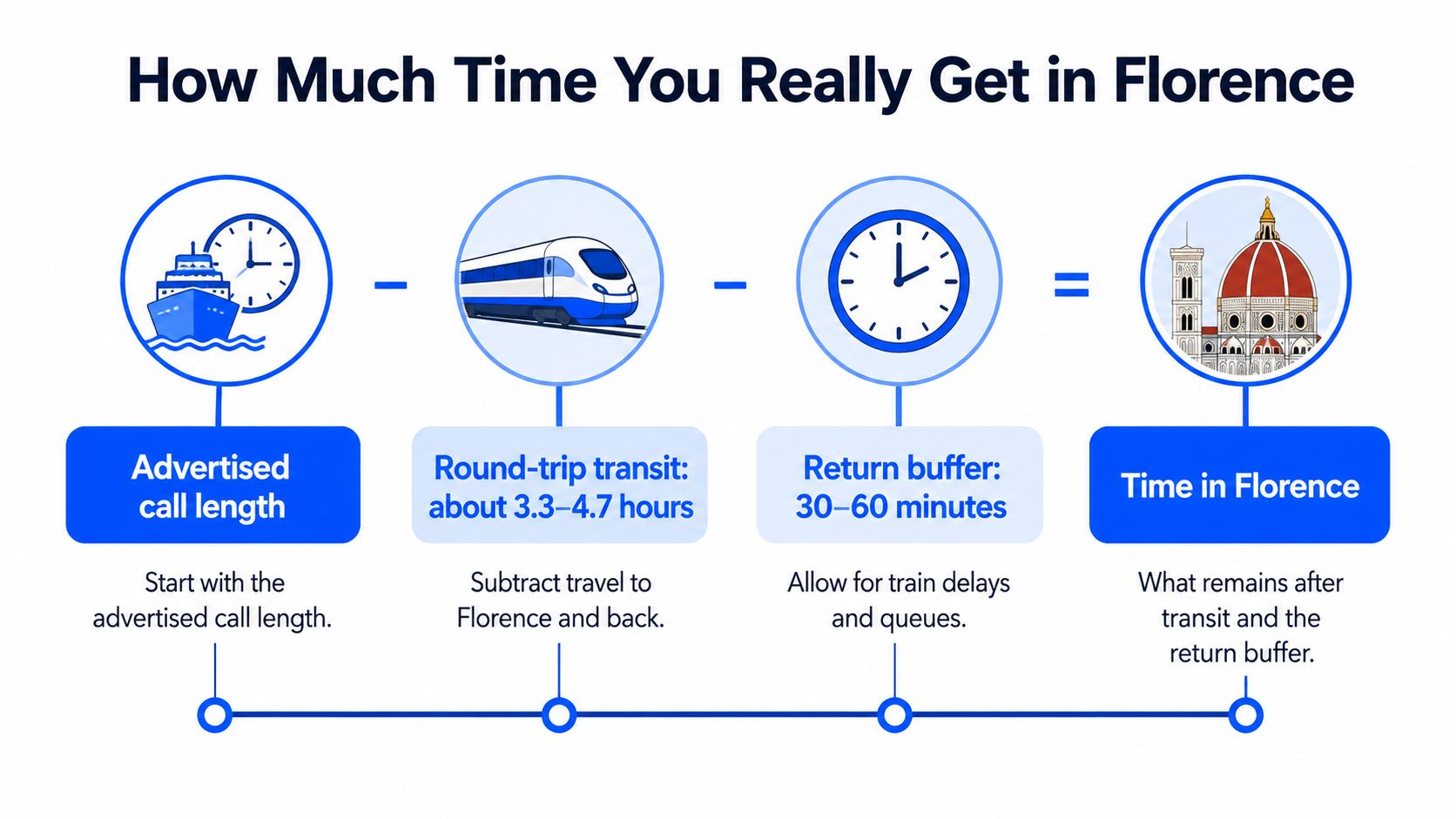
One worked example
Say your ship docks at 07:00 and you're realistically off and moving by 08:00, after disembarkation and the shuttle queue. With the station link, waiting time, the train, and the walk into the centre, you reach central Florence at about 11:00. That's not pessimism. That's the chain from the previous section running normally.
Now work backward from the ship. If all-aboard is 17:30, you should be clearing back through the port process at about 16:50, which means leaving Florence at roughly 15:00. That gives you from 11:00 to 15:00 in the city, and the 40 minutes between port arrival and all-aboard is your buffer. Don't spend that buffer on one more sight. It's the margin that absorbs a late train.
A 9-10 hour port call typically leaves only about 4-5 usable hours in Florence once transit and a conservative return buffer are counted.
Read your call length honestly
| Port Call Length | Time Deducted | Usable Time in Florence |
|---|---|---|
| 8 hours | About 3.8-5.7 hours for transit and buffer | About 2-4 hours |
| 9 hours | About 3.8-5.7 hours for transit and buffer | About 3-5 hours |
| 10 hours | About 3.8-5.7 hours for transit and buffer | About 4-6 hours |
| 11 hours | About 3.8-5.7 hours for transit and buffer | About 5-7 hours |
Use the table before you buy timed entries. A museum booking at 11:30 sounds safe after an 11:00 arrival in the centre, but only if you've counted the walk from your arrival point, the entry queue, and bag checks. If the booking is across town from your arrival point, it isn't safe. Book later, book closer, or don't book it at all.
My recommendation is simple. Pick one major timed sight, build unstructured time around it, and protect your departure from Florence. Travelers who stack two distant timed entries into a four-hour window usually spend the day watching the clock instead of the city.
Ship Excursion or Independent Train Compared
Missed-ship risk is the difference that matters most, and it's where the two options split sharply. A ship excursion costs more per person, but the coach, the guide, and the return coordination are handled for you. Independent travel can cost less, but you own every link, and one missed connection on the way back can leave you watching your ship from the quay.
The independent route is a multi-stage transfer with a rail segment commonly about 68-100 minutes and a complete trip of roughly 100-140 minutes each way, while organized excursions cost more but reduce coordination risk. That framing should drive your choice. You're not choosing between a coach and a train. You're choosing who carries the risk when something runs late.
| Factor | Ship Excursion | Independent Train |
|---|---|---|
| Transfers you manage | None; coach and guide handle the links | Shuttle, city transport, train and station walk |
| Cost | Higher per person | Lower, plus rail tickets and taxis |
| Usable time in Florence | Set by the tour schedule | Set by your return train; about 3-5 hours on a 9-hour call |
| Missed-ship risk | Lower; the tour holds the return | Higher; one missed connection can strand you |
| Accessibility coordination | Arranged through the cruise line | You book shuttle and station help in writing |
| Itinerary flexibility | Fixed stops | Full control of museums and lunch |
| Best for | First-time cruisers, tight schedules, mobility needs | Confident planners with long port calls |
If you book the ship excursion
Don't just pay and relax. Confirm in writing that the tour returns with a clear margin before all-aboard, and ask where the coach drops you, at the station side of the city or closer to the centre. Those two answers decide how much walking you'll do and whether a timed museum entry fits.
Keep the excursion voucher and the ship's port card saved on your phone, with a screenshot that works offline. If you're weighing how cruise lines structure these products, this overview of Carnival cruise excursions shows the kind of inclusions and meeting-point details worth checking before you commit.
If you go independent
Write down your return train before you choose your first museum slot, and identify one earlier train as your fallback. The fixed train times set your day, not your wish list. Independent travel rewards confident planners on long calls. It punishes anyone who treats the return as something they'll figure out after lunch.
Luggage, Timing and Access Checks for Port Day
Run this checklist the night before, not at the gangway. Most port-day problems are small items left in the cabin or assistance that nobody confirmed.
The night-before checklist
- Confirm all-aboard in writing: Get it from the ship's daily program or guest services, not only from the app, because that time sets every return decision you'll make.
- Save documents offline: Keep your excursion voucher, passport copy, train details, and the shuttle return point on your phone without needing a signal.
- Take a day bag only: Large suitcases make the shuttle, the station, and train boarding harder, and you don't need them for a port day.
- Tag and photograph your bag: Put your name and cabin number on it and take a photo before you go ashore, so you can describe it precisely if it's misplaced.
- Pack light for dark cabins: A small torch or headlamp helps during pre-dawn departures. One compact option is the Magnetic Motion Sensor Night Light for Cruise, a rechargeable magnetic light with motion sensor auto mode and always-on mode, offered in 1-pack, 2-pack, or 3-pack variants for cabins, bathrooms, and hallways.
- Book accessibility help in advance: If you use a wheelchair or walker, arrange an accessible shuttle plus station assistance at both Livorno Centrale and Firenze Santa Maria Novella, and get each booking confirmed in writing.
- Plan a taxi fallback: Allow extra time for elevators and boarding, and know how you'll reach the station if the shuttle is full.
A reusable traveling packing checklist keeps steps 2 through 5 from depending on your memory the night before an early start.
Mobility handoffs, in order
This route is possible with mobility limitations, but it isn't simple. Guidance for this port notes that passengers at the commercial cruise berth may be prohibited from walking or rolling through the port and must arrange an accessible shuttle in advance, then accessible city transport and station assistance at both ends. Count the handoffs before you commit: accessible shuttle, Livorno city transport, Livorno Centrale assistance, train boarding, Florence station assistance, then the same sequence in reverse.
The commercial cruise berth is not the passenger-ferry port, and arrangements that work at one may not apply at the other. Confirm which area your ship uses. A companion changes the plan for the better, since one person can manage tickets and doors while the other manages the chair. A folding wheelchair gives you more taxi options if an accessible vehicle doesn't show, but only if you can transfer safely.
Don't ask whether Florence is accessible in general. Ask whether your ship, berth, shuttle, station, train, and return schedule work together for your specific needs, and get the answer in writing.
If any single handoff can't be confirmed, switch to the organized excursion. That's not giving up. That's choosing the option where one operator owns the chain.
Decide Whether Florence Fits Your Port Day
Here's my verdict. Go to Florence independently only if your port call is 10 hours or more and you're comfortable managing transfers alone. Otherwise, take the organized excursion, go to Pisa, or stay in Livorno. A shorter, calmer day beats a famous city seen at a run.
Run three tests
Time ashore comes first. Ten hours or more makes an independent day workable. Nine hours is borderline, with roughly three to five usable hours if everything connects. Under eight hours, the transit eats the day and Florence isn't worth the risk.
Berth and shuttle come second. Confirm that you're at the commercial berth, where the shuttle picks up, and whether it runs at your arrival and return times. If you can't confirm the shuttle, you don't have a plan, you have a hope.
Mobility and risk tolerance come third. If you need assistance at any handoff, or you can't absorb the cost and stress of a missed connection, book the organized excursion. Confidence isn't a personality trait here. It's whether you've handled multi-leg regional rail travel under a deadline before.
Apply it to your situation
A confident independent traveler on a long call should go, book one major sight, and protect the return. A first-time cruiser on a nine-hour call should take the excursion or choose Pisa, where the shorter trip leaves a real sightseeing day. Anyone with mobility needs and unconfirmed assistance should let the cruise line coordinate. A short call should stay in Livorno and enjoy it properly.
Your next step takes ten minutes. Check your port schedule and all-aboard time, write down your return train before your first museum slot, and confirm any assistance in writing. Do that tonight, and tomorrow's decision is already made.
Before your Livorno morning starts in the dark, sort the cabin basics that make early port days easier, from compact magnetic night lights for safe movement to organizers that keep documents and chargers where you can grab them fast. Browse the cruise cabin range at Nordmoose and pack for the transfer chain, not just the destination.