

TSA Approved Luggage Tags: What the Label Really Means
TSA does not approve or certify luggage tags, so a tag labeled TSA approved carries only the seller's claim. The term TSA-accepted applies to certain locks, not tags.
Why, then, do so many tags carry the badge as if screeners require it? That confusion leads travelers to pay for a label instead of judging the things that actually help a bag come home, its attachment, its legibility, and the information it shows strangers.
Table of Contents
- What TSA Approved Means and Whether Tags Need It
- Luggage Tag Types Ranked for Durability and Recovery
- What to Show on Your Tag and What to Keep Private
- How to Set Up Your Tag Before You Fly
- What to Do If Cruise Luggage Goes Missing
- Choose the Right Tag Setup for Your Next Cruise
What TSA Approved Means and Whether Tags Need It
Does a luggage tag need TSA approval to help your bag reach a cruise ship? No. TSA accepts certain locks, not luggage tags. A tag marketed as TSA approved luggage tags does not have a tag certification for you to verify.
A TSA-accepted lock serves a different purpose. Screeners can open accepted designs with a master key or universal tool during inspection. If a lock cannot be opened that way and officers need access, they may cut it. Acceptance affects access to the bag, not its identification.
Four labels people mix up
| Item | Who issues the mark | What it means | Does it change handling? |
|---|---|---|---|
| TSA-accepted lock | TSA design acceptance | Screeners can open it with a master key or universal tool | Secures the bag; does not identify it |
| Luggage tag marketed as TSA approved | Seller marketing | No TSA certification exists for tags | No; judge it on material and information design |
| Airline bag tag | Airline and IATA standards | Routing and tracking label with a barcode | Yes; must stay visible and unobstructed |
| Personal ID tag | Owner | Name and contact details for recovery | Supplements the airline tag, does not replace it |
The airline tag works like a parcel's routing barcode: machines use it to sort and route the bag. Your personal tag is more like a return address, giving a person a way to contact you if the barcode is damaged or no longer useful.
Whether a tag needs approval
It does not. TSA authority covers screening, inspection access, and security procedures. Baggage identification involves airlines, airports, and passenger information, as described in the Department of Homeland Security baggage screening fact sheet. A personal tag works alongside the airline label and screening process, but no approval label guarantees correct delivery.
The scale of screening helps explain why a backup contact method can be useful. The Department of Homeland Security baggage screening fact sheet reports that the Transportation Security Administration screened approximately 904 million passengers and 500 million checked bags in 2024. Bags pass through many hands, belts, and transfers on the way.
For a cruise connection, focus on the tag's job, not a dramatic lost-bag scenario. If part of an airline label is torn or obscured by rain and friction, a securely attached personal tag with a legible name and mobile number gives staff another way to identify the owner. At a cruise port, that contact may help if a bag is separated from its airline routing information before pier delivery.
A phone call does not replace the airline's tracing record. It gives a person another route to reach you while the carrier uses its own data. A contact card inside the suitcase can provide a backup if the outside tag comes off.
Practical rule: Check a lock for TSA acceptance. Choose a tag for secure attachment, readable contact details, and privacy: show a name and useful contact method, not information a recovery agent does not need.
Luggage Tag Types Ranked for Durability and Recovery
The infographic below ranks seven types against three purchase criteria you can check in your hand.
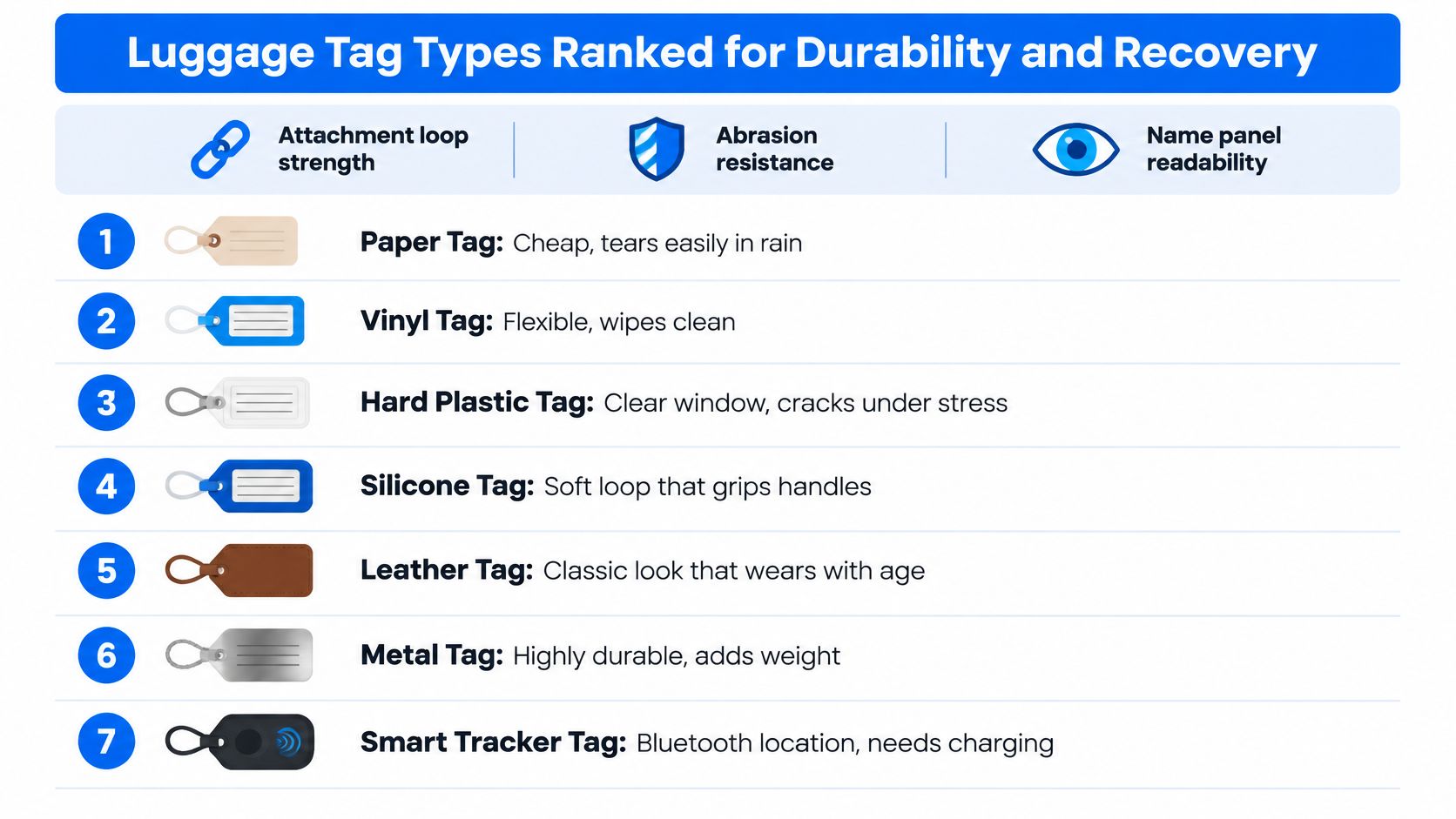
Test every candidate for attachment loop strength, abrasion resistance, and a name panel that stays readable after months of handling. Decorative shape matters less than whether the loop survives a conveyor snag and the printing remains clear after rain and friction.
| Tag type | Strengths | Weaknesses | Best for |
|---|---|---|---|
| Hard plastic with clear window | Rigid, easy to read, inexpensive to replace | Can crack; window can fog or collect grime | Frequent flyers who want a clear name panel |
| Flexible silicone loop | Quiet on conveyors, does not snag on straps | Name area is often small | Soft-sided bags and bags with many straps |
| Leather or woven strap | Soft on handles, attractive appearance | Can fade, stretch or tear under strain | Style-led buyers and lighter loads |
| Stainless steel or metal tag | Very durable, hard to tear away | Heavier; can scratch hard-shell cases | Bags that take rough handling |
| Privacy-flap tag with concealed card | Hides address and phone from passers-by; spare card inside | Flap can lift open or stick | Privacy-conscious travelers |
| QR code tag | Links to a current contact profile | Useless to a recovery agent without a scanner or signal | Only as a supplement to printed text |
| Bluetooth tracker tag | Live location through nearby phones | Battery upkeep; signal depends on nearby devices; airline rules vary | Travelers who need location, not only identity |
A clear-window hard tag suits a frequent flyer because the insert can be printed large and replaced when it fades. A silicone loop grips a thin top handle without adding a rigid edge that catches neighboring straps. Stainless steel is the sensible overkill for a bag that regularly gets dragged, stacked, and handled roughly.
Redundancy matters because low rates still affect many people. The IATA Resolution 753 implementation guide is cited with U.S. transportation figures of approximately 2.72 million mishandled bags among about 494.28 million enplaned bags, which works out to about 0.55 mishandled bags per 100 enplaned bags. The guide identifies the airline's ten-digit bag-tag number as mandatory for recording tracking points, and that operational number belongs on the carrier's tag, not copied onto your consumer tag in advance.
Use printed text as the primary identifier. A QR code should never stand alone because recovery staff may work offline, lack scanning access, or face damaged printing. Pair large, high-contrast name, mobile, and email details with a protected QR code only if you want a second path.
- Pull the loop firmly: It shouldn't slip, stretch pale, or work loose from the handle.
- Read the panel at arm's length: If you squint indoors, an agent won't read it across a baggage room.
- Check the barcode path: Your tag and strap mustn't cover the airline label after check-in.
While packing compact cabin items, travelers may also carry a Magnetic Motion Sensor Night Light for Cruise, a rechargeable magnetic light with motion sensor auto mode, an always-on mode, dimmable brightness, multiple color options, and 1-pack, 2-pack, or 3-pack choices.
What to Show on Your Tag and What to Keep Private
Show the minimum on the outside. A name, one mobile number, and an email address give a recovery agent enough to reach you without turning the tag into a public travel profile.
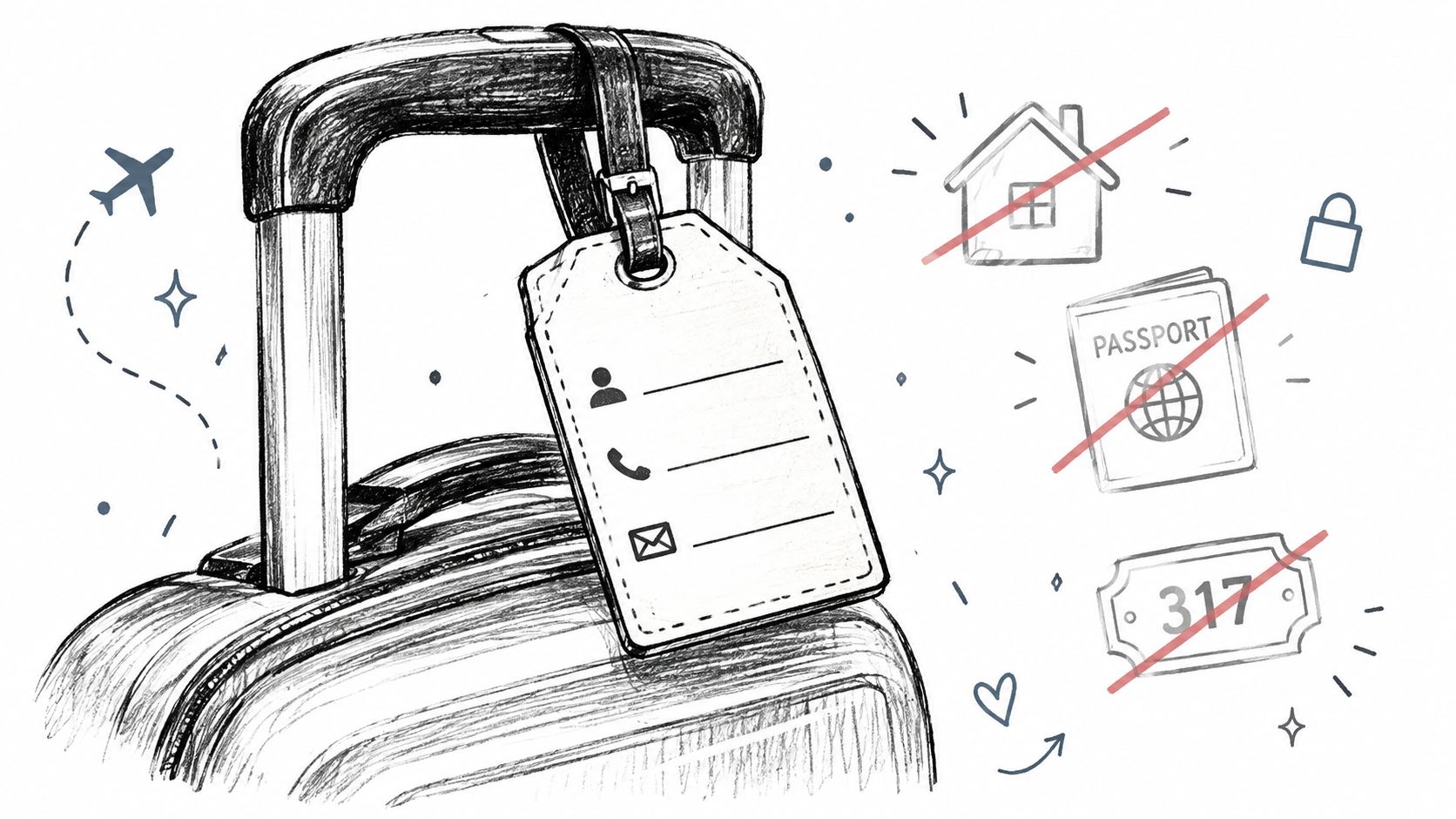
Leave off your full home address, passport details, cabin number, and full itinerary. Those details tell anyone nearby where you live, that you're away, and where you're heading next. A privacy flap helps with casual viewing, but anyone handling the bag can open it, so keep even concealed information limited.
Put richer recovery details on a card inside the bag. Include a second phone number or emergency contact, your cruise line and ship, sailing dates, and, after check-in, the airline bag-tag number from your receipt. That card helps staff confirm ownership if both exterior labels disappear.
The tag should function as a durable supplemental identification device with a highly legible panel, while airline-issued interline tags follow standardized processes under the IATA baggage standards. IATA guidance also says checked baggage should carry exterior identification when it lacks the passenger's family name and initials, and baggage tags must be adequately secured for ordinary transportation. Keep the airline barcode unobstructed when you add your own identification.
QR codes and trackers
Point a QR code to a page you control that displays only the contact details you choose. Test it from a phone that isn't signed into your accounts, because a finder gets the public view, not your account view. If the page exposes your address or travel dates, trim it before you leave.
Bluetooth trackers add location, but they also bring an account tied to your phone, shared-device and unknown-tracker alerts, battery upkeep, and carrier rules you need to check. Turn off sharing you don't need, leave unknown-tracker alerts on, and treat the tracker as a supplement to printed contact information. Travelers organizing documents for embarkation can also review guidance on keeping cruise ship cards accessible during port days, since cards, receipts, and bag references are easiest to use when kept together.
Read the finished tag as a stranger standing in a terminal would. Remove anything that stranger shouldn't know.
How to Set Up Your Tag Before You Fly
The process graphic shows the basic sequence, from printing the panel to testing the fit.
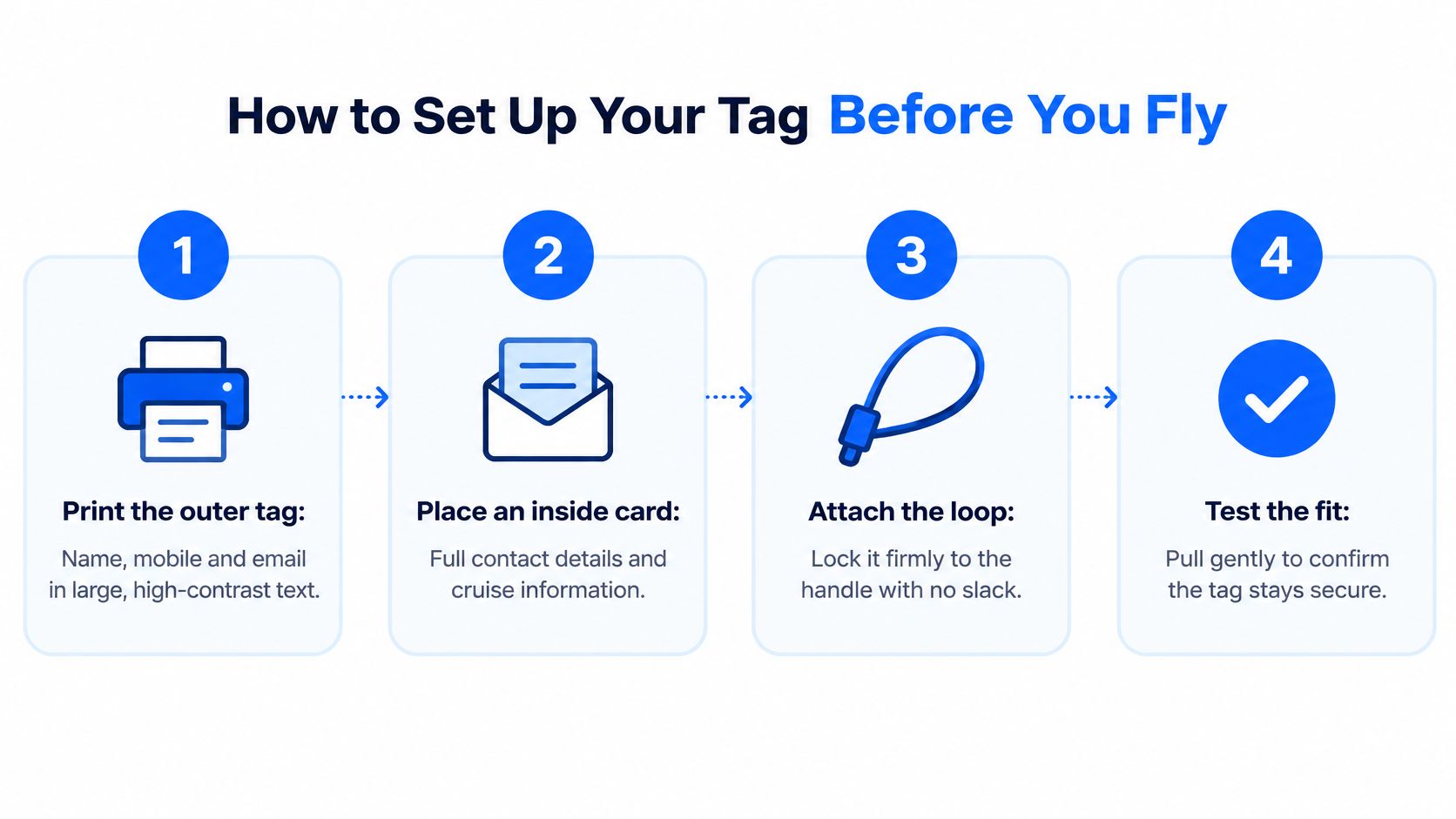
Work through these steps at home, where you can reprint a card or replace a weak strap without standing at a check-in counter.
- Print the outer panel: Use your name, mobile number with country code, and email in large, high-contrast text. Handwriting that looks clear on a desk may blur after moisture touches it.
- Place a detailed card inside: Add full contact details, cruise line, ship, sailing dates, and an emergency contact near the top of your belongings. This is the backup if the external tag tears away.
- Attach it to a reinforced fixed handle: Pass the complete tag through a flexible loop, or buckle the strap snugly around the top or side carrying handle. Don't use a telescoping handle, zipper pull, wheel housing, or lock.
- Keep the airline barcode uncovered: Do not wrap your strap or tag across it. Automated sorters need a clear read, and this is the most frequent setup error.
- Photograph both tags and the bag: Save the photo and note the airline's ten-digit bag-tag number on your phone. You'll describe the bag faster and more accurately if it doesn't appear.
- Keep paper evidence in your carry-on: Carry the boarding pass and baggage receipt with you, not in the checked bag they may be needed to trace.
- Add the cruise line tag at the pier: Use its tag for cabin delivery and keep your personal tag attached as backup. Both can ride on the handle if neither covers routing information needed by port staff.
For a loop or buckle demonstration, the linked visual guide on how to attach a luggage tag to a fixed handle shows placement choices in more detail. The video below gives another look at checking the finished attachment before travel.
Finish with a home test. Pull firmly from the front, back, and sides, then extend and retract the trolley handle and lift the bag by its fixed grip. If the tag shifts, hangs far enough to snag, traps a moving part, or shows fading print, replace the strap or panel before the trip.
What to Do If Cruise Luggage Goes Missing
Start the recovery process at the airport: contact the airline, file a report, and give staff clear details before leaving the arrival area. A missing bag is often delayed rather than permanently lost, and a tag can help an agent connect the suitcase to you when its journey goes off course.
The U.S. Department of Transportation Air Travel Consumer Report reported that airlines handled 45.7 million bags in December 2024 and recorded a mishandled-baggage rate of 0.60% that month. The reported rate for the full year was 0.55%, compared with 0.58% in 2023. These figures cover delayed, damaged, pilfered, and otherwise mishandled bags, not only bags that disappear. A suitcase may be set aside or sent along the wrong route and still catch up with you.
A different problem can happen at the carousel: your suitcase arrives, but a handle is cracked. A clear personal tag can help staff identify the bag and reach you while they record the damage. The tag supports the airline's process; it does not replace the airline report or determine how the claim is handled.
Recovery steps before you sail
- Check the airline tracking channel and baggage office: Report the problem before leaving the arrival area, while local staff can check nearby carousels and storage rooms.
- File the report and keep the reference number: Save it with your boarding pass and bag receipt. Photograph any paper form you receive.
- Give the agent precise identifiers: Share the bag-tag number, color, brand, distinctive features, and a phone photo taken before departure. Mention contents only when they can help confirm ownership.
- Tell cruise guest services: Provide the airline reference, ship, sailing date, and stateroom information so the team can direct a delivered bag to your cabin.
- Keep receipts for essentials: Save receipts for toiletries, medication-related supplies, and reasonable replacements bought while the bag is missing, in case you file a claim.
- Check status daily: Note each contact's time, channel, and update, along with any delivery address or next step.
Pack medication, documents, chargers, swimwear, and one change of clothes in your carry-on. That gives you access to what you need if checked luggage is delayed on the way to the port. Use this cruise traveling packing checklist to sort items that should stay with you from those that can travel in checked baggage.
If your bag arrives damaged, photograph the shell, wheels, handles, zips, and any damaged contents at the carousel. Report the damage before leaving the airport, and keep the airline tag attached until staff have recorded the claim.
Choose the Right Tag Setup for Your Next Cruise
Choose tags for attachment, legibility, and privacy, not for a “TSA approved” label. Match the setup to your route: a bag may pass through airline handling, the port terminal, and delivery to your cabin.
| Traveler situation | Recommended setup | Why it fits |
|---|---|---|
| First-time cruiser flying to a port | Durable hard tag with a clear name panel, plus an internal card | Covers airline transfers and pier delivery |
| Frequent cruiser with several bags | Matching tags with a color code, plus a photo log of each bag | Helps you identify your bags at the carousel |
| Privacy-conscious traveler | Privacy-flap tag with a concealed card and a QR code to a controlled page | Keeps details out of view while allowing recovery |
| Traveler with expensive or fragile luggage | Hard tag plus a Bluetooth tracker if airline policy allows | Adds location information alongside identification |
| Family sharing a stateroom with several bags | Color-coded tags for each person, plus a shared contact card | Helps match bags at pier delivery and at the cabin door |
At the pier, give each family member's bag a distinct tag color and put the shared contact card on every bag. That makes it easier to match luggage to the right person when several bags arrive together.
Before your next sailing, pick a tag that stays attached, is easy to read, and limits the personal details on display. You can also round out your cabin kit with cruise accessories designed for compact ship spaces. Visit Nordmoose to explore cabin comfort, organization, and low-light navigation products.