

Cruise Ship Cards: What They Do and How to Keep Yours Safe
At the gangway, your suitcase is beside you and a crew member has just handed you a card. The passenger ahead taps theirs and boards. Yours may look like a hotel key, but it also connects your cabin access, onboard charges, boarding checks, and emergency muster information. One small item, several jobs.
Keep it somewhere easy to reach, like a house key you need throughout the day. If it goes missing, you may have trouble getting into your cabin or using your onboard account, and staff may need to confirm your identity. Treat the card as your operational identity for the trip, not just a room key.
Table of Contents
- What Cruise Ship Cards Do on Board
- How Cruise Cards Work Behind the Tap
- Where Your Card Is Scanned and Charged
- What to Do When a Card Is Lost or Damaged
- Security and Privacy Limits of Your Card
- Pre-Sail Checklist and Muster Planning
What Cruise Ship Cards Do on Board
At the gangway, you tap your card, then use it later at your cabin door, a bar, or a shop. The same item connects your identity to boarding, cabin access, purchases, and your assigned muster station. Your card does three jobs that usually sit in three different places, and it can also show where to go in an emergency.
Cruise lines use different names and formats. You may receive a keycard, a SeaPass-style card, a wristband, or a wearable medallion. Focus on what your ship's credential does, rather than the name or logo.
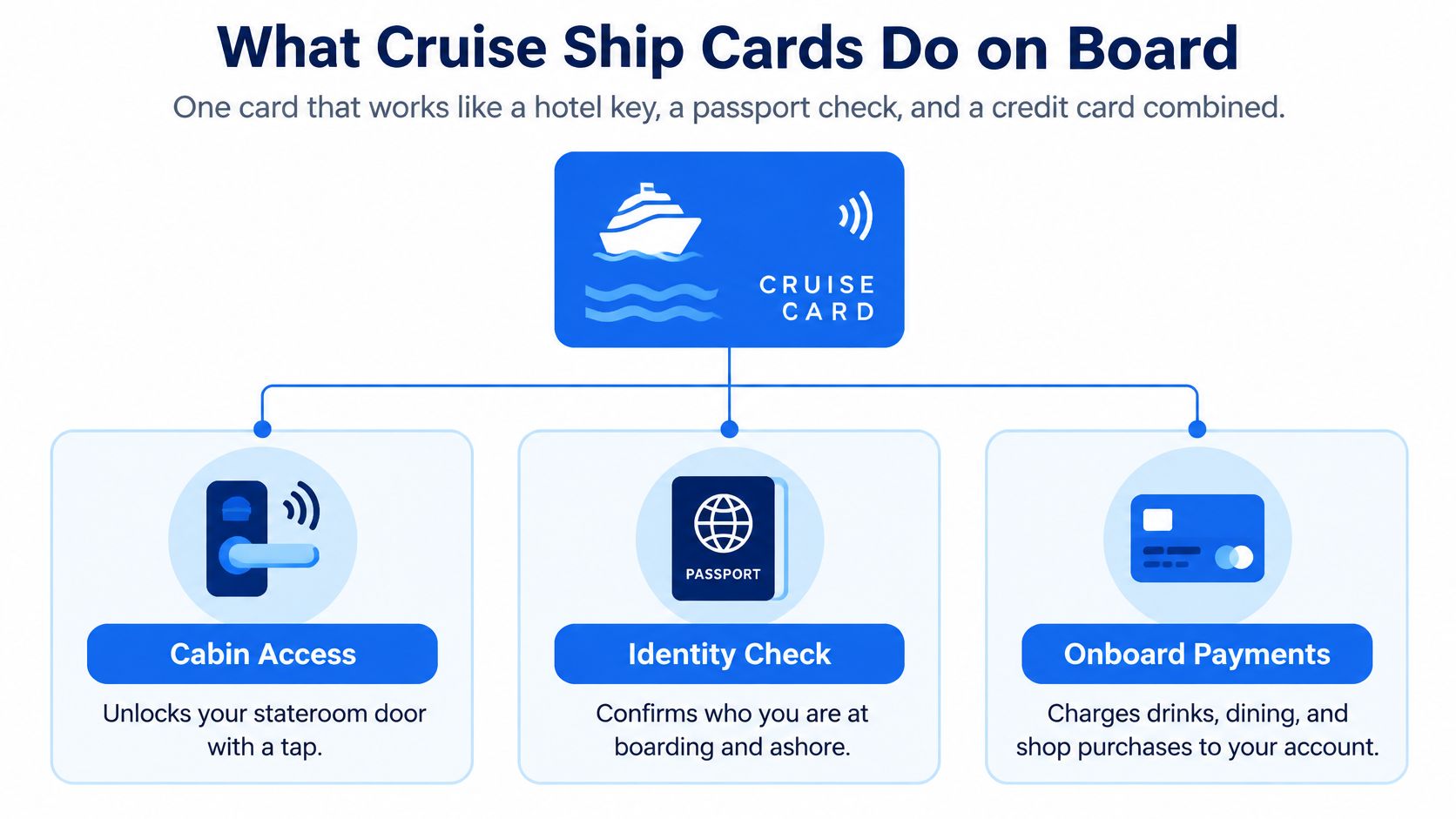
Cruise credentials have served several onboard roles for years. In December 2009, Royal Caribbean introduced waterproof RFID wristbands on Oasis of the Seas, combining room access, identification, and cash-free payments. The ship began with 1,000 tags, according to a published account of cruise RFID credentials. In 2014, the line sold a $2 waterproof band for Quantum of the Seas. The band used 13.56 MHz contactless technology under the ISO 14443 standard.
| Function | What it does | Where you use it | What stops without the card |
|---|---|---|---|
| Cabin access | Opens your stateroom door with a tap | Stateroom door, sometimes connecting doors | You cannot enter your room until guest services re-issues a card |
| Onboard account | Posts bar, dining, shop, and spa purchases to your account | Restaurants, bars, shops, spa, some photo services | Purchases need a registered payment method or cash where accepted |
| Identity check | Confirms you are the registered passenger | Gangway at embarkation, port return, disembarkation | Boarding and leaving the ship can be delayed |
| Muster station | Shows your assigned emergency assembly point | Printed on or stored in the card on many lines | Check your printed itinerary or ask guest services for the station |
The cabin door is often where you first notice the card's role. Its other jobs matter just as much: if the card goes missing, entering your room, charging purchases, or confirming your identity may all become harder at once. Ask the crew which functions your ship ties to its card. Details vary by cruise line and ship, so check where your muster station is listed before you need it.
How Cruise Cards Work Behind the Tap
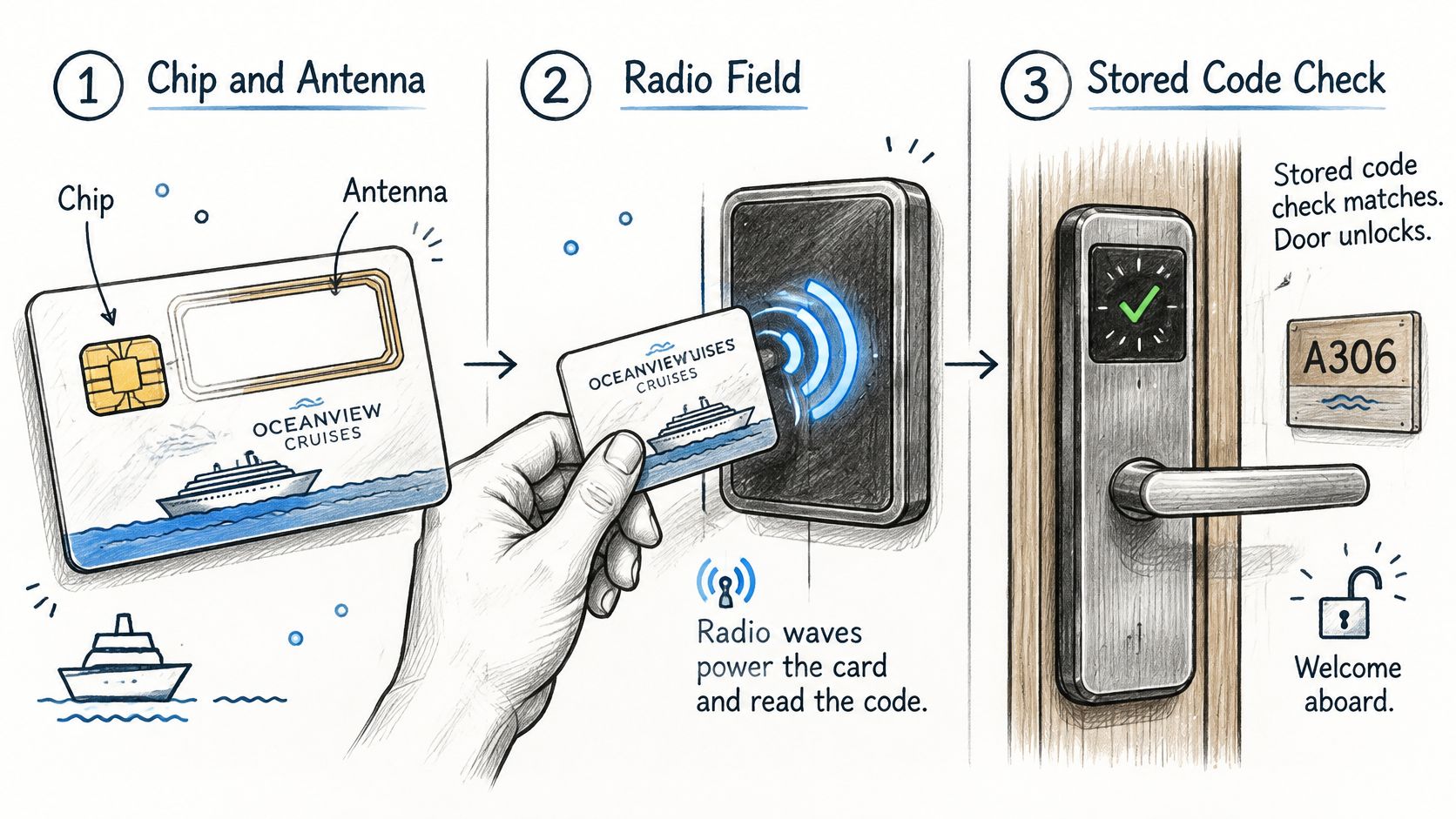
At your cabin door, hold the card close to the reader and pause. A small radio exchange takes place: the reader sends out a weak field, the card's antenna and chip respond with a stored code, and the lock checks whether that code grants access to the cabin. The same card can also serve as your identity token for boarding and connect purchases to your onboard account, depending on how the cruise line uses it.
In the documented Royal Caribbean setup, SeaPass credentials use 13.56 MHz RFID, with NXP MIFARE Ultralight C chips following ISO/IEC 14443. Battery-operated RFID locks were installed on 3,394 cabin doors, according to Royal Caribbean SeaPass card notes. That standard supports checks using the card's electronic credential. Older ships may instead issue magnetic-stripe cards, which must pass through a reader at the right speed and with the stripe facing correctly. Wristbands and medallions can use the same short-range radio method.
The reader must be close to the card, so someone across a lounge is unlikely to read it casually. In a busy crowd, a protective sleeve can also keep the card from being read when it brushes against a nearby reader. It does not replace keeping the card with you.
When the door stays shut
Pause before trying again and check the likely causes in order:
- Hold the card flat and still a few centimeters from the reader for about a second.
- Move it away from your phone, metal ring, or thick wallet, which may interfere with the signal.
- If there is a neighboring door, try your card there to help tell whether the card or the lock is the problem.
- Check for cracks, bending, or water damage.
- Ask guest services to re-encode the card rather than repeatedly tapping the reader.
Keep the card dry and avoid folding it until it creases. If it has a magnetic stripe, keep that stripe away from magnets on bags and cases. When the cruise line links cabin access, gangway checks, and purchases to one credential, a damaged card can affect more than getting into your room.
This short clip shows how to hold a card to a cabin-door reader:
Where Your Card Is Scanned and Charged
Every purchase tap is a charge, even when nobody mentions money. The card works as a shipboard charge card. A drink, a dinner, a shop bag, a spa treatment, or an excursion desk booking posts to your account the way a restaurant tab does. At the end of the voyage the line settles that tab through the card or account you registered before sailing. Industry reporting puts onboard spending at roughly 30% of cruise-company revenue in normal years, covering drinks, dining, retail, entertainment, and excursions, per cruise industry revenue notes. Royal Caribbean's WOWband, introduced with Quantum of the Seas in 2014, already combined stateroom entry and purchases. Later wearables from other lines added event access and location-based services. Losing the credential can block the door, the ID check, and spending at once.
What each tap actually means
| Touchpoint | Card use | Charged to account | Notes |
|---|---|---|---|
| Embarkation gangway | Identity and boarding scan | No | Needed to board; keep the card ready |
| Cabin door | Room access | No | Tap to open; no charge |
| Bars, restaurants, and shops | Purchase | Yes | Settled at the end of the cruise |
| Spa, salon, and excursion desk | Booking or purchase | Yes | Confirm whether bookings post to the account |
| Port departure and return | Scan out and back in | No | Required on most lines when you go ashore |
| Disembarkation | Final identity scan | No | Bring the card to the gangway |
The port row is the one people forget. Most lines scan you off the ship and scan you back on. Leave the card in the cabin and you can be stuck on the pier with a valid ticket and no way to prove it quickly. Carry it on every stop, including a "quick look at the shops."
Gratuities are a separate line on that same bill. If you want a plain walk-through of how those charges usually land, read how much tips are on a cruise before you assume the automatic amount is the whole story.
Three habits keep the tab from surprising you.
- Check midweek. Open the cruise app or stop at guest services and read the running balance, not just the last receipt.
- Ask about a limit. Some lines will cap daily spending on the account. Ask before a teen has the card for the afternoon.
- Read the final bill. Do it before you settle, while guest services can still pull a charge.
Booking and posting rules differ by line. Your confirmation, not a forum post from another ship, is the document that counts.
What to Do When a Card Is Lost or Damaged
You step off the ship to browse, then reach for your card and find an empty pocket. With all-aboard approaching, contact guest services right away rather than searching for hours. Your card connects several jobs: it opens your cabin, identifies you during boarding, records onboard charges, and supports the ship's passenger checks.
A lost card is a security problem as well as an inconvenience. A cybersecurity advisory on certain Norwegian Cruise Line door controllers described locks that accepted NFC credentials using only a static 7-byte UID. A UID is an identifier, not a secret. In the reported setup, someone close to the reader could capture and replay it because the lock did not require the card to prove it held a secret. Credentials that answer a challenge with encrypted information are harder to copy. Report a missing card promptly, and use a shielded sleeve if you want to reduce casual reads.
First move by situation
| Situation | First action | What to expect |
|---|---|---|
| Lost on board | Report to guest services at once | The old card should be deactivated and a replacement issued; fees vary by line |
| Lost in port | Tell guest services and the port agent before all-aboard | You may need photo ID and a replacement card to re-board; timing depends on the ship |
| Stolen | Report it to guest services and note when and where it happened | Ask staff to cancel the card and explain the replacement process |
| Damaged magnetic stripe | Visit guest services and keep the card away from magnets | Staff can issue a replacement; RFID cards do not rely on a swipe stripe |
| Lost before sailing | Contact the cruise line and check your boarding documents | A terminal replacement may be possible; confirm by phone |
Right after you report it
Tell guest services your cabin number, sailing date, and the last place you remember having the card. Check your pockets, day bag, and cabin safe while staff explain the replacement fee and expected wait. These vary by cruise line, so ask before paying. Then ask for confirmation, on a note or your account screen, that the old card has been deactivated. Replacing the card without cancelling the original leaves the missing credential usable.
Practical rule: Get the fee and wait time before you agree to pay. If staff cannot confirm them, ask what the replacement process involves before handing over payment.
Security and Privacy Limits of Your Card
At the gangway, your card may be checked for boarding. At the cabin, it opens the door. At a bar, it can charge a drink to your account. Some lines also link it to safety and passenger records. Handle it like an operational ID you use throughout the ship, and keep track of where it is.
RFID describes how a card communicates with a reader. It does not tell you how well the cabin lock protects access. A reader that accepts a static code may be more vulnerable to copying than one that checks a credential's cryptographic proof. Passengers cannot see which system their ship uses, so protect the card and report it promptly if it goes missing.
The information linked to a card can extend beyond purchases. MSC's privacy information says transactions may be associated with purchasing records, security photographs, embarkation and disembarkation scans, passenger manifests, Wi-Fi purchases, and medical assistance. The policy lists purposes including fraud prevention, age verification, legal compliance, and onboard safety. For example, a security photograph may be linked with your passenger record, helping the ship identify who is using the card.
Four questions people actually ask
Can another passenger use your card? A card may work for a purchase without a face check, depending on the outlet. Keep it with you, even among friends, rather than lending it for a quick drink.
What happens if you replace a card? Follow the steps in the lost-card section and ask guest services to confirm that the missing card has been deactivated.
Are port movements recorded? MSC's privacy information includes embarkation and disembarkation scans among the records it may link to your card. Check your cruise line's privacy page to learn how long records are kept.
Can you request access or deletion? You can ask the cruise line. Whether it can grant the request depends on the laws that apply and any records it must retain for safety. Contact the line's privacy team for an answer, preferably in writing.
Simple ways to protect your information
- Use a sleeve. It can reduce unwanted close-range reads in a crowded lounge or shop.
- Keep the card private. Don't lend it or post a photo of its front, which may show details you did not mean to share.
- Read the privacy page before sailing. The records linked to a card vary by cruise line.
- Dispose of old cards carefully. Destroy cards that still show your name, cabin, or account details, rather than keeping them in a drawer.
A waterproof ID holder lanyard can keep your card close while you move around the ship. Choose a holder that lets you take the card out when a reader needs it, and keep the card secure when it is not in use.
Pre-Sail Checklist and Muster Planning
On many ships, your card connects several parts of the trip: it identifies you for boarding and leaving the ship, opens your cabin, and may display your muster station, the place to go if an alarm sounds. Keep the station information somewhere you can find it even if the card is misplaced. NCL's departure-day guidance shows how boarding and card procedures work on that line. Check your own cruise line's instructions too, since card rules vary.
At the terminal, a family is ready to board, but one card has gone missing. Before sailing, the group should know where to find the muster station, how to handle boarding if a card is unavailable, and whether any traveler needs an accessible room. NCL advises guests who need an accessible room to contact the line before embarkation, since onboard availability is not guaranteed. Arrange that before you arrive.
Card functions are not universal. Confirm your line's current rules instead of relying on a story from another ship.
Before you leave home
- Read the card and boarding instructions in your confirmation, and note your boarding time.
- Register a payment method and check how the onboard account works, including any automatic gratuity.
- Contact the line before embarkation if anyone needs an accessible room.
- Ask whether one adult can hold cards for several travelers, and what photo ID the gangway requires if a card is missing.
- Save the muster deck and station in your phone notes or on the printed itinerary. Do not include the card number.
- On day one, locate the muster station and guest services on the deck plan. Walk the route from your cabin, including the slower route your group will use.
If the station is difficult to read, ask guest services to say it aloud and point it out on the deck plan. If the route may be difficult for someone with limited mobility, raise that before the safety drill.
Choose one place in the cabin for the card and travel papers. A Magnetic Cruise Door Organizer is one option for keeping those items together in your cabin. Its product page lists current price and availability. The organizer also comes with over-the-door hooks for home use. Pack those separately, as some lines do not allow hooks on cabin doors. For other first-sailing preparations, see these tips for first-time cruisers.
Before you leave home, save the muster station and check your cruise line's boarding and accessibility instructions.