

Piraeus Athens Port Guide: Terminals, Transfers and Tips
Piraeus handled approximately 18.6 million passengers in 2014, which made it Europe's busiest passenger port that year, according to an OECD and International Transport Forum study. That same study recorded about 980,000 cruise passengers in 2015 and described the port as one of Europe's largest cruise destinations. Ferries, cruise ships, and cargo share one waterfront, so the Piraeus Athens port is a working city gate, not a quiet pier.
A map still makes Athens look like a short hop. The city ride is the easy half. The hard half starts after you pass security: the assigned gate, a walk with bags, and however many other ships are alongside that morning.
I would not plan this call from a single line about minutes to the center. Confirm the terminal, match the transfer to the bags you are carrying, and treat embarkation as a sequence with a clock on it.
Table of Contents
- Piraeus Cruise Terminals and the Right Gate for Your Ship
- Busy Days at the Port and How to Plan Around Them
- Getting From Piraeus Port Into Athens
- Luggage, Security and Packing for Embarkation
- Nearby Services and Mistakes to Avoid
- Build Your Arrival-Day Plan Before You Sail
Piraeus Cruise Terminals and the Right Gate for Your Ship
Piraeus runs three cruise terminals. Terminal A uses Gate E11. Terminals B and C use Gate E12. The two gates sit about 1.5 km apart, according to Clickncruise's Athens cruise notes. Pick the wrong access point and you pay for that gap on foot before a metro entrance is in sight.
| Terminal | Access gate | Typical walk to metro station (estimate from berth) |
|---|---|---|
| Terminal A | Gate E11 | 15 to 30 min |
| Terminal B | Gate E12 | 15 to 30 min |
| Terminal C | Gate E12 | 15 to 30 min |
The table gives a range because the walk changes with the assigned berth. A day pack hides that time. A carry-on with a tired wheel does not. First-time cruisers, families, older travelers, and anyone boarding with bags feel it more than a passenger stepping off only to sightsee.
Match the ship, then move
The embarkation letter names the terminal. The morning berth board can still move the ship. Read both, then walk.
- The night before, save the terminal name and its gate from the embarkation letter.
- On arrival, read the berth board before you leave the taxi rank or the station.
- If the board reassigns the ship, update the gate before you start walking.
- Ask whether that berth uses the internal shuttle. Some ships sit far enough from the station door that a roller bag on the apron is a bad trade.
Practical rule: Confirm the terminal and gate the evening before sailing, then recheck the berth on arrival morning, because ships get reassigned.
A generic metro tip skips this. Secure-port access, berth assignment, and baggage handling decide the morning as much as the ride into town. The same gate-check habit keeps a Cádiz cruise port arrival from turning into a lap of the wrong quay. I would spend ten minutes on the documents rather than twenty between E11 and E12 with a suitcase.
Busy Days at the Port and How to Plan Around Them
862 calls pushed 1,863,397 passengers through Piraeus in 2025, up from 810 calls and more than 1.7 million in 2024. The split tells the operational story.
| Year | Ship calls | Total passengers | Homeport passengers | Transit passengers |
|---|---|---|---|---|
| 2024 | 810 | More than 1.7 million | More than 1 million | Not published separately |
| 2025 | 862 | 1,863,397 | 1,091,364 | 772,033 |
Those totals come from Port Authority figures carried by OT's report on the port's cruise year: 810 calls and more than 1.7 million passengers in 2024, with homeport passengers above 1 million, then 862 calls and 1,863,397 passengers in 2025, split into 1,091,364 homeport and 772,033 transit.
Homeport means your ship starts or ends the cruise here. A large group checks in, clears security, and boards in the same window, so taxis, shuttles, X-ray lanes, and metro platforms all spike together. Transit means the ship is calling and most passengers already sleep on board. You still share the rank and the gates, but you avoid the full turnaround crush.
Why one ship count can mislead your date
Annual growth hides daily friction. A Cruise Alert port update recorded 584 ship arrivals in the first nine months of 2026, down 16.3% year over year, while passenger volume fell 19% to 1.3 million, yet in that same first nine months of 2026 homeport passengers rose 23.1%, from 39,165 to 48,216, and homeport ships went from 19 to 20. Total calls, transit traffic, and turnaround demand do not rise and fall as one number.
That mix decides your morning. Homeport growth means more suitcases at E11 and E12 at the same hour, even when the headline call count looks quiet.
Read the ship list for your date. A quiet month can still put three ships on your pier the morning you sail.
On a single-ship day, keep the cruise line check-in window and add only the walk from your gate. Four ships alongside changes the calculation. Assume a second wait at the rank and at security, and pre-book the car if you are starting or ending a cruise here. If a regional disruption shifts the schedule, the berth board beats yesterday's email. I would rather hold a booked pickup than negotiate a fare while two gangways empty at once.
Getting From Piraeus Port Into Athens
Four moves get you off the quay, and only three of them put you in the city. Cost, speed, and how much walking your luggage allows should pick the winner. The pin on the map does not.
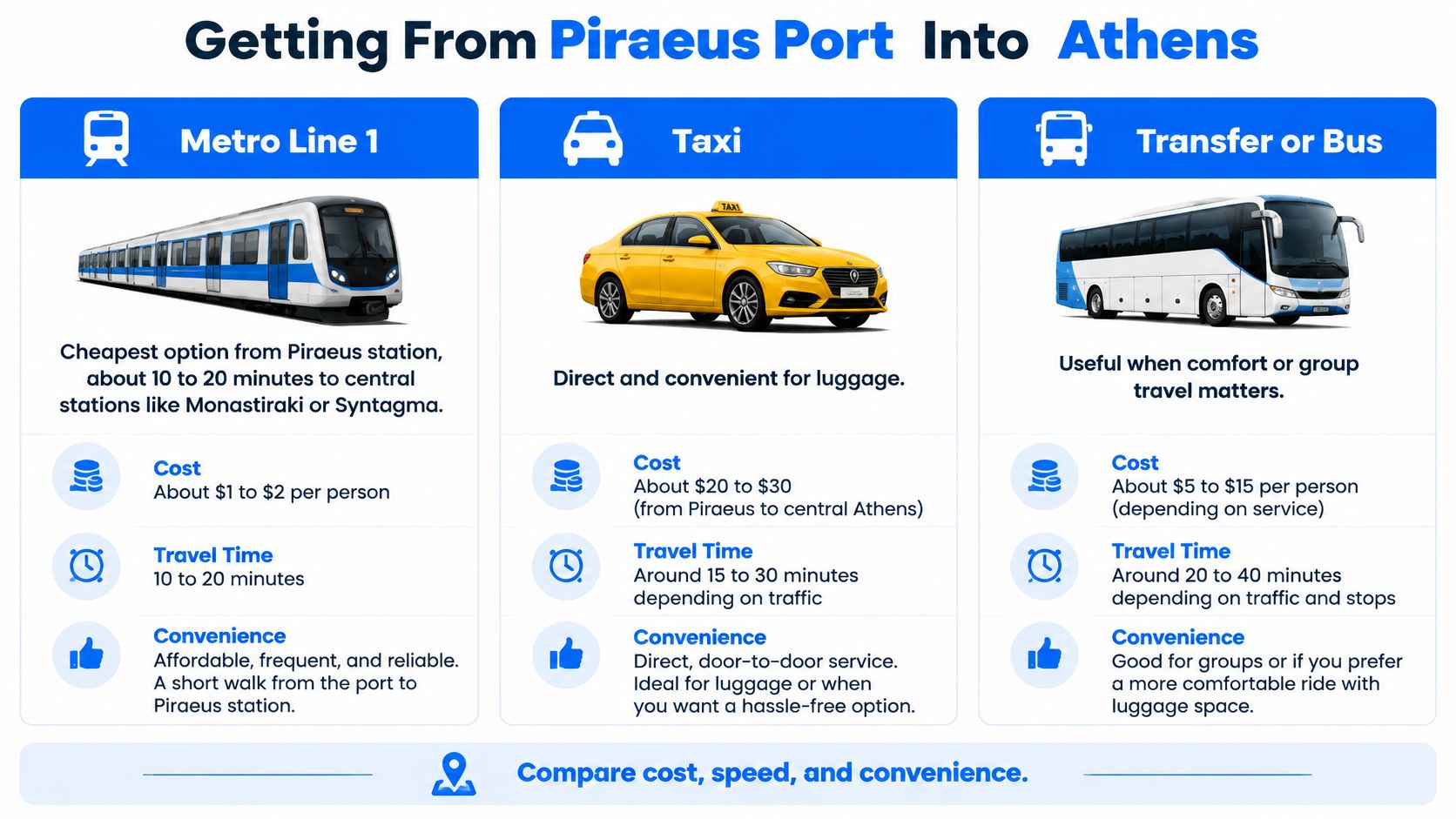
Four ways off the quay
Metro Line 1 from Piraeus station is the low-cost default once you reach the station. It suits a traveler with a carry-on, working knees, and time to spare. It loses the moment the bag is a full-size suitcase or the walk from your berth has already left you winded. That walk comes before the train clock starts, and it is the part no fare table shows.
A taxi from the terminal wins when the group is large, someone has limited mobility, or the sailing is late and a wrong turn costs a check-in slot. Door to door beats the train in light traffic. When several ships discharge together, the same ride sits in the queue you were trying to skip. Use the official rank, confirm the meter is running, and name the Athens address before the car moves.
A pre-booked private transfer fixes the pickup point and the price before you land, which takes the negotiation at the rank out of the morning. It is the right call for families who do not want to hunt a car after a long flight. It is a poor call for one person with a backpack and a flexible afternoon, because you pay for certainty you will not use.
The free port shuttle moves you inside the cruise area only, which helps when the berth sits far from the gate. It does not run to Syntagma, the Acropolis, or your hotel. Board it expecting a terminal transfer and it does its job. Board it expecting a city bus and you can watch your onward connection leave without you, then reach check-in after the window has closed.
| Option | Typical time to central Athens (my estimate) | Best for | Cost |
|---|---|---|---|
| Metro Line 1 from Piraeus station | About 10 to 20 minutes in the car, after the walk from your berth | Walkers with carry-on bags | Lowest public fare |
| Taxi from the port | About 20 to 25 minutes in light traffic, longer at peak times | Groups, families, and heavy luggage | Metered, above the metro |
| Pre-booked private transfer | Close to a taxi, set by traffic | Travelers who want a fixed pickup and price | Quote agreed before pickup |
| Free port shuttle | Moves within the port area only, not to Athens | Long walks between terminal and gate | Free |
Those figures are working estimates for planning, not published timetables, and they assume you are already standing at the gate. Check the current fare before you leave home. This port changes its taxi picture with the ship list, and a price from last season is not a promise. The same split, a pier walk plus a separate city ride, shows up at other inland-access calls, including the cruise port for Florence.
Compare the whole journey, not the ride. A cheap fare stops looking cheap once it drops you at the wrong gate with two cases and a boarding time.
Luggage, Security and Packing for Embarkation
The final walk inside the port, not the metro ride into Athens, is where luggage choices show up first. Port Authority materials filed through Euronext Athens describe three passenger stations totaling 15,000 m², 20 X-ray machines, a free shuttle around the cruise port, and 9 to 11 simultaneous berthing positions, including 2 to 3 berths for the largest cruise ships. That is a parallel-flow hub. When several large ships process guests at once, security, baggage drop, and the shuttle ramp overlap. Gear you can see and carry in one trip beats a neat stack of matching cases.
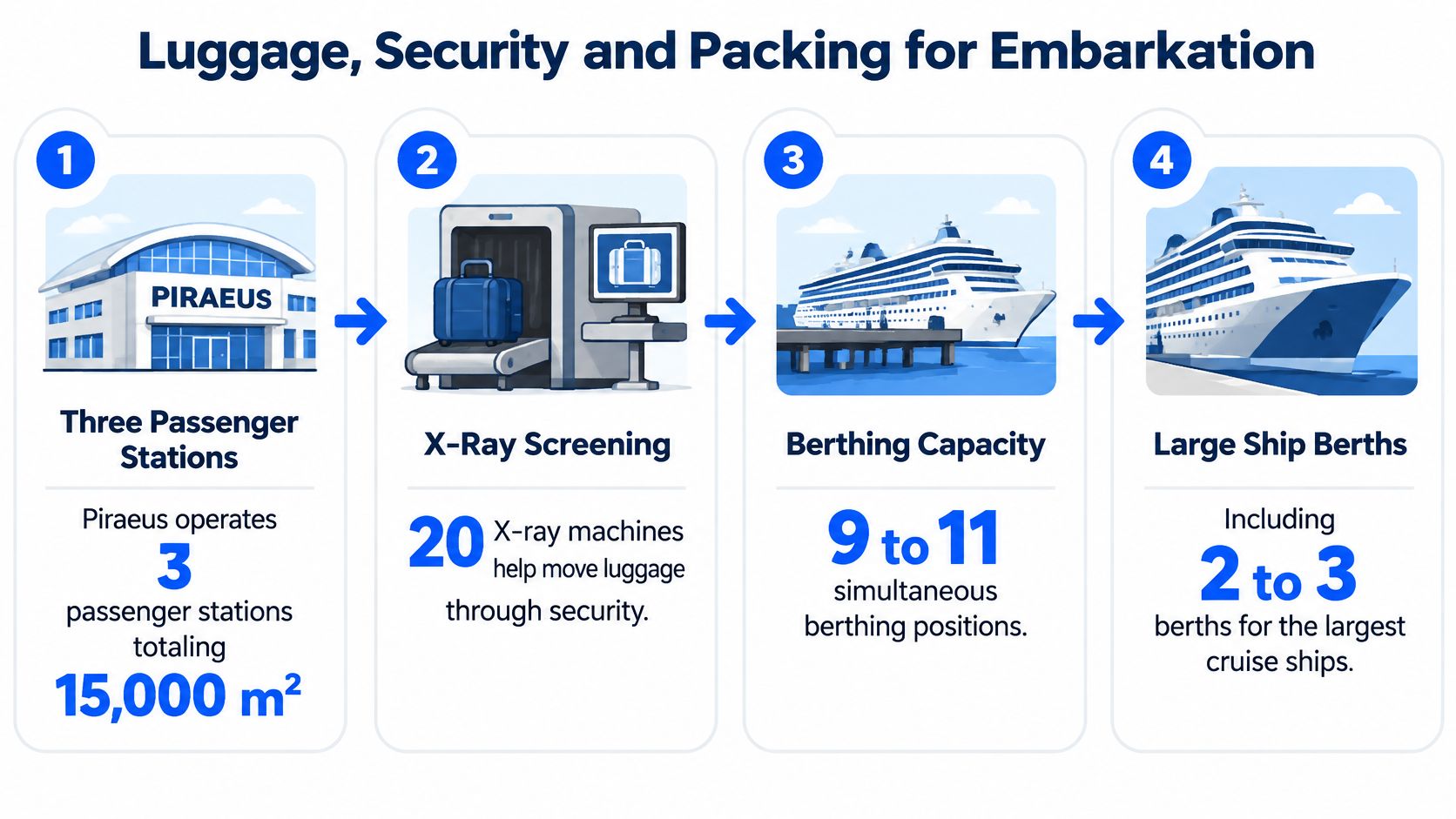
What rides with you
Split the bags the night before, not in the taxi queue. A cruise luggage tag with your name and a phone number on every handle, plus a photo of each bag before you hand it over, is the recovery plan if a case misses the cabin.
| Item | Carry-on | Checked bag | Reason |
|---|---|---|---|
| Passport and travel documents | Yes | No | Needed at check-in and security |
| Medication and seasickness patches | Yes | No | Must stay accessible during delays |
| Swimwear and one change of clothes | Yes | No | Usable if the checked bag is late |
| Chargers and power bank | Yes | No | Needed during transfers and in the cabin |
| Full-size toiletries | No | Yes | Keeps the carry-on light for walking |
| Formal wear for the first night | No | Yes | Bulky and not needed until the cabin |
The sequence, and the slip that breaks it
1. Confirm the terminal and gate on arrival. Follow the letter only after the board agrees. The common slip is trailing a crowd toward the ferry gates because those signs are larger.
2. Clear security at the passenger station. Keep documents and medication in the carry-on, outside any locked pocket. A passport buried under a sweater turns a two-minute scan into a repack on the floor.
3. Drop checked luggage where the ship's handlers point. Photograph the tag and the belt. A bag with no contact details is a bag the pier staff cannot match if it comes off the wrong truck.
4. Board the free shuttle only if the berth is far from the station door. It stays inside the port. The wheel-or-taxi decision belongs to the transfer planning above, not to the security queue.
5. Hold the carry-on until you are in the cabin. Checked bags often arrive after you do. If the only swimsuit and the only charger went in the big case, the first hours on board are a wait.
Once the door shuts
Counter space and the wardrobe are both small. A compact organizer on the wall frees the desk. A short magnetic clothesline takes wet swimwear off the chair. A Magnetic Fan for Cruise Ship Cabin uses a magnetic base on most stateroom metal, USB-C charging, multi-speed control, and a body compact enough to pack in the carry-on instead of fighting the suitcase.
Keep the carry-on where you can reach it without opening the big case. The charger, swimsuit, and documents do the most work in the first hour. Everything else can wait until the ship is underway.
Nearby Services and Mistakes to Avoid
The metro ride to Athens is the predictable part. The walk from the berth to the correct gate decides the morning. Terminal A feeds through E11, Terminals B and C through E12, and the passenger station, taxi rank, cafés and metro entrance do not sit at equal distance from each. Read the gate board at the exit, then commit to that gate.
Inside the passenger station, use the information desk to confirm a gate change before you roll bags anywhere. Vending water near the doors costs time in line on a three-ship Saturday. Buy water at the small shops outside the flow, keep documents out, and keep the pickup point fixed.
Mistakes here look different from a missed train.
If the taxi rank stands empty, do not chase shouted offers down the curb. Step back inside, confirm the meter or fixed price with the next licensed car, or call the car you booked. A bad pickup adds a fare dispute to a gate problem.
If the board changes the gate after check-in, return to the desk and re-confirm the baggage tag and berth. Rolling to the old gate with a photo of the wrong sign still means a second walk.
I treat that last walk as the budget to protect. A berth tucked far inside the port turns a short map distance into fifteen slow minutes with luggage, while the metro to the city runs on rails.
Build Your Arrival-Day Plan Before You Sail
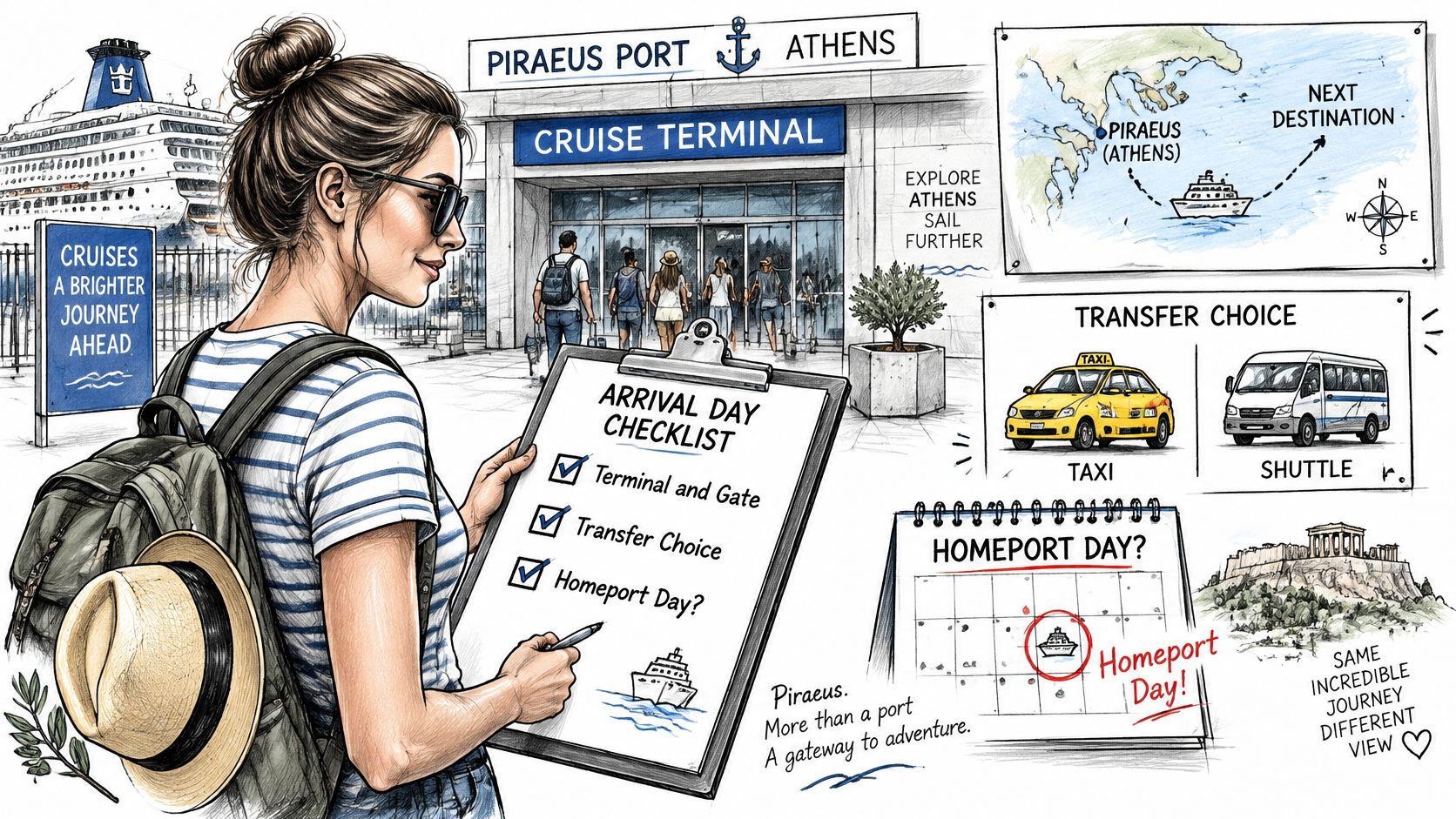
Three facts decide whether Piraeus feels orderly or hostile: your terminal and gate, the transfer that matches your bags, and whether your date is a homeport morning with a full turnaround crowd. A wrong gate does not care what you packed for the stateroom.
The arrival-day checklist
The night before. Save the gate and berth details offline. Check how many ships share your date. Print the page if your phone battery is already tired from the flight. Photograph the berth board, the gate sign, and the taxi rank or metro entrance you plan to use, so the route is on your camera roll when your hands are full.
Set a leave time. Work backward from the gate, not from the city. Put a concrete time on the checklist and add a buffer for the final walk inside the port. That walk is the variable the map hides.
Arrival morning. Recheck the berth before you leave the hotel. Keep documents, medication, a charger, and one change of clothes on your body side of the luggage. Record the transfer choice next to the leave time: taxi or booked car for a heavy bag or a stacked ship list, metro for a carry-on and a single ship.
At the port. Follow gate, security, baggage drop, then shuttle only if the berth needs it. Do not improvise a new route because another passenger looks confident.
Before you leave home. Map the walk from your assigned gate to the metro entrance or taxi pickup. Know the route while your hands are empty. Photograph the turn from the gate to the pickup point, and write down the gate name exactly as it appears on the board.
Nordmoose makes compact cabin gear for the hours after you clear a port like Piraeus: warm staterooms, almost no counter space, and wet clothes with nowhere obvious to hang. The range covers magnetic fans, wall organizers, clotheslines, night lights, and seasickness patches sized for a carry-on. Browse the current cruise essentials at Nordmoose.