

How to Get Last Minute Cruise Deals: Timing and Costs
Waiting until the last minute isn't a reliable way to get a cheaper cruise. Cruise lines discount cabins they still need to sell, not cabins you happen to want. If your departure date, balcony, and itinerary are nonnegotiable, waiting can leave you paying more for less choice.
The practical answer to how to get last minute cruise deals is to shop for flexibility, then test the whole trip before paying. A reduced cabin fare only counts as a bargain if transportation, accommodation, cancellation terms, and your arrival plan still work.
Table of Contents
- When Last-Minute Cruise Deals Appear
- How to Set Up Fare Tracking and Alerts
- Cabin Trade-Offs That Free Up Better Prices
- Break-Even Cost and Flight Feasibility
- Negotiating With Agents and Cruise Lines
- Lock In Cancellation Terms Before You Pay
When Last-Minute Cruise Deals Appear
Last minute does not reliably mean cheaper. Cruise lines use demand-based pricing, reducing selected departures while increasing fares on sailings that continue to sell. The useful question is whether the seller still has cabins that match what you'll accept.
The Miami Herald's cruise-pricing reporting describes this split and cites a projected 11.5% year-over-year increase in Caribbean passenger capacity for 2026, which could create opportunities on selected routes without making every sailing cheaper. Capacity growth and cheap fares are different things. Extra cabins help only where demand hasn't already absorbed them.
Booking windows that signal the lowest prices
Treat these windows as typical ranges worth investigating, not promises of a discount. Individual sailings move with demand, ship, and season.
| Timing signal | Typical pattern | How to use it |
|---|---|---|
| Inside cabins, final week | Often reach their lowest prices within 7 days of sailing | Be ready to book on the spot; the cheapest cabins go first |
| Ocean-view and balcony cabins | Most often bottom out 31 to 90 days before departure | Book inside this window if a view or balcony matters to you |
| Cruise line discount window | Prices commonly fall 1 to 2 months before departure when inventory remains | Compare any drop against the fare conditions, since promotional fares often carry restrictions |
| Distressed-inventory period | Roughly 2 to 4 weeks before departure | Viable only if your dates, port, and cabin type can all flex |
| Hard booking cutoff | About 3 days before departure, with rare exceptions 2 days out | Treat this as the end of the decision, never a starting point |
Separate flexible trips from constrained trips
Flexible sailings include shoulder-season itineraries, non-holiday Caribbean departures, and trips where you can substitute another embarkation port. Repositioning cruises can also be worth checking, but examine the return journey before treating the fare as good value. A one-way fare to an overseas port stops looking cheap once you price the flight home.
Constrained sailings include summer Alaska, peak-season Mediterranean itineraries, and holiday voyages. If you need school-holiday dates, an accessible cabin, or adjacent rooms, your usable inventory is narrower than the booking page suggests.
Seasonal savings carry seasonal compromises. Before choosing a cheaper Caribbean departure, understand the itinerary uncertainty and preparation involved in cruising during hurricane season.
Practical rule: Waiting pays when the cabin, date, and port can all change. If one requirement is fixed, book once the total price is acceptable rather than betting on a discount.
How to Set Up Fare Tracking and Alerts
A useful fare alert tracks something you'd book. A broad notification about cheap cruises can fill your inbox without helping you recognize whether your preferred sailing has become better value.
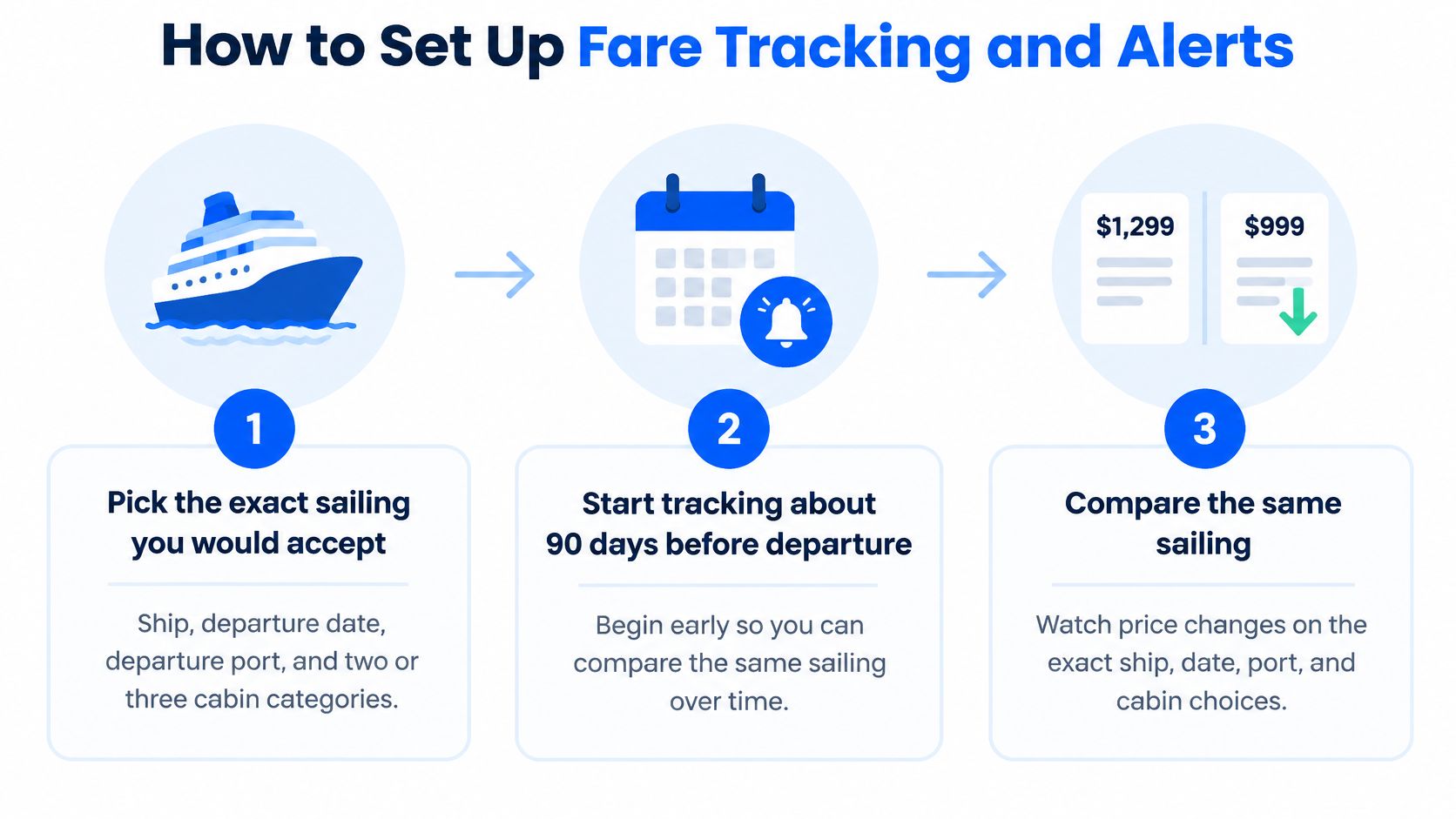
Use this setup to keep the comparisons consistent.
Build a usable comparison
- Define acceptable sailings. Record the ship, embarkation port, departure date, and cabin categories you'd take. Keep alternative departures on separate rows so you don't mistake a different itinerary for a price reduction.
- Start before the final scramble. Use a monitoring plan beginning around 90 days before departure, compare fares at least twice weekly, and intensify checks during the final 30–60 days, consistent with the approach described in AAA's last-minute cruise guidance. Starting early gives you a baseline instead of making you rely on the seller's discount label.
- Compare equivalent offers. Check the cruise line's website and reputable travel agencies using the same passenger mix, cabin category, and fare conditions. A refundable fare and a restrictive promotional fare aren't interchangeable, even when their cabin descriptions match.
- Test less convenient departures. Include workweek itineraries rather than searching only weekend-friendly trips. Record whether connecting rooms, accessible accommodation, preferred cabin locations, and dining arrangements remain available, because a lower fare won't replace an essential feature.
- Save searches and log the checkout total. Use the booking site's fare alerts when available, plus a simple Google Sheets or Excel tracker with columns for seller, date checked, cabin, total payable, inclusions, and cancellation terms. Save a screenshot or quote reference so you can verify what was offered.
- Increase attention when inventory changes. Move to daily checks during your active buying period, especially when your shortlist shows category changes or new promotions. Set a maximum acceptable total in advance so you can act without restarting the entire comparison.
Read the signal correctly
A fare reduction means the seller has repriced that offer. It doesn't mean another reduction is coming, and it doesn't establish that the trip is affordable after transport.
Likewise, a rising fare on a tightly constrained sailing isn't a reason to keep waiting automatically. If the available offer meets your requirements and budget, protect the trip rather than chasing the lowest imaginable price.
For another walkthrough of cruise-deal shopping, use the video alongside your own fare log.
Cabin Trade-Offs That Free Up Better Prices
An interior cabin is only a bargain if you'll be comfortable sleeping in it. A balcony earns its premium only when you'll use it enough to justify spending less elsewhere.
The category also affects your buying window. CabinSaver's 2025 sailing report found that inside cabins typically reached their lowest prices within 7 days of sailing, while ocean-view and balcony cabins most often reached their lowest prices 31–90 days before departure. Treat those as observed patterns rather than a promise for your sailing.
Compare the room you'll live in
| Cabin choice | What you gain | What to inspect before accepting |
|---|---|---|
| Interior | An option for travelers prioritizing fare over a view | Windowless sleeping conditions, bed layout, storage, and location |
| Ocean-view | Daylight without committing to a balcony | Obstructed views, window configuration, and usable floor space |
| Balcony | Private outdoor space | Obstructions, deck position, neighboring public areas, and fare premium |
| Guaranteed category | Category-level booking without choosing a specific room | Assignment terms and whether any location would be unacceptable |
Don't infer room size from the category name. Compare the actual layout and cruise ship cabin sizes, especially when sharing with children or other adults.
Check the deck above and below, not just the cabin's own corridor. A room near a theater, dining venue, or busy service area may be a poor exchange for a modest saving if you're sensitive to noise.
Interior rooms also run dark and can feel warm, so weigh your tolerance for both before booking. A portable fan handles the warmth without taking counter space; our Magnetic Cruise Fan with Remote Control is rechargeable, offers multi-speed control and remote operation, and mounts magnetically on suitable metal cabin surfaces.
Set your limits before searching
- Must-haves first. Write down required features such as bed configuration, accessibility, or daylight before browsing.
- Price the actual occupants. Request the total for everyone sharing the room, including solo supplements or additional-guest charges.
- Treat substitutes as new offers. If your category sells out, request the alternative in writing and assess its layout and location independently.
Don't accept an unsuitable cabin because someone suggests an upgrade might appear at check-in. Book the room you can accept, and treat any upgrade as unconfirmed until it appears in writing.
Break-Even Cost and Flight Feasibility
Before checking whether the fare is cheap, establish whether you can reach the ship reliably. Travelers within driving distance of a departure port have a simpler decision because they don't have to coordinate a late flight purchase with a fixed embarkation deadline.
Flying changes the calculation. The operational concern highlighted by Seatrade Cruise's coverage of short-notice bookings is that airfare, accommodation, transfers, and disrupted journeys can erase cabin savings; for a fly-in trip, plan to arrive at least one day before embarkation.
Clear the arrival test first
Check actual flight availability before placing a nonrefundable cruise payment. Prefer a nonstop journey where practical, or choose a connection with enough recovery room that a minor delay won't immediately unravel the itinerary.
Then investigate the destination airport. Confirm how you'll reach the hotel and terminal, whether your arrival time works with available transport, and how much luggage the transfer can carry.
For an international itinerary, verify passport validity and visa or transit requirements using the relevant official authorities. An available cabin doesn't establish that you have the documents needed to board.
If you're driving, count parking, fuel, tolls, and any necessary hotel rather than treating ground travel as free. Check the terminal address carefully, particularly where a city serves multiple cruise terminals.
Break-even cost worksheet for a last-minute cruise
Build this worksheet for the whole traveling party, even if the seller advertises a per-person fare. Keep the passenger count and included services identical when comparing alternatives.
| Cost item | Include when | Common miss |
|---|---|---|
| Cruise fare per person | Always, using the final quoted price | Solo supplements and third or fourth guest rates |
| Taxes and port charges | Always | Added after the headline fare appears |
| Gratuities | Unless already prepaid | Daily charges added at the end |
| Travel insurance | When cancellation or medical cover is needed | Skipping cover without assessing the exposure |
| Airfare or train | When you cannot drive to the port | Expensive close-in transport |
| Pre-cruise hotel | When arriving before embarkation | Higher late-booking hotel costs |
| Airport-to-port transfer | When you are not driving | Surcharges, luggage fees, and hotel-transfer legs |
| Contingency buffer | Always | Replacement transport or accommodation after disruption |
Cruise-booking analysis from Cruise Ship Tracking warns that late airfare and hotel costs can eliminate cruise savings and describes a common booking cutoff of about three days before departure, with exceptional bookings sometimes possible two days out. Don't build a travel plan around getting an exception.
For gratuities, use the amount applicable to your line and cabin rather than copying an estimate from another itinerary. This guide to how much tips cost on a cruise can help you identify what to check in the quote.
Decide whether the saving survives
Use this calculation:
All-in trip cost = final cruise quote + unpaid onboard charges + transport + lodging + insurance + contingency allowance.
Compare that result with a comparable trip you could book now. Match duration, passenger count, cabin standard, and inclusions; otherwise, you may be comparing a stripped-down offer with a more complete package.
Say the cruise fare falls, but the remaining flight requires an overnight connection and an extra hotel stay. The cabin has become cheaper, but your holiday may have become more expensive and harder to execute.
A contingency allowance can help pay for disruption. It can't make an unworkable arrival schedule safe.
I would skip a fly-in sailing if arriving before embarkation isn't practical. I'd also skip it when the buffered total no longer beats a suitable alternative, regardless of how attractive the advertised fare looks.
Negotiating With Agents and Cruise Lines
Treat negotiation as a request for a better confirmed package. The seller may have little room to change the fare itself, but a different eligible promotion or an added inclusion can still improve what you receive.
Booking directly gives you the cruise line's own quote and terms. A travel agent can compare several lines at once and may have access to agency-specific offers, so pricing both channels on the same sailing costs you nothing except a few minutes. What you can't do is assume an agent's headline price includes the same services as the direct quote.
Ask questions that produce comparable answers
- Exact fare. Is this the lowest eligible fare available today for this ship, departure, passenger mix, and cabin category?
- Usable inclusions. Are drinks, Wi-Fi, gratuities, or onboard credit included, and what restrictions apply?
- Occupancy pricing. What is the full amount for my actual party, including any solo supplement or additional guests?
- Fare-drop treatment. If the price falls after booking, can this reservation be repriced or rebooked, and what charges or lost benefits would apply?
- Cabin certainty. Can you confirm a cabin number, or explain precisely how an unassigned cabin will be allocated?
On a flexible sailing, tell the agent which nearby dates and ports you'll accept. That gives them alternatives to search rather than asking them to change a fixed offer they may not control.
On a limited sailing, focus on inclusions you'll use. Onboard credit is worth less than cash if you wouldn't otherwise make eligible purchases, and a drinks package has little value when it doesn't match your habits. I'd rather hold a fare with confirmed perks I want than chase a bigger headline discount padded with benefits I'll never use.
Use a short, specific request
One paragraph covering the whole ask is enough. You can send this wording without claiming that another seller has made an offer:
Please quote your best complete offer for this sailing and cabin category, including mandatory charges and the total for everyone traveling. I'm flexible on cabin location and nearby departures. Please confirm any included benefits, cabin-assignment terms, and fare-drop options in writing before I authorize payment.
Ask who handles servicing after purchase and whether the agency charges separate change or cancellation fees. An agent who answers these questions quickly and specifically is a better bet than one who promises to sort things out later.
Any promise that affects your decision needs its conditions in writing before you pay. A verbal "we'll look after you" gives you nothing to point to if the fare drops or a promised inclusion disappears from the final invoice.
Lock In Cancellation Terms Before You Pay
A late booking leaves little room to discover that the fare is restrictive or the cabin differs from what you expected. Read the full booking conditions and treat the promotional summary as advertising, since the binding terms live in the confirmation paperwork.
Use those documents as your final checklist before authorizing the charge.

Verify the reservation and the money at risk
Start by matching the passenger names to travel documents. Then check the ship, departure port, sailing date, cabin category, passenger count, and every inclusion that influenced your choice.
Your written paperwork should make these points clear:
- Payment obligations. The deposit amount, payment due dates, remaining balance, and accepted payment method.
- Cancellation consequences. The penalty schedule, when each penalty applies, and whether eligible compensation arrives as a refund or future cruise credit.
- Occupancy charges. Any solo surcharge and the confirmed rates for additional guests sharing the cabin.
- Supplier responsibility. The cruise operator, agency details where applicable, and who to contact for changes or problems.
Set calendar reminders for every outstanding payment and penalty date. A missed deadline can move you into a higher penalty tier even when the cruise line sends no warning, and an agent may be unable to reverse it.
Check what insurance covers
If you're buying insurance, read the cancellation triggers, medical coverage, exclusions, and purchase conditions before relying on it. Standard policies pay only for listed reasons, so confirm the situations that concern you appear in the wording. A missed departure caused by your own delayed flight, for example, often sits outside basic cover unless the policy includes specific missed-connection provisions.
Compare the policy against your flight and cruise arrangements, including documentation requirements and claim deadlines, so you know what evidence a claim would need.
Read the fine print before you pay, not after you cancel.
If motion sensitivity shapes your packing decisions, discuss suitable remedies with a pharmacist or clinician rather than relying on marketing claims alone. For customers choosing our patches, we offer a 30-day satisfaction guarantee on Sea Sickness Patches for Cruise; that product policy sits apart from your cruise cancellation terms and does not change the fare's penalty schedule.
Keep the booking confirmation, insurance documents, transport reservations, and seller's written answers together in a folder you can access offline.
Book only when the total cost, arrival plan, and cancellation exposure are acceptable. If any condition that affects your decision remains unclear, leave the offer unpurchased. Walk away from a fare you cannot comfortably afford or reliably travel on, whatever the headline saving.
Nordmoose offers compact cruise-cabin accessories, including magnetic fans, organizers, night lights, and a cruise clothesline. Once your booking and arrival plans are secure, visit Nordmoose to choose practical cabin essentials and check delivery options against your departure date.