

Cruise Gadgets for 2026: What to Pack and Verify
You've booked the cabin and memorized the deck plan. Now the packing list has turned into a shopping cart: a fan, magnetic hooks, a night light, a clothesline, a patch for the sea days, and a tracker for the suitcase. Half of it you'll never touch. Some of it your cruise line may take off you at the pier.
First-time cruisers planning their first sailing are in exactly that spot. The Cruise Lines International Association's 2025 State of the Cruise Industry Report counted 34.6 million ocean cruise passengers worldwide in 2024 and found 68% of international travelers were considering a first cruise. In my experience, first-timers overbuy most.
There's an order that fixes this. Match the gadget to a real cabin problem, check the rule for your specific ship, then run the luggage-handoff test on anything that has to survive the trip from airport to cabin. That last step matters more than people expect: your suitcase leaves your hands at the airport, changes hands again at the pier, and shows up outside your cabin door hours later. Anything clipped to it has to survive that chain. Buy in that order and the kit gets smaller, not bigger.
Table of Contents
- Cruise Gadgets Matched to Each Cabin Problem
- How to Check If a Gadget Is Allowed on Your Ship
- Choosing Cabin Fans and Judging Feature Claims
- Organizers, Night Lights and Drying Lines That Work
- What Motion Comfort Aids Can and Cannot Do
- Tracking a Bag From Airport to Cabin
- Pack Your Cruise Gadget Kit Before You Sail
Cruise Gadgets Matched to Each Cabin Problem
A stateroom usually fails in the same few places: heat, storage, light, drying space, motion, and the bag that may not reach the cabin when you do. Buy for those failures and the kit stays small.
| Cabin Problem | Gadget Type | What to Look For | Check Before Boarding |
|---|---|---|---|
| Warm or stuffy cabin | Rechargeable magnetic fan | Multi-speed control, rechargeable battery, metal-surface mount | Whether the fan is battery-powered or plug-in |
| Little storage space | Magnetic organizer | Pockets sized for toiletries, sunglasses, documents and chargers | A metal wall or door surface is available |
| Dark bathroom or passageway at night | Motion-sensor night light | Rechargeable, low-glare light | Magnetic hold on a metal surface |
| Wet swimwear, no drying space | Magnetic cruise clothesline | Magnetic mounting and enough line for wet items | Cabin wall panel finish and cruise line guidance |
| Seasickness on sea days | Non-drowsy patch or other motion aid | Clear label and intended side-effect profile | Interactions with other medicines, checked with a pharmacist |
| Lost bag at embarkation | Bluetooth luggage tracker with visible ID tag | Battery life and notification settings | Radio-function rules on the cruise line's prohibited-items page |
Three filters kill most bad purchases before the rules page even opens.
- It has to hold on metal. Walls and doors are the spare storage in a small cabin. A magnetic organizer adds vertical storage without using counter or floor space, and a fan or night light with a magnetic mount has somewhere to go when every flat surface is taken.
- It has to run without an outlet. Sockets are few and usually claimed by a phone and a camera. A USB-C rechargeable fan rated around 4 to 12 hours per charge, depending on speed and light, can get through the night without a plug.
- It has to pack flat. A fan thinner than a book that slips into a carry-on or handbag earns its place. Anything needing its own packing cube has to prove daily use.
The last decision is the luggage handoff. If an item cannot survive the airport-to-cabin trip, or you cannot name the exact moment you will use it (the 2 a.m. bathroom walk, the wet swimsuit at 5 p.m., the third sea day), leave it out of the kit.
How to Check If a Gadget Is Allowed on Your Ship
Every cruise line publishes a prohibited-items list, and that page outranks anything a product listing, packing video, or forum thread claims. Enforcement happens ship by ship at the embarkation scanner, so a fan that sailed on one operator can be held on the next, and the wording that counts is the version live the week you leave.
Four checks do most of the work before you spend a dollar.
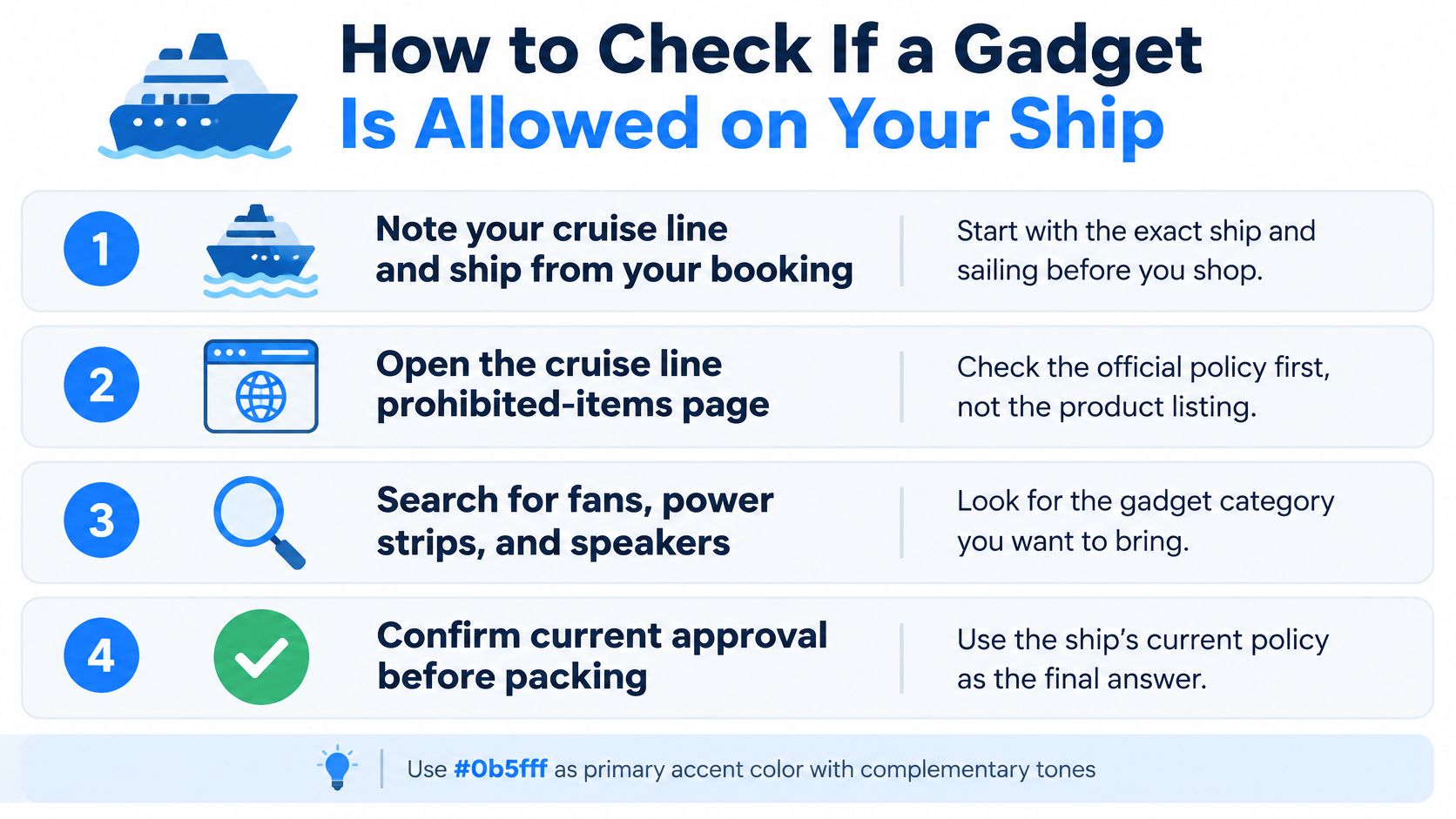
- Pull the line and ship name straight from your booking. Policies attach to the operator, and some rules get enforced differently vessel to vessel at the security scanner.
- Open the prohibited-items page on the line's own site. Search it for fans, power strips, speakers, and routers. The line's own page is the authority; product listings and blog roundups lag behind it.
- Sort each gadget by power source and circuitry. Battery-powered items draw the least scrutiny. Anything plug-in touches the ship's electrical system and gets a harder look, and some lines ban surge-protected circuitry outright, which is how an ordinary power strip ends up in the security bin.
- Flag radios and magnets, then confirm grey areas in writing. Bluetooth, Wi-Fi, and routing hardware can be restricted even when the device seems harmless at home, and a strong magnet that grips a steel wall can also mark a finished panel. When the page is ambiguous, email or chat with the line and keep the written reply on your phone.
The wording varies enough between operators that a few examples are worth pinning down.
| Cruise Line | Documented Rule | Practical Action |
|---|---|---|
| Holland America | Bans electrical devices with surge protection, including some small fans and power strips, per its prohibited items policy | Check fan labels and leave power strips at home |
| Norwegian | Permits only small electric or battery-operated fans; security may confiscate them for inspection | Choose a battery-powered fan and expect a bag check |
| Carnival | Prohibits portable and Bluetooth speakers | Leave speakers at home and pack headphones |
| Royal Caribbean | Fan and power-strip rules sit on the line's own prohibited-items page | Screenshot the current page before you sail |
For any operator not listed here, the same four checks apply: find the page, search your categories, and keep a copy of the wording, because it changes.
Rule of thumb: a battery-powered fan goes in your carry-on. Anything with a cord, a plug, or a radio gets verified before you pay for it, and whatever clears the list still has to earn its spot in the bag that stays with you.
The same scrutiny applies to the everyday items in your case, and this guide to what you can take on a cruise lays them out item by item.
Choosing Cabin Fans and Judging Feature Claims
Airflow changes how a humid cabin feels, not its temperature. A 2025 monitoring study of three cruise cabins and six other onboard environments recorded cabin temperatures averaging 22.3 ± 1.4 °C, relative humidity of 68.2 ± 5.3%, ventilation above 20 L/s per person, and carbon dioxide generally below 1,000 ppm, as set out in research on cruise ship indoor air quality. Decent air on paper. It still sits close when nothing moves it, and moving air across your skin is what changes comfort.
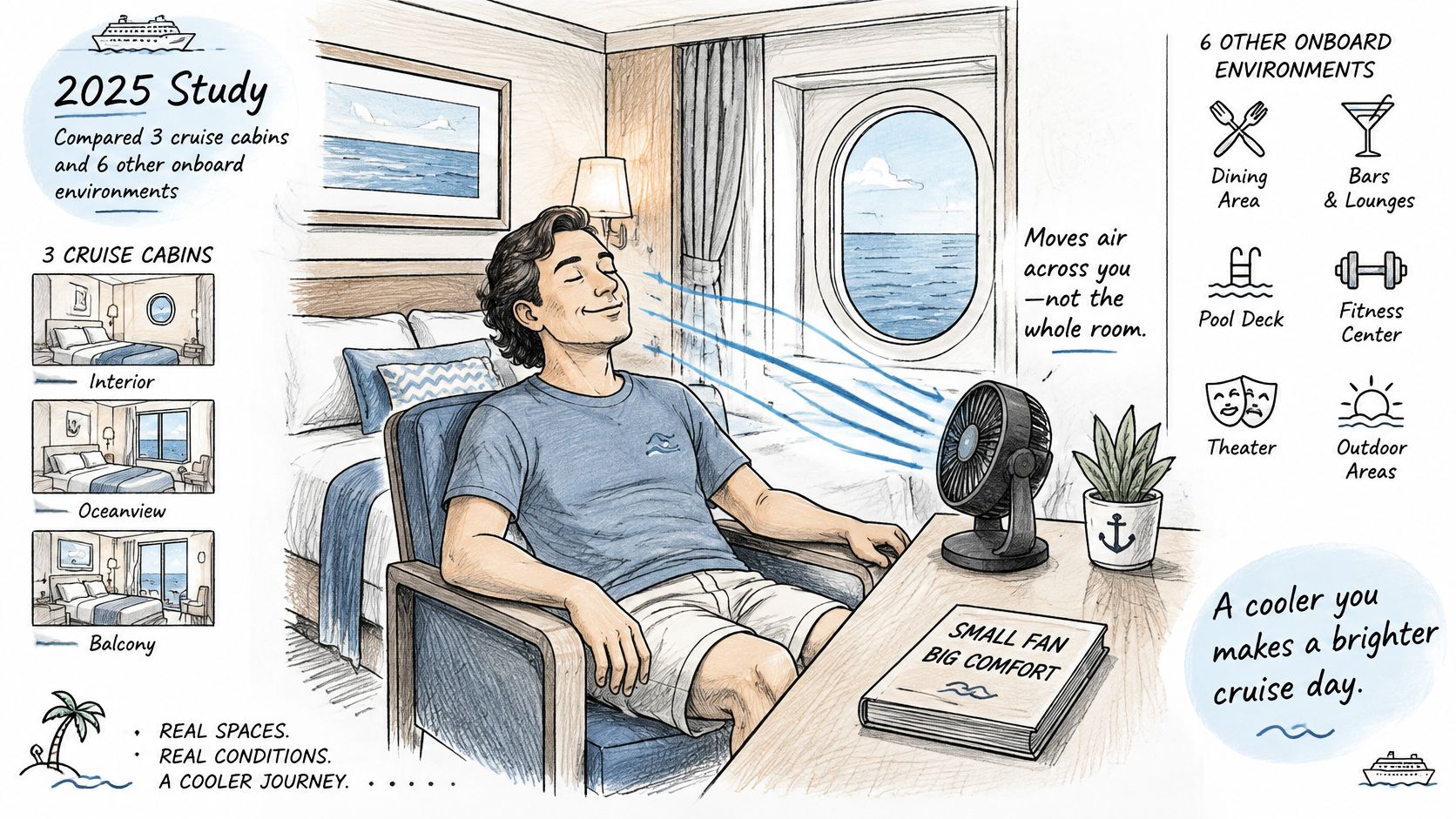
The buying checks, in the order that matters:
- Mounting. Confirm the wall, door, or ceiling takes a magnet, then test the hold before you trust it over a bed.
- Speed range. You want multiple speed settings so you can run it low overnight without a gale across the pillow.
- Battery. Ask for runtime at each speed, because the top setting and any built-in light drain it fastest.
- Noise. A quiet low setting matters more for sleep than maximum airflow.
- Direction. Aim airflow at the desk or seating area. Do not park it pointed at a sleeping passenger all night, since constant high local air velocity gets uncomfortable.
Three listing terms get used loosely, so pin them down before you compare models. Magnetic means the base holds to steel without screws, tape, or a stand. Rechargeable means it runs on an internal battery and a USB-C cable instead of hunting for an outlet. Compact means it packs flat into a carry-on or handbag. None of those words implies quiet, powerful, or compliant with your ship.
| Feature | Why It Matters | Check When Buying |
|---|---|---|
| Magnetic base | Holds gear off counters and shelves | Confirm the cabin wall, door or ceiling is metal |
| Rechargeable battery | No outlet hunting in a crowded cabin | Check runtime at the setting you will use most |
| Compact footprint | Fits a carry-on, handbag or drawer | Measure thickness against your packing space |
| Multi-speed control | Allows gentle airflow for sleep | Test the lowest setting before you cruise |
| Timer or auto-off | Saves battery and avoids running all night | Confirm the timer range and how the device turns off |
| Remote or app control | Adjusts settings without standing up | Decide whether you need it; it is optional |
Take the fan we sell, the Magnetic Fan for Cruise Ship Cabin. It's cordless and USB-C rechargeable, rated at 4 to 12 hours per charge depending on speed and light, thinner than a book, with multiple speed settings and a magnetic base for walls and ceilings. That spec sheet is the same one you should demand from any fan you're considering, including the runtime figure most listings hide.
Skip what the cabin already gives you. A fan with a remote is convenient. A fan with a remote, a timer, an app, and a nightlight is a device you'll charge twice a day.
Because airflow settings matter more than raw power, read up on variable speed fan control before you pick a model. Then run a placement test at home: lowest speed for an hour before bed, then adjust where it points.
Organizers, Night Lights and Drying Lines That Work
A cruise cabin works as a bedroom, bathroom, closet, and drying rack, often inside the same twelve hours. CLIA's 2025 global market data puts the average cruise at 7.0 days, down slightly from 7.1 days in 2024, with roughly 35% of ocean-going passengers under 40 and 34% over 60 (CLIA global market overview). That is seven repetitions of every small annoyance, shared by people who may want very different things from the same room.
Three gadgets cover most of that friction. Match each one to the problem it solves.
The counter problem. Two people, one bathroom counter, and a hairbrush already rolling toward the sink. A magnetic organizer hangs on the bathroom door or a metal side wall in under 30 seconds and holds toiletries, sunscreen, chargers, and the day's documents where you can see them. It adds vertical storage without taking up counter or floor space, and nothing gets knocked into the drain.
The wet-swimsuit problem. Suits come back soaked and the bathroom's retractable line sits inside the shower. A magnetic clothesline goes on a wall where air moves, holds swimwear and towels off the bed and chairs, and keeps the vent clear. A family of four can hang four suits on a bathroom-door line after a pool afternoon and have them dry by morning.
The dark-cabin problem. Someone needs water or the bathroom at 2 a.m., and the overhead light would wake the room. A rechargeable motion-sensor light along the bathroom doorway and the path to the door lights up when it senses movement, giving low-glare guidance without anyone touching a switch.
Buying order follows the same logic. Start with the organizer, because the clutter happens every day. Add the night light if anyone in the cabin wakes in the dark. Finish with a clothesline if your itinerary includes pool or beach days. None of the three needs an outlet, a screwdriver, or a manual.
What Motion Comfort Aids Can and Cannot Do
No gadget cures seasickness, and any product implying otherwise is overselling. Seasickness is a sensory-conflict response to ship roll and pitch: your inner ear registers the sway while your eyes see a still room, and your body reacts with nausea and stress. A peer-reviewed review of sea sickness in naval personnel describes it as motion sickness caused by roll and pitch movement, which makes sea state, exposure time, and where you are on the ship the variables that matter.
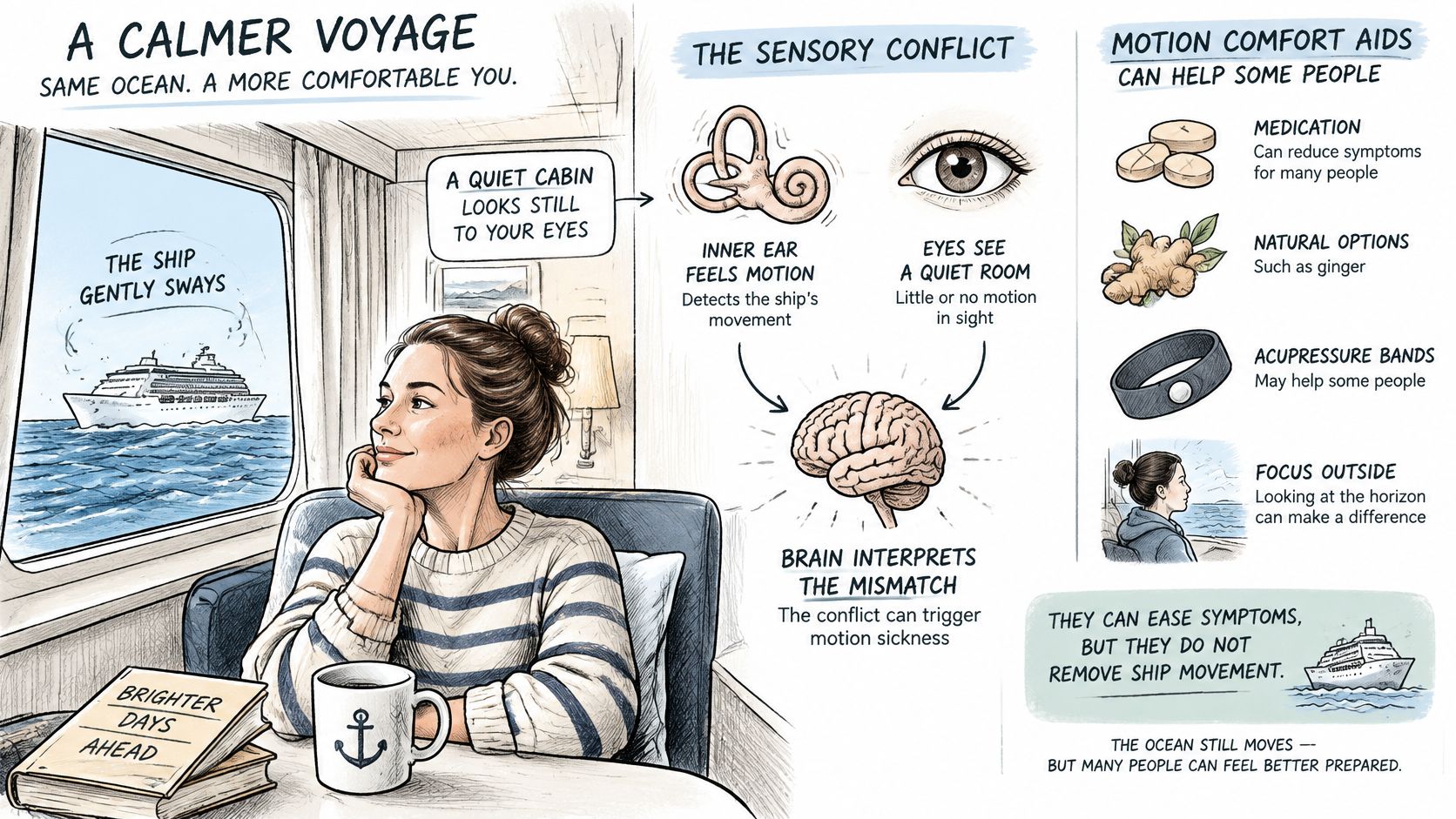
What reduces the mismatch, in order of effect:
- Book a midship cabin on a lower deck. Motion is smallest near the ship's center of rotation, lower and more central than the bow or stern.
- Find a stable horizon. Looking at a distant fixed point from an open deck cuts the visual-vestibular conflict.
- Spend less time in high-motion areas on rough days. The bow and upper decks amplify movement, so a sea day in a low, central lounge beats a top-deck stroll if you're susceptible.
- Use a labeled aid as designed. A non-drowsy patch belongs in the routine, applied and dosed per its label, not as an emergency measure after symptoms start.
- Check interactions with a pharmacist. Anyone taking other medicines or managing a condition should confirm before adding a patch.
"Non-drowsy" describes an intended side-effect profile. It isn't a promise that every passenger responds the same way, and susceptibility varies from person to person and voyage to voyage. Test any patch or aid at home before the trip, never for the first time on a rough sea day.
Tracking a Bag From Airport to Cabin
A bag passes through five handoffs between airline and cabin: airline transfer, port staging, ship loading, cabin delivery, and disembarkation pickup. Each stage has its own blind spot, and each one calls for a different tool. Demand for visibility is now mainstream: 88% of travelers say real-time luggage tracking would increase their confidence, and 42% tracked checked luggage through an airline app in 2025, up from 35% in 2024, according to IATA's 2025 global passenger survey.
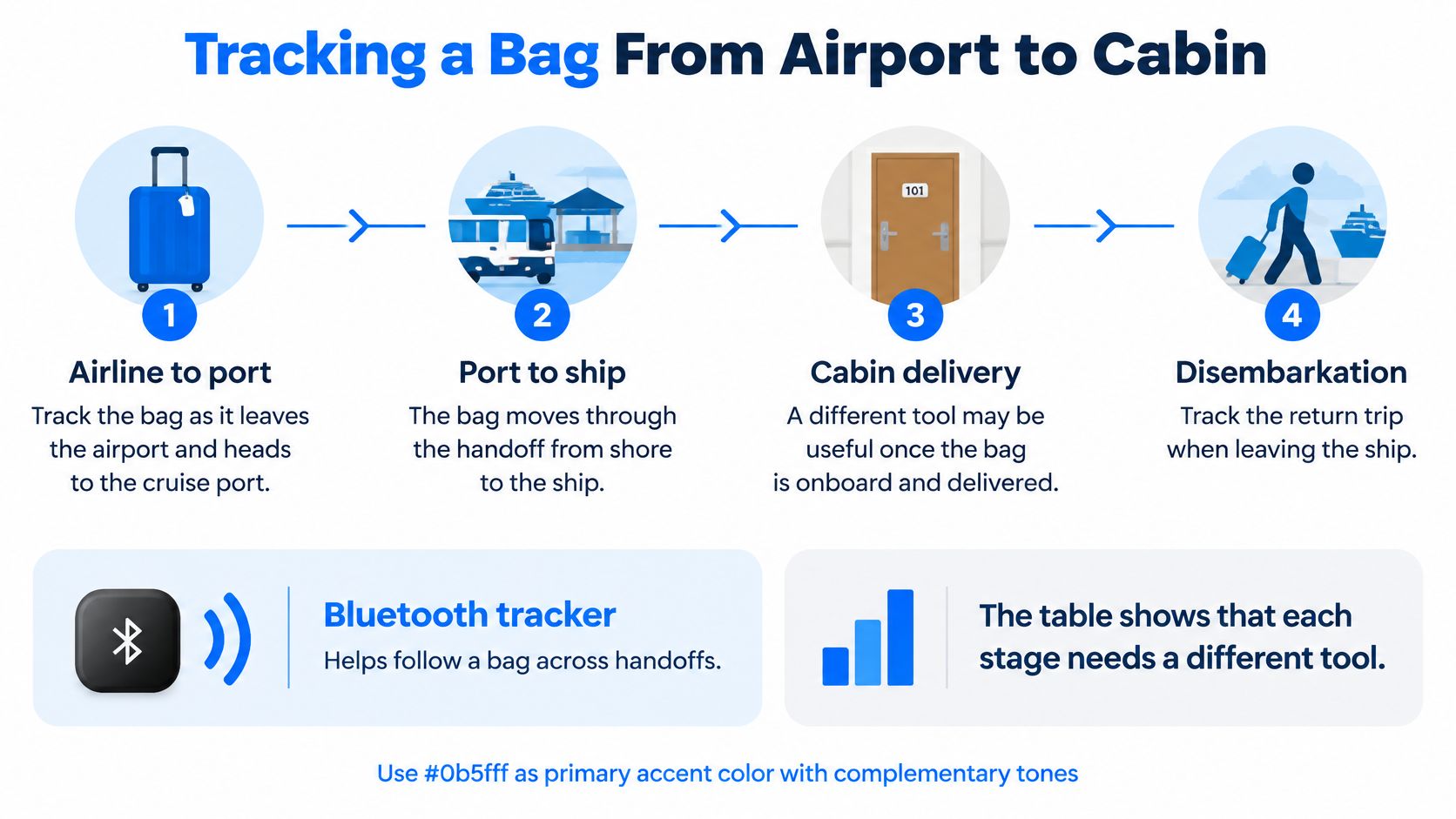
| Travel Stage | Tool | What It Shows | Main Limit |
|---|---|---|---|
| Airline check-in to destination | Airline baggage app | Scan events on a checked bag | Updates depend on airline scans |
| Terminal and port transfer | Bluetooth tracker | Nearby phone-network location | Shows proximity, not a guaranteed bag position |
| Ship loading and cabin delivery | Visible ID tag and photos | Your contact details and contents | Depends on someone reading the tag |
| Disembarkation pickup | Bag tag with cabin number and photo record | Proof of ownership | Depends on handling and the port's process |
Know what a Bluetooth tracker reports. In a crowded terminal it marks proximity to phones on the tracking network, which gives an approximate area rather than a fixed position. Gaps are normal whenever a bag sits somewhere with few devices nearby, so a quiet tracker usually means the bag is out of range. Treat the tracker as one layer of a wider system.
Build the rest of that system before you fly:
- Photograph every bag inside and out, including the exterior fabric, the tag, and the contents spread on a bed. That photo is the evidence you'll hand an airline or port agent.
- Put a card inside each bag with your name, cabin number, and sailing date.
- Use a visible ID tag with two contact methods, one of them a mobile number that works abroad.
- Keep airline baggage claim numbers in your phone so a claim can be filed without hunting for a receipt.
For privacy, write initials on a tracker rather than a home address. A tracker that travels with someone else can trigger an unwanted-tracking alert on their phone, so switch it off when you don't need it. This trackable cruise luggage tag setup guide walks through labels and tag details in more depth.
Give the bag tag details to the port agent if a suitcase goes missing between the terminal and your deck, and note the time each bag leaves your hands. A documented handoff is what turns a lost bag into a recoverable one.
Pack Your Cruise Gadget Kit Before You Sail
Decide in this order and you'll board with less than you think and everything you need.
- Pick your top two problems from the first table. Warm cabin and no storage are the most common pair.
- Run the rules check for your ship before you buy, not after it arrives.
- Charge every rechargeable item fully before embarkation day. A fan or night light that boards at half power starts the trip already behind.
- Pack battery items in your carry-on. That keeps them out of checked luggage and makes the security conversation easier.
- Photograph and label your bags with cabin details before the porters take them at the terminal.
Nordmoose builds its catalog around these exact cabin constraints, with magnetic cruise fans, cruise organizers, seasickness patches, cruise night lights, and a cruise clothesline. For cabin walls and doors, the recommendation is the magnetic setup on the Magnetic Cruise Door Organizer whenever the surface takes it, since the magnets hold the organizer flat to the metal and it lifts off again in seconds. The Magnetic Cruise Organizer 5 Pockets attaches in less than 30 seconds and adds vertical storage without taking counter or floor space, which matters on embarkation day when you're unpacking standing up.
The habit behind all of this is worth keeping. 82% of people who had cruised planned to cruise again in 2025, according to CLIA's 2025 industry report announcement, so gear that survives one voyage gets used on the next one. Buy for repeat trips, not for a single week.
Problem match and ship rules settle most of the list. The last test is the handoff itself: every gadget has to pack flat and ride from your hands to the porter's cart to the cabin without costing space you do not have. A fan that fixes a stuffy cabin but travels badly still fails that test, no matter how useful it would be once it got there.
Nordmoose stocks the pieces that pass all three checks: magnetic cruise fans that mount on cabin walls, magnetic organizers that turn a door into storage, rechargeable night lights, a magnetic clothesline, and non-drowsy patches for sea days. Each one is built for the space and rules of a real stateroom rather than a hotel room. Browse the cruise essentials at Nordmoose and pack for the cabin you'll be in.