

Waterproof Phone Pouch with Lanyard: Cruise Guide
You're standing on a pool deck with wet swimwear, sunscreen on your hands, and a phone you need for photos, boarding details, and directions. Then someone bumps your shoulder, the tender shifts under your feet, or the phone slips from a damp pocket. At sea, that split second can turn a useful device into a lost device.
A waterproof phone pouch with lanyard solves two separate problems at once. The sealed pouch creates a barrier against water, while the strap keeps the phone attached to you instead of resting loose on a lounger, in a beach bag, or beside a tender seat. But don't trust a pouch merely because its listing says “waterproof.” Check the test conditions, inspect the closure, and understand what the water rating does and doesn't promise.
Table of Contents
- Why Every Cruiser Needs a Waterproof Phone Pouch With Lanyard
- Understanding IP Ratings and Waterproof Claims
- Choosing the Right Size and Seal Type for Your Device
- Lanyard Styles and Secure Attachment Methods
- Cruise-Specific Scenarios for Pouch Use
- Maintaining and Testing Your Waterproof Pouch
Why Every Cruiser Needs a Waterproof Phone Pouch With Lanyard
I've watched cruisers make the same mistake repeatedly. They leave the phone in a swimsuit pocket during a pool break, set it on a wet railing for a photo, or carry it loose while boarding a tender. The phone doesn't need to spend hours underwater to become a problem. A splash through an open pocket or one awkward drop is enough.
A regular pocket fails because it doesn't secure the device against movement. Wet fabric stretches, pockets open when you sit, and crowded pool areas give phones plenty of opportunities to slide out unnoticed. A lanyard changes the failure point. If the phone leaves your hand, it remains connected to your body, provided the attachment point and strap are properly secured.
Water damage is a meaningful consumer risk. One widely cited survey reported that 4 in 10 people had damaged a cellphone by dropping it in water or spilling liquid, while a Kelton Research survey of 1,000 smartphone users reported that 20% had damaged a device after dropping it into a toilet. Those figures aren't cruise-specific and come through a device-protection provider, so treat them as directional evidence, not a global incidence rate. Still, they make the practical point clearly: liquid accidents happen often enough to justify prevention. Consumer survey context on cellphone water damage
Where the strap earns its place
The lanyard matters most in places where recovery is difficult:
- Tender boats: Boarding involves movement, wet surfaces, and limited personal space.
- Pool decks: Swimwear pockets and slippery hands are poor phone storage.
- Shore excursions: A dropped device can disappear between rocks, into surf, or under a boat seat.
- Embarkation lines: Crowds create accidental knocks and hurried handling.
- Piers and small boats: A phone over the edge may be unrecoverable, even if the pouch stays sealed.
A pouch doesn't guarantee flotation or recovery. It also doesn't make careless handling safe. It gives you a better physical setup: phone enclosed, strap attached, hands available.
Practical rule: If you're carrying the phone near water, attach it before you leave the cabin, not after you reach the pool.
Choose a pouch you'll wear. A bulky case that stays in your luggage offers no protection when the phone is in your hand. For cruise travel, the useful combination is simple: a transparent viewing window, a closure you can verify, a compatible fit, and a reinforced lanyard attachment.
Understanding IP Ratings and Waterproof Claims
“Waterproof” is a marketing word. IP is a standardized classification system with defined meanings. The international framework is IEC 60529, which underpins the globally recognized Ingress Protection code. The International Electrotechnical Commission says the first edition was published in 1976 to consolidate enclosure-protection requirements into one standard. IEC explanation of IP ratings
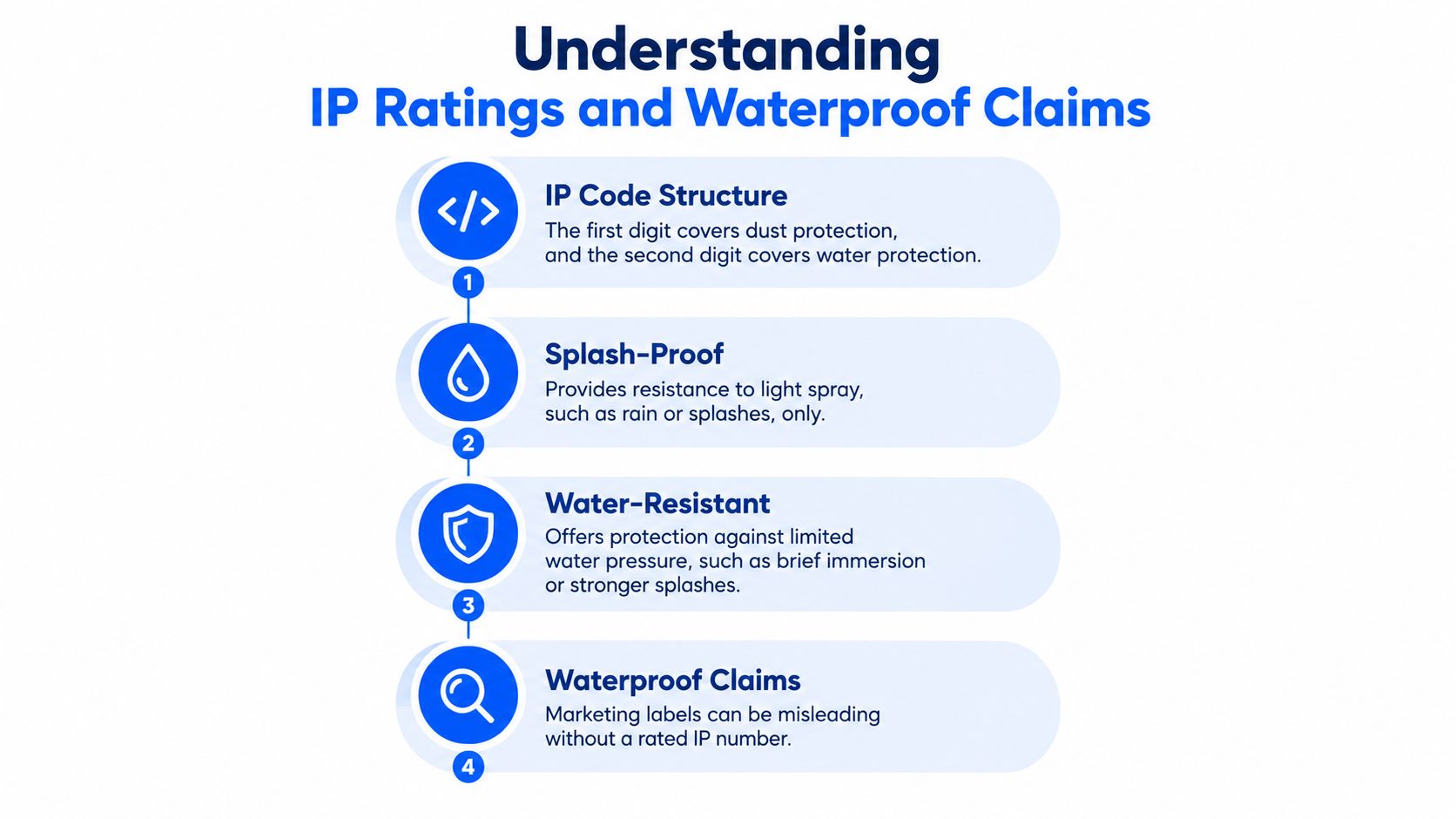
An IP code uses two numerals. The first rates protection from solid objects and dust on a scale from 0 to 6. The second rates protection from liquids on a scale from 0 to 9. That difference matters on a ship, because a vague “waterproof” label tells you nothing about dripping pool water, spray from a tender, or a full dunk.
Why IPX8 needs more detail
Under the IEC system, an IPX8 enclosure is designed for continuous water immersion beyond 1 meter, but the manufacturer must state the tested depth and duration. IPX8 does not mean unlimited underwater use. Two pouches can share the same IPX8 label and still be tested under different conditions, so the badge alone is not enough for a buying decision. Explanation of manufacturer-declared IPX8 conditions
Ask for four details:
- Immersion depth, stated in clear units.
- Test duration, not just the word “continuous.”
- Closure configuration, including whether every locking element was engaged.
- Lanyard configuration, if the pouch was tested with the strap attached.
The rating describes water ingress protection. It does not automatically describe buoyancy, impact resistance, ultraviolet durability, or saltwater corrosion resistance. A pouch can stay sealed while its strap attachment tears, or it can pass a laboratory test while a poorly closed seal leaks in real use.
Match the rating to the scenario
Rain and pool spray do not create the same exposure as a phone dropped from a tender. A shallow-immersion pouch is not the same as one tested for deeper submersion. Read the declared test condition, then match it to the way you move through a cruise day.
The same habit applies to other cruise gear. A waterproof ID holder with lanyard still needs the same scrutiny. Check what was tested, what the label says, and whether the product was evaluated under conditions that resemble a wet deck, a crowded pool area, or a tender transfer.
For cabin organization, the Magnetic Clothesline for Cruise Ship Cabin is described with rubber-coated magnets, a portable retractable design, and a carrying bag. Those are product features, not an IP rating. Read the specification that matches the risk, and do not let a broad label do the work for you.
Choosing the Right Size and Seal Type for Your Device
A phone can fit inside a pouch and still be poorly protected. Measure the device with its everyday case installed, then compare those measurements with the pouch's usable interior area. Exterior dimensions are misleading because the closure channel and reinforced edges reduce the room available for the phone.
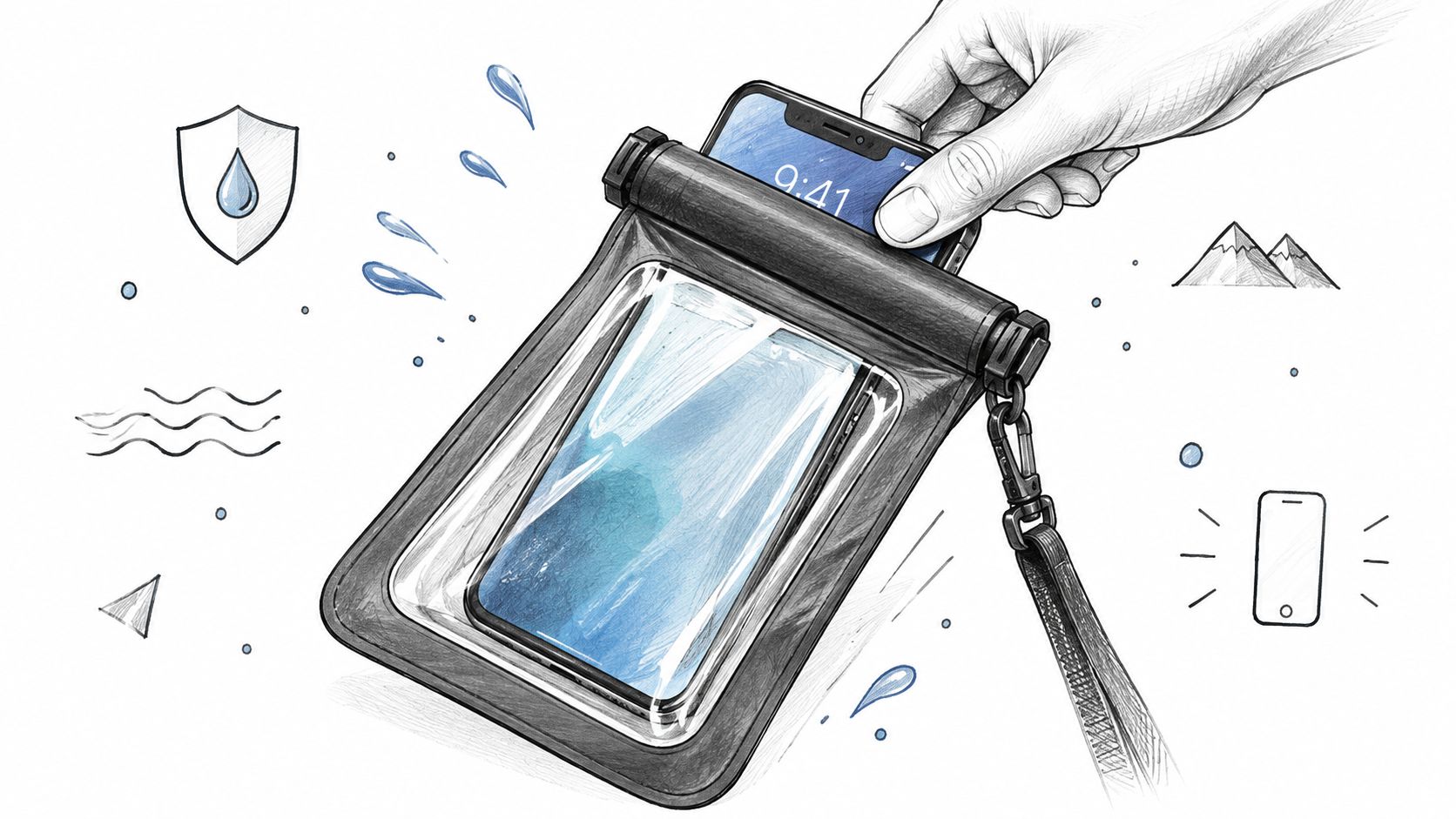
Leave enough space to load the phone without pushing it against the seal. A tight fit makes insertion awkward and can strain the closure. An oversized pouch creates its own problems: the phone shifts, tapping becomes less accurate, and loose membrane material can fold across the display. Choose the smallest size that accommodates the phone and case without pressure.
Roll-top closures versus zipper locks
A roll-top closure relies on folded material and a securing mechanism. It can form a strong barrier when the roll is even and fully secured. Uneven folding, trapped fabric, or an incompletely fastened closure defeats that protection, particularly when you are handling wet swimwear or moving through a crowded pool area.
A zipper-style lock gives a clearer visual check because you can inspect the track from end to end. Sand, hair, sunscreen, and folded material can still prevent a complete seal. Neither closure should be trusted solely because its marketing uses the word waterproof.
| Feature | Roll-top closure | Zipper-style lock |
|---|---|---|
| Daily handling | Requires consistent folding | Usually quicker to close |
| Inspection | Check the fold and securing point | Check the entire zipper track |
| Common failure risk | Uneven roll or trapped material | Sand, hair, or incomplete engagement |
| Cruise suitability | Useful for deliberate immersion preparation | Convenient for frequent poolside access |
Visibility does not guarantee normal operation
A transparent membrane keeps the screen visible, but water still affects capacitive touch controls. Wet fingers, droplets, and a thin film of water can produce missed or unintended inputs. University of Washington testing recorded a 21.34% gesture-error rate on an unmodified smartphone interface during wet-screen interaction. Its RainCheck method reduced errors to 5.2%, a 75.7% reduction. University of Washington research on wet-screen interaction
Dry the outside before tapping. Use deliberate swipes, avoid tiny on-screen controls, and set up navigation, tickets, or camera settings before leaving the cabin. A thin, clear membrane with little slack is easier to operate than thick plastic that wrinkles over the display.
Here's a practical demonstration of how a pouch can be loaded and worn:
If motion discomfort makes wet-deck handling harder, Sea Sickness Patches for Cruise are described as waterproof, non-drowsy travel support worth packing alongside the pouch for excursion days.
Lanyard Styles and Secure Attachment Methods
The pouch is only half the system. A sealed phone attached to a weak loop is still a lost phone waiting to happen. Treat the lanyard connection as a load-bearing component, not a decorative accessory.
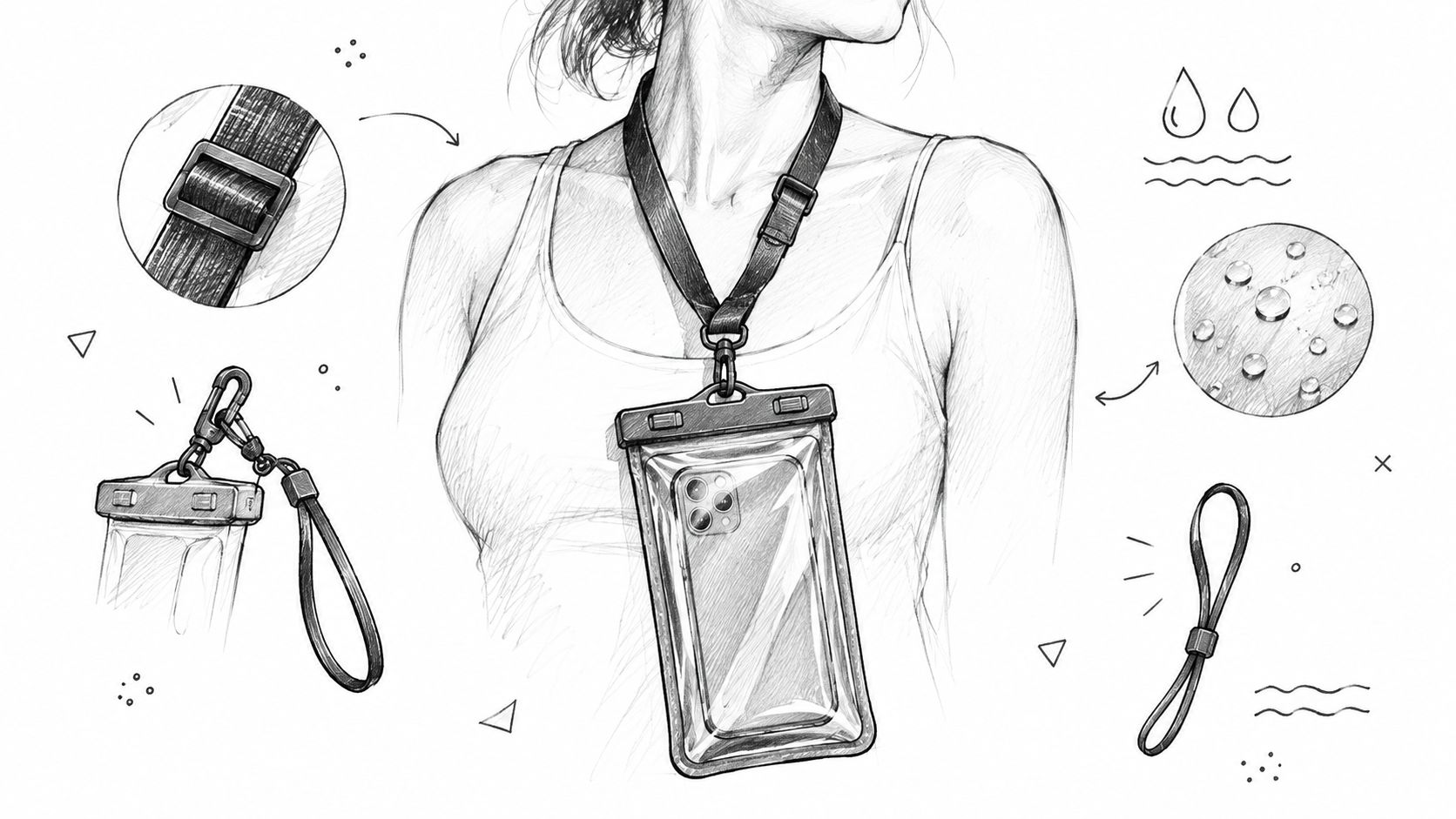
An adjustable neck strap suits pool decks, walking tours, and boarding areas because it keeps the phone accessible without occupying a pocket. A wrist loop works better for short periods when you're actively taking photos. Clip-on designs can be convenient, but the clip and the point it attaches to must both resist movement.
Test the complete setup
Use this routine before the voyage:
- Inspect the pouch empty. Look for torn film, damaged edges, distorted seals, or a loose attachment point.
- Insert a dry tissue or paper towel. Place it where the phone normally sits.
- Close the pouch exactly as instructed. Don't improvise the fold, snap, zipper, or locking bar.
- Apply controlled water exposure. Start with splashing and handling, then follow the manufacturer's stated testing guidance. Don't jump straight to carrying your phone underwater.
- Remove and inspect the tissue. Any dampness means the pouch needs further investigation before use.
- Load the phone and repeat the closure check. Confirm that the device hasn't pushed fabric into the seal.
- Test the attachment. Pull the lanyard firmly in several directions and inspect the connection afterward.
The strap should hold the pouch without forcing the closure. Don't swing it, yank it, or let it dangle while moving through crowds. A reinforced attachment point matters because the pouch may stay watertight even when the strap detaches.
Prepare access before the water arrives
Face or fingerprint authentication may fail through the pouch. Set a passcode before departure, and make sure you can reach the functions you'll need without depending on a wet, unreliable touchscreen.
Prepare offline boarding passes, emergency contacts, medical information, camera shortcuts, flashlight access, and the lock-screen emergency-call route. Practice opening, calling, taking a photo, activating the flashlight, and opening a boarding pass while the pouch is sealed.
For other cabin convenience, the Magnetic Cruise Fan with Remote Control is described as a rechargeable fan with a magnetic base, remote control, timer, adjustable airflow, and a multi-color night light. Separately, light-up lanyards for cruise use can help with visibility, but they don't replace a tested waterproof pouch attachment.
Cruise-Specific Scenarios for Pouch Use
Different cruise situations demand different habits. On the pool deck, keep the phone sealed before you leave your lounger. Wet hands, wet swimwear, and crowded chairs create more risk than most travelers expect. The lanyard should sit securely around your neck or wrist, never trailing where another passenger can catch it.
Tender boats deserve stricter handling. Hold the pouch close to your body while boarding, avoid using the phone during the most unstable movement, and don't treat the strap as permission to let the device swing. A sealed pouch may protect against water entry, but it doesn't guarantee that the phone will float or survive an impact.
Shore excursions combine spray, rain, sand, sunscreen, and repeated opening. Keep the closure clean and open the pouch only with dry hands when possible. On a wet shore, a phone that's easy to reach is useful, but a phone that can't authenticate or register taps is still frustrating in an urgent moment.
Make wet operation deliberate
A transparent pouch preserves visibility, not normal touchscreen performance. Water between your finger and the membrane can create false touches or shift the point the phone detects. Dry the outer surface, use firm swipes, and rely on physical controls for camera triggers, volume, or emergency actions when the screen becomes unreliable.
Before the excursion, complete a short usability drill:
- Access: Confirm that the passcode works through the sealed pouch.
- Call: Open an emergency contact without depending on biometric authentication.
- Photograph: Use the camera shortcut and a physical button if available.
- Light: Activate the flashlight with the pouch closed.
- Retrieve: Open an offline boarding pass or essential travel document.
For carrying towels, swimwear, and other wet items separately, a packable beach tote for cruise days can complement the pouch, but it shouldn't become the place where you leave an unprotected phone.
Cabins create a different problem. Don't place the wet pouch on bedding or leave it pressed against clothing that needs to dry. Separate the phone from damp swimwear, wipe down the exterior, and inspect the seal before the next outing.
Maintaining and Testing Your Waterproof Pouch
A pouch can survive a poolside splash today and leak on the next tender ride. Sand, sunscreen, hair, salt crystals, bending, repeated opening, and a closure that is only partly engaged can create a new route for water. Inspect it before trusting it with your phone.
The lanyard needs attention too. Its attachment point can tear or loosen while the pouch itself remains sealed. Check both systems separately, because a watertight pouch is useless if the phone drops overboard.
Use a pre-trip inspection routine
Before every voyage and before each major water outing:
- Check the film: Look for punctures, clouding, cracks, and stretched sections.
- Clean the seal: Remove sand, hair, sunscreen residue, and trapped fabric.
- Inspect the closure: Confirm that every snap, fold, zipper, or locking bar is fully engaged.
- Examine the attachment: Look for fraying, loose stitching, torn tabs, or a distorted ring.
- Run the tissue test: Seal a dry tissue inside and expose the pouch to controlled water. Remove it and check for dampness.
- Dry the exterior: Wipe away water before handling the phone.
- Replace doubtful gear: If the tissue is damp or the attachment looks compromised, keep your valuable phone out of the pouch.
The tissue test is a practical inspection, not proof that the pouch will remain safe in every situation. Use the same closure configuration planned for the cruise, and test with the phone installed if the design changes when loaded. A pouch that passes while empty may behave differently when the device presses against the film or closure.
Treat salt and sand as equipment hazards
Salt crystals left in a fold can slowly wedge the closure open, so rinse or wipe the exterior after saltwater exposure according to the manufacturer's care instructions. Do not force a dirty closure shut. Sand can damage a zipper track, stop a snap from seating, and scratch the viewing area.
Wet swimwear and crowded pool decks make contamination easy. Keep the pouch away from towels and damp clothing, then rinse away grit before storing it. In the cabin, dry the pouch open enough for air circulation when the product instructions allow it. Keep it away from sharp objects in luggage, and do not fold it around the phone for long-term storage.
A rating matters only when you know the test conditions and maintain the seal that was tested.
The reliable cruiser's routine is simple. Check the product's declared depth and duration, inspect the pouch before each outing, test it with tissue, prepare phone controls in advance, and secure the lanyard. If a product page says only “waterproof” without meaningful test information, choose a different pouch.
Nordmoose offers cruise-focused accessories such as compact cabin gear, magnetic organizers, clothes-drying solutions, motion-comfort products, and other travel essentials designed around shipboard use. Visit Nordmoose before your voyage, and pack for wet decks, crowded tenders, and small cabin spaces.