

Light Up Lanyards for Cruises: A Practical Guide
You've just come back from dinner, the corridor is dim, and your family has scattered between the elevators, the stairs, and the cabin door. Everyone is wearing a similar jacket, the ship is full of moving passengers, and a phone flashlight feels too bright for the people already sleeping nearby. A light up lanyard can make that small problem easier, but only if you choose it for visibility and identification rather than for novelty alone.
The useful question isn't whether a lanyard glows. It's how it glows, where the light sits, how long it lasts, and whether other people can recognize it without glare. On a cruise, that distinction matters in crowded embarkation areas, dark corridors, outdoor decks, terminals, and family meetups.
Table of Contents
- Why Cruise Travelers Reach for Light Up Lanyards
- The Three Main Types of Light Up Lanyards Explained
- Activation Modes and How Each One Behaves Onboard
- LED Placement, Brightness, and 360-Degree Visibility
- Five Cruise Moments Where Light Up Lanyards Earn Their Place
- Battery Life, Charging, and Airline Packing Rules
- Buying Checklist and Pre-Trip Habits for Light Up Lanyards
Why Cruise Travelers Reach for Light Up Lanyards
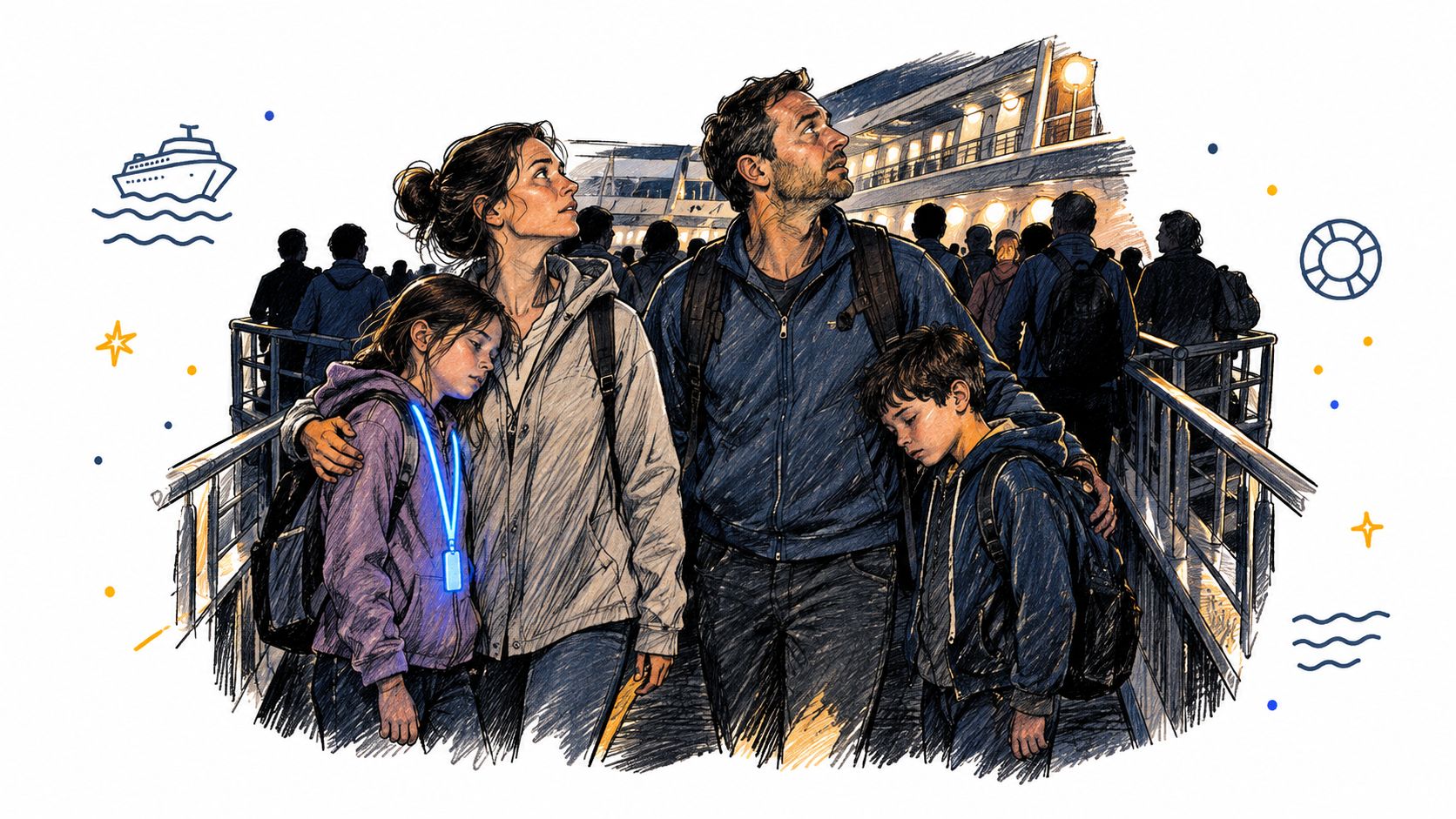
The first evening aboard often creates the exact situation these accessories are meant to solve. After muster drill, one parent may be guiding a tired child while another stops to check directions. The group reunites near a gangway or elevator lobby, surrounded by guests in nearly identical clothing. A small glow around the neck gives the eye another landmark to find.
That makes a light up lanyard more than a decorative badge holder. It can act as a personal identification marker, a soft guide for short nighttime walks, and a way for companions or crew to distinguish one guest from a crowd. The light's position near the neck or upper torso also gives it a better chance of being seen than a tiny lamp hanging low from a pocket.
Five practical jobs onboard
- Finding family members: A steady color or gentle pulse can help a parent recognize a child from across a busy deck or terminal.
- Helping a crew member identify you: Illumination can make your badge area easier to notice, although it doesn't replace following crew instructions.
- Locating a keycard: A lanyard keeps the card near your hand and can make the surrounding area easier to see in a dark cabin.
- Staying together during disembarkation: A shared color gives a group a simple visual cue while passengers move through a crowded terminal.
- Guiding short cabin trips: A low setting can help with a bathroom visit without switching on the main cabin lights.
Research on illuminated wearables supports the basic visibility principle. A review of pedestrian-visibility interventions found that lamps, flashing lights, and retroreflective materials can improve nighttime detection and recognition, especially with red and yellow materials (research on pedestrian visibility interventions). The same source describes experimental work in which LED-equipped clothing reached a minimum recognition distance of 198.8 meters, while LED-equipped subjects were recognized approximately 150.9 meters farther away than subjects without the enhanced equipment. Those measurements don't prove that every lanyard performs identically. Battery condition, viewing angle, obstruction, color, and ambient light all change the result.
Practical rule: Treat the glow as a wayfinding and identification aid, not as permission to ignore shipboard safety systems, signs, or crew directions.
The best cruise lanyard therefore balances visibility with courtesy. A controlled glow can help people find one another. Maximum brightness or rapid flashing may attract attention, but it can also disturb cabin neighbors or create discomfort.
The Three Main Types of Light Up Lanyards Explained
The easiest way to compare products is to start with the power source. Product pages may use different names, but most light up lanyards fit into three practical families.
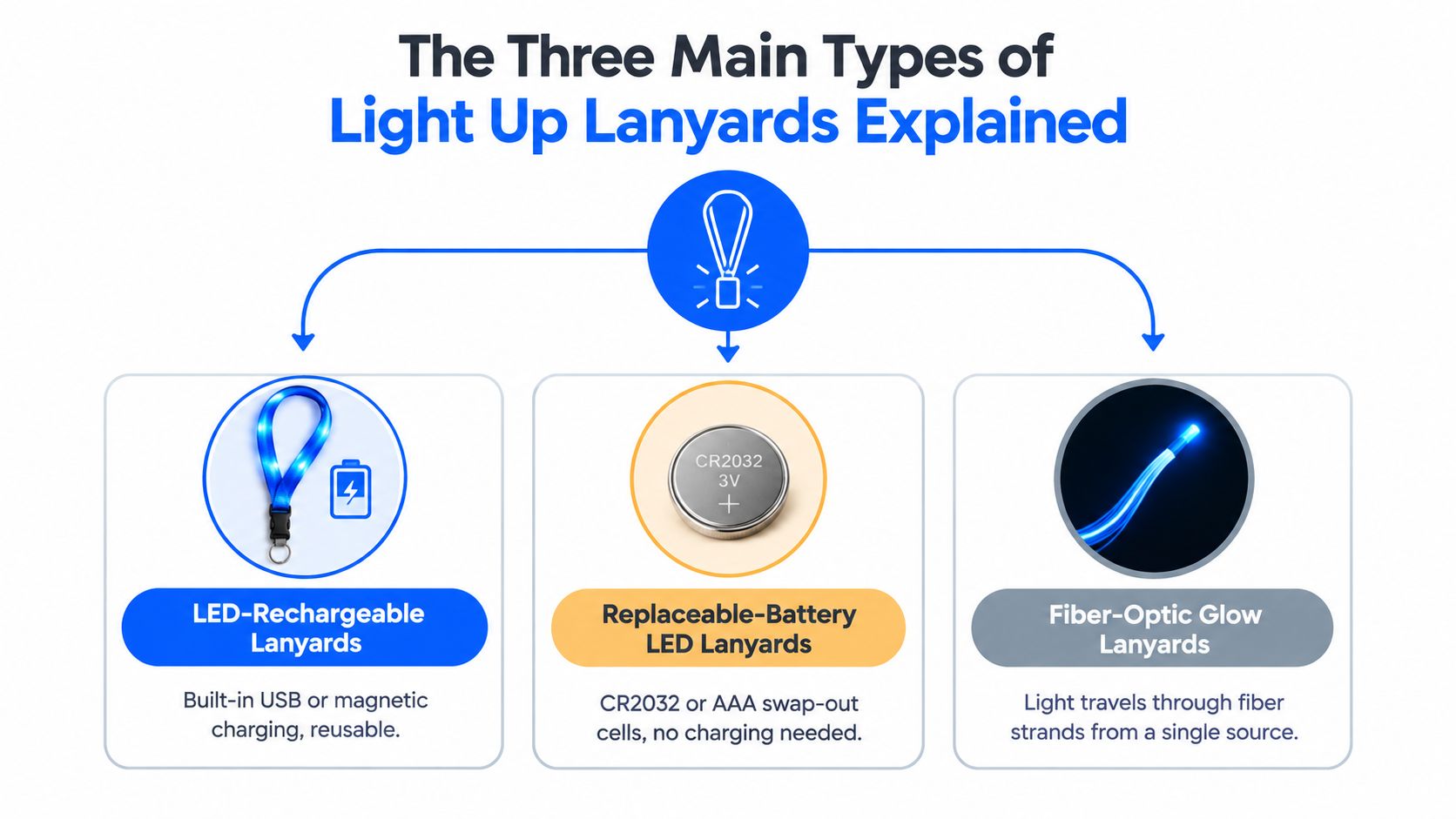
Rechargeable LED lanyards
These contain a built-in battery charged through USB, a magnetic charging connector, or another proprietary contact. They suit travelers who expect to use the lanyard repeatedly throughout a sailing and don't want to carry spare cells.
The trade-off is dependency. A sealed rechargeable unit may be convenient, but the product page should explain runtime by mode, charging time, low-battery behavior, and whether the battery can be replaced. EU guidance on the Batteries Regulation says portable batteries generally must be removable and replaceable by end users, with spare parts available for five years after the last model is placed on the market. The relevant replacement obligations apply from February 18, 2027, with stated exceptions (EU guidance on portable battery replacement requirements). Those rules don't answer every question about a particular lanyard, so travelers should still check the manufacturer's design and instructions.
Replaceable-battery LED lanyards
These use cells such as coin batteries or AAA batteries. They're useful when you want to restore the light quickly without finding a charging port, especially during embarkation or a port day.
Their weak spot is storage and handling. Spare batteries need protection from loose metal objects, and the battery compartment must close securely. A product that accepts replaceable cells also deserves a check for accidental activation, water resistance, and whether the light stays on inside luggage.
Fiber-optic glow lanyards
A fiber-optic design uses a small light source to send illumination through thin strands. It can distribute color along the strap while keeping the main electronics in one pod.
These models can create an attractive, even glow, but the light may be less powerful than a well-designed distributed LED system. They're a reasonable choice for a short event, a port meetup, or a child who wants a visible accessory without carrying a larger device. For a multi-day sailing, ask how the source is powered and whether the strands remain bright when the battery weakens.
The strap itself may be a flat woven band, a tubular sleeve around a conventional strap, or a clip-on pod attached to an ordinary lanyard. If your main goal is all-round visibility, a pod facing forward is less useful than illumination distributed around the neck loop.
A cruise fan can be part of the same practical packing conversation without being confused with a lanyard. The Rechargeable Cruise Fan with Magnetic Hook to Hang on Cruise Walls & Ceilings is described as a compact, rechargeable fan for cabins and travel, with a magnetic hook and selected timer or speed options. It solves airflow, not identification, but both accessories reward travelers who check power, packability, and cabin use before departure.
Activation Modes and How Each One Behaves Onboard
A light up lanyard's mode changes its usefulness more than many shoppers expect. The same hardware can be polite in a cabin, noticeable on a gangway, or irritating in a dark lounge depending on the setting.
Always-on illumination
A steady, low-brightness glow works well when a child is walking from the cabin to the bathroom or when a family wants a constant identifier during a quiet indoor stretch. It's easier to interpret than a rapid flash and usually feels less intrusive.
The setting can still be too bright near sleeping passengers. Look for dimming or a genuinely low setting rather than assuming every “steady” mode is cabin-friendly.
Slow pulse
A gentle rise and fall is often the most practical cruise default. It gives the wearer movement and presence without the visual intensity of a fast strobe. On an embarkation route, outdoor deck, or busy elevator lobby, a slow pulse can help a family member notice you without making the lanyard dominate the scene.
It may also reduce power use compared with running the light at full output continuously, but runtime depends on the product's electronics and brightness settings. Ask for measured runtime for the actual mode you'll use.
Fast flash
Fast flashing can make a wearer stand out in a crowded outdoor space, but it shouldn't be the everyday setting. Research on illuminated pedestrian equipment shows that visibility outcomes depend on context, and a 2025 study found that LED bands didn't significantly increase drivers' likelihood of yielding, even though they produced smoother deceleration (study of driver responses to pedestrian LED bands). That distinction matters onboard too. More attention isn't automatically safer attention.
Avoid aggressive flashing around people who may be photosensitive or uncomfortable with strobe effects. A cruise lanyard shouldn't be treated as an emergency beacon unless the product and situation specifically support that use.
Off and standby
This mode protects battery life between uses and prevents accidental illumination in a cabin drawer or travel bag. For a child's lanyard, off or motion-activated behavior may be the least disruptive option inside the stateroom.
A useful default is slow pulse outdoors, low steady light indoors, and off whenever the lanyard isn't needed. If motion activation is available, test its sensitivity before the trip. A sensor that triggers every time the wearer shifts in bed won't be as helpful as one that responds to a short corridor walk.
A calmer light is often easier for companions to recognize because it doesn't compete with every other moving light around it.
LED Placement, Brightness, and 360-Degree Visibility
LED count is a poor shortcut for judging a lanyard. Placement, luminance, and viewing angle determine whether people can recognize the wearer from the front, side, or rear.
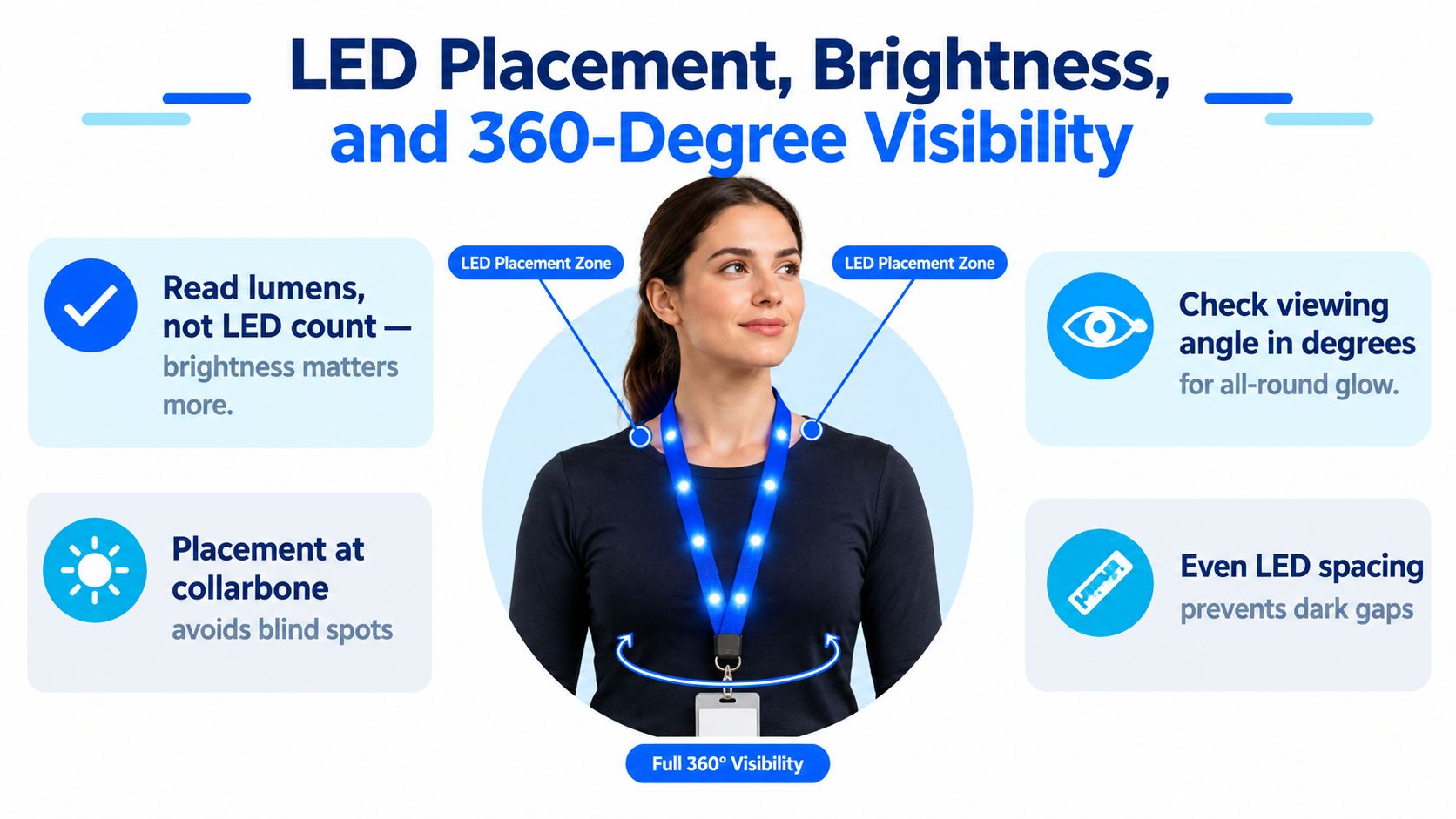
German occupational-safety testing found that isolated LEDs spaced at least 10 cm apart, along with small LED arrays up to 4 cm², were difficult to see at 50 m when luminance was only 10 cd/m². Across the tested configurations, performance was strongest around 400 cd/m², although excessive luminance can create glare (German occupational-safety testing of LED visibility). These are test findings for specific configurations, not a universal specification for consumer lanyards.
A front light versus distributed illumination
A single lamp on the chest may be easy to see when the wearer faces you. It becomes much less useful when that person turns a corner, walks ahead, or is viewed from behind. A distributed light source around the neck loop gives observers more opportunities to detect the accessory.
That's the practical meaning of 360-degree visibility. It doesn't mean the lanyard will be equally bright at every angle. It means the design shouldn't depend entirely on one front-facing point.
The viewing environment matters too. A bright light can wash out a badge, reflect off a cabin mirror, or feel uncomfortable in a dark room. Adjustable brightness is more valuable than a headline claim about maximum output.
What to look for on the product page
- Brightness specification: Look for a measured luminance or another clear output description, not only the number of LEDs.
- Mode runtime: Check whether the seller gives separate operating times for steady, pulse, and flashing settings.
- Light distribution: Favor illumination around the loop when all-round recognition matters.
- Angle testing: Look for front, side, and rear visibility rather than a single frontal photograph.
- Dimming: Choose a model that can be softened for cabins and indoor areas.
For nighttime cabin guidance, a separate rechargeable night light for cruise cabins may be more appropriate than wearing a bright lanyard. The lanyard helps people identify a moving wearer. A night light provides a stationary route marker.
Five Cruise Moments Where Light Up Lanyards Earn Their Place
A lanyard earns its space in your suitcase when it solves a repeatable problem. These five situations show where the accessory can help without turning every cruise activity into a lighting display.
| Scenario | Best mode | Why |
|---|---|---|
| Night embarkation or a busy gangway | Slow pulse | Gives family members a moving visual marker without the intensity of a rapid flash |
| A late-night bathroom trip | Low always-on or motion-activated | Offers enough guidance to avoid bright overhead lights |
| Disembarkation in a crowded terminal | Slow pulse or shared steady color | Helps a group recognize one another while matching tags and documents |
| Outdoor deck movement after sunset | Low steady or slow pulse | Keeps companions easier to spot during photos, dining, or a walk |
| A port meetup | Steady color | Acts as a simple identifier alongside a card holder or passport holder |
At night embarkation, keep the light visible but don't assume it makes a gangway safe by itself. Wet surfaces, stairs, crew directions, and changing traffic still require normal attention. The accessory helps your family find one another; it doesn't replace the ship's lighting.
For a cabin bathroom run, the goal is comfort rather than distance. A dim lanyard can be worn briefly, but motion activation is even better if it switches off after the wearer stops moving. Test it at home so you know whether the sensor responds to a small step or remains on for several minutes.
Disembarkation is where a shared color can be useful. One person may carry documents while another manages bags, so a recognizable glow gives the group another reference point. Keep passports, cruise cards, and luggage labels secure rather than relying on color alone.
On an outdoor deck, a soft setting helps companions keep track of one another without competing with ship lighting or other guests' cameras. If the lanyard has reflective material as well as LEDs, that passive layer can remain useful when the battery is depleted.
At a port meetup, the lanyard can identify your group before anyone sees the badge or phone screen. Choose a steady color and agree on it before leaving the ship.
Battery Life, Charging, and Airline Packing Rules
A runtime claim means little unless you know which mode produced it. A lanyard that lasts well in standby may run for much less time at maximum brightness or continuous flashing.
Ask four questions before buying:
- Which mode produced the advertised runtime?
- How long does a full charge take?
- Does the battery drain while switched off or in standby?
- What happens when the battery is nearly empty?
A rechargeable model may suit a multi-day sailing if you can charge it reliably. A replaceable-battery model may be easier during a long port day, provided you pack protected spares. A chemical glow product has no charging routine, but its fixed illumination period makes it better for a short planned use than for repeated trips around the ship.
Cabin charging arrangements vary, so check the ship's available outlets and bring only compatible charging equipment. This guide to cruise ship electrical outlets can help you plan how a small rechargeable accessory fits into the rest of your cabin setup. Don't assume that every USB socket delivers the same charging performance, and don't leave a device powered on just because it's connected.
Packing for the flight
Put a rechargeable lanyard and its charging cable in your carry-on bag, where you can inspect it and prevent accidental activation. Don't place a device with an active or damaged battery in checked luggage. Switch it fully off, engage a travel lock if the product has one, and protect the button from pressure inside the bag.
For replaceable-battery versions, prevent loose cells from touching keys, coins, or other metal objects. Keep the battery compartment closed and carry spares in suitable packaging.
Wet decks and damaged batteries
A lanyard used near pools, rain, or a wet gangway needs a clearly stated ingress limitation. “Water resistant” isn't the same as safe for immersion, and saltwater can reach charging contacts even when the housing looks sealed. Follow the manufacturer's cleaning instructions and let the unit dry before charging.
Stop using a device if the battery swells, the casing separates, the charging port becomes damaged, or the unit grows unusually hot. Don't charge a swollen or visibly damaged battery. A passive reflective backup and an ordinary identification method remain useful if the powered accessory fails.
Buying Checklist and Pre-Trip Habits for Light Up Lanyards
A sensible purchase starts with four answers: power type, brightness by mode, runtime by mode, and charging method. If a product page only says “long-lasting” or “super bright,” you still don't have enough information to compare it with another model.
Before flying, build a short routine:
- Charge it the night before: Confirm that the indicator reaches the expected state.
- Switch it off before packing: Prevent accidental activation and unnecessary battery drain.
- Carry it in your cabin bag: Keep the device available for inspection and protected from checked-bag conditions.
- Record identifying details: Photograph the model or serial information so you can find the instructions later.
Onboard, rinse or wipe the lanyard according to its care instructions after saltwater exposure, recharge it during a convenient sea day, and retire any swollen battery. Pair the glow with a passive reflective element or ordinary identification method. A light up lanyard can improve recognition in darkness, but it isn't a certified high-visibility garment and shouldn't replace caution, ship procedures, or crew guidance.
For a more conventional identification option, a waterproof ID holder lanyard can carry essential cards while protecting them from splashes. The practical choice may be one illuminated accessory for finding people and one passive method for identification when the battery is off.
Keep this final checklist with your travel documents:
- Buy: Confirm power source, brightness, mode runtime, and charging method.
- Pack: Charge, switch off, protect the battery, and carry it with you.
- Use: Select low-glare modes, avoid unnecessary flashing, and follow ship guidance.
- Back up: Carry a passive identification method and don't depend on the light as safety equipment.
Nordmoose offers cruise-focused accessories such as rechargeable cabin fans, magnetic organizers, night lights, and other compact solutions for small staterooms and travel routines. If you're building a practical cruise packing kit alongside a light up lanyard, visit Nordmoose to compare options designed around cabin comfort, storage, and nighttime use.