

Magnetic Toothbrush Holder for Cruise Cabins
You're brushing your teeth before breakfast, the ship is moving, and the toothpaste tube has just slid off the narrow sink ledge. Your toothbrush rolls toward the basin, the damp towel is hanging from the nearest door handle, and someone else in the cabin is waiting for the only usable patch of counter. That's a normal cruise-cabin morning, not a packing failure.
A magnetic toothbrush holder can fix the most irritating part of that routine by moving your brush off the wet ledge and onto unused vertical space. But don't treat it as a magic hygiene device or buy the first small magnet you see online. On a ship, the right choice depends on the wall surface, humidity, side loading, drip control, and how well the holder fits into a broader cabin-storage plan.
Table of Contents
- Why Cruise Cabins Need a Smarter Toothbrush Setup
- What a Magnetic Toothbrush Holder Actually Is
- Hygiene and Moisture in a Cruise Bathroom
- Choosing the Right Size and Magnet Strength
- Mounting and Placement in a Small Cabin
- Beyond the Toothbrush Other Things to Hang Up
- Cleaning Mid-Cruise and Packing It Back Home
- Buying Checklist for Cruise-Ready Holders
Why Cruise Cabins Need a Smarter Toothbrush Setup
Cruise bathrooms are built around quick use. You shower, shave, brush, rinse, and leave. They aren't designed to store a household's daily toiletries on a counter that's often only a few inches deep. The glossy surface gives bottles little grip, and once the bathroom door closes, the air can stay damp around the sink and shower area.
That creates a predictable chain reaction. A wet toothpaste tube slides into the basin. A toothbrush rests on a ledge that never seems fully dry. A razor occupies the only clear corner, while toiletries remain scattered because there's nowhere else to put them.
Cruise-cabin rule: If an item is used every morning, get it off the counter and onto a wall, door, hook, or caddy.
A magnetic toothbrush holder is a direct answer because it uses vertical storage instead of competing for horizontal space. On many ships, metal surfaces make that especially practical. A holder can attach to a suitable steel wall, cabinet door, or other metal fixture, keeping the brush head away from the sink and reducing the chance that a rolling item ends up on the floor.
Placement still matters. Keep the holder outside the main splash zone, leave room for the brush to air-dry, and make sure the magnet doesn't slide when you nudge it sideways. A holder that stays attached during ordinary cabin movement is useful. One that drops into the sink after every door slam becomes another item to manage.
For a wider cabin-storage approach, the same principle applies to toiletries, charging cables, sunglasses, and small accessories. This small-space cruise storage guide is built around that broader idea: use overlooked vertical surfaces rather than forcing everything onto a tiny vanity.
What a Magnetic Toothbrush Holder Actually Is
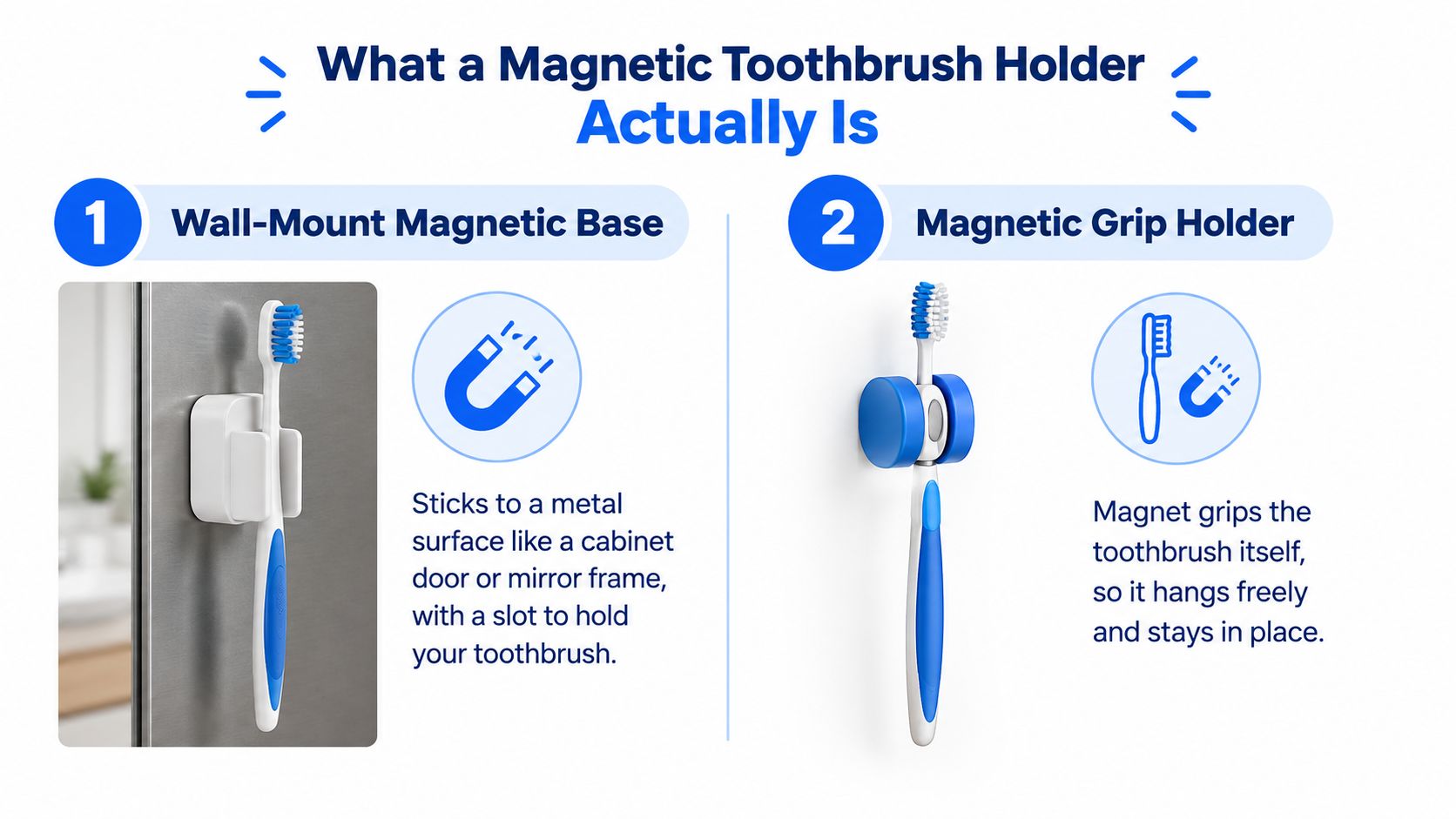
A magnetic toothbrush holder uses magnets in one of two ways. A wall-mount design holds the container or base against a metal surface, while a magnetic-grip design uses a magnet to suspend or secure the toothbrush itself. Those approaches look similar in a product listing, but they behave differently in a cruise bathroom.
A wall-mount base is usually the more forgiving option. The toothbrush sits in an open slot, cup, or cradle, while the magnetic back holds the unit to a metal wall or cabinet. If the bathroom surface isn't magnetic, some models use a separate metal plate attached with adhesive or hardware.
A magnetic-grip holder is slimmer and often lighter. It may use a cap, collar, or metallic component on the toothbrush handle, allowing the brush to hang from a wall strip. That can free more space, but compatibility becomes the main question. A non-magnetic handle may need an added metal piece, and a poorly matched cap can trap moisture around the brush head.
The category fits a broader move toward wall-mounted bathroom storage. As counters shrink, vertical surfaces become the logical place for items that need to stay visible and accessible. Patent records show that magnetic toothbrush storage isn't a recent novelty. A magnetic toothbrush and holder application was filed on February 7, 2008 and granted on May 20, 2014, while another magnetic-electric toothbrush holder was filed on November 5, 2010 and published on May 10, 2012. Later European patent work published in 2025 continued exploring magnetic or ferromagnetic attachment for hygienic wall storage. The patent record for the magnetic toothbrush and holder and the magnetic-electric toothbrush holder publication show a category that has been repeatedly refined.
If you're also organizing toiletries outside the bathroom, a Magnetic Cruise Door Organizer uses magnetic attachment on a cabin wall or door and provides mesh pockets for items such as toiletries and shoes. It's a separate storage tool, not a substitute for a compact toothbrush holder.
Hygiene and Moisture in a Cruise Bathroom
A magnetic toothbrush holder solves one clear hygiene problem: it keeps the brush off a wet, crowded counter. It doesn't sanitize the bristles, remove bathroom humidity, or guarantee that the brush will dry properly.
Cruise bathrooms combine several awkward conditions. A short shower can leave residual humidity in an enclosed room. Water splashes around the basin, and the area near the shower threshold may stay damp. Once the door closes, airflow can be limited. If the holder sits directly below the brush, water can run down onto the wall and collect at the base.
The best setup keeps the brush upright and open to air. Consumer guidance recommends air-drying toothbrushes in an upright position and avoiding closed or airtight containers because trapped moisture encourages bacterial growth. That makes an open cradle or vented holder preferable to a sealed cap that stays damp inside.
What the holder helps with
- Counter contact: The brush no longer rests on a ledge where toothpaste residue and splash water collect.
- Air circulation: An open design gives the bristles a better chance to dry between uses.
- Drip control: A holder with a removable cup or drain opening can keep water from pooling against the wall.
- Shared-space order: Each person can have a defined slot instead of placing brushes together in one cup.
What it doesn't fix
A wet brush still needs to drain. If the holder has a solid bottom, rinse it and empty it regularly. If the wall below shows a damp ring, wipe it rather than assuming the magnetic mount is keeping the area clean.
One practical solution is a small microfiber square placed beneath the holder during the voyage. It catches occasional drips and can be rinsed at the sink. Don't wrap the brush head in cloth, though. The cloth should protect the wall or ledge, not restrict airflow around the bristles.
A magnetic holder reduces contact with dirty surfaces. It doesn't replace rinsing, upright storage, or air-drying.
Material choice matters in this environment. Stainless steel grades such as 304 and 316 are preferred for wet areas because they resist rust, while exposed magnets can corrode if moisture reaches them through a damaged coating or failed encapsulant. The bathroom holder materials guidance highlights why sealed construction matters more than a shiny finish.
Choosing the Right Size and Magnet Strength
Start with the bathroom footprint, not the brush handle. A holder that technically fits the toothbrush can still block the mirror, collide with the faucet, or occupy the only place where another passenger needs to stand.
For one or two brushes, choose a compact body with a slim profile. A longer strip makes sense for a family or for combining toothbrush storage with a few light grooming tools, but only if the available wall is wide enough. Keep the loaded holder smaller than your open palm when possible. Every extra protruding edge becomes something to bump during a rough morning or a rolling ship movement.
Match the holder to the surface
The ship's wall may look magnetic while still providing less grip than a thick steel plate. Paint, wall thickness, curvature, and surface texture all affect performance. Neodymium magnets generally provide stronger attachment in a compact size than ceramic ferrite magnets, but the sealed housing and contact surface matter just as much.
The table below is a practical selection framework. It avoids pretending that a catalogue pull rating equals real-world holding capacity.
| Wall Surface | Recommended Magnet Grade | Minimum Pull Force | Notes |
|---|---|---|---|
| Clean, flat painted steel | Neodymium, preferably N35 or stronger | At least 3 times the loaded weight | Test for sideways sliding before use |
| Thin or lightly curved cabin steel | Strong sealed neodymium | Well above the loaded weight | Curvature and wall thickness reduce effective grip |
| Metal cabinet door | Neodymium with a high-friction face | At least 3 times the loaded weight | Avoid placing it where the door edge can strike the holder |
| Glass, tile, or painted drywall | Magnetic base with a separate metal plate | Based on the plate and adhesive rating | The magnet cannot attach directly without suitable metal |
| Textured or coated surface | Magnetic base plus secure backplate | Conservative margin above the loaded weight | Texture reduces contact and adhesive reliability |
Guidance for magnetic holders recommends using at least a 3x safety factor on clean, dry steel, while side loading can reduce practical holding capacity to roughly 15% to 25% of catalogue pull force before safety factors are applied. Those figures come from magnetic-holder load guidance. In a cruise bathroom, side loading comes from removing a cup, bumping the holder, or moving it while the ship rolls.
Press the holder against the wall, then push it sideways. If it slides easily instead of resisting movement, don't trust it with a wet brush. For more ideas about using magnetic accessories safely in a cabin, see these magnetic wall-hook tips.
Mounting and Placement in a Small Cabin
Scout before you stick anything down. Check the inside of the sink cabinet door, the side of a metal mirror frame, and the wall behind or beside the faucet. The best location is usually close enough for convenient use but high enough to escape the main splash pattern.
Mount the holder at least 15 centimeters above the basin, based on the practical placement guidance in the brief, and keep it away from the shower curtain's path. That distance won't prevent every splash, but it gives the brush a better chance of staying dry and keeps the unit from occupying the narrowest part of the vanity.
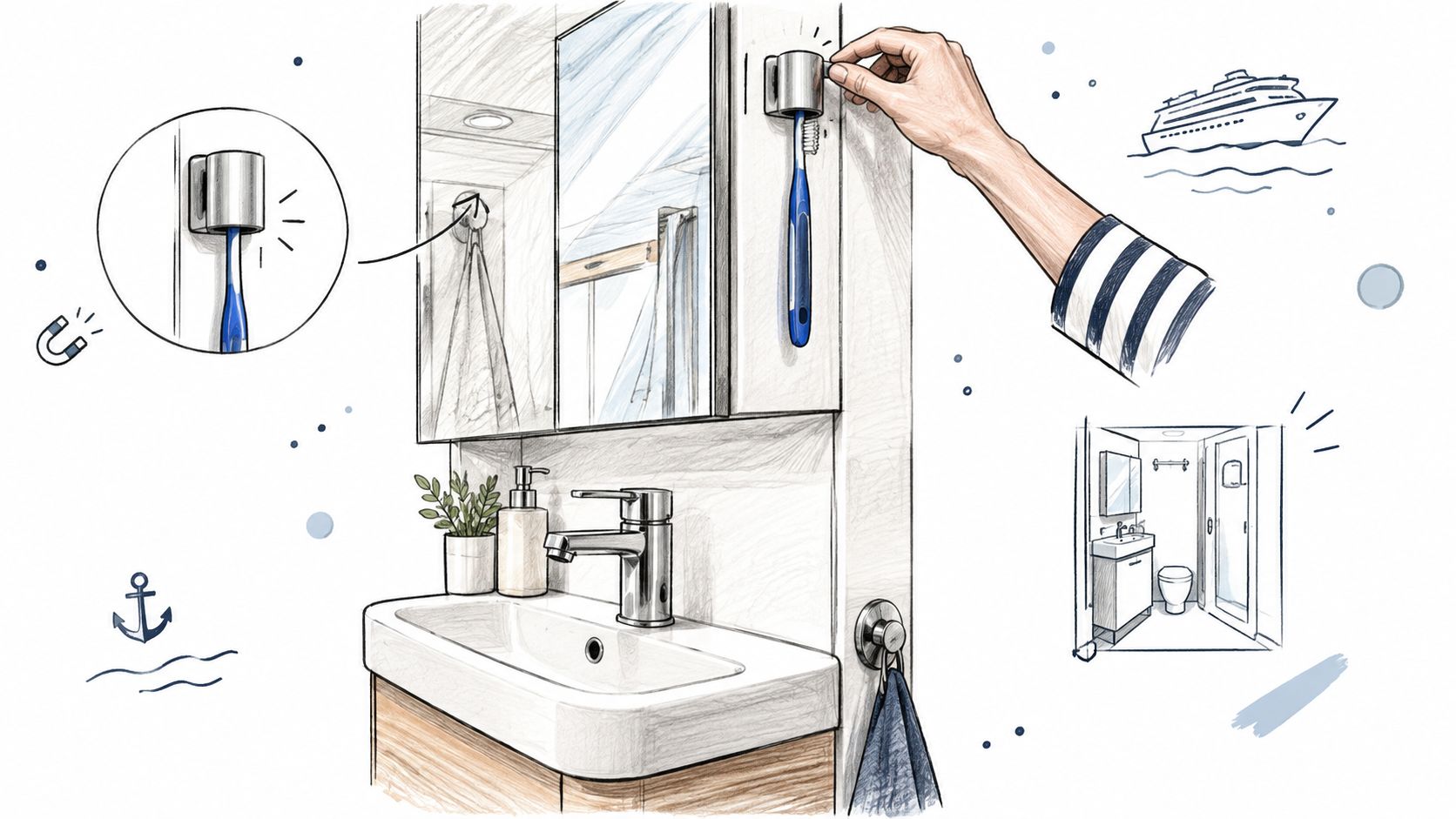
Look for a position near a ventilation grille if the cabin layout offers one. Don't place the holder where it blocks an outlet, catches on the toilet-paper roll, or swings into a mirror door. A holder that's easy to reach but sits outside the splash zone is more useful than one mounted directly over the sink for convenience.
When the wall isn't magnetic, create a proper magnetic surface rather than relying on a weak attraction through paint or tile. A small steel or galvanized backplate can provide the target surface, while a removable adhesive system should be rated above the holder's loaded weight. Follow the adhesive maker's curing instructions and clean the wall first. Don't attach anything to a damp or visibly dusty surface.
The cabin may also have curved panels or fabric-covered areas. In that case, a clip-on caddy over an existing towel bar can be less troublesome than forcing a flat magnetic plate onto an unsuitable surface. You're solving a storage problem, not trying to turn every wall into a mounting point.
A useful cabin test is simple. Nudge the holder sideways as if a wave or a shoulder had hit it. If it shifts, move it to a flatter surface, reduce the load, improve the contact face, or add a second anchor. The cruise magnet placement guide can help you identify other suitable cabin surfaces.
For a visual example of compact placement, watch this demonstration before you pack:
Beyond the Toothbrush Other Things to Hang Up
A magnetic toothbrush holder works best when it becomes part of a small system rather than a one-purpose gadget. The cabin's vertical surfaces can handle many light, frequently used items, but you need to separate objects that attach directly from those that need a hook, pouch, or caddy.
What belongs on a magnetic strip
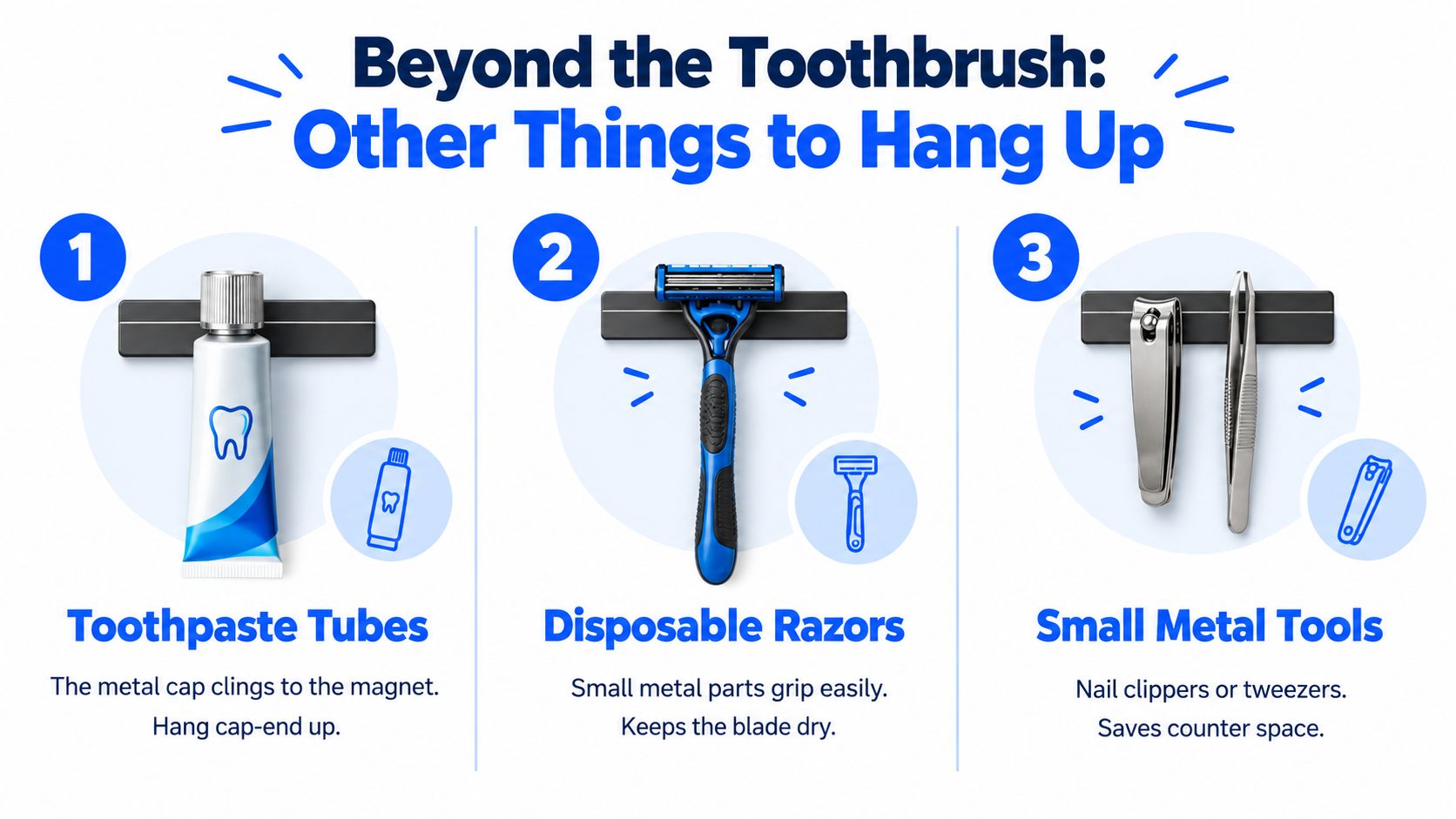
- Toothpaste tubes: A tube with a metal cap may cling at the cap end. Hang it cap-end up and squeeze from the bottom so the opening stays cleaner.
- Small grooming tools: Nail clippers, tweezers, and some folding scissors often attach directly if enough of their material is ferromagnetic.
- Disposable razors: Metal parts may grip a strip, keeping the razor off the counter. Protect the blade and don't assume every plastic-bodied razor will attach.
- Metal travel mirrors: A metal frame can make a mirror easy to park near the vanity without consuming the sink ledge.
- Glasses and sunglasses: Metal frames or hinges may attach to a light-duty bar near the door, where they're easier to find.
A deeper caddy is better for soft tubes, bottles, retainer cases, and items with irregular shapes. A flat strip keeps light metal tools visible, but it won't corral a collection of loose toiletries. Use a magnetic hook for a washcloth, loofah, earplug case, or cruise-card lanyard, provided the load remains modest.
What should stay off the magnet
Skip anything heavy, anything that's only superficially ferrous, and anything with sensitive electronics. Tablets, e-readers, and hearing aids belong in padded cases, not on a bathroom wall. Keep cards and other magnetic-stripe items away from strong magnets as well.
The organizing principle is straightforward: metal goes up, soft goods go in a caddy, and electronics stay protected. That division prevents you from turning a convenient strip into an unstable pile of objects that fall whenever someone opens a cabinet.
Cleaning Mid-Cruise and Packing It Back Home
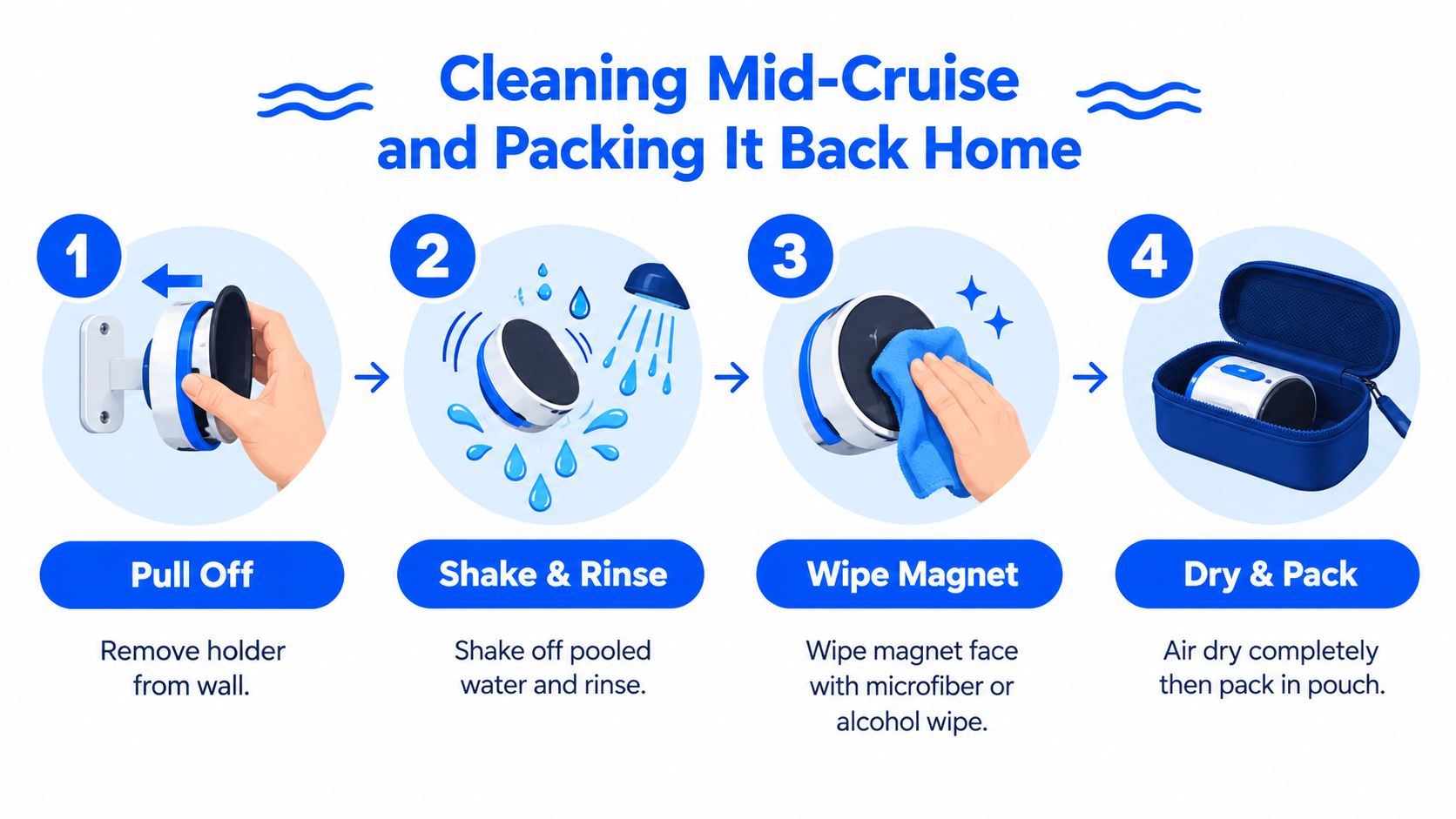
A magnetic holder needs a short cleaning routine, especially on a humid ship. Each evening, remove it from the wall, shake out pooled water, rinse any removable cup, and wipe the magnet face with a small microfiber cloth or alcohol pad. Then dry the wall behind it before reinstalling the holder.
That routine catches the moisture that product photos never show. Water can collect around seams, under a cup, or between the magnetic face and the wall. A quick wipe also removes toothpaste film and mineral residue before it hardens.
A simple onboard routine
- Pull it off: Remove the holder rather than wiping around it.
- Shake and rinse: Empty trapped water and rinse detachable parts.
- Wipe the magnet face: Use microfiber or an alcohol wipe on the contact surface.
- Dry and replace: Let the parts air-dry fully before mounting them again.
Salt air and bathroom humidity can leave a mineral film on surfaces. Give the holder a more thorough wash during the voyage with warm water and a drop of mild dish soap, then rinse and dry it completely. Don't soak a sealed magnetic assembly unless the manufacturer specifically allows it. Enclosed toothbrush caps deserve extra attention because they can trap moisture where you can't see it.
Packing rule: Dry the holder completely before it goes into luggage. Dampness trapped around the magnet is a corrosion problem waiting to happen.
Strong neodymium magnets also need careful packing. Keep the holder away from hotel key cards, credit cards, magnetic strips, tablets, e-readers, and compass-based equipment. Sandwich it between rigid cardboard, place it in a protective pouch, and position it in the center of your carry-on rather than loose beside electronics.
Before you leave the ship, wipe the wall and the holder's contact area one last time. That prevents a damp outline or rust residue from being left behind for the next passenger.
Buying Checklist for Cruise-Ready Holders
Buy for the ship, not for a showroom bathroom. A polished holder with a weak magnet, poor drainage, or an exposed steel part is a bad cruise accessory no matter how attractive it looks in a product photo.
The essential features are sealed magnets, corrosion-resistant construction, and a design that lets wet bristles drain and air-dry. Stainless steel or a properly protected body is preferable in a humid bathroom. The magnet should have enough margin for side loading, and the holder should grip the intended surface without sliding when you push it sideways.
Must-haves
- Protected magnetic assembly: Choose sealed or encapsulated magnets that limit moisture exposure.
- Rust-resistant body: Prefer stainless steel or a durable moisture-resistant coating.
- Drip control: Look for drainage, a removable cup, or an open design that doesn't pool water.
- Surface compatibility: Confirm that the holder works with the cabin wall or includes a suitable metal backplate.
- Slim footprint: Keep it clear of cabinet doors, faucets, outlets, and shower curtains.
Nice additions
A silicone contact layer can add friction and protect painted surfaces. A removable brush cap may protect the head during packing, but it must vent or dry properly between uses. A low-profile body is useful when the space between the mirror and light fixture is tight.
Skip these designs
Avoid cheap ceramic magnets that lose practical grip under side load, open-bottom holders that collect water, and adhesive-only mounts that may peel from coated steel or leave residue. Suction cups are also a poor default for cruise use because humidity, vibration, and surface texture can make them release.
Use this five-line checklist at the store:
- Sealed magnet
- Rust-resistant construction
- Drainage or open-air drying
- Confirmed wall compatibility
- Slim, stable profile
A cruise bathroom rewards function over decorative finish. Choose the holder that stays attached, dries the brush, and packs cleanly.
Nordmoose offers cruise-focused magnetic organizers and other compact cabin accessories designed around metal walls, limited storage, and packability. If you want to build a broader vertical-storage setup around your toothbrush holder, visit Nordmoose and choose the pieces that match your cabin layout.