

Magnetic Wall Hooks for Cruise Cabins: A Complete Guide
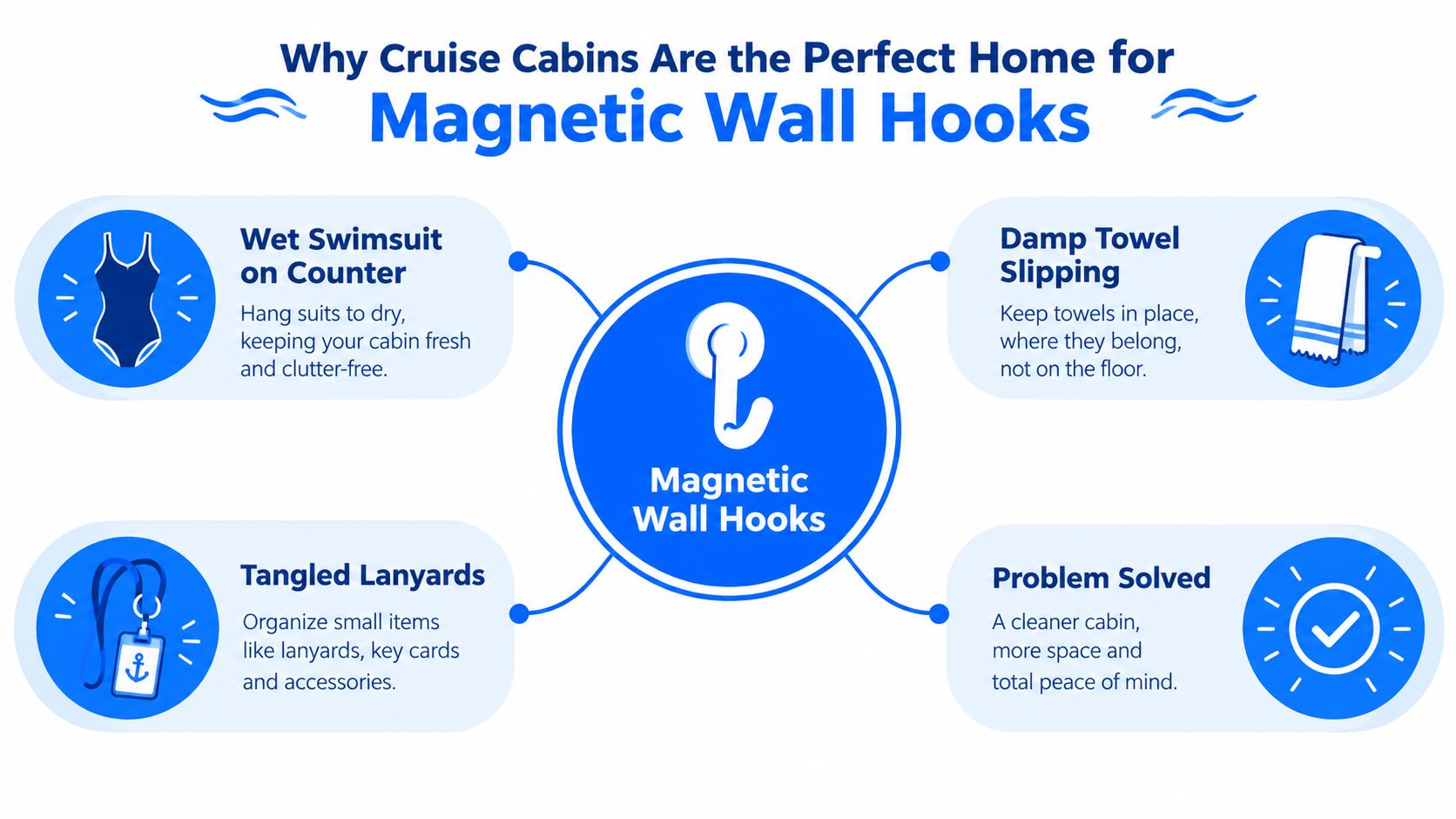
You're standing in a cruise-cabin bathroom with a wet swimsuit draped over the counter, a towel sliding toward the floor, and lanyards tangled in a drawer. The cabin is compact, the walls are difficult to use, and every item left on a chair becomes something that can shift when the ship moves.
Magnetic wall hooks offer a practical way to reclaim that vertical space without drilling holes or relying on adhesive. But cruise cabins create a specific challenge that many product descriptions overlook. A hook tested on a thick, clean steel plate won't behave the same way on a thin, coated wall while the ship vibrates and your belongings hang sideways. The useful question isn't how much a magnet can pull. It's how much it can hold safely in your actual cabin.
Table of Contents
- Why Cruise Cabins Are the Perfect Home for Magnetic Wall Hooks
- How Magnetic Wall Hooks Actually Work
- Choosing the Right Magnet Strength and Hook Size
- Installing and Removing Hooks Without Damage
- Cruise-Specific Uses That Solve Real Cabin Problems
- Weight Limits, Safety, and the Thin-Steel Problem
- Packing, Storage, and Buying Checklist for Your Cruise
Why Cruise Cabins Are the Perfect Home for Magnetic Wall Hooks
A cruise cabin often has enough unused wall surface to improve organization, yet travelers hesitate to use it. They may assume that hanging anything requires screws, adhesive strips, or suction cups. Those methods can be inconvenient in a temporary room, especially when humidity, painted surfaces, laminate, and cabin turnover are involved.
Magnetic wall hooks avoid most of that commitment. A magnet can attach to a suitable ferromagnetic surface, and you can reposition or remove the hook without leaving a drilled hole. The wall still needs testing, because decorative panels, trim, and coverings can weaken the connection, but the basic idea fits the temporary nature of a cruise stateroom.
Small problems become easier to manage
Use a hook near the bathroom for a swimsuit that needs airflow instead of leaving it on the counter. Place another near the entrance for a jacket, backpack, or lanyard. A few lightweight hooks can make daily items visible, which matters when two people share a small room and every flat surface already has a job.
Compared with an over-the-door hanger, a wall hook doesn't swing against the door or bang in a corridor. Compared with an adhesive hook, it doesn't depend on glue surviving steam and repeated handling. You can move it from an interior wall to another suitable surface, then pack it away at the end of the voyage.
Cabin principle: Reversible storage works best in a room you'll occupy briefly. Attach only what you can test, reach, and remove without force.
The broader wall-hook market was valued at $3.2 billion in 2025 and is projected to reach $4.8 billion by 2034, according to market data on magnetic wall hooks. That source describes magnetic wall hooks as the fastest-growing product category, with a projected 7.9% CAGR through 2034, while adhesive hooks held the largest absolute share at 32.4% in 2025. Those figures describe the wider market, not the capacity of an individual cruise hook, so your buying decision still comes down to surface, direction, friction, and load.
How Magnetic Wall Hooks Actually Work
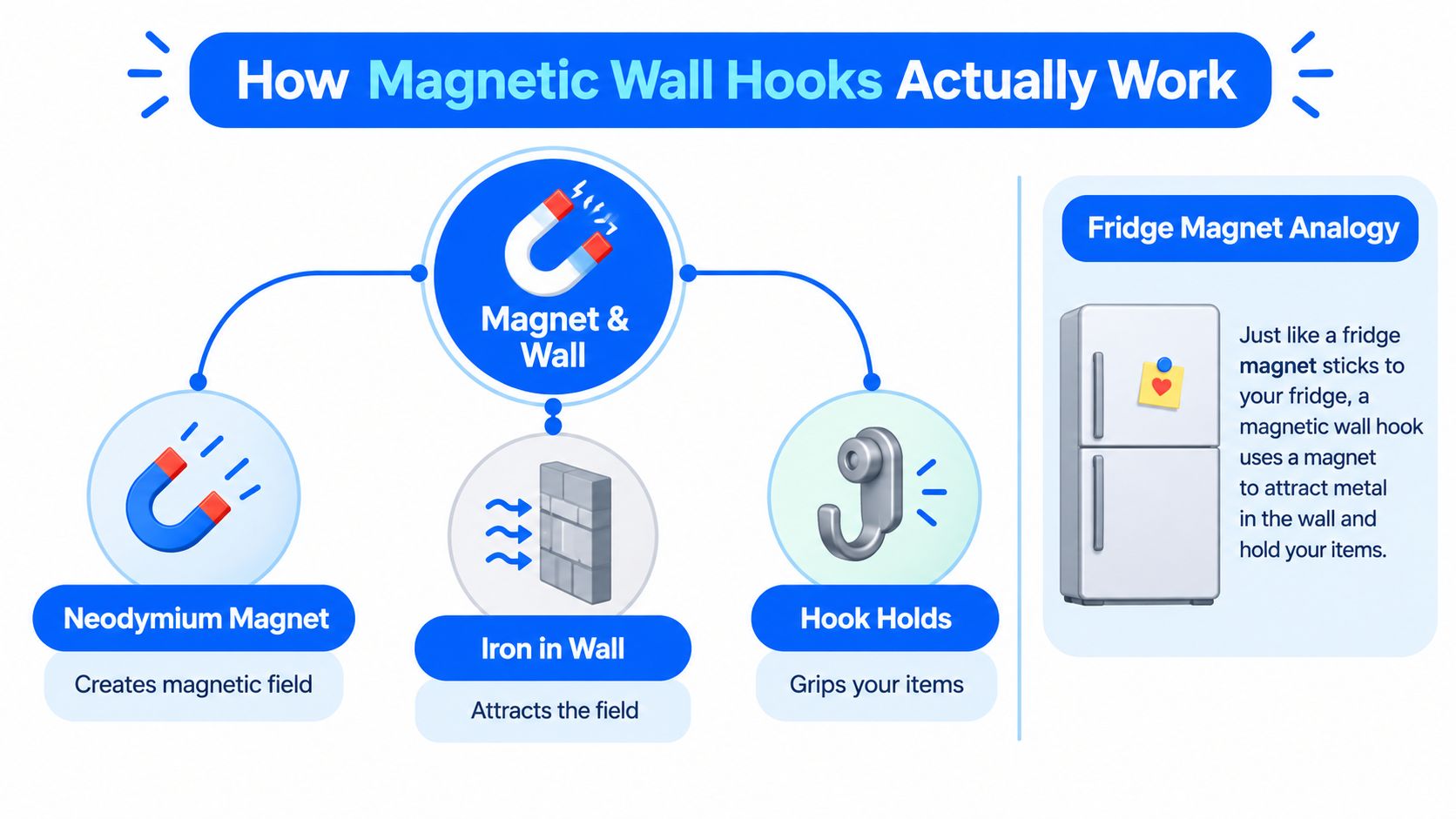
Think of a magnetic wall hook as a stronger, more specialized version of a refrigerator magnet. A neodymium magnet inside the base creates a magnetic field. That field attracts iron-containing steel in the wall, while the hook gives you a point from which to hang an item.
The magnet's rating usually describes pull force, meaning resistance to being pulled directly away from the steel. A cruise-cabin wall hook usually faces another force, shear force, when an item hangs downward and tries to slide the magnet along the wall. Those forces aren't interchangeable. Technical guidance recommends treating shear load as roughly 15% to 30% of the derated normal-force rating unless friction or mechanical capture has been engineered into the setup, as explained in this technical guide to pull force.
Why a wall hook slides
A smooth metal-to-metal contact can provide less grip against a sideways load than a rubberized base. Rubber or silicone adds friction, helps protect a finished surface, and can reduce sliding when gravity pulls the load downward. Hook geometry matters too. A hook that keeps the item close to the wall creates less force than one that lets a bag hang far out from the surface.
The test environment also matters. Magnetic wall-hook ratings are generally measured with a straight pull at 90 degrees against a thick, flat, clean steel plate. A 1 mm air gap can reduce holding force by 30% to 60%, and painted, rough, thin, or alloyed steel can reduce it further, according to technical information on neodymium hook magnets. A decorative skin on a cabin partition can therefore change the result before the item is even hung.
A portable fan is one example of equipment where the attachment method matters as much as the appliance. The Rechargeable Cruise Fan with Magnetic Hook to Hang on Cruise Walls & Ceilings is described as a compact, rechargeable cruise-cabin fan with a magnetic hook, with timer and multiple-speed features on selected models.
The practical lesson is simple. Read pull-force numbers as a way to compare products, then judge the hook by the wall and load direction you'll use.
Choosing the Right Magnet Strength and Hook Size
A hook's printed pull rating can be useful, but it isn't a safe working load for a moving cabin. The strongest-looking number on the package may assume a clean, thick steel plate and a direct pull. Your towel, toiletry pouch, or backpack may apply a sideways force through a coated, thin wall.
Use the table as a selection framework, not a promise of performance. The load descriptions are qualitative because the same item can behave differently depending on moisture, surface thickness, and movement.
Match the hook to the job
| Hook Size | Published Pull Force | Best Cabin Use | Derated Working Load |
|---|---|---|---|
| Small disc, roughly 6 to 10 mm | Not specified in verified data | Lanyards, hats, keys, and other light items | Light items only, test first |
| Mid-size hook, roughly 20 to 25 mm | Not specified in verified data | Damp towel or toiletry pouch | A fraction of the published rating after surface and motion derating |
| Larger hook, roughly 30 to 40 mm | Not specified in verified data | Swimsuit, light organizer, or single jacket | Use only after a gradual load test |
| Multi-magnet base | Not specified in verified data | Clothesline, shower caddy, or stacked lightweight items | Divide the load across tested attachment points |
The important comparison is between direct pull and sideways hanging. The technical guidance cited earlier recommends assuming shear strength is only about 15% to 30% of a derated normal-force rating, so a hook that looks powerful in a catalog may still slide under a bag on a vertical wall.
Coating and shape matter
Nickel-copper-nickel coatings can resist corrosion, which is useful around bathroom humidity, but they may offer less friction than rubber. A rubber or silicone base can protect painted surfaces and improve grip. Choose a hook with a broad, stable base and a hook shape that keeps the load close to the wall.
Published ratings also depend on steel thickness. The magnetic hook reference for thin steel surfaces notes that traditional hooks are commonly tested on thick steel, while newer designs may address thin-steel applications and displacement force on vertical surfaces.
Store rule: Choose for the item's direction of force, not the largest pull number printed on the label.
Installing and Removing Hooks Without Damage
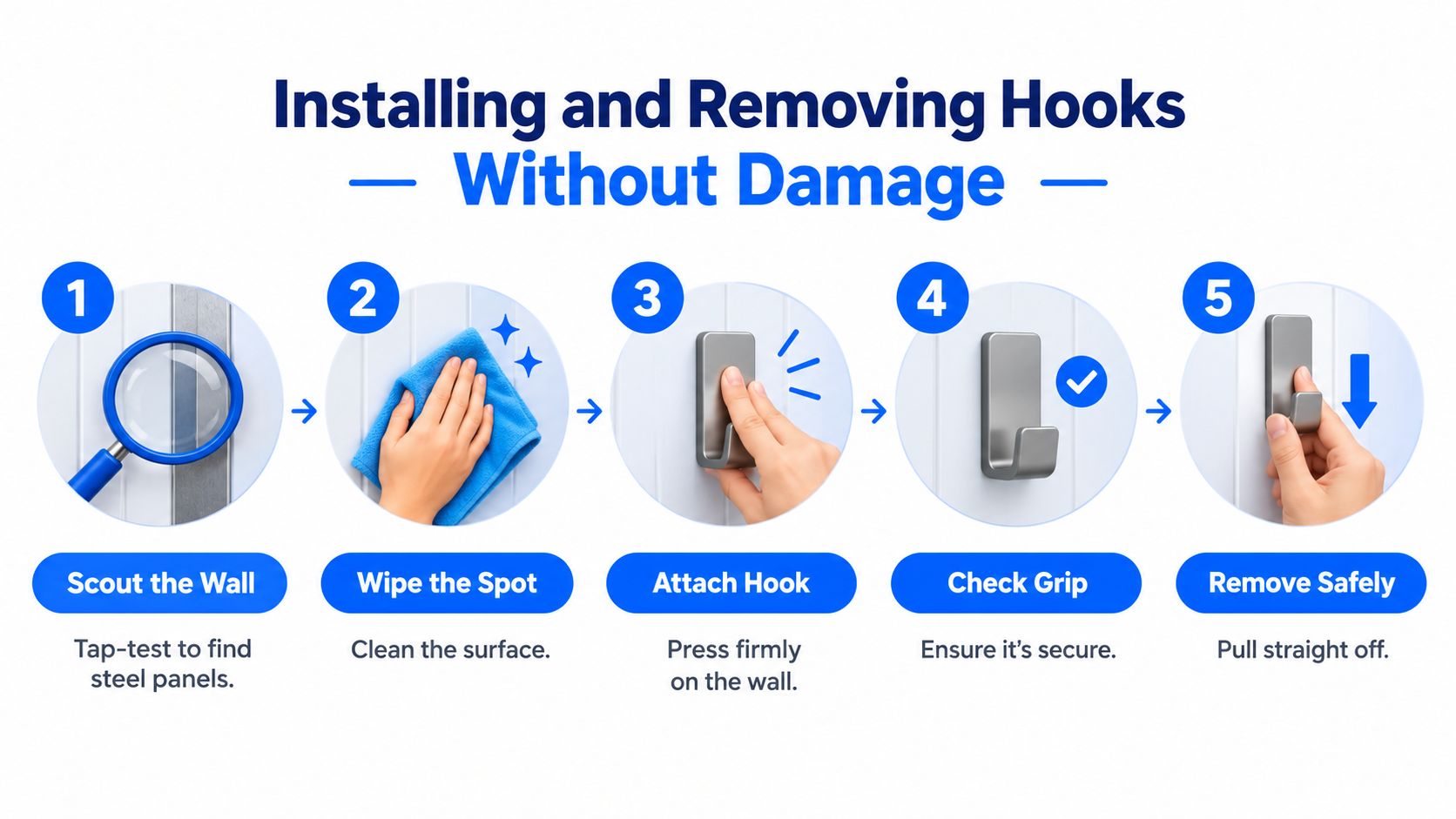
Start with the wall, not the hook. Look for likely steel panels near the entrance, around a mirror, or behind the bathroom area, but avoid assuming that every decorative section has the same backing. A light tap and a small test with the hook can help identify a suitable surface. Don't place hooks near sensors, sprinklers, smoke detectors, walkways, or anywhere a falling object could strike someone.
Use a repeatable attachment routine
- Scout the surface. Test a discreet, reachable area and confirm that the hook attracts firmly.
- Wipe the spot. Use a dry microfiber cloth to remove body oil, dust, and moisture.
- Press the base flat. Set the hook against the wall without twisting it into place.
- Check for movement. Apply gentle sideways pressure before adding anything valuable.
- Test gradually. Start with a light item, then increase the load while watching for creep.
A short cabin test can reveal more than a package rating. Hang a damp towel and watch it for 60 seconds, then add a full water bottle and observe it for another 60 seconds. Those test intervals are a practical routine for this article, not a manufacturer-certified capacity test. If the base creeps, tilts, or begins to peel away, remove the load immediately.
Remove from an edge
Don't yank a powerful magnet straight away from the wall. Peel it from one edge, or slide a plastic card behind the base if it's difficult to release. Avoid metal tools, which can scratch the finish or snap toward the magnet.
Keep your fingers clear of the gap while removing the hook. Neodymium magnets can pinch, and a hook carrying a wet or bulky item can release suddenly.
The following video can help you visualize careful handling and placement:
Cruise-Specific Uses That Solve Real Cabin Problems
The most useful magnetic wall hooks solve a problem you encounter several times a day. A hook that looks unnecessary at home can become valuable when the cabin has limited counter space, few drying options, and a floor that responds to the ship's movement.
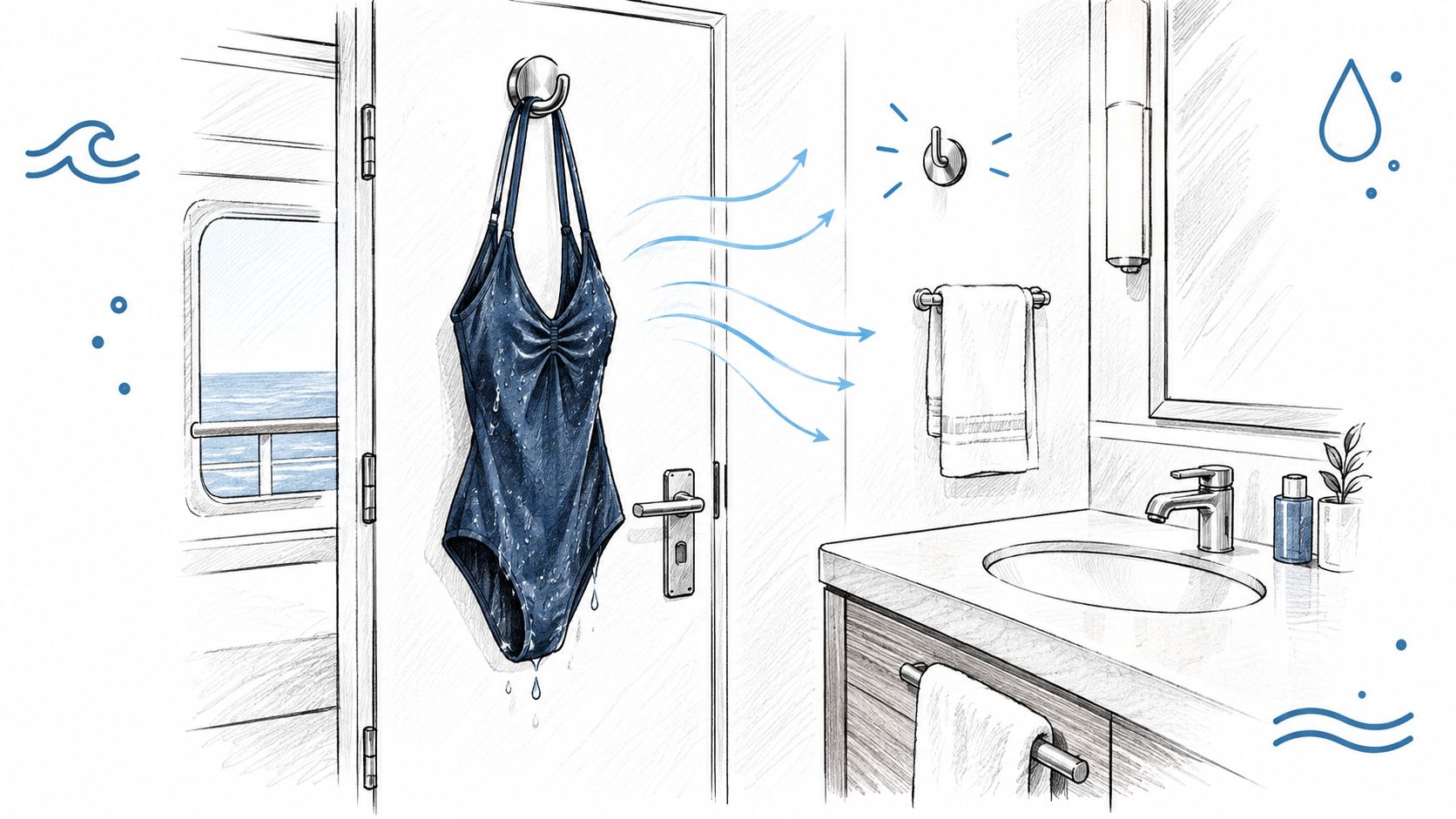
In the bathroom, place a rubber-backed hook where a swimsuit can hang without touching the counter. Keep it away from a direct spray and check that the wet fabric doesn't swing into a mirror or fixture. A damp towel creates more stress than a dry one, so treat the first placement as a test rather than a permanent installation.
Build a simple entry station
Near the entrance, a small hook can catch a lanyard, sunglasses case, or hat. A stronger, well-tested hook can hold a jacket or small backpack, but keep the load close to the wall and avoid placing it where someone will brush against it.
Three lightweight hooks in a row can separate daily items:
- First hook: Room cards and lanyards.
- Second hook: Hats or sunglasses.
- Third hook: Shore-excursion paperwork or a small tote.
For more ideas that combine vertical storage with compact packing, use these small-space storage solutions for cruise cabins.
A pair of properly tested hooks can support a lightweight clothesline for socks, underwear, or swimwear, but tension introduces sideways force at both attachment points. Don't treat the line like a shelf. Formal-night clothing also benefits from hanging early, especially if the alternative is leaving garments folded over a chair where they can slide during movement.
Weight Limits, Safety, and the Thin-Steel Problem
The thin-steel problem changes how you should interpret almost every magnetic wall-hook specification. A lab test typically uses a clean, flat steel plate that gives the magnet an ideal magnetic path. A cabin wall may have thin sheet steel, a decorative covering, a rough finish, or a gap between the magnet and the actual metal.
That's why a published pull rating is best treated as a comparison metric, not a safe working load. Technical guidance on magnetic pull force explains that direct-pull ratings can differ substantially from real use when air gaps, coatings, load direction, vibration, or repeated handling enter the picture.
Use conservative derating
A safer process starts with the manufacturer's rating, then reduces your expectations for the exact surface and direction. Don't apply a neat percentage as though every cabin wall behaves identically. Test the actual hook on the actual wall, start low, and leave a margin.
| Cabin Condition | Starting Pull Rating | Derating Factor | Effective Working Load |
|---|---|---|---|
| Thick, clean steel and straight pull | Manufacturer's published rating | Minimal environmental reduction | Comparison baseline only |
| Thin or coated cabin steel | Manufacturer's published rating | Substantial reduction from gap and substrate | Lower than the label suggests |
| Vertical wall with sideways load | Derated normal-force rating | Shear guidance of about 15% to 30% | A small fraction of the derated rating |
| Vibration, sway, or repeated handling | Derated working estimate | Use a safety factor of at least 3× to 5× | Keep loads light and close to the wall |
| Benign static use | Derated working estimate | Use a safety factor of at least 2× | Suitable only after testing |
The shear guidance and safety-factor recommendations come from the pull-force technical guide. In plain terms, a hook that looks adequate for a damp towel may not be suitable for a loaded organizer or a tensioned clothesline.
Keep falling objects away from people
Avoid hanging heavy items over beds, chairs, or walkways. Check hooks after cabin cleaning, after moving the load, and whenever the ship's motion changes. If a hook releases, remove the item, inspect the wall and hook, and relocate the setup instead of immediately reattaching the same load.
For broader guidance on where magnets fit into cabin organization and cruise packing, consult this cruise ship magnets guide.
Packing, Storage, and Buying Checklist for Your Cruise
Pack magnetic wall hooks as carefully as you pack chargers and room cards. Put each hook in a small zip pouch, then separate the magnetic face from delicate items with a piece of steel, a tin plate, or suitable protective material. Wrap coated hooks in microfiber so they don't knock against one another or rub against painted accessories.
Keep magnets away from cards, electronics, magnetic storage media, and medical devices that may be affected by magnetic fields. During the voyage, store spare hooks in a drawer or secure them to a suitable metal surface inside the closet. Loose hooks in a suitcase can attract metal clasps and become difficult to find when you need them.
Shop for cabin conditions
Look for these characteristics rather than choosing by headline strength alone:
- Magnet material: A clearly specified neodymium core gives you a useful basis for comparison.
- Surface protection: Rubber, silicone, or another protective base can reduce scratching and sliding.
- Humidity resistance: Nickel or epoxy protection is relevant in a damp bathroom environment.
- Hook geometry: A broad base and a hook that keeps items close to the wall can reduce tipping.
- Published testing context: Prefer products that explain the test surface and load direction.
- Practical quantity: Several moderate hooks can distribute light items more flexibly than one overloaded hook.
The cruise ship essentials collection can also help you review other compact cabin accessories while you prepare. A magnetic hook, a small organizer, and a drying solution serve different jobs, so plan the cabin setup around the items you'll carry.
Buying decision: Choose the smallest protected hook that can handle your tested load with a generous margin. The strongest magnet isn't automatically the best choice for a vibrating, thin-steel cabin wall.
Before departure, test your hooks on a comparable metal surface, pack them where you can reach them, and decide where the first low-load test will happen after boarding. That preparation turns a clever accessory into dependable cabin organization.
Nordmoose offers cruise-focused accessories including magnetic cabin solutions and rechargeable travel gear designed around compact staterooms, metal surfaces, and packability. Visit Nordmoose to compare options for organizing, drying, and improving comfort before your next sailing.