

Magnetic ID Holder Guide for Cruises
You're at the cruise terminal, one hand holding your phone and the other searching through a carry-on for the card you need at the next checkpoint. The line keeps moving, your documents are buried under sunglasses and charging cables, and the cruise card that should be easy to reach has somehow disappeared into a pocket.
A magnetic ID holder can remove much of that friction. It can keep a cruise card visible on a metal cabin door, bathroom wall, or other suitable surface, while still allowing you to carry the card when you leave the room. The important questions are less about buying the strongest magnet and more about card fit, privacy, cruise-line rules, contactless performance, and where the card will live during the trip.
Table of Contents
- Embarkation Day and the Missing Badge
- What a Magnetic ID Holder Actually Is
- Why Cruise Cabins Are a Natural Fit
- Magnetic Holders Compared to Clips, Lanyards, and Sleeves
- How to Choose the Right Holder for Your Cruise
- Privacy, Visibility, and What Your Card Should Reveal
- Care, Safety, and Cruise-Line Compatibility
- A Simple Pre-Cruise Checklist
Embarkation Day and the Missing Badge
Embarkation often exposes a small travel problem that becomes surprisingly annoying. You show identification at the terminal, collect or activate a cruise card, pass through security, and then need that same card again for access, purchases, muster procedures, or an excursion check-in. Each interaction is brief, but repeatedly opening a bag or checking several pockets creates friction when other passengers are waiting behind you.
A holder helps when the card needs to stay easy to see and retrieve. For example, you might keep it in a magnetic sleeve on a suitable cabin surface after boarding, then move it into a pocket or lanyard before heading ashore. That makes the accessory a storage and access tool, not a replacement for the cruise line's required identification or embarkation process.
Where it helps most
The strongest use cases are situations where the card changes hands often:
- Cabin access: Keep the card in a predictable location rather than leaving it among receipts and room keys.
- Muster-related movement: Retrieve it quickly when you're moving through the ship and don't want to search your luggage.
- Excursion check-ins: Carry the card on your person when leaving the cabin, especially if the group requires repeated checks.
- Shared cabins: Give each traveler a consistent storage spot so cards don't end up on different counters or beds.
A magnetic holder isn't necessary for every cruiser. If you already use a lanyard and rarely remove the card, a wall-mounted option may add little. It becomes more useful when the card needs to be displayed in the cabin between outings, particularly in a room with limited flat storage.
Practical rule: Decide whether your card needs a home on the cabin wall, a place on your body, or both. The answer determines the right format.
What a Magnetic ID Holder Actually Is
A magnetic ID holder is a card-sized accessory with three basic parts: a cavity for the card, a transparent or partly transparent viewing area, and a magnet that lets the holder attach to a ferromagnetic surface. You can think of it as a small picture frame that grips a metal door instead of hanging from a nail.
Most designs are based on the ID-1 card format, commonly called CR80. ISO/IEC 7810 specifies nominal dimensions of 85.60 mm by 53.98 mm, approximately 3.370 by 2.125 inches, with a nominal thickness of 0.76 mm. The standard also permits thickness between 0.68 and 0.84 mm and defines rounded corners with a radius of approximately 2.88 to 3.48 mm. These specifications are documented in the ISO/IEC 7810 card-format reference.
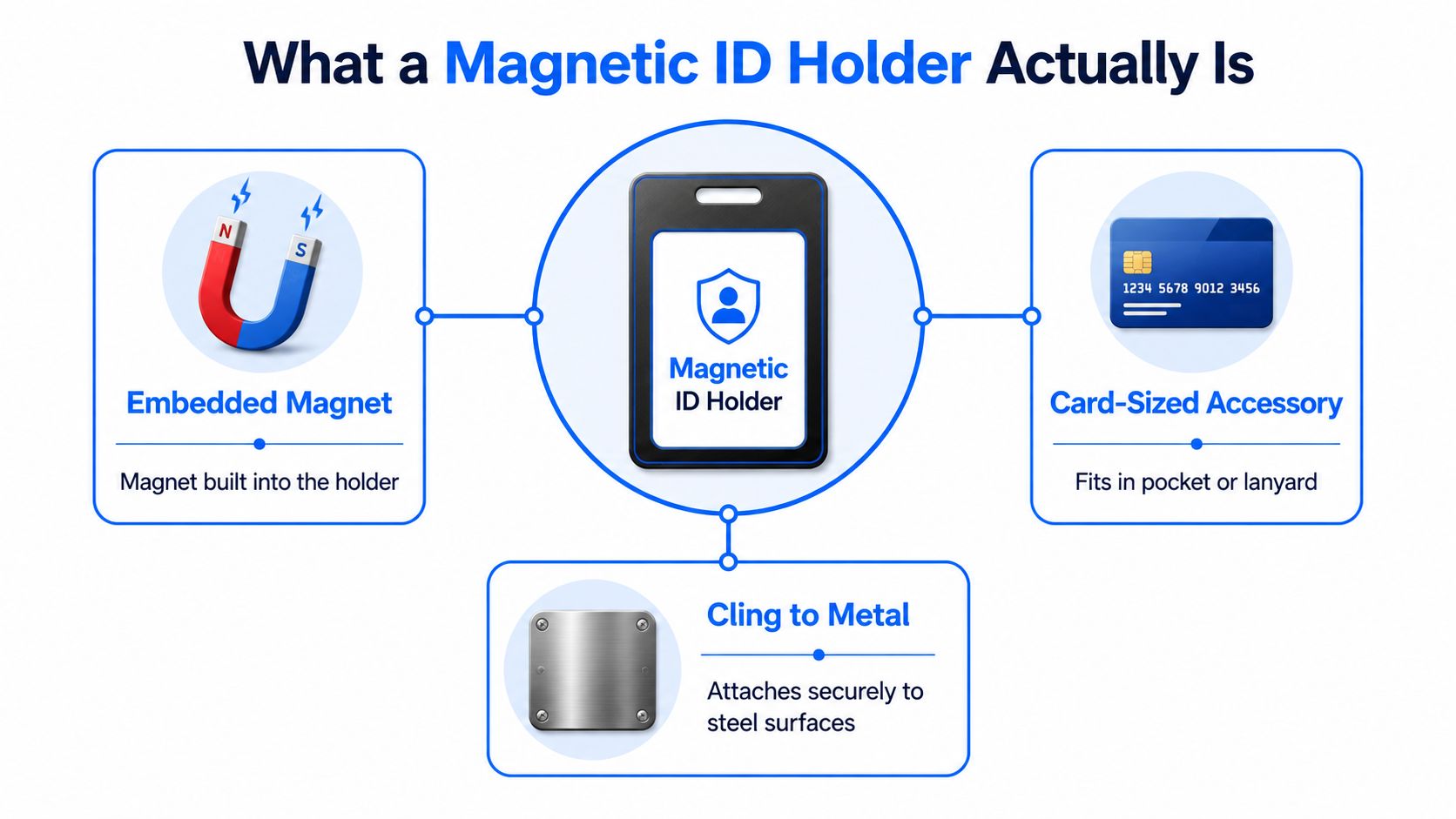
That format is familiar because it's used for many government identification cards, employee badges, payment cards, and access credentials. A holder designed with suitable clearance can therefore accommodate more than a cruise card, although you should still check the product's stated dimensions and orientation before buying.
Three related products
The names sound similar, but the carrying behavior differs:
- A magnetic holder attaches to metal and usually keeps the card enclosed behind a window.
- A magnetic sleeve is generally slimmer and may prioritize protection or storage over a strong surface mount.
- A magnetic badge reel combines a body clip, retractable cord, and badge attachment. It's designed for wearing the card, not leaving it on a cabin door.
The holder's internal pocket needs enough room for insertion and removal without allowing excessive movement. If it's too tight, the card may bend or become difficult to remove. If it's too loose, the card can slide or become partly obscured.
For a larger cabin-storage product, the Magnetic Cruise Door Organizer uses magnets to attach to suitable metal walls or doors, but it serves a different purpose from a card holder. It organizes toiletries, shoes, sunscreen, and other small items rather than displaying one identification card.
Why Cruise Cabins Are a Natural Fit
Cruise staterooms often provide something many hotel rooms don't: useful vertical surfaces made from or backed by metal. A cabin door, bathroom wall, closet frame, or steel-backed fixture may accept a magnet, turning an otherwise unused surface into a place for a card, small organizer, night light, or fan.
That doesn't mean every surface is magnetic. Paint, trim, decorative panels, wood, and certain fixtures can interrupt the attraction. The practical advantage comes from testing the actual surface rather than assuming that every door or wall on every ship will hold the same accessory.
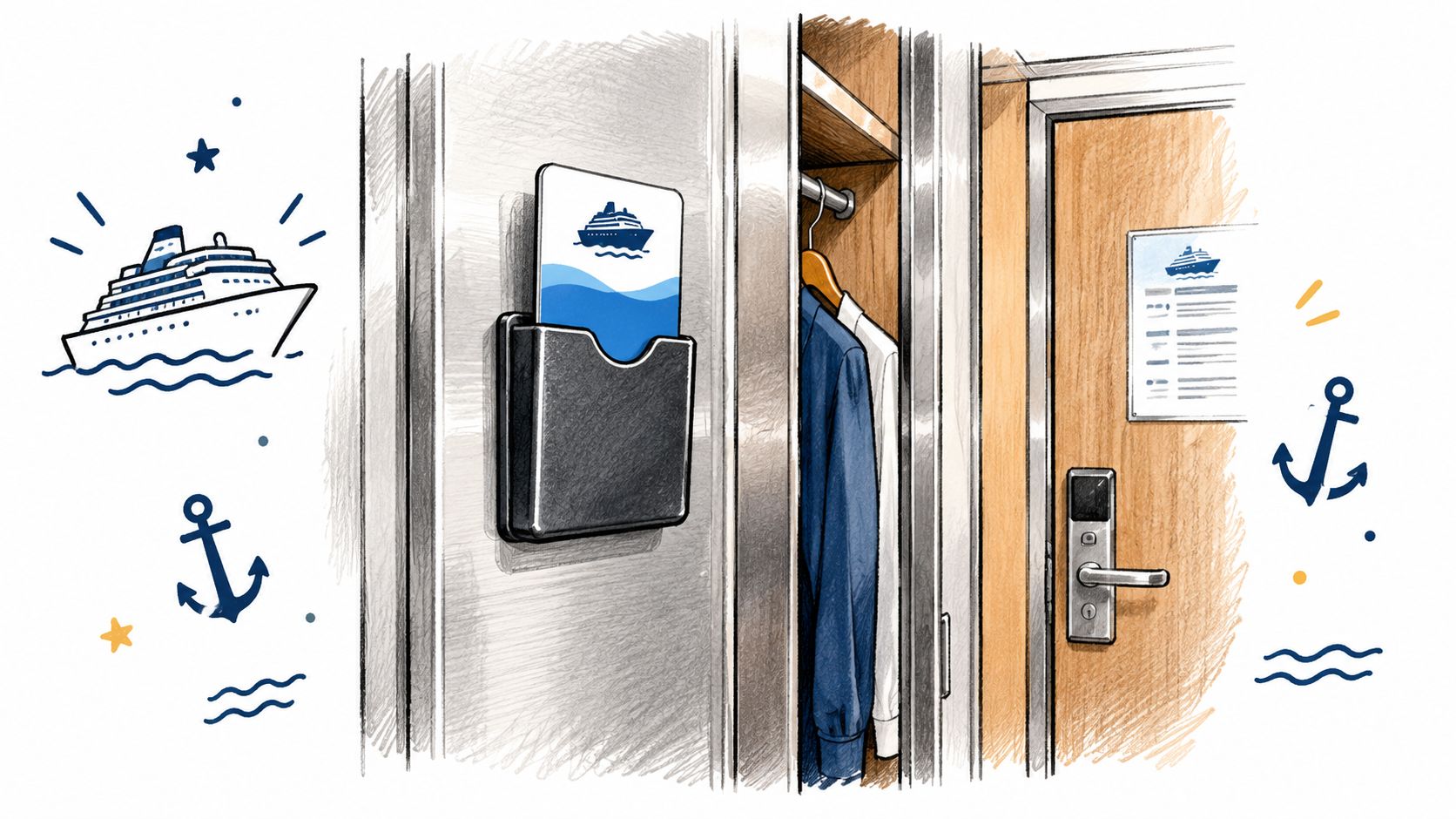
Vertical storage with less clutter
A holder positioned near the cabin entrance can give your cruise card a predictable location. Mounting it around chest height may also make retrieval easier than searching a low drawer, bending beside the bed, or turning on bright lights late at night.
The same principle applies to shared cabins. One person can keep a card holder near the door while another uses a wallet or lanyard. The accessory works because it uses the room's structure, not because it replaces every other carrying method.
Hotels create a different test. A hotel wall may be drywall, plaster, or wood, so a magnet can fall immediately. That's why a magnetic ID holder is particularly suited to a cruise cabin, but less dependable as a universal travel-room accessory.
Test the surface before unpacking
On boarding day, place the holder against the intended area without loading it with valuables. Open and close the door gently, check whether the holder shifts, and confirm that it doesn't cover room instructions, emergency information, handles, or other required markings.
Cruise policies can vary, and a magnetic surface can still be unsuitable if the holder scratches paint, projects into a walkway, or obstructs information. Surface compatibility is part of the product choice, not an afterthought.
Magnetic Holders Compared to Clips, Lanyards, and Sleeves
The best way to compare carrying styles is to ask where the card needs to be. A magnetic holder is strongest as a cabin-surface solution. A lanyard stays with your body. A clip attaches to clothing, while a sleeve protects the card but may not provide a stable mounting point.
| Carry Style | Best For | Trade-Off |
|---|---|---|
| Magnetic holder | Keeping a card visible on a suitable metal cabin surface | Depends on ferromagnetic surfaces and line-specific rules |
| Lanyard | Travelers who need the card with them throughout the day | Can feel inconvenient at meals, in the shower, or during active excursions |
| Retractable reel | Quick access while keeping the card attached to clothing | Adds a clip and moving parts, and can snag |
| Clip-on sleeve | Simple attachment to a pocket, belt, or uniform | May slip, swing, or detach more easily than an enclosed holder |
| Plain sleeve | Protecting a card inside a wallet or pocket | Doesn't create a visible, dedicated cabin location |
A lanyard makes sense for a crew member, a group moving between activities, or anyone who wants constant body access. It's less useful when the card needs to be stored neatly in the cabin between outings. A retractable reel offers a similar body-based arrangement, but its cord and clip add bulk.
A clip-on sleeve is familiar and inexpensive in concept, yet it depends on the clothing fabric and attachment point. A loose shirt, swimsuit cover-up, or jacket may not provide enough stability. A standard sleeve avoids some attachment problems, but it still leaves the card buried unless you establish a consistent storage place.
For a closer look at an alternative waterproof carrying format, compare waterproof ID holder and lanyard options before you choose.
The decision doesn't need to be permanent. Some cruisers use a magnetic holder in the cabin and a lanyard or wallet ashore. That combination recognizes that the cabin and the port environment impose different demands.
How to Choose the Right Holder for Your Cruise
Start with the card, not the magnet. A holder based on the ID-1 or CR80 format should provide enough clearance for a card measuring 85.60 mm by 53.98 mm with a nominal thickness of 0.76 mm, as specified by ISO/IEC 7810 dimensions and tolerances. The pocket should hold the card without bending it or allowing it to slide over the viewing area.
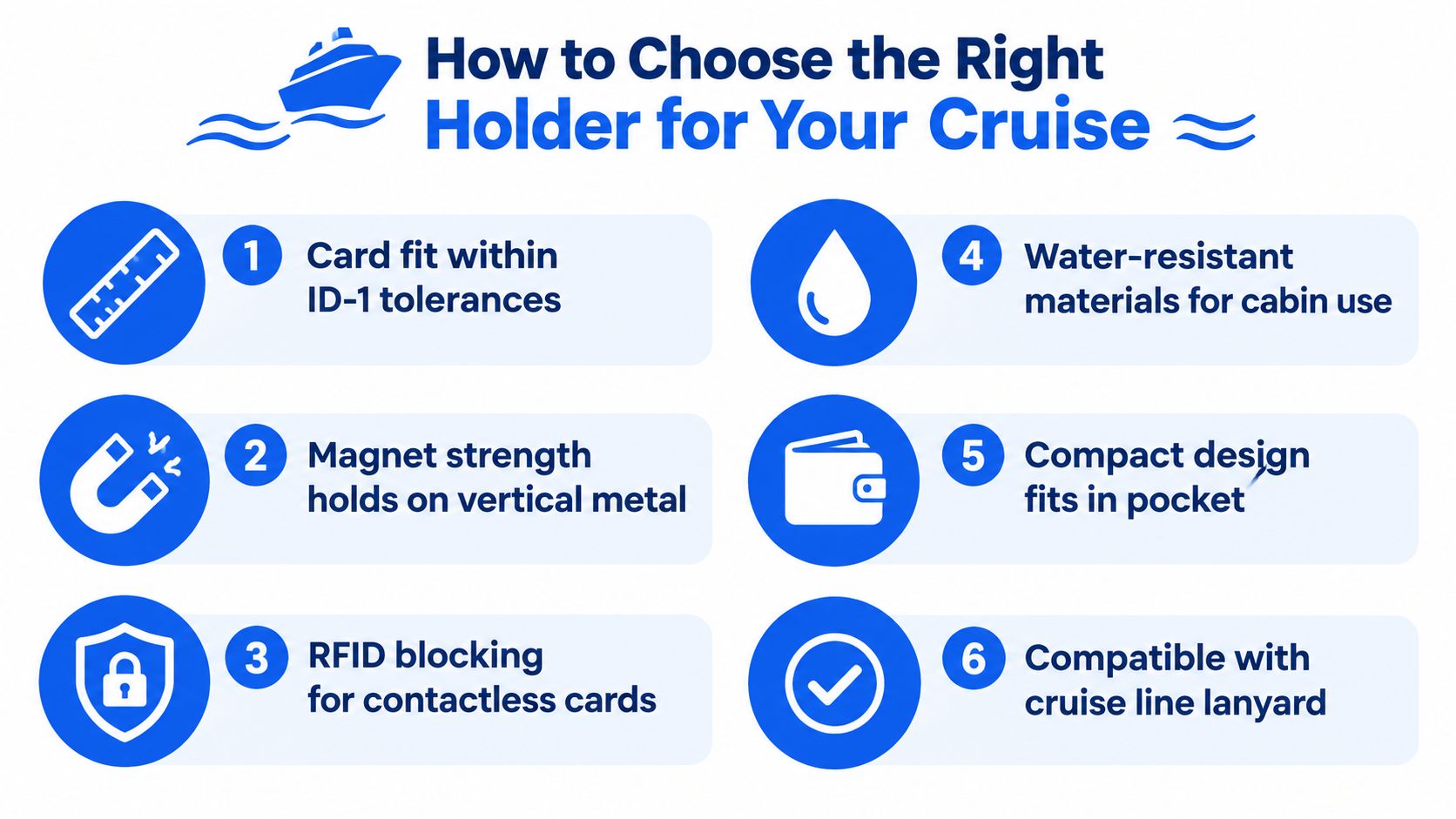
Use these checkpoints before packing:
- Check the card pocket. Insert the actual card, close the holder, and turn it upside down briefly over a soft surface. The card should remain secure without needing force to remove it.
- Test vertical grip. Place the empty holder on a refrigerator or another steel surface, then move it slowly downward. A holder that slides immediately may be unreliable on a cabin door.
- Inspect the window. Hold the card under cabin-style lighting and view it from different angles. Glare, cloudy plastic, or a narrow window can make a readable card difficult to scan.
- Review the backing. A steel plate or metal clip behind a contactless card can affect communication. A nonmetallic presentation face and careful separation from conductive materials are preferable.
- Check the closure. Open and close the holder repeatedly, then place it in a bag with ordinary travel items. The closure should resist accidental opening without making card removal awkward.
- Consider surface contact. Run a finger around the magnet and backing. Exposed metal, rough edges, or a holder that extends beyond the magnet may mark a door or snag nearby items.
Strong attachment isn't automatically better. Excessive force can make repositioning difficult, while a hard or exposed backing can create damage concerns. Choose enough grip for a vertical surface, then confirm the cruise line's current rules.
If the holder will carry a contactless card, test it at home through the holder. Present it to a compatible reader with the card in different orientations, then repeat with the card removed. A noticeable difference suggests that the holder's backing or surrounding materials may be affecting performance.
Privacy, Visibility, and What Your Card Should Reveal
A visible luggage or ID card can help staff identify an item, but visibility also exposes information to strangers. The usual advice is to print as much as possible, yet a cruise terminal, ship corridor, transfer bus, or excursion queue is a shared environment. Maximum information isn't always maximum security.
Separate the information into two groups. The visible side should support practical recovery without revealing more than necessary. The concealed side can contain additional details, provided the holder protects it from casual viewing and the insert can be removed when the trip ends.
A balanced information plan
Consider these choices:
- Visible: A first name or initials, a travel-specific contact method, and a cabin-related identifier where the cruise line's practices make that appropriate.
- Concealed: A permanent home address, full personal contact details, and information that has no role in recovering the bag during the current trip.
- Removable: A temporary luggage insert that can be replaced for the next voyage instead of leaving old travel details in the holder.
- Protected: An opaque back panel, privacy flap, or folding design that prevents the information from being read from several angles.
A magnetic ID holder isn't automatically private. A clear window may show the entire card from the front and back, and a holder placed on a door can expose the contents to anyone walking past. Check whether the card is readable from the side, whether the back is covered, and whether the holder can be removed before you leave the cabin.
Cruise guidance from MSC on preparing luggage and contacting Guest Services confirms that passengers should label bags before reaching the terminal and contact onboard Guest Services if baggage is damaged or lost. That guidance supports labeling, but it doesn't require displaying a permanent home address to every person who handles the bag.
Privacy principle: Show enough to support recovery during the journey, not enough to create a permanent profile of the traveler.
The same distinction applies to a cruise card. Keep the card accessible when it must be scanned, but don't leave it exposed in a place where other passengers can study unnecessary details. A cover, removable insert, or controlled storage location can preserve convenience without treating transparency as the only form of security.
Care, Safety, and Cruise-Line Compatibility
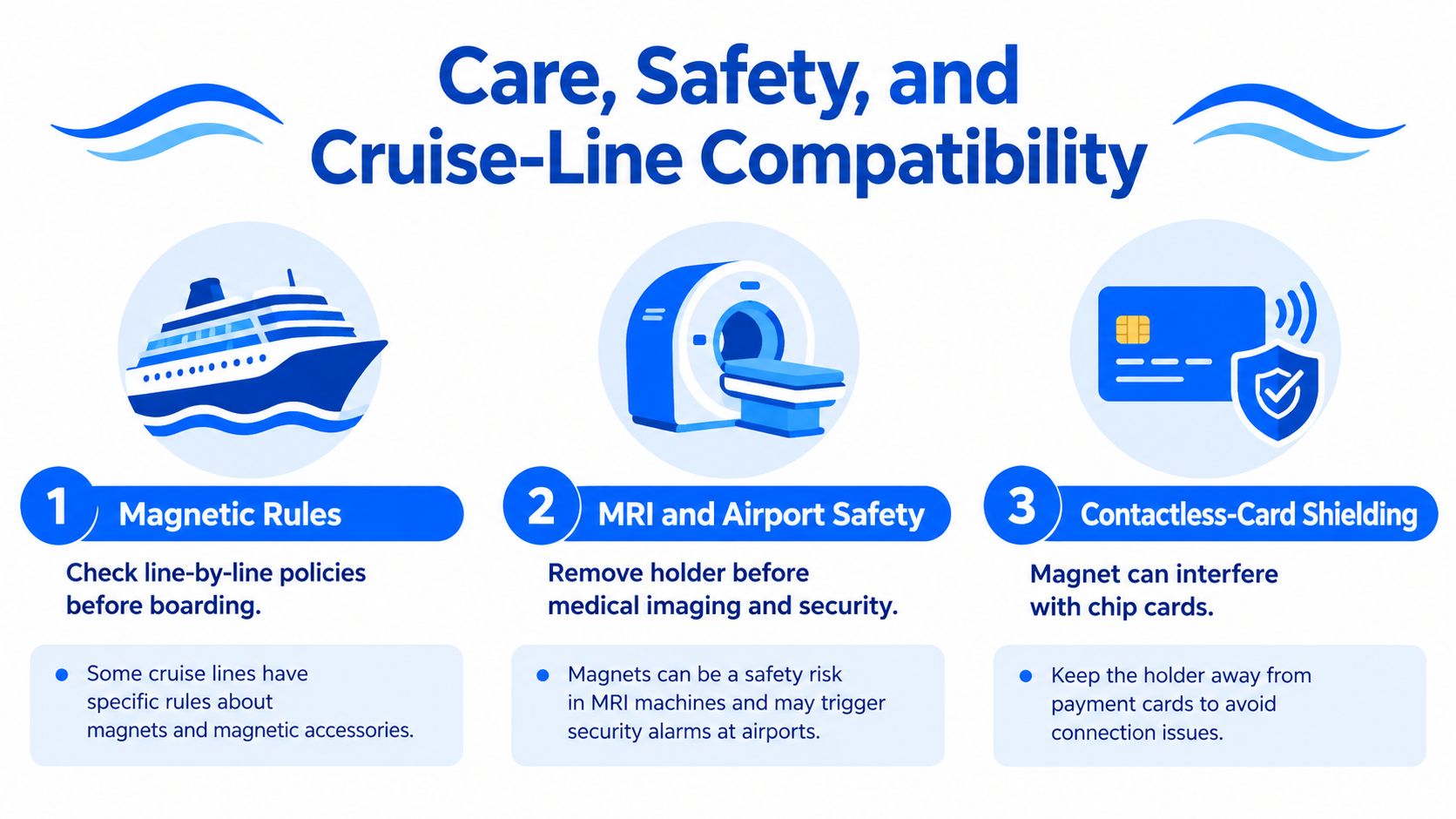
A magnetic accessory has to pass three separate tests: the cruise line's policy, the physical surface, and the card's electronic behavior. These tests aren't interchangeable. A holder may grip a steel door well and still be unsuitable for a wooden door, prohibited in a particular location, or difficult to use with a contactless card.
Disney guidance, for example, says decorations belong only on the stateroom door, prohibits hallway or ceiling placement, warns that some wooden Concierge doors won't hold magnets, and prohibits over-the-door organizers. The cruise-door decoration guidance also notes that door damage may lead to charges. Check your own line's current rules before boarding rather than treating one ship's policy as universal.
Medical and airport precautions
Remove the holder before entering an MRI environment. The FDA's MRI safety guidance warns that static MRI fields can attract magnetic objects and accelerate them into dangerous projectiles. A holder's magnet, steel backing, and clasp all form part of the assembly, so don't assume that a small consumer accessory is harmless.
For contactless cards, the magnet itself isn't necessarily the main problem. NIST explains that ISO/IEC 14443 proximity cards typically operate at approximately 7 to 15 centimeters, while ISO/IEC 15693 vicinity cards can reach up to about 1 meter. Its discussion of RFID behavior also notes that higher-frequency signals penetrate metals and liquids less effectively than lower-frequency signals. Review the NIST contactless-card and RFID technical material and test the complete holder, especially if it includes steel or metallic foil.
The maintenance routine is simple:
- Wipe the viewing window so scanners can read the card.
- Inspect the closure for stretching, cracking, or debris.
- Check the magnet on a representative metal surface.
- Test contactless reading through the holder before departure.
- Keep a nonmagnetic backup method for a wooden or unsuitable cabin surface.
For broader guidance on magnets and cruise cabins, see cruise ship magnet considerations before you pack.
A Simple Pre-Cruise Checklist
Ask one question first: where will the card live when it isn't in your hand? If the answer is a suitable metal cabin door or wall, a magnetic ID holder can create a reliable home base. If the card stays on your body or your cabin has nonmagnetic surfaces, choose a lanyard, sleeve, or clip instead.
Before leaving, confirm the card fit, test the grip, check the line's current rules, and decide which information belongs behind the visible window. Clean the holder, test contactless use, and pack a nonmagnetic backup. Add the rest of your essentials with this travel packing checklist.
Nordmoose offers cruise-focused cabin organizers and other compact accessories designed around metal stateroom surfaces and limited storage. Visit Nordmoose to explore options that can keep documents, daily items, and cabin essentials easier to find throughout your voyage.