

Magnetic Headphone Holder for Cruise Cabins
You've unpacked, the ship has left port, and your headphones are already migrating around the cabin. They slide off the nightstand, disappear under a beach tote, or end up tangled with a charging cable while you're trying to clear space for room service. In a shared stateroom, a small magnetic headphone holder can turn one patch of usable wall into a reliable place to keep them within reach.
But a cruise cabin isn't a desk. Humidity, ship movement, tight quarters, and other people sharing the space all affect where a holder belongs and whether it's safe to use. A good setup needs to keep headphones accessible without letting them slide, scrape a finish, or sit beside cards and sensitive medical devices.
Table of Contents
- Why Cruise Cabins Need a Magnetic Headphone Holder
- How a Magnetic Headphone Holder Actually Works
- Reading the Numbers Behind Magnetic Strength
- Mounting Options That Fit a Small Cabin
- Choosing the Best Spot Inside the Cabin
- Safety, Implants, and the Risks Most Reviews Skip
- Packing, Installing, and Living With the Holder
Why Cruise Cabins Need a Magnetic Headphone Holder
On embarkation day, headphones tend to land wherever there's an open surface. One person puts a headset on the bed while unpacking; the other shifts a tote onto the nightstand. Later, the headphones are wedged between the safe and a bag, or sliding toward the edge as the ship moves. It's not a dramatic problem, but it's exactly the sort of small mess that gets repeated in a cabin where two people share storage and floor space.
A magnetic headphone holder gives those headphones a designated spot without taking up the surface you need for a phone, a drink, or the room key. The useful change is vertical storage: instead of making the nightstand do double duty, you use a suitable metal wall or door. That can help during the day, when bags are open and belongings are being shuffled, and at night, when you want your headphones close without hunting through luggage.
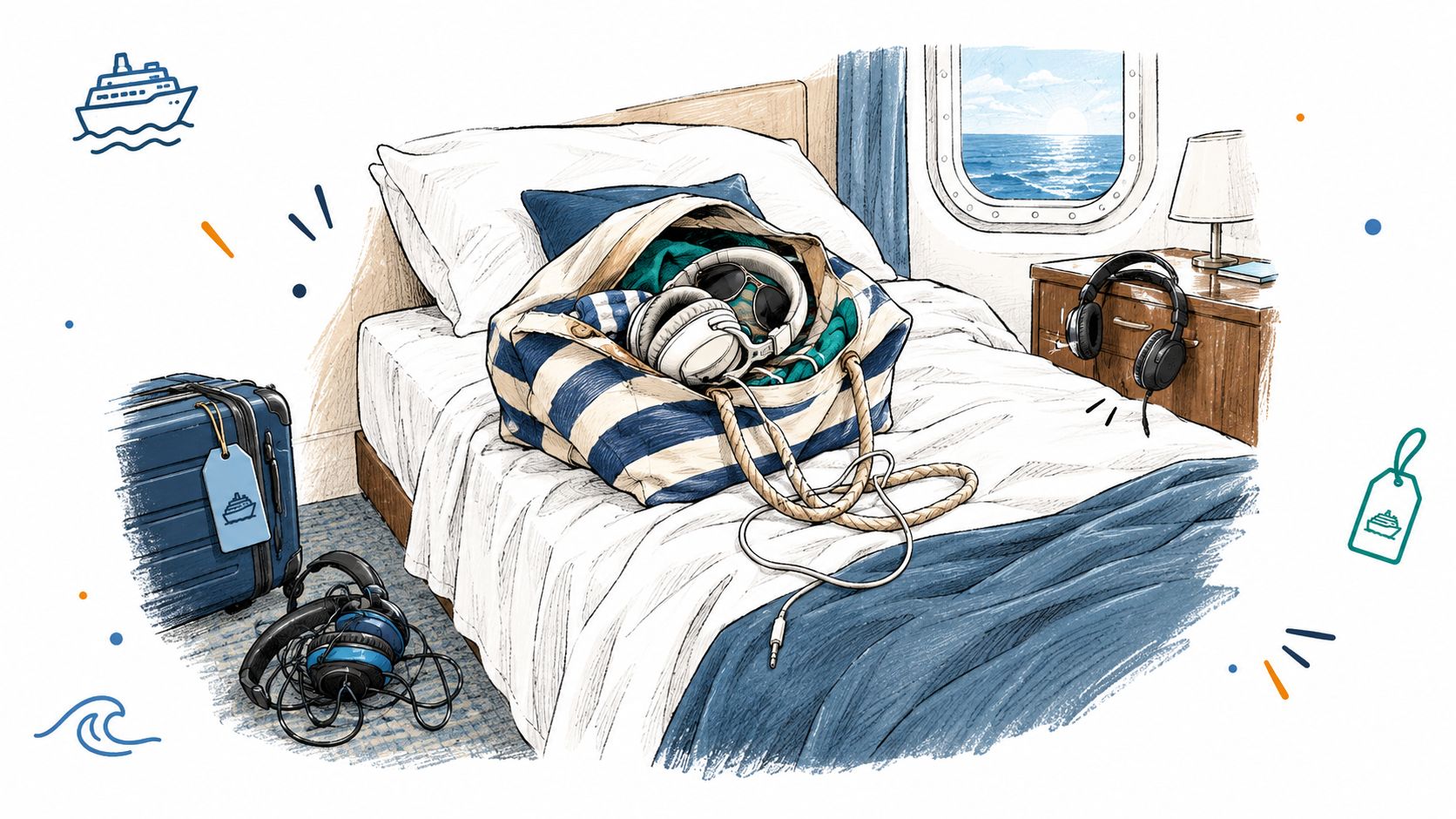
Make storage part of the cabin plan
A magnetic mount only works where the surface and the placement make sense. Before you unpack fully, check whether a cabin wall or door holds a magnet, then choose a spot that's easy to reach but not where someone will brush against it. A holder that gets knocked every time a roommate opens a closet is less useful than a slightly less convenient spot that stays clear.
The same vertical-storage logic applies to other cabin essentials. Small-space cruise storage ideas can help you think beyond the headphones and keep everyday items from competing for the same limited surfaces.
Treat it as retention, not just a hook
A headphone holder's job is to keep the headset from wandering, dangling, or falling during ordinary cabin use. It isn't a replacement for a protective case, and it shouldn't be treated as a guaranteed restraint in rough conditions. Once you see it as one part of a cabin storage system, it's easier to choose a sensible location and know when to put the headphones away instead.
How a Magnetic Headphone Holder Actually Works
The basic arrangement is straightforward. A magnet sits inside the holder, and a metal plate or a second magnet is attached to the headphone cup or headband. Bring the headphones close, and magnetic attraction couples the two parts. The holder stays on a suitable metal cabin surface, while the plate or matching magnet gives the headphones a point of contact.
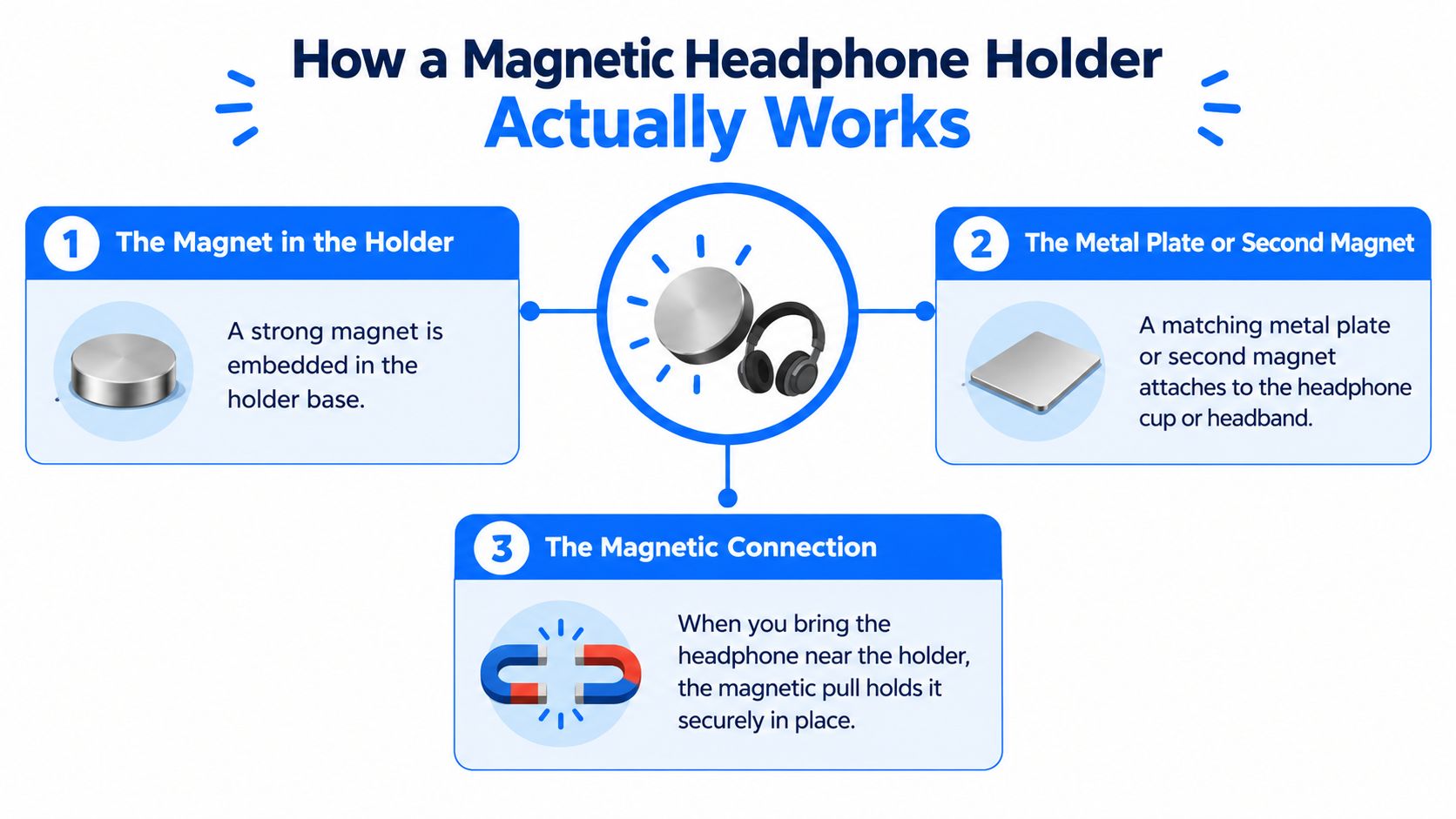
That connection can look secure in a product photo and still behave differently in a cabin. A spec sheet may list pull force, the force needed to separate two magnetic faces directly, as well as sliding or shear force, the force resisting sideways movement. A pair of headphones hanging from a wall usually puts more demand on the holder in the downward or sideways direction than in a clean, straight pull away from the surface.
Think of a coat button held against a fridge. Pull straight out and the button may take considerable force to separate; nudge it sideways and it can slide much more easily. A dangling cable, a bump from a shoulder, or ship motion can all add sideways force. The magnet's advertised pull number doesn't tell you by itself how well the holder resists those cabin-specific loads.
Read the spec that matches the load
Look for a stated shear rating, not only a headline pull-force figure. A practical safety margin matters because the headset doesn't hang as a perfectly still, centered weight. Its center of mass, the angle of the holder, cable movement, and imperfect wall contact all affect the actual load.
Practical rule: A conservative design commonly uses at least a 3:1 safety factor for static loads. That's a starting point, not a promise that the holder will stay put in every location or sea condition.
A broad, flat contact face can help keep the holder stable, while gaps between magnet and mounting surface can weaken the connection. Paint, plastic, fabric, and a curved panel may leave space where you don't expect it. For more on why cabin surfaces behave differently, use this guide to cruise ship magnets and metal surfaces. The practical lesson is simple: test the exact spot before trusting a holder with your headphones.
Reading the Numbers Behind Magnetic Strength
A representative 15 mm neodymium disc is rated at approximately 31.4 N, or about 3.2 kgf, for direct perpendicular pull. The same magnet's sliding force is about 6.21 N, or 630 gf, roughly five times lower. Those figures come from the 15 mm neodymium magnet data sheet.
That difference is the part most buyers miss. Headphones hanging from a wall don't pull the magnet straight away from the surface. They create a downward load, and a cable can apply force if it catches or swings. A painted surface, a curved panel, or a small contact patch can reduce the useful grip further, so the data-sheet number is a reference point rather than a cabin guarantee.
| Spec on the data sheet | Number | What it means on a cabin wall |
|---|---|---|
| Perpendicular pull force | Approximately 31.4 N, or 3.2 kgf | Force for separating the magnet straight away from a surface under test conditions |
| Sliding force | Approximately 6.21 N, or 630 gf | Better indicator of resistance to downward or sideways movement |
| Difference between ratings | Roughly fivefold | A strong pull rating can still overstate practical resistance to sliding |
Translate the rating into a decision
Typical over-ear headphones are light enough that the 630 gf sliding rating can exceed their static mass. But static mass isn't the entire load. The holder also has to tolerate the headset's position, a swinging cable, vibration, surface gaps, and occasional contact from a person moving around the cabin. Those factors can consume the margin that looks generous on paper.
Don't assume that adding a stronger magnet alone fixes the problem. A magnet rated under ideal contact conditions may perform poorly if its face sits far from the wall or if the surface is uneven. A headband that hangs off-center can also torque the holder, pulling one edge away from the mounting surface rather than loading it evenly.
Look for the load direction, not the biggest number. A useful spec sheet gives a shear or sliding rating and clarifies the mounting conditions. If it lists only pull force, treat that as incomplete information for a wall-mounted headphone setup.
For a cruise cabin, favor a holder with a stable, broad contact face and a stated shear rating. Then test it on the actual surface with the actual headphones. Keep the cable from hanging where someone can snag it, and don't make the holder your only restraint for a heavy headset when the ship is moving.
Mounting Options That Fit a Small Cabin
Start with a metal cabin wall. It's often the most practical place if the magnet couples firmly, the panel is reasonably flat, and the holder won't be in the path of luggage or people. A bathroom door can also work, but check that it's magnetic before attaching anything and keep the holder away from spots where water may splash.
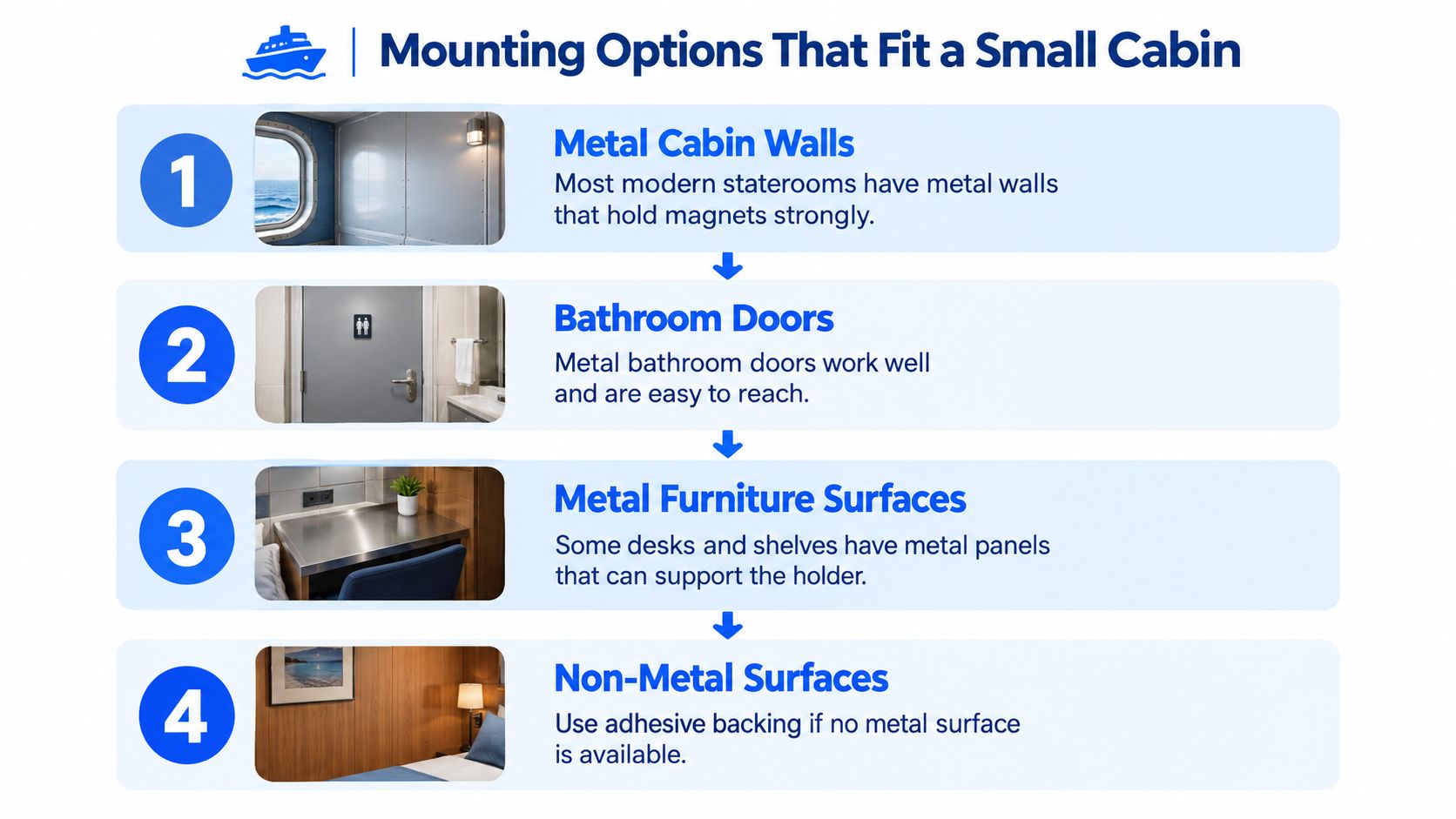
Metal furniture panels may provide another option, but don't assume a desk or shelf is magnetic just because it looks metallic. Some surfaces may be aluminum or covered by a nonmagnetic finish. Check the exact spot, including whether it's curved, and use a soft contact pad to reduce the chance of scratching the finish.
Check the location before committing
Closet rods and ceiling panels may seem convenient, but they're not automatically suitable. A holder attached to a rod can rotate or slide, while a ceiling position near a vent may be awkward to reach or exposed to airflow. Don't mount anything overhead unless the holder's design and the cruise line's rules support that use.
For open-deck movie nights or excursions, a holder attached to luggage may be useful temporarily, but luggage moves and gets handled. Keep headphones secured in a case when the bag is being carried or stored with other bags. If no metal surface works, use a purpose-made adhesive option only if its instructions allow it and the cabin surface can tolerate it.
Don't assume door hooks are allowed
Over-the-door hooks can be convenient at home, but they may risk damaging a cabin door, and some cruise lines don't allow them. Nordmoose notes that its organizers use anti-scratch magnets for attachment to metal cabin walls or doors and include over-the-door hooks for non-cruise travel, while warning that some lines restrict hooks because of door-damage concerns (magnetic wall-hook ideas for cruise cabins). Check your cruise line's policy rather than assuming a hook is permitted.
A quick decision guide helps when you first enter the cabin: test the wall, then the bathroom door, then suitable furniture surfaces. Choose the flattest stable place that's easy to reach and out of the way. If nothing works, switch to a case or an approved adhesive mount rather than forcing a magnetic attachment onto an unsuitable panel.
Choosing the Best Spot Inside the Cabin
The best spot depends on when you use the headphones and who shares the cabin. A bedside wall is usually the most convenient place for personal headphones: they're close for a movie or quiet listening, but can stay off the bed and nightstand. A closet location is less accessible, yet useful for a backup pair or a headset you don't use throughout the day.
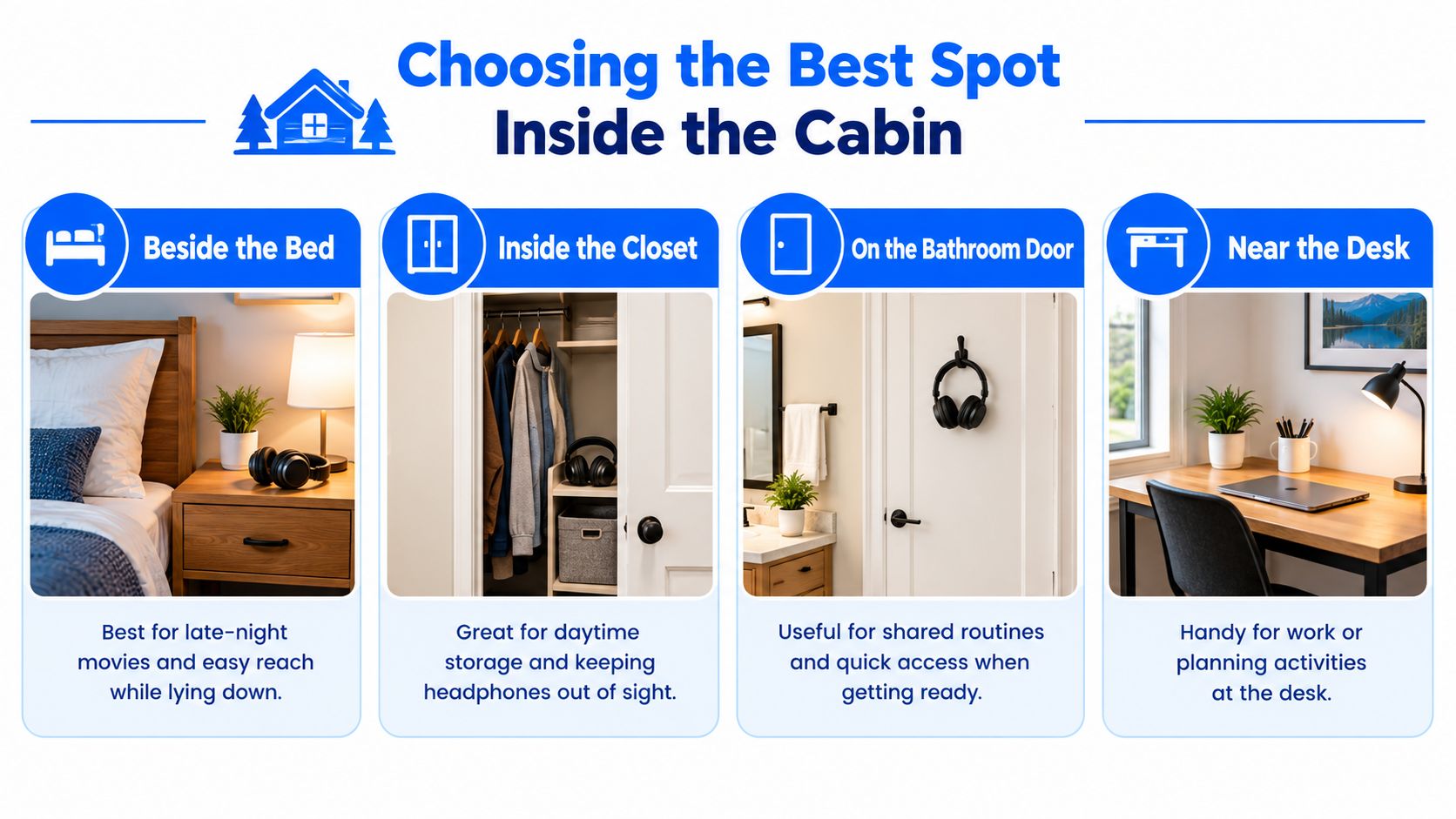
The bathroom door can be handy when you're getting ready, but it's a poor choice if the headphones could be exposed to steam or splashes. A desk-side location makes sense for work or trip planning, though it may compete with chargers and other essentials. Luggage-mounted storage is easy to move, but works best as a temporary solution rather than a permanent home.
| Location | Access | Moisture exposure | Motion and impact | Shared-cabin access |
|---|---|---|---|---|
| Beside the bed | Easy for personal use | Usually lower than bathroom areas | Depends on how close it is to traffic | Easy to reach, so agree on whose headphones go there |
| Inside the closet | Less immediate | Generally sheltered | Lower risk of accidental bumps | Keeps a backup pair out of the way |
| Bathroom door | Convenient while getting ready | Higher, especially near showers | Door movement can bump the holder | Shared access, but not ideal for moisture-sensitive gear |
| On luggage | Convenient while packing or heading out | Depends on where the bag is used | Higher while bags are moved | Easy to move, but not stable storage |
Make the choice in the cabin
For personal headphones, start with the bedside wall if it passes the surface and safety checks. Put a backup pair in the closet, where it's less likely to be knocked or misplaced. Keep the bathroom option for dry, well-positioned spots rather than hanging headphones near a wet shower area.
A larger organizer can help free up cabin space alongside a headphone holder. The Magnetic Cruise Door Organizer attaches to metal cabin walls or doors with anti-scratch magnets and can be repositioned; it's intended for organizing items rather than securing headphones. Treat luggage mounting as a short-term setup for packing or moving around, not as the place to leave a headset overnight.
The decision doesn't need a lengthy rearrangement. Choose the spot you can reach without crossing a roommate's space, keep it away from moisture and frequent bumps, and move it if the cabin routine shows that it's in the way.
Safety, Implants, and the Risks Most Reviews Skip
A stronger magnet isn't automatically a better cabin choice. Placement matters more than a high advertised weight rating when passengers share a tight space with cards, watches, medical devices, and luggage. A holder can be mechanically secure and still be in the wrong location.
A headphone-holder safety manual advises keeping the product at least 15 cm (6 inches) from pacemakers and other implanted medical devices, and warns that neodymium magnets can fracture into sharp pieces after impact (headphone-holder safety manual). Follow the device manufacturer's guidance and any advice from a clinician, especially if someone in the cabin has an implant. Don't place a magnetic holder beside a roommate's bed or somewhere another passenger may unknowingly bring an implanted device close to it.
Strong magnets can also damage magnetic-stripe cards, hotel-style key cards, mechanical watches, hearing aids, and some data-storage media. Keep the holder away from the safe's card storage, wallets, watches, and electronics rather than relying on a product's weight rating as a measure of safety. The assembly and the distance between the magnet and sensitive items matter.
Set a safe cabin position
Choose a spot where a child won't pull the holder down or play with the magnet. Keep it out of routine contact zones, such as a doorway or a narrow path beside the bed. If the magnet or its housing is cracked, chipped, or loose, stop using it; brittle neodymium can break into sharp fragments after a strike.
A cabin holder is for ordinary storage, not for securing headphones through rough seas or preventing every accidental fall.
When the ship is moving, put expensive or heavy headphones in a case or another secure place rather than relying on a wall-mounted magnet alone. That's especially important in a shared cabin, where one person may not know the holder is there or may move belongings without noticing it. A short placement check protects people and equipment more effectively than choosing the strongest magnet available.
Packing, Installing, and Living With the Holder
Pack the holder so its magnet can't knock against a watch, card, or fragile electronic item in your luggage. Keep it in a separate pouch, and wrap any removable metal plate so it doesn't scratch the headphone cup or other belongings. During embarkation, bags may be stacked or moved before they reach the cabin, so don't leave the holder loose in an outer pocket where it can catch on something.
Install it only after testing the spot
- Check the surface. Hold the magnet against the intended wall or door and confirm that it couples firmly. Don't assume every metal-looking panel will hold it.
- Clean the contact area. Wipe away dust or residue so the holder can sit flat. If you're using an adhesive-backed mount, follow its instructions and avoid attaching it to a surface that could be damaged.
- Test the fit. Put a thin piece of cardboard between the holder and the surface to see whether a small gap changes the grip. Remove it before final use, then hang the headphones and check whether the holder shifts.
- Choose a stable position. Keep the cable from hanging where a roommate can catch it, and mark or remember the location so you don't keep moving the holder around the cabin.
After a beach day or time around a pool, dry the headphones before hanging them. A holder keeps gear accessible, but it doesn't protect ear cushions, cables, or electronics from moisture, pressure, or salt air. If the headphones are damp, use a ventilated place to dry them first; when the cabin environment is humid, a protective case with desiccant may be a better storage choice than leaving them exposed.
Take the holder down before room service or cabin cleaning if staff may move nearby belongings or furniture. At the end of the trip, check the wall, bathroom door, closet, and the area around the safe before you leave. Remove the metal plate from the headphones if it's detachable, pack the holder in its protective pouch, and keep it away from cards and watches on the journey home.
Nordmoose makes cruise-focused accessories including magnetic cabin organizers designed to use vertical space in compact staterooms. If you're planning a cabin setup and want to compare those options with your headphone-storage approach, visit Nordmoose before you pack.