

8 Cruise Ship Phrases Every Traveler Should Know
You're standing in your cabin doorway with a key card in one hand, a carry-on in the other, and the ship's speaker starts talking. “Welcome aboard.” Then something about your muster station. Then a reminder about dining times. Later, you hear “all ashore that's going ashore,” and suddenly everyone around you seems to know exactly what to do.
That's the moment many first-time cruisers realize cruise vacations have their own language.
The good news is that most cruise ship phrases aren't complicated once you connect them to a moment, a place, and a next step. Some are announcements you need to recognize right away. Others are phrases you can use politely with crew or fellow passengers. A few sound dramatic but mean “pay attention and follow directions.”
This guide keeps things practical. For each phrase, you'll get the plain-English meaning, when you'll hear it, what action should follow, and any etiquette that matters. That last part helps because not every onboard term is meant for passengers to repeat, and not every announcement requires the same level of urgency.
You'll also notice that cruise language makes more sense when it's organized by the journey itself. Booking terms matter before you sail. Muster language matters on day one. Port-call announcements matter when you're tempted to cut return timing too close.
Use the examples here as a translator, not a substitute for ship rules. Always follow your cruise line's current instructions, app alerts, posted signage, and crew guidance over any general example.
Table of Contents
- 1. All Ashore That's Going Ashore
- 2. Welcome Aboard
- 3. Muster Drill or Muster Station
- 4. Main Dining Room Now Open
- 5. All Hands on Deck or Meet Your Team
- 6. Code Blue and Emergency Medical Announcements
- 7. Life Jacket Stations and Safety Equipment Signage
- 8. Welcome to Port and Disembarkation Announcements
- 8-Point Comparison: Cruise Ship Phrases
- Turn Every Announcement Into an Action
1. All Ashore That's Going Ashore
This is one of the most classic cruise ship phrases, and it matters because it's tied to departure.
In plain English, it means: if you're not sailing with the ship, get off now. On embarkation day, it signals that the pre-departure window is closing. In port, it can also mark the final call before the ship leaves.
For a first-time cruiser, the passenger version of this phrase is simple. Be done with anything that requires time in your cabin before the ship moves.
Here's the practical context. You board, find your room, drop your bags, and start thinking you have plenty of time to unpack later. Then the ship begins cycling through announcements. Once departure-related language starts, your attention should shift from “settling in eventually” to “finishing essentials now.”
What to do when you hear it
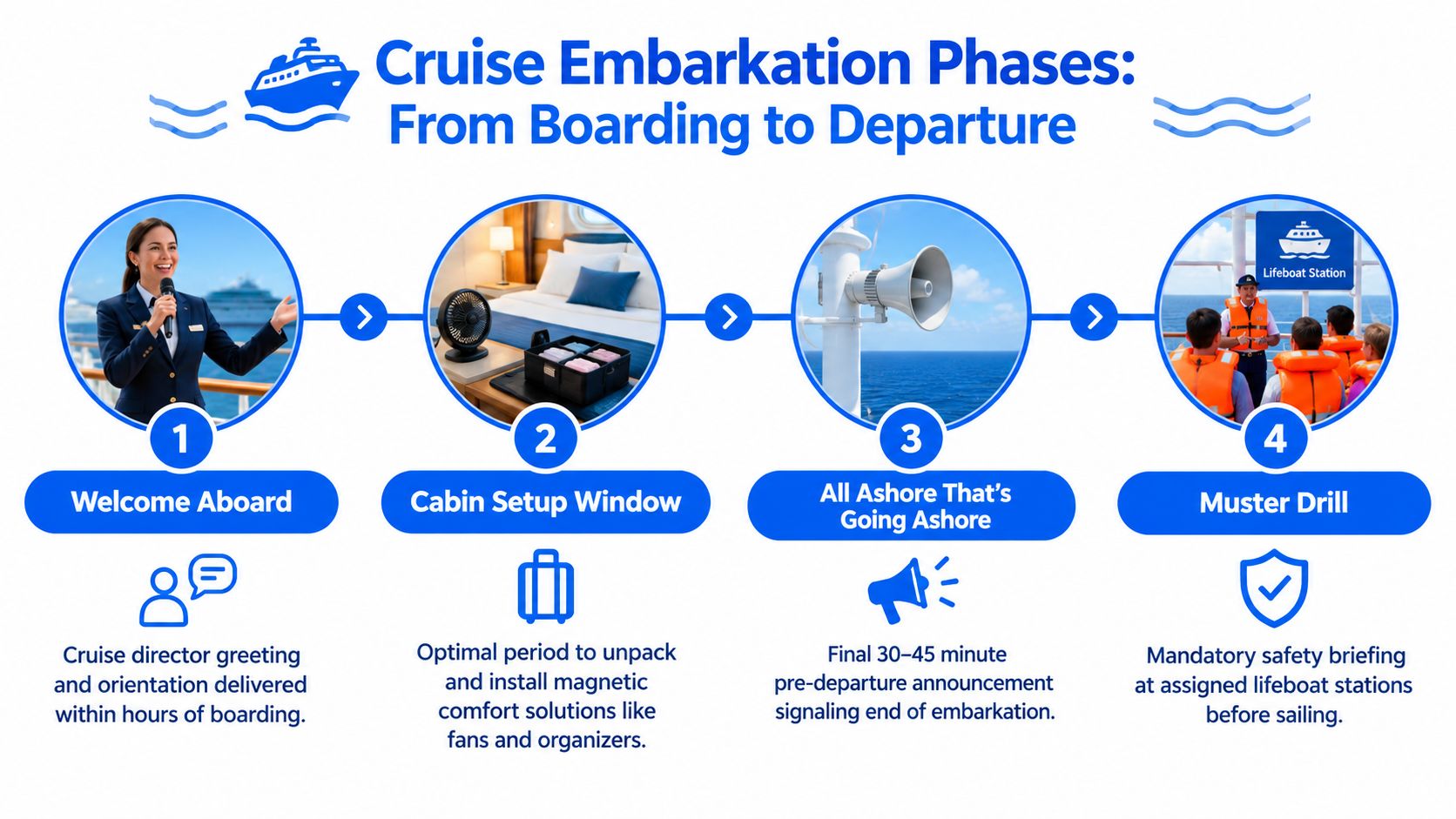
- Finish cabin setup: Put away what you'll need soon, especially medications, swimwear, chargers, and documents.
- Check your departure items: If you're prone to motion discomfort, prepare before sailaway, not after you start feeling off.
- Confirm your luggage plan: If larger bags haven't arrived yet, keep essentials with you and make sure your tags were attached clearly. A cruise luggage tag guide from Nordmoose can help first-timers understand that part before they sail.
A real example looks like this: a family boards at midday, heads to lunch, and assumes they'll unpack after eating. That can work, but if muster instructions and departure reminders start stacking up, the easy window disappears fast.
Practical rule: Treat your first hour onboard as setup time, not drift-around time.
If cabin airflow matters to you, this is also when small cabin tools are easiest to place. The Rechargeable Cruise Fan with Magnetic Hook to Hang on Cruise Walls & Ceilings is described as a portable rechargeable fan for cruise cabins and travel setups, with a magnetic hook included and selected models offering timers and multiple speed settings.
Etiquette to remember
Passengers usually don't say this phrase themselves unless they're joking. You just need to recognize it. If you're still onshore during a port stop, don't test how literal the timing is. Head back.
2. Welcome Aboard
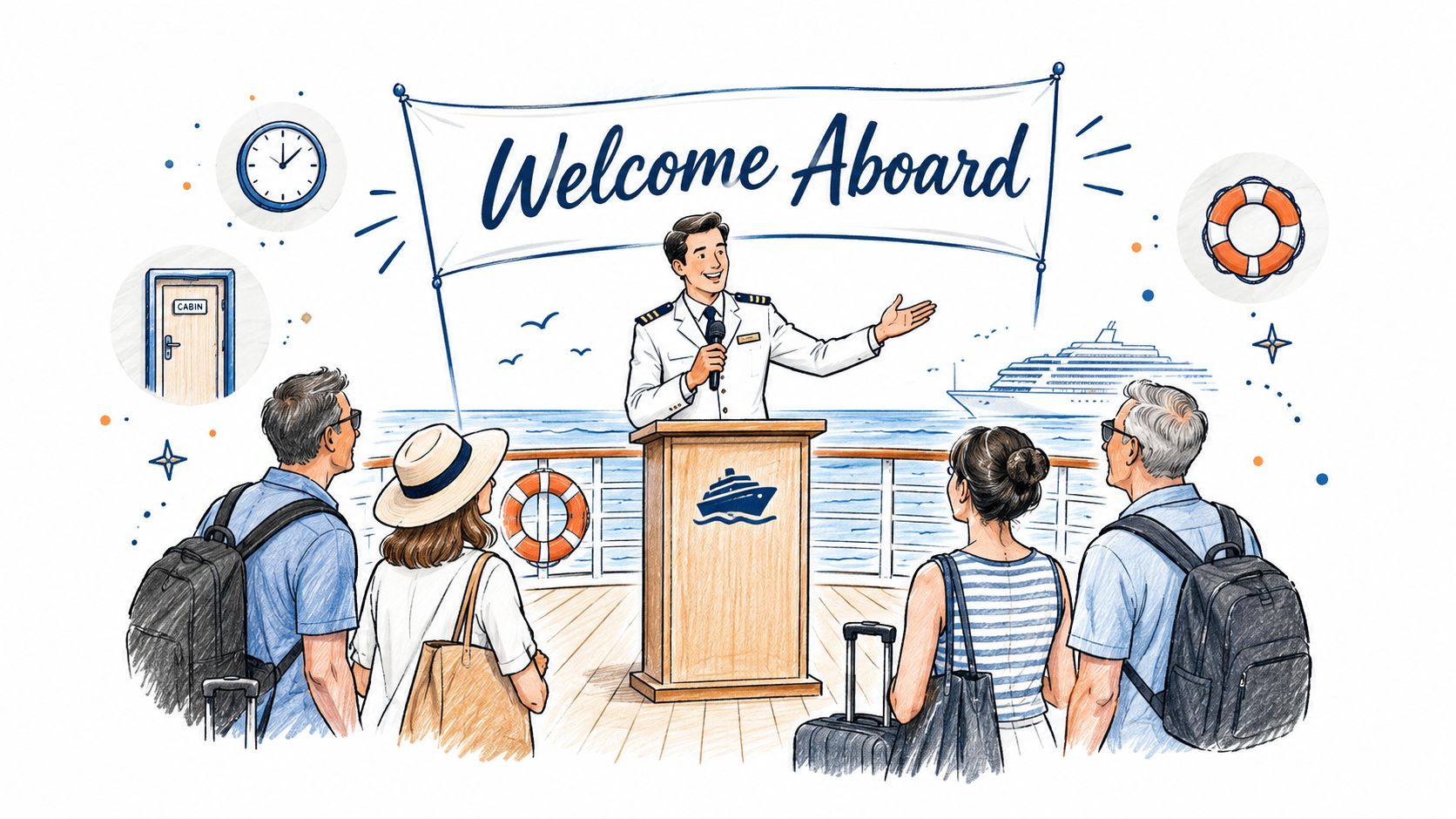
“Welcome aboard” sounds obvious, but on a cruise it often comes bundled with useful instructions.
This announcement usually introduces the tone of the trip. It may mention dining schedules, activity planning, safety reminders, phone procedures, or where to find information in the app. It's easy to tune out because it feels ceremonial. Don't.
What you're really hearing is your first orientation briefing.
The gap in a lot of cruise vocabulary advice is that it focuses on dictionary definitions like port, starboard, and embarkation, but doesn't tell people which phrases matter at which moment or what to do next. That's why a scenario-based approach is more useful, as noted in this discussion of underused practical cruise phrase guidance.
What this announcement usually means for you
When crew say “welcome aboard,” listen for the details hidden inside the greeting.
- Save your cabin basics: Learn your room number, cabin phone details, and where your muster information is posted.
- Note the daily-information system: Some lines rely heavily on the app, some on printed schedules, and some on repeated announcements.
- Handle clutter early: The Magnetic Cruise Door Organizer is described as a cruise cabin organizer with 3 anti-scratch magnets, 15 mesh pockets sized 7.5" x 10", repositionable placement on metal cabin walls or doors, and a stated capacity of up to 25 lbs.
A realistic first-day example: you hear “welcome aboard,” ignore the details, and later can't remember whether dinner is open seating, assigned seating, or app-based reservation timing. That creates avoidable stress.
What you can say back
You don't need special language here. A simple “thank you” works perfectly when crew greet you. If you have a cabin question, this is also a polite time to ask it clearly.
“Hi, this is our first cruise. Could you point us to our muster station and let us know how dining works tonight?”
That sounds better than trying to copy nautical phrases you've heard online.
3. Muster Drill or Muster Station
This is the one phrase you should treat as completely non-optional.
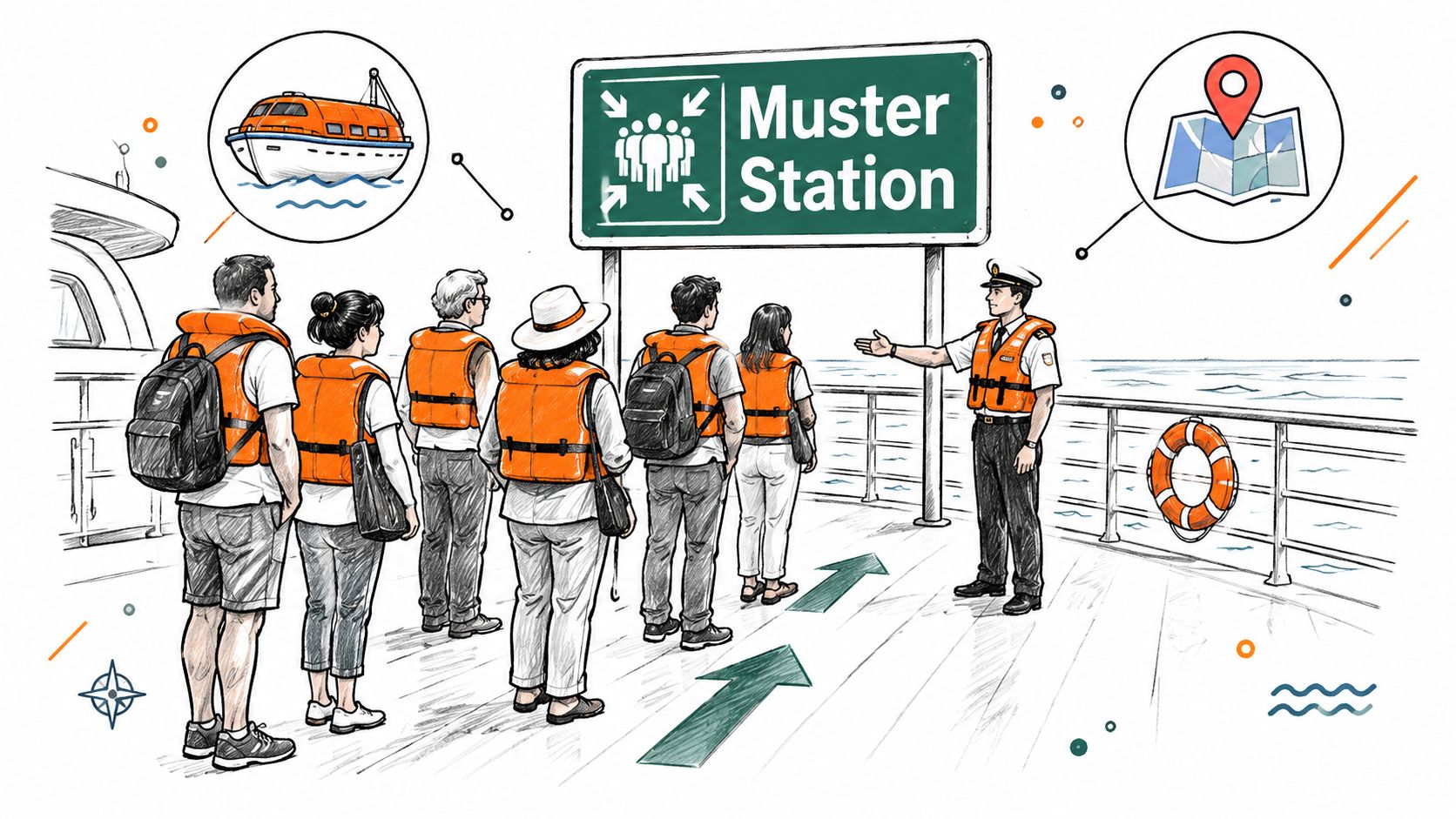
“Muster drill” means the mandatory safety briefing. “Muster station” means the place you're assigned to go in an emergency. Your station is usually tied to your cabin and listed on your key card, cabin door, or ship materials.
On many sailings, this is one of the first high-priority announcements you'll hear.
What the words mean in plain English
If the ship says “proceed to your muster station,” stop treating it like background audio. Go there promptly, bring what the ship tells you to bring, and follow crew instructions.
That's not just formality. It's how you learn where to report and what to expect if a real emergency happens.
What action should follow
- Bring the essentials the ship requests: Usually your key card is important for check-in or verification.
- Pause whatever you're doing: Don't finish your snack, your unpacking, or your selfie first.
- Pay attention to your route: The path matters almost as much as the station itself.
A useful comfort note belongs here too. A full-ship monitoring study on a large sailing cruise ship found average cabin-area conditions across monitored spaces of 68.2 ± 5.3% relative humidity and 22.3 ± 1.4°C, with CO2 typically in the 400–1200 ppm range and generally below 1000 ppm_2024.pdf). In plain terms, air quality was usually acceptable, but humidity often ran higher than standard indoor comfort targets. If your cabin feels muggy before muster, that feeling isn't unusual.
Missing muster creates the kind of problem you don't want on day one. When the ship says go, go.
Etiquette to remember
Don't joke through the briefing. Don't block hallways. Don't assume your previous cruise experience makes this one skippable. Each ship's procedures can differ, and crew need passengers moving as a group.
4. Main Dining Room Now Open
This phrase is less dramatic, but it's one of the most useful. It tells you how the ship's daily rhythm works.
“Main dining room now open” usually means exactly what it sounds like. A restaurant is open for a meal period. But the hidden message is this: the cruise day is running on a schedule, and your comfort gets easier when you follow it.
Passengers who miss meal timing often end up rushing, wandering, or showing up underdressed, late, or confused about reservations.
Why this announcement matters more than it seems
Cruise ships teach you their routine through repetition. Breakfast windows, lunch openings, early dinner, late dinner, buffet alternatives, and app reminders all shape how crowded public spaces feel and how calm your cabin time can be.
A simple example: if you know the main dining room opens soon, that may be the best moment to shower, change, or rest before everyone else returns to the corridor at once.
For travelers trying to understand restaurant timing before a sailing, menu and venue explainers like this Terraces Restaurant menu overview can help set expectations about how onboard dining language gets used.
What action should follow
- Check whether it applies to you: Is this your assigned dining room, an open venue, or just a general reminder?
- Match the ship's pace: Use these announcements to plan naps, pool time, and cleanup rather than drifting until you're hungry.
- Look ahead one step: If dinner is open now, ask yourself where you need to be next, not just where you are.
A realistic scenario: you hear “main dining room now open,” assume you can show up anytime, then learn your assigned time already started. The phrase wasn't just information. It was a timing cue.
Words you can use politely
You don't need insider language here either. These work well:
- Ask clearly: “Is this open seating or assigned tonight?”
- Confirm timing: “Are we in the early or late dining group?”
- Check dress expectations: “Is tonight more casual or more formal?”
That kind of plain speech prevents more problems than trying to sound experienced.
5. All Hands on Deck or Meet Your Team
You open your cabin for the first time and find three things that matter right away. A steward contact card, a safety map on or near the door, and a phone or QR code for guest services. None of those are decoration. They are the ship's shortcut system.
“All hands on deck” is old seafaring language for everyone reporting in. On a cruise, passengers usually see the softer version: introductions from your cabin steward, dining staff, or signs that tell you who handles what. The plain-English meaning is simple. Meet the people and tools that help you solve problems fast.
Here is the easiest first-day technique.
Before you unpack, stand in the doorway for 30 seconds and do a mini scan:
- Find the cabin map that shows your emergency route.
- Find the steward card or name tag location, often near the desk, mirror, or wall slot.
- Check the cabin phone for the button or label for guest services.
- Take one photo of the steward card and one photo of the emergency route, if the line allows photos in the cabin.
Those two photos help later when you are tired, turned around, or trying to explain your location.
What each contact means
Your cabin steward handles room issues. That includes missing towels, a sofa bed setup, extra hangers, ice, or a cabin that needs attention.
Your dining team handles meal questions. Ask them about table assignments, food allergies, or whether a venue is open seating.
Guest services handles account, key card, billing, and general ship problems that do not belong to housekeeping or dining.
The nearest crew member can still point you in the right direction. But knowing the first stop saves time.
A simple comparison helps here. Your steward is like the point person for your room. Guest services is the front desk for the whole ship.
A realistic first-day moment
Your cabin feels warm after sailaway. New cruisers often tell the first crew member they see in the hallway or mention it at dinner. That can work, but it adds an extra handoff.
The faster move is to check the steward card, use the cabin phone or speak to your steward by name, and report the cabin number with the problem. Plain English works best: “Hi, this is cabin 9246. The room feels warm. Could someone check the air conditioning?”
That is the action hidden inside “meet your team.” It is not about sounding experienced. It is about matching the problem to the right person.
What to say and what to do
If you meet your steward in the hall, use a clear request:
- “Could we get two extra towels?”
- “Can the beds stay separated?”
- “Where should we leave laundry?”
- “Who should we call if the room temperature doesn't improve?”
If the issue is not a room issue, switch channels:
- Billing problem: contact guest services.
- Dining time confusion: ask the dining host or restaurant staff.
- Wayfinding question: ask any nearby crew member.
Takeaway: Learn one name, find one card, and save two photos. That small setup step removes a lot of first-day confusion.
You do not need crew jargon. Respectful, specific requests are easier to act on than vague ones. “Our shower is draining slowly in cabin 9246” is better than “Something is wrong in our room.”
6. Code Blue and Emergency Medical Announcements
This category makes some people nervous, so it helps to separate what you need to know from what's mostly internal.
A phrase like “Code Blue” generally signals a medical emergency response. Passengers may or may not hear internal codes directly, depending on the ship and situation. What matters for you is not decoding every announcement. It's knowing how to respond appropriately.
In most cases, your job is simple. Stay out of the way, don't crowd the scene, and follow nearby crew direction.
What passengers should understand
Medical language onboard often includes public instructions and private operational terms. Public instructions tell you where to go or what to avoid. Operational terms help crew move fast.
There's also a wider etiquette issue here. Public interest in cruise insider language has grown beyond standard passenger vocabulary, including coded terms and crew slang, but much of that coverage leaves out privacy, safety, and context. This discussion of cruise code words and crew slang shows why it's better to separate passenger-safe terms from crew-only language.
What action should follow
- Know the infirmary location early: Don't wait until someone feels sick to figure it out.
- Know your cabin phone number: If you need assistance, clear location details matter.
- Move aside quickly: Hallways and elevators may need to stay clear.
If motion sickness is your concern, there's one useful myth to clear up. A controlled study found that cabin location itself wasn't statistically associated with seasickness likelihood, while age and sex tracked more strongly with risk, and ship-motion comfort work points to reducing motion exposure as the main design priority. In plain English, don't assume a certain cabin placement guarantees you won't feel queasy.
If you want practical prep ideas before sailing, this guide on what to do for seasickness on a cruise is the kind of planning resource many first-timers find useful.
If you hear a medical response announcement, your best move is often to do less, not more.
7. Life Jacket Stations and Safety Equipment Signage
You will not hear every safety instruction over the speaker. Some of the clearest directions on a cruise are posted on walls, doors, and ceilings.
Treat ship signage like airport wayfinding with higher stakes. It tells you where to go when you are relaxed, and it still works when you are tired, turned around, or trying to move with a crowd.
Here are the signs that matter most during the middle of your cruise journey, after boarding and muster but before port routines and final departure start to take over.
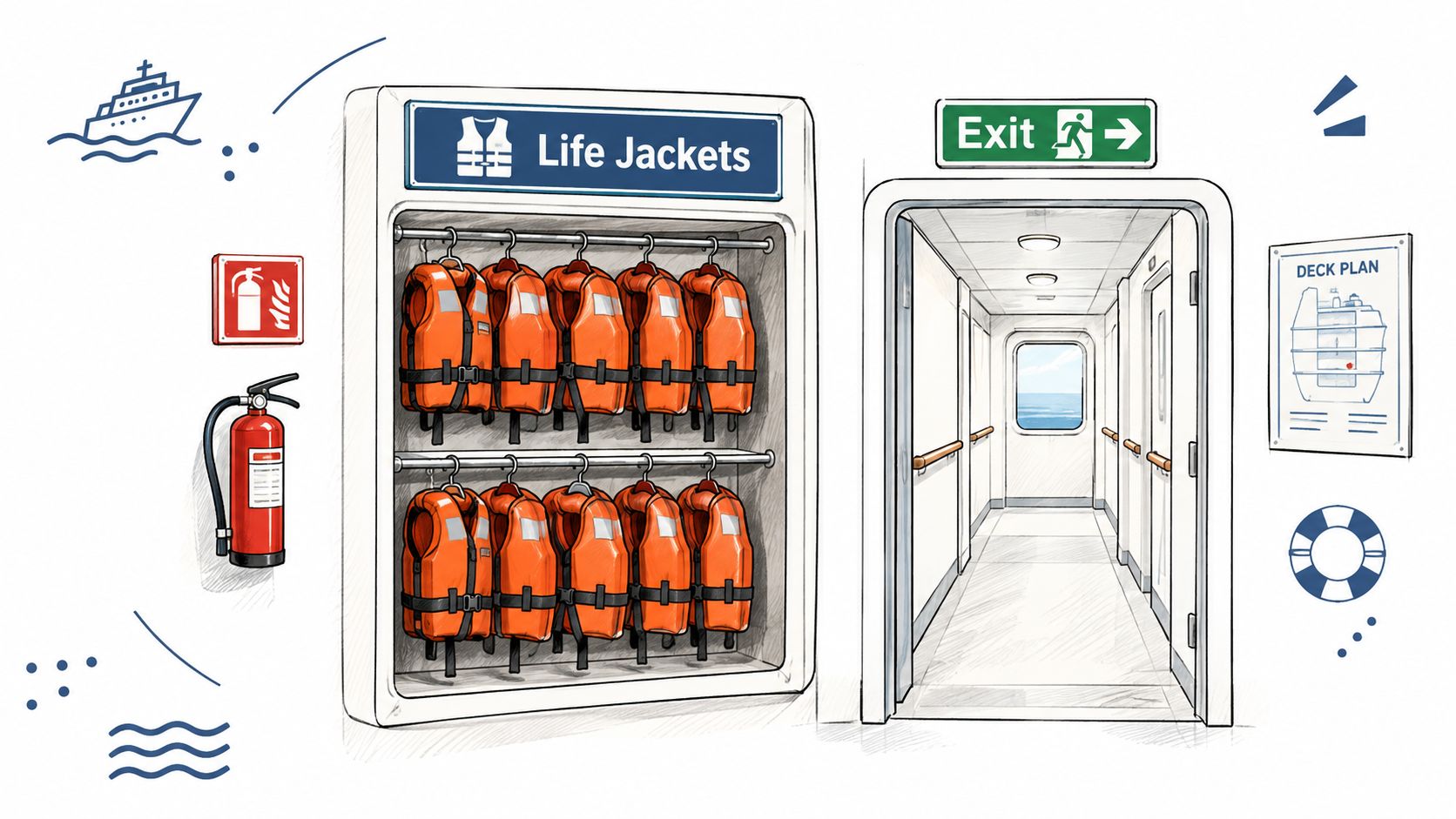
Muster letter or station number. In plain English, this is your assigned safety meeting point. You will see it on your cabin information, often on the back of your door, and sometimes on nearby hallway signage. When you spot it, match it to what you learned during muster and remember the route from your cabin.
Exit arrows and stairwell signs. These show your nearest path out of a corridor or public area. You will notice them in hallways, near elevator banks, and above doors. Your action is simple: check which direction the arrow points before you need it.
Deck plans. These are the ship's maps. You will usually find them by elevators and stair towers. Use them when you feel disoriented, then anchor yourself to one fixed point such as Forward, Aft, or a stairwell number.
Life jacket and equipment labels. These tell you what the item is for and whether it is passenger-use equipment or emergency gear meant for trained crew. If you are unsure, read first and touch second.
A quick cabin habit helps more than trying to memorize the whole ship. Open your cabin door, look left and right, and note the nearest stairwell. Then check the route map on your door. One clear path beats a fuzzy mental map of ten decks.
A common first-cruise problem happens after dinner or a show. Every hallway starts to look the same. The fix is usually visual, not verbal. Read the deck number, find the stairwell marker, and use the posted map to reset your position.
Fast takeaways
- Learn one route first: Cabin to muster station matters more than knowing every venue.
- Use stairwells as landmarks: They are easier to track than identical cabin doors.
- Read signs before you need them: Familiar routes feel much easier under stress.
- Leave safety gear alone: Ask a crew member before handling anything meant for emergencies.
One last comfort note. Safety signage is there to reduce decision-making. The more you notice it on day one, the less mental effort each announcement will require later.
8. Welcome to Port and Disembarkation Announcements
You are eating breakfast, the ship docks, and an announcement starts listing times, gangway details, and local reminders. That cheerful message is really a travel checklist spoken out loud.
Port announcements answer three practical questions: Can I get off yet? When do I have to be back? What rules apply in this port? Final-day announcements do the same job for leaving the ship.
Here is the easiest way to hear them.
If the announcement says “clearance has been granted” or “the gangway is open,” passengers may start going ashore. It does not mean you need to leave at once. Your action is simple: check whether your group, tour, or personal plan is ready, then leave when it makes sense.
If you hear “all aboard,” treat it like the ship's return deadline. A good comparison is an airport boarding cutoff. The trip is not over, but your free time has a hard stop. Your action: confirm the exact time on the ship's clock, not the time on a phone that may have switched to local time.
That one detail causes a lot of stress for first-time cruisers.
A useful habit is to make the announcement visible. Take a photo of the return-time sign near the gangway, write the time in your notes app, or set an alarm labeled “ship time.” Do it before you step off the ship, not halfway through lunch ashore.
Final-night and final-morning announcements need a different response. Listen for phrases like “luggage must be placed outside your cabin by...” or “self-assist disembarkation.” In plain English, the crew is telling you how your bags will leave and whether you are carrying them off yourself. Your action depends on the method. If checked luggage is being collected, pack early and attach the correct tags. If self-assist is allowed, keep your bags with you and be ready to move them without help.
Cabin instructions matter too. If the announcement says your cabin must be vacated by a certain time, that means the room needs to be empty even if your departure group has not been called yet. The best move is to finish packing the night before, keep morning items in one small bag, and settle your bill before the rush.
A quick translation guide
- “Gangway is open.” You may leave the ship. Check your passport, room key, and return time first.
- “All aboard.” Be back on the ship by this time. Use ship time.
- “Luggage out by tonight.” Your larger bags need to be packed, tagged, and placed outside your cabin door on schedule.
- “Self-assist disembarkation.” You carry your own bags off. Pack light enough to manage stairs or lines.
- “Departure group X may now disembark.” Wait for your group, then head to the exit instead of joining the line early.
Fast takeaways
- Hear port announcements as instructions: each phrase tells you what freedom you have and when it ends.
- Treat all-aboard time like a hard cutoff: check ship time every time.
- Prepare for the last morning the night before: luggage rules arrive early, when people are tired and distracted.
- Match the phrase to the action: gangway open means you may leave. Group called means go. Cabin deadline means clear out.
8-Point Comparison: Cruise Ship Phrases
| Announcement | Complexity 🔄 | Resources & Timing ⚡ | Expected Outcomes ⭐📊 | Ideal Use Cases 💡 | Key Advantages ⭐ |
|---|---|---|---|---|---|
| All Ashore That's Going Ashore – Embarkation and Port Departure Announcement | Low, single scheduled PA call, minimal coordination | Minimal: PA system; short window 30–45 min before sailing | Clear cutoff for boarding; prompts rapid cabin setup; signals imminent departure 📊 | Final unpack/install of magnetic fans/organizers before sailaway | Universally recognized cue; enables Day‑One comfort setup ⭐ |
| Welcome Aboard – Greeting and Onboard Orientation Announcement | Low, delivered by cruise director/captain; information‑dense | Minimal: PA/podium; within hours of embarkation | Establishes tone, logistics, safety basics; orients passengers 📊 | Unpacking, noting cabin amenities, initial ventilation setup | Consolidates essential info; sets expectations for services ⭐ |
| Muster Drill or Muster Station – Mandatory Safety Briefing Announcement | High, regulatory coordination and verification required 🔄 | Significant: crew, life vests, muster stations; scheduled pre‑departure or shortly after embarkation | Ensures regulatory compliance; familiarizes passengers with emergency procedures 📊 | Mandatory safety training; accountability of all passengers | Critical for safety; legal requirement (SOLAS/USCG) ⭐ |
| Main Dining Room Now Open – Meal Service and Daily Schedule Announcements | Low, recurring, routine broadcasts | Low: PA/TV/app; repeated multiple times daily ⚡ | Informs meal times and activities; helps plan cabin occupancy and timing 📊 | Scheduling meals, timing cabin tasks (e.g., drying, fan use) | Regular reminders reduce uncertainty; helps time cabin tasks ⭐ |
| All Hands on Deck / Meet Your Team – Crew Introduction & Signage | Medium, ongoing signage and crew coordination | Moderate: printed signage, crew boards, visible IDs; continuous | Connects passengers to crew; clarifies points of contact for cabin issues 📊 | Locating steward, requesting cabin assistance or mounting advice | Personal contact improves follow‑up; enhances trust ⭐ |
| Code Blue & Emergency Medical Announcements – Medical Protocols & Signage | Medium, formal protocols; staff readiness required | Moderate: medical staff, infirmary signage, cabin packets; as needed | Clear medical access info; reduces anxiety for motion‑sensitive travelers 📊 | Medical emergencies, preventive care, seasickness management | Standardized response; informs where to get help ⭐ |
| Life Jacket Stations & Safety Equipment Signage – Visual Safety Navigation | Low–Medium, installation & upkeep of signage/illumination | Moderate: illuminated signs, color‑coding, deck maps; continuous ⚡ | Improves evacuation navigation and low‑light wayfinding 📊 | Emergency egress, nighttime cabin navigation, orientation | Standardized, legally required cues; aids quick recognition ⭐ |
| Welcome to Port & Disembarkation Announcements – Port Arrival & End‑of‑Cruise Communication | Medium, multilingual logistics and timing coordination | Moderate: PA/app, crew coordination; at port arrival and prior to disembarkation | Clarifies all‑aboard times, checkout procedures, local safety guidance 📊 | Port visits, final evening packing, product removal decisions | Reduces disembarkation confusion; provides local safety info ⭐ |
Turn Every Announcement Into an Action
Cruise ship phrases become useful only when they change what you do next.
That's the main lesson first-time cruisers need. You don't have to memorize every nautical term or learn a secret onboard vocabulary. You need to recognize the handful of phrases that affect timing, safety, movement, meals, and getting back to the ship on time.
Start with departure language. If you hear “all ashore that's going ashore,” stop assuming you have endless setup time. Use that early window to get your cabin functional, locate documents, and prepare anything you'll want before sailaway.
Treat muster language even more seriously. “Muster station” isn't trivia. It's a direct instruction tied to your assigned safety location. Learn it early, walk the route once, and respond promptly when called. That one habit makes the entire first afternoon smoother.
Use crew names and role-based language whenever possible. You don't need to sound nautical. You need to be clear. “Could you help us find our muster station?” and “Could we get an extra blanket?” are better than trying to perform cruise expertise.
Watch the ship's routine through dining and daily announcements. Meal openings, venue reminders, and app prompts tell you when public spaces will get crowded and when your cabin may be the better place to reset. The same goes for visual language. Deck plans, exit signs, and door diagrams teach you the ship if you pay attention once instead of guessing repeatedly.
On port days, all-aboard timing is the phrase that deserves your full attention. Set an alarm. Double-check ship time. Build in a cushion instead of cutting it close. That one decision protects the rest of your trip better than any clever packing trick.
At the end of the cruise, disembarkation language becomes a packing schedule. Listen for luggage instructions, group calls, and cabin deadlines. Pack nonessential cabin items the evening before so the final morning stays simple.
If you like using gear that helps organize a small cabin, brands such as Nordmoose focus on compact cruise-cabin accessories built around metal walls, limited surfaces, and travel packability. The useful part isn't the product itself. It's the habit behind it. Set up early, store clearly, and avoid last-minute scrambling.
That's the translation of cruise ship phrases. Hear the words. Match them to the moment. Take the right action quickly, politely, and with safety first.
Nordmoose offers cruise-focused accessories such as magnetic organizers, rechargeable cabin fans, night lights, and other compact tools designed for ship cabins. If you want to make these cruise ship phrases easier to act on, from embarkation setup to final-day packing, visit Nordmoose before your next sailing.