

Cruise Luggage Tag Holders That Keep Bags Found
You're standing at the curb with your suitcases, your boarding pass on your phone, and a sheet of home printed paper stapled around a handle. That paper is the only thing telling a porter, a loader, and a stateroom attendant where your bag belongs. Cruise luggage tag holders exist because that sheet was never built for rain, stacking, or a wet pier, and choosing one well depends less on thickness than on how and when you travel to the ship.
Table of Contents
- What Cruise Luggage Tag Holders Actually Do at the Pier
- The Core Anatomy of a Cruise Luggage Tag Holder
- Plastic Sleeves Straps Hard Cases and Smart Holders Compared
- Why the Fly-to-Port Itinerary Changes the Right Holder
- How to Attach a Cruise Tag Holder Step by Step
- How Tags Actually Fail and How Holders Stop Each Failure
- Smart and Trackable Tags and a Final Pre-Cruise Checklist
What Cruise Luggage Tag Holders Actually Do at the Pier
A bag swings onto the pier carousel with its paper half torn away. The name is there, but the deck number is gone, so the bag stops moving while every readable bag around it keeps going. That delay is what a holder is meant to prevent.
Cruise lines run a two stage baggage system, not a single drop off. MSC instructs passengers to label every bag before reaching the terminal, then later provides new tags in the cabin and has passengers leave tagged bags outside the cabin the night before departure, as described in MSC guidance on labeling bags before the terminal and again for disembarkation. Embarkation and disembarkation are separate tagging events, and different people handle the bag at each stage.
A Downloaded Tag, Not a Supplied Label
Today's tag usually starts as a download. Your electronic documents contain a tag tied to your ship, sailing date, stateroom, and deck, which you print, fold, and attach before you reach the pier. Because it's itinerary specific, a holder has to fit that folded format and keep the printed routing visible from curb to cabin.
The flow below shows where that small piece of paper does its work.
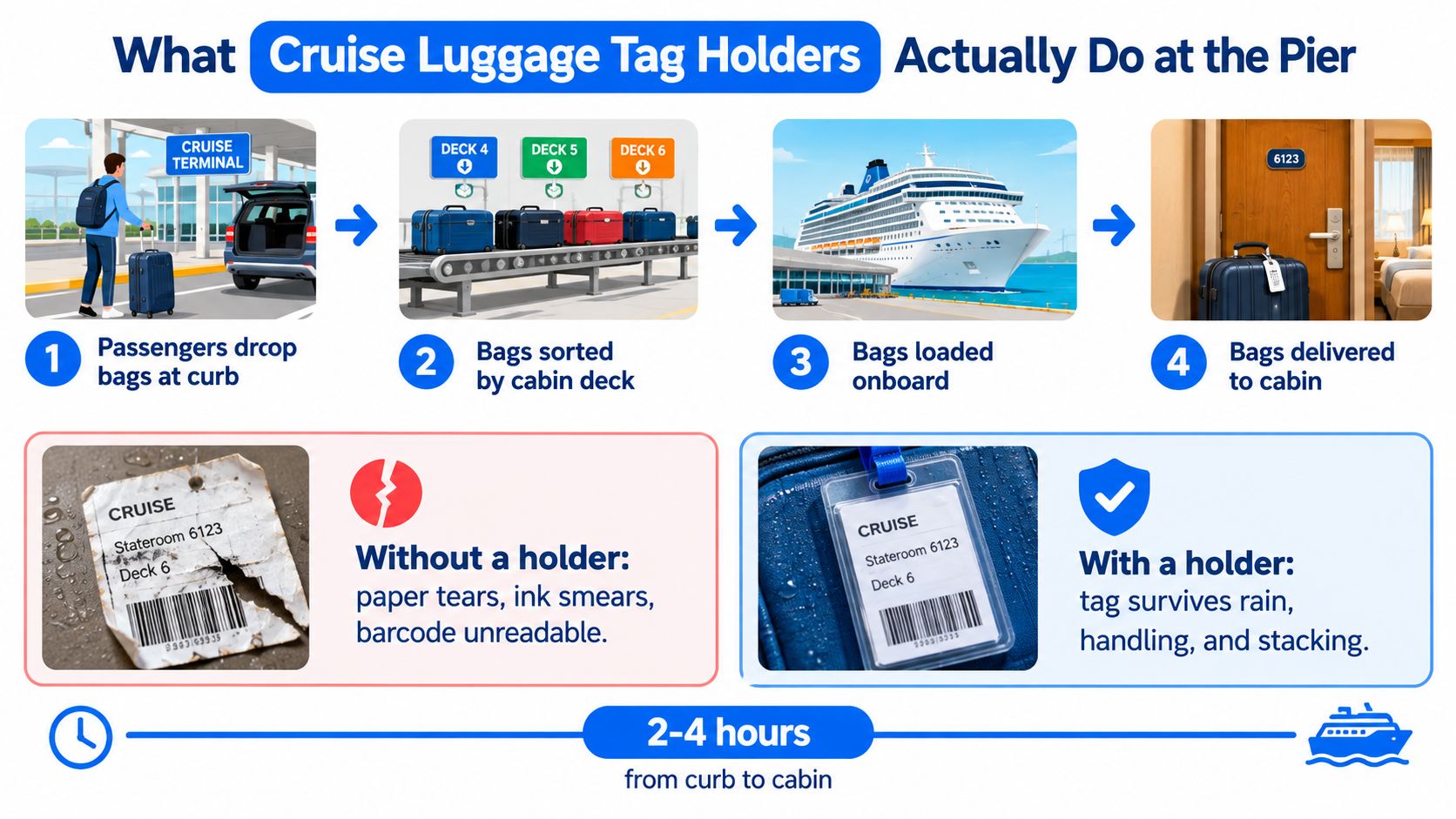
Porters sort by what they can read at arm's length. Loaders group bags by deck. Attendants deliver by stateroom. If ink smears or a corner tears, the bag doesn't get lost in a dramatic way, it gets set aside for manual sorting, which is slower and less predictable.
Treat the holder as mission specific gear for one printed tag, not as a generic ID tag you'll leave on the suitcase all year.
That's the practical distinction in this overview of the cruise luggage tag itself, and it shapes everything else. The holder's job is narrow and unforgiving, keep a specific sheet readable, attached, and scannable through handling you won't see.
The Core Anatomy of a Cruise Luggage Tag Holder
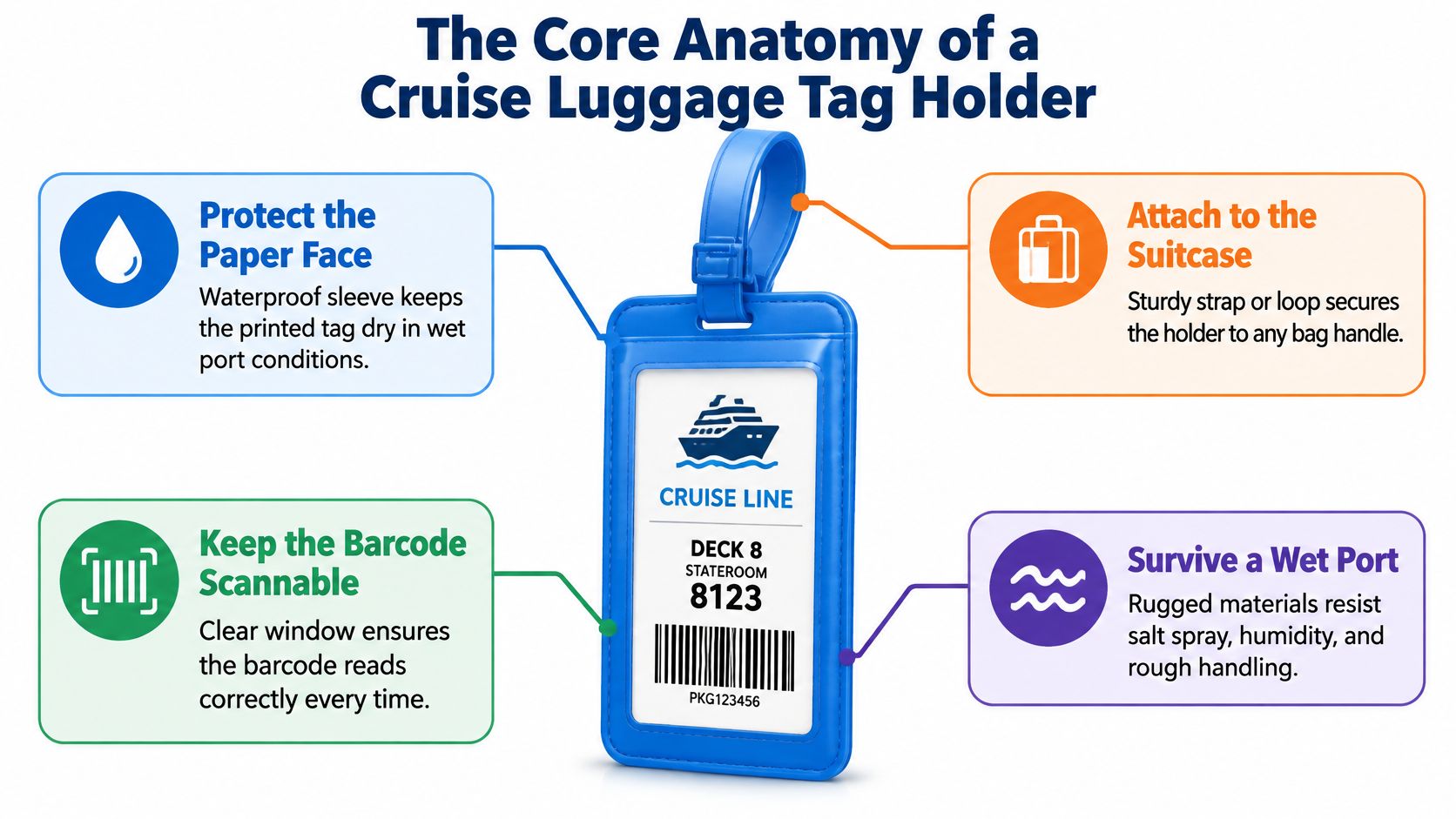
Think of a suitcase as the system and the holder as four small parts doing different work on it. The sleeve is the passport cover, shielding the paper face. The loop is the carabiner, bearing the load. The closure is the zip pocket on a travel vest, pointless if it gaps open.
Sleeve and Window
The sleeve should keep the folded tag flat and dry without distorting it. Clear plastic matters because barcode contrast matters. Tinted plastic, heavy glare, or a fold crossing the barcode can make a tag that looks fine to you fail for staff who need to read it quickly under terminal lighting.
Fit is the part shoppers skip. One commonly marketed multi line format is approximately 8.9 by 19 centimeters, or about 3.5 by 7.5 inches, while a separate Holland America format is listed at 6.5 by 3 inches, a difference noted alongside Norwegian Cruise Line instructions to download and print tags from electronic documents. A holder that's too loose lets the paper slide and bunch. A holder that's too tight forces a crease exactly where you don't want one.
These four functions are easier to judge when you see them separated.
Loop and Closure
The loop must engage the structural handle, not a zipper pull or decorative fitting that'll bend or snap under a tug. A metal cable or similarly durable loop holds up better than a thin disposable tie when bags are pulled from a stack.
- Protect the paper face: Flexible, water resistant material that doesn't crack when bent.
- Attach to the suitcase: A loop that closes fully and can't work open in a pile.
- Keep the barcode scannable: Clear, flat plastic with no tint or heavy texture.
- Survive a wet port: A tight closure or overlap so splash can't wick straight into the fold.
If any one of those four is missing, you've bought a sleeve, not a system. Judge holders on a shelf in that order and most weak designs eliminate themselves.
Plastic Sleeves Straps Hard Cases and Smart Holders Compared
Shopping pages blur four different products into one category. They behave differently at a port, and they behave very differently if your bag flies first. Run them against the same criteria, water resistance, snag risk, barcode clarity, and replacement cost, and the trade offs become clear.
Cruise Luggage Tag Holder Styles Compared
| Holder style | Water resistance | Snag risk | Barcode clarity | Best for |
|---|---|---|---|---|
| Flexible plastic sleeve with cable loop | Good when fully closed | Low if it hangs flat | High, paper stays flat | Most cruisers, most lines |
| Strap on loop holder | Varies by sleeve design | Moderate, straps can project | Good if window is clear | Irregular handles, duffels |
| Rigid protective case | High for the paper face | Higher, bulk catches on stacks | High, very flat presentation | Drive to port travelers |
| Smart or trackable holder | Depends on electronics housing | Moderate to high | High if window is separate | Longer, higher risk itineraries |
The flexible sleeve with a cable loop is the workhorse. It's cheap to replace, packs flat in a carry on, bends instead of cracking, and keeps the tag close to the case. Its weakness is the closure. A cheap seal that pops open turns good plastic into a funnel for rain.
Strap on designs solve an awkward handle problem, then create a snag problem. A long strap lets the holder swing and project outward, which is exactly where adjacent luggage and handling equipment catch it. If you choose one, shorten the hang as much as the design allows.
Where Rigid and Smart Designs Win and Lose
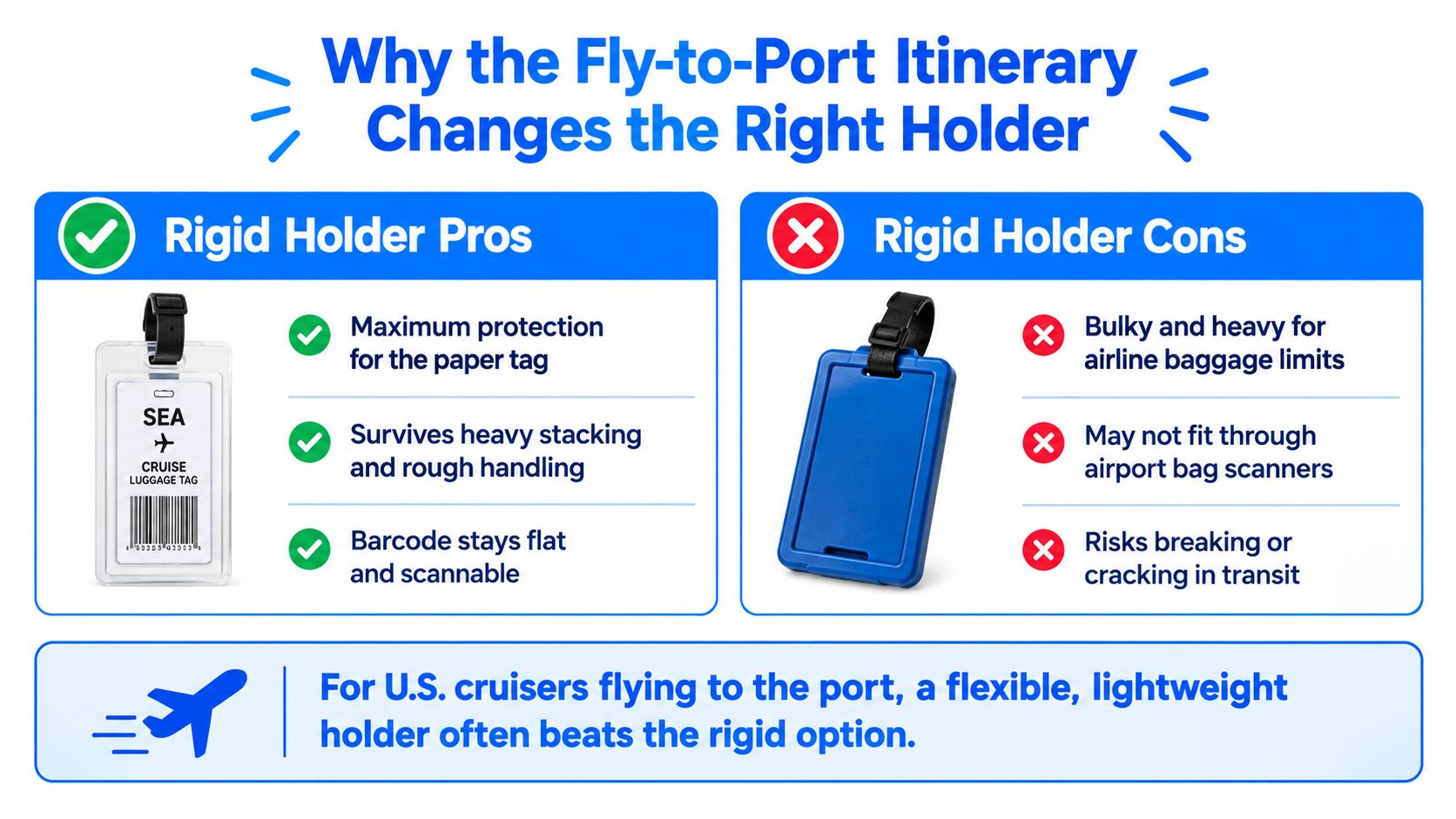
A rigid case keeps the barcode beautifully flat and shrugs off stacking pressure. It also adds bulk, can't flex when a bag is compressed, and is the worst of the four to send through airline handling. For a casual Caribbean cruiser driving to the port, that trade can work. For a frequent cruiser or a family of four buying holders for every checked bag, flexible sleeves usually win on cost, storage, and spares.
Smart holders add tracking or digital identification, not better paper protection. A privacy focused traveler may value recovery help if a bag goes missing, but the electronics add charging, pairing, and bulk. They don't replace the printed cruise tag, since pier staff still route by what they can read on the bag.
The setup that underperforms almost everywhere: A thin, open ended sleeve on a disposable tie, attached to a zipper pull. It fails on water, attachment, and snag risk at the same time.
Pick by itinerary first and materials second. Most travelers should start with the flexible sleeve and a strong loop, then move to rigid or smart only for a specific reason they can name.
Why the Fly-to-Port Itinerary Changes the Right Holder
The strongest holder on the shelf isn't automatically the right one. That assumption breaks down fastest for U.S. cruisers who fly to the embarkation port, because their bags face two different handling systems in one trip.
Cruise guidance and airport reality point in opposite directions. Royal Caribbean recommends securing the tag before leaving home and makes replacements available from pier porters, a position set out in Royal Caribbean answers on securing bag tags before the pier. At the same time, anything protruding from a checked bag can be torn off in airline handling, long before a cruise porter ever sees it.
The comparison below frames why bulk that's helpful at the pier can hurt you earlier in the trip.
A Simple Decision Rule by Itinerary
Resolve the contradiction with timing, not thicker plastic.
- Driving or using a private transfer: Attach the holder at home, check it once, and hand the bag over ready to route.
- Flying, especially with a connection: Keep the folded tag and holder in your carry on. Install it after you collect your checked bags and before you hand luggage to the cruise porter.
- Hotel night before sailing: Attach it at the hotel, not at home. You get a calm, dry moment to check the barcode and loop.
That timing protocol prevents more failures on a fly to port trip than upgrading from a good sleeve to a rigid case. A holder that encourages you to attach early because it feels indestructible becomes a snag point on a belt it was never designed for.
Watch how the handoff sequence works before you decide when your tag goes on.
Keep the two tags in your life separate. Each checked bag needs its own cruise routing tag, while your personal identification tag serves a different purpose and shouldn't be hidden inside the cruise holder. Confusing the two leaves pier staff reading your address when they need your deck.
How to Attach a Cruise Tag Holder Step by Step
Attachment takes a minute, but order matters. Think like the porter who'll grab your bag first, and build the connection so his tug is the test it already passed at home.
The Repeatable Sequence
- Choose the structural handle: Use the fixed top or side handle. Skip zipper pulls, telescoping handles in motion, and decorative straps.
- Insert the folded tag: Follow your line's fold so the name, stateroom, and barcode face outward without a crease crossing the printed code.
- Close the sleeve fully: Run one firm pass along the seal or overlap. A half closed sleeve is worse than it looks, because splash enters and then stays against the paper.
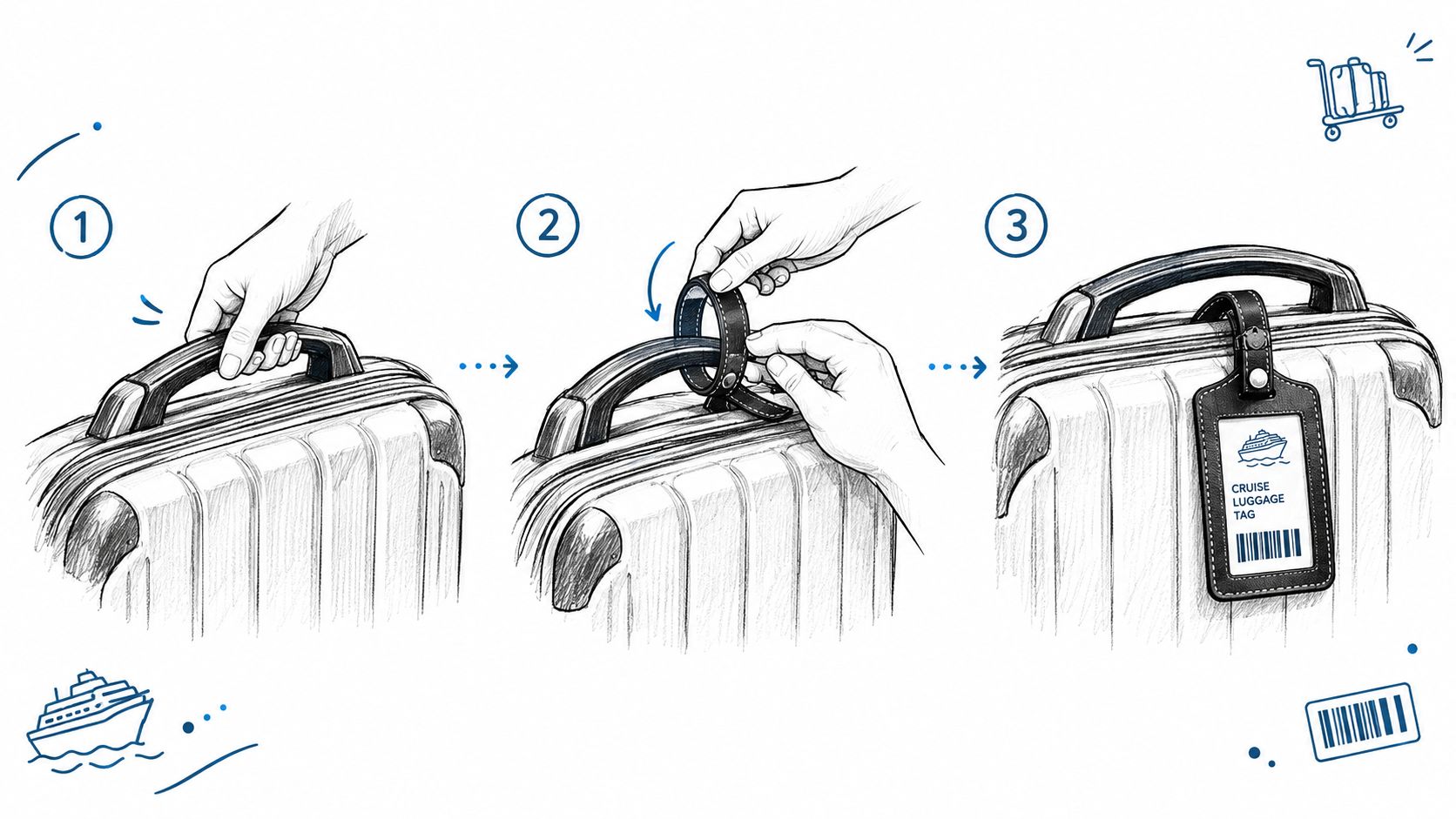
- Thread the loop through the handle: Close the cable or strap completely and position the holder so it hangs flat against the case, not projecting outward.
- Tug and inspect: Pull the loop at handle level, check that the tag hasn't slid, and confirm the barcode is still flat and uncovered.
That inspection step is the one people skip. Most failures start in the first handling after handoff, so a ten second tug while you can still fix it is worth more than worrying about it from the pool deck. The same sequence is laid out in this step by step guide to attaching a luggage tag if you want a printable version for embarkation morning.
The illustration below shows the handle, loop, and flat hang working together.
Pre-Cruise Habits That Prevent Curb Panic
Print a spare copy of each tag and keep it in your carry on, separate from the bags themselves. If a holder is damaged in transit, you can rebuild the setup at the hotel instead of hunting for a printer. Fly to port travelers should pack holders flat with those spares, not already looped onto checked luggage.
Practical rule: If you can't tug the loop hard without the holder twisting away from the case, rethread it before a porter tests it for you.
Put your personal ID tag on a different handle or a different part of the same handle, clearly separate from the cruise holder. Staff routing bags shouldn't have to flip past your home address to find a deck number.
Once onboard, small organization choices follow the same logic. Some cruisers use a Magnetic Cruise Door Organizer, which attaches to metal cabin walls or doors with magnets and provides mesh pockets for toiletries and daily items, to keep embarkation paperwork and spare tags in one visible place during the cruise.
How Tags Actually Fail and How Holders Stop Each Failure
Tags rarely fail for one mysterious reason. They fail in a chain, and each link has a specific countermeasure. Understanding the chain lets you judge a holder by observed behavior instead of marketing words like heavy duty.
The Dominant Failure Chain
It starts with mechanical snagging. A holder that projects outward catches on adjacent luggage or equipment, the loop takes a sideways load, and either the paper tears or the whole assembly comes off. A flat hang and a flexible sleeve reduce that catch point, and a strong loop on a structural handle keeps a tug from becoming a detachment.
Moisture is the second link. Rain, humidity, condensation, and spilled liquid soften paper and smear print, which is why guidance on baggage tags stresses resistance to tearing, moisture, abrasion, and detachment under transport stress, as discussed in this account of why baggage tags must resist tearing and moisture. A tight closure and overlap stop splash from reaching the fold, where paper is weakest.
Abrasion is quieter. A tag rubbing against luggage fabric or other bags scuffs the printed surface until the barcode loses contrast. Keeping the paper flat behind clear, untinted plastic protects the face while preserving the sharp edges a scanner or a person needs to read quickly.
Use a Benchmark, Then Test at Home
Waterproof is not a specification. A more useful reference is at least IP44, protection against solid objects of at least 1 mm and water splashing from any direction, the minimum recommended in IATA implementation guidance recommending at least IP44 for electronic bag tags. A passive cruise holder isn't an electronic tag, but splash from any direction is exactly what a wet pier delivers.
- Flex it repeatedly: Bend the filled holder and confirm the paper stays flat and the plastic doesn't whiten or crack.
- Pull at handle level: Tug the loop firmly several times and check the closure and handle connection.
- Splash it: Run water over the closed holder from different angles, then open it and check the fold.
- Read it afterward: Photograph the barcode and confirm your name and stateroom are still crisp at arm's length.
A holder reduces the probability of failure. It doesn't eliminate it.
That's why the backup rule matters. Put a second readable identifier inside the bag, with your name and contact details, so a bag that loses its external tag can still be identified when staff open it under their procedures. The holder handles the common failures. The interior identifier handles the uncommon one.
Smart and Trackable Tags and a Final Pre-Cruise Checklist
Do you need a Bluetooth or GPS tag as well? For most short Caribbean sailings, a missing bag is usually a delayed bag, sitting somewhere in the ship's sorting process while staff work through a pile. A tracker tells you it's onboard, which is reassuring, but it doesn't speed up delivery to your door.
The calculus changes on longer voyages, fly to port itineraries with tight connections, or trips where a bag separated before embarkation could miss the sailing entirely. There, knowing a bag's last location helps you act quickly with an airline or hotel. Weigh that against one more battery to charge, one more app to check, and one more device to remember to pack out of the cabin.
If tracking fits your itinerary, work through this trackable cruise luggage tag setup guide before you sail rather than pairing devices at the curb. Keep the printed cruise tag as the routing authority either way, because pier and ship staff deliver by the tag they can read, not by a signal on your phone.
One Screen Pre-Cruise Checklist
- Print two copies of each tag: One in the holder, one spare in your carry on.
- Match the holder to your line: Check the format before you fold, not at the terminal.
- Attach at the right moment: At home when driving, after your final flight when flying.
- Use the structural handle: Fixed top or side handle only, never a zipper pull.
- Keep the barcode flat and uncovered: No fold, tint, or glare across the code.
- Tuck a backup ID inside the bag: Name and contact details, readable without the external tag.
- Inspect after handoff when you can: A quick look and tug before the bag disappears into the stack.
One honest exception, if you're boarding carry on only for a short sailing and your bags never enter the checked system, leave the holders in the drawer. They solve a pier handling problem you don't have.
Cruise luggage tag holders are a small purchase, but the decision behind them touches printing, timing, attachment, and cabin organization. Nordmoose builds compact, magnetic, and rechargeable accessories for the realities of modern cruise cabins, from storage to airflow, so you can solve the small problems before embarkation day. Visit Nordmoose to review the cruise essentials that fit your itinerary and pack with a plan your luggage can survive.