

Clips for Beach Chairs That Stay Secure and Compact
You're halfway through your drink when the breeze picks up, your towel slides down the back of the lounger, and your cover-up lifts off the armrest. You stand, fix everything, sit back down, and do it again two minutes later. That's the exact moment clips for beach chairs stop looking like a novelty and start looking like hardware. Buy them for the job they'll do, attach them to a surface that can take the load, and they'll earn their tiny spot in your bag. Buy the wrong type, and you've packed colorful plastic that slips, marks fabric, or snaps when you need it.
Table of Contents
- Why Beach Chair Clips Matter
- Choosing the Right Beach Chair Clip
- Compare Materials and Chair Compatibility
- Attach Clips Without Slipping or Damage
- Handle Windy Days and Accessories Safely
- Pack and Store Clips for Cruise Travel
- Use a Simple Clip Safety Checklist
Why Beach Chair Clips Matter
You're on a cruise deck at midafternoon. The ship turns, the wind hits the lounger sideways, and your towel bunches behind your shoulders while a lightweight shirt heads for the next row of chairs. You don't need a stronger towel. You need a removable connection between fabric and chair that holds while you're sitting, shifting, and standing up.
That sounds simple until you separate the jobs. Retention means keeping a towel or garment positioned on a supported chair surface. Hanging means suspending a light item so it stays off wet sand or a damp deck. Stabilization is different work entirely. A clip that keeps a towel from creeping isn't automatically fit to control a flapping canopy, and you shouldn't treat it that way.
Practical rule: Decide what will happen if the connection lets go. A slipped towel is annoying. A loose rigid accessory in a gust is a safety problem.
How a Small Problem Became Its Own Category
Portable seating created this market. As chairs became lighter and easier to fold and carry, their narrow frames and movable fabric gave towels less to grip. Purpose-built hardware followed. A U.S. design patent for a clip securing beach towels to chairs received priority on February 23, 1988, and was granted and published on November 6, 1990, followed by a chair-attaching towel-clip filing on June 26, 1995.
That history matters because these weren't ordinary household clamps with beach colors sprayed on. Designers were solving for repeated attachment to outdoor seating, movement from an occupied chair, and quick removal. Judge modern clips the same way. Ask what's being held, where the clip connects, and whether the chair part underneath can tolerate pressure. If you can't answer all three, don't buy it yet.
Choosing the Right Beach Chair Clip
Start with the attachment job, not the color. A towel spread across a lounger needs broad, gentle retention. A damp shirt needs a supported edge where its weight won't drag the clip sideways. A small bag needs a hanging point, not a clamp crushing its strap against a moving joint.
The visual below sorts the main options by job so you don't confuse a retainer with a hook.
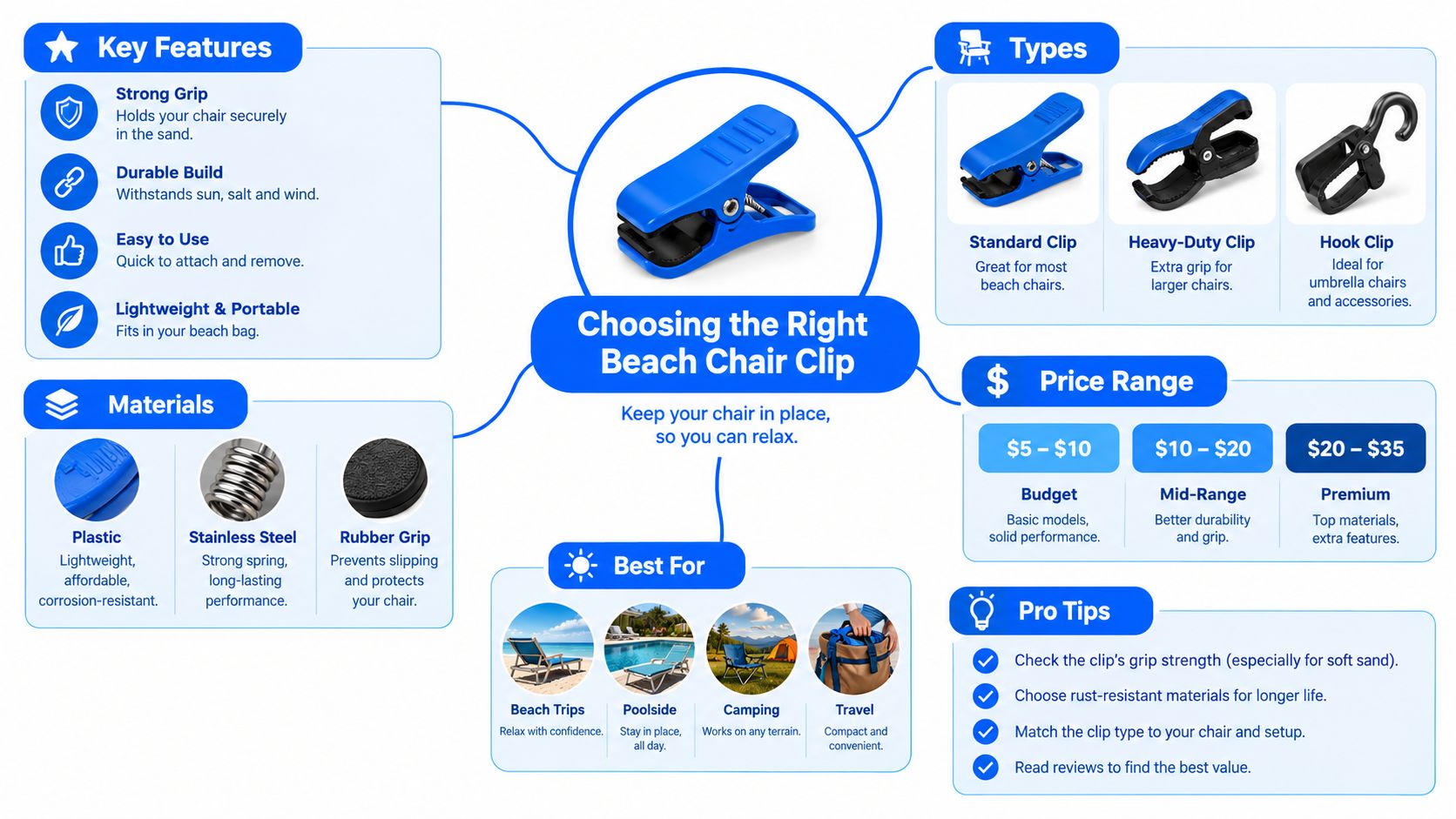
Match the Family to the Task
- Spring clamps: Use these on a supported frame edge or sturdy fabric edge to hold a towel in position. They're your default choice, provided the jaws close fully and don't concentrate pressure on a seam.
- Clamp-style retainers: Use these when you want the clip to capture part of the towel near the chair back. They're for positioning fabric, not suspending heavy gear.
- Hooks and carabiner-style pieces: Use these to hang a lightweight bag or garment from a suitable, stationary chair part. Keep the load close to the frame so it doesn't swing and pry the connection open.
- Binder clips and household substitutes: Treat these as temporary only. They can pinch a light towel on a calm day, but you shouldn't assume they'll tolerate repeated outdoor opening, moisture, or an awkward chair shape.
Chair construction explains why one design can't cover everything. Helen Petrie's 1892 Seaside Seat targeted camps, yachts, and beaches, while a 1953 folding-chair filing emphasized one-motion folding, lightweight tubular frames, and easier manufacture and assembly. Modern chairs still reflect that push toward portability, which is why you'll see tubes, slats, mesh, suspended fabric, and folding brackets on the same beach.
My recommendation is straightforward. Own one reliable set of spring clamps for towels, and add a hook only if you regularly hang a light bag. Skip oversized clamps sold purely on grip theatrics. You need controlled pressure in the right place, not the hardest bite you can carry.
Compare Materials and Chair Compatibility
Material labels don't tell you enough. A clip can survive while the chair fabric tears, the hinge loosens, a sharp jaw edge cuts a mark, or a contact pad slides on sunscreen. Shop for the whole connection, not a resin or metal name.
Plastic clips pack light and usually won't rust, but repeated flexing, heat, and sun can change how firmly they close over time. Coated or corrosion-resistant metal can feel more positive in your hand, yet it's heavier and can damage a chair finish if the contact points are poorly shaped. Mixed constructions try to balance a durable hinge with gentler pads, but every joint and material transition is another place to inspect.
Beach Chair Clip Decision Matrix
| Clip or Material | Best Attachment Job | Compatible Chair Parts | Packability | Key Limitation |
|---|---|---|---|---|
| Plastic spring clamp | Holding a towel to a supported edge | Tubular frame, sturdy fabric edge, broad slat | Light and compact | Heat, sun, and repeated flexing can reduce closing force |
| Coated metal clamp | Firmer retention on a rigid edge | Frame tube or slat with a suitable profile | Heavier, still compact | Can mark finishes or concentrate pressure |
| Mixed-material retainer | Positioning fabric with a padded contact point | Supported fabric, selected frame edges | Compact | Hinge, pin, or pad may fail before the body |
| Hook or carabiner style | Hanging a light bag or garment | Stationary frame member or suitable armrest structure | Very compact | Swinging loads can shift or pry at the attachment |
| Household binder clip | Temporary light towel pinch | Thin, supported fabric edge | Very compact | Not a dependable repeated outdoor solution |
Use the table as a filter, then inspect your actual chair. A tubular frame needs jaws shaped to sit without rolling. Supported fabric needs distributed pressure away from stitching. Mesh needs restraint, because a hard bite can distort or damage it. An armrest might work for a garment, but only if the clip doesn't block your hand, scrape skin, or sit near a folding mechanism.
Don't overtighten to compensate for a poor fit. If you need force to make the geometry work, you've chosen the wrong clip or the wrong attachment point.
Serious validation goes beyond squeezing a clip in the store. A sound approach uses static pull-off testing on the actual chair material, repeated open-close cycling, then fresh testing after UV, heat, moisture, and salt exposure, with a minimum 3:1 safety factor over the intended working load as the practical benchmark. You don't need a lab for a beach towel, but you should borrow the logic. Test on your chair, cycle the hinge, and recheck after a salty trip. No material wins every beach.
Attach Clips Without Slipping or Damage
Good attachment is a sequence, even though you'll eventually do it in seconds. The infographic shows the flow I want you to build into muscle memory before you lean back.
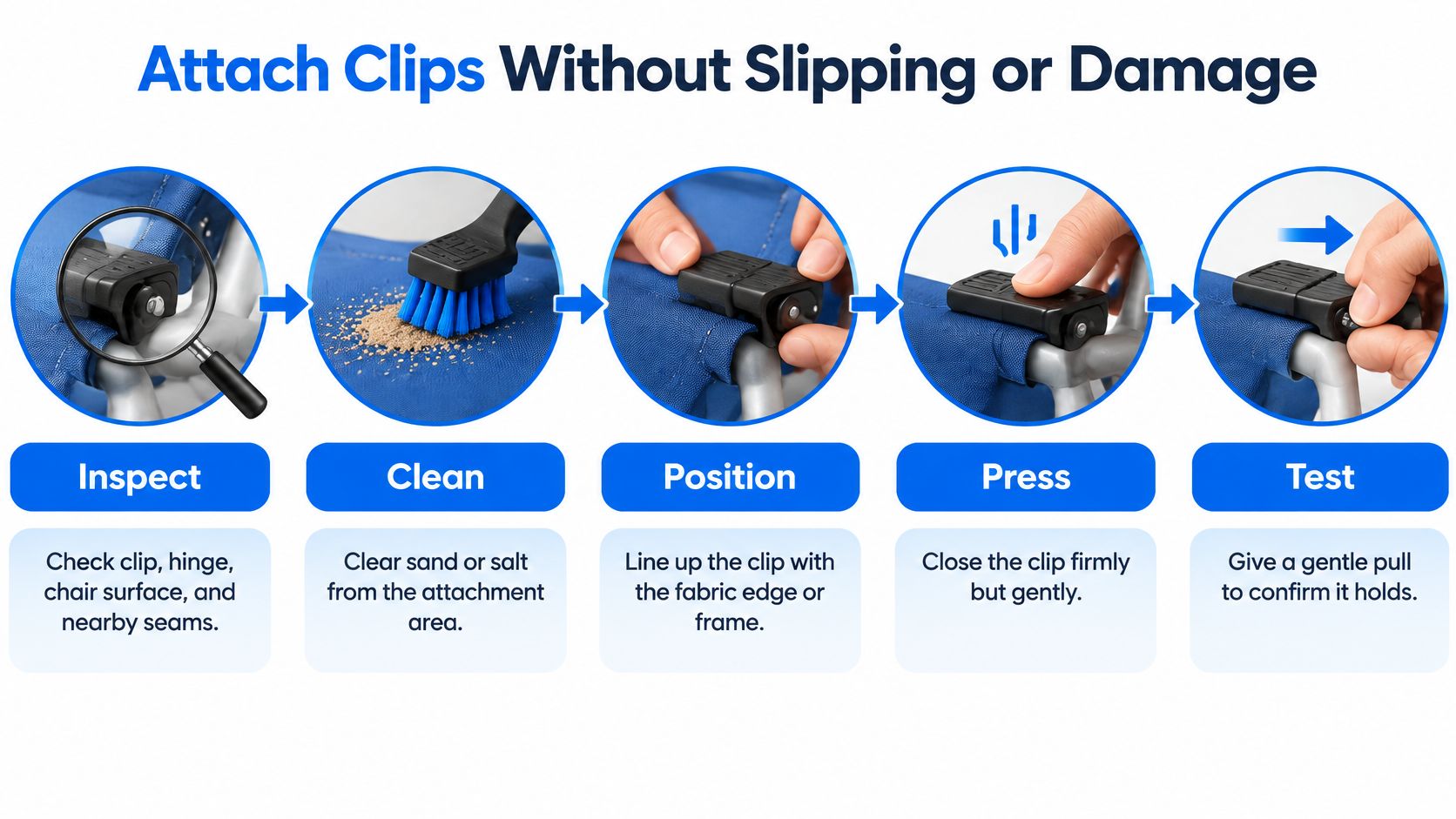
Begin by opening and closing the empty clip. It should move cleanly, align at the jaws, and return without gritty resistance. Look at the hinge, pads, and edges, then inspect the chair for seams, worn fabric, sharp frame ends, and moving brackets. Brush sand and dried salt from both surfaces, because grit trapped under a jaw reduces contact and can grind into the chair.
Position, Close, Then Prove It Holds
Place the towel where you want it before you bring in the clip. Choose a supported fabric area or a frame section that doesn't move when the chair folds or reclines. Align the jaws so pressure lands evenly, close gradually, and stop if fabric puckers sharply or the clip twists. Spread the towel's weight instead of letting one corner drag from a single point.
Now pull gently in the direction the towel would naturally slide. Don't yank it like you're testing climbing gear. You want to confirm that it stays seated without creeping, rocking, or chewing into the surface. Sit down, shift once, stand up, and look again. If it moved during that short test, it won't improve after an hour in the sun.
The video below is useful for watching hand placement and closure speed before you try it on your own chair.
Correct placement looks boring. The clip sits flush on a suitable tube or supported edge, clears your shoulder and hands, and opens with one hand. Incorrect placement is just as recognizable. The jaws straddle thin unsupported mesh, bite beside a sharp edge, wedge near a reclining bracket, or press directly over stitching. Move it or choose another design.
If it slips, clean the contact area and use a better-supported point before adding pressure. If it leaves a mark, remove it immediately and switch to broader contact. If you can't release it comfortably with one hand, retire it from beach duty. The same care applies back in the cabin when you're learning how to hang clothes on a clothesline without stretching or marking damp garments.
Handle Windy Days and Accessories Safely
The strongest clip isn't automatically the safest clip. That assumption causes most bad decisions on a windy beach. Excess pressure can injure mesh or fabric, and a rigid connection can pass gust loads into parts of the chair that weren't meant to absorb them.
Conditions also change the load after you've attached everything. A towel that felt light at noon becomes heavier when wet. Sand works into a hinge and changes the closing action. Saltwater attacks susceptible hardware. You add repeated movement every time you sit, stand, reach for a bag, or adjust the backrest.
Those aren't minor details. Available wind-safety guidance warns that holding force may decline when sand enters the hinge, saltwater accelerates corrosion, or wet fabric becomes heavier, while an over-tightened clip can damage mesh or fabric and a rigid attachment can transfer wind loads into the chair frame.
Keep Three Jobs Separate
- Towel retention: Use appropriately sized clips on supported surfaces and accept that severe gusts may still win. A towel releasing cleanly can be safer than one tearing or dragging the chair.
- Canopy control: Don't improvise stabilization with towel clips. Canopy movement creates different loads and different consequences, especially if a rigid piece breaks free.
- Valuable-item security: Don't rely on a beach clip as your only protection for a phone, wallet, or bag. Keep valuables tethered or stored deliberately, and take them with you when appropriate.
Never use clips to modify an accessibility, wheelchair, surf, or rental chair around belts, harnesses, wheels, brakes, transfer handles, cables, or flotation components. Those parts support safe movement and emergency handling. A clip in the wrong place can obstruct a transfer, interfere with a control, or create a pinch point for the user or caregiver.
If it's borrowed equipment, your permission threshold is simple. Ask the operator before attaching anything, and accept no as the final answer.
Before you leave a chair unattended, remove loose attachments rather than trusting them through changing weather. That includes garments that can sail, bags that can swing, and rigid clips sitting where another person could knock them loose. Wind doesn't care that your setup worked during a calm test. Adjust early, detach when conditions worsen, and don't let convenience turn a light accessory into a projectile.
Pack and Store Clips for Cruise Travel
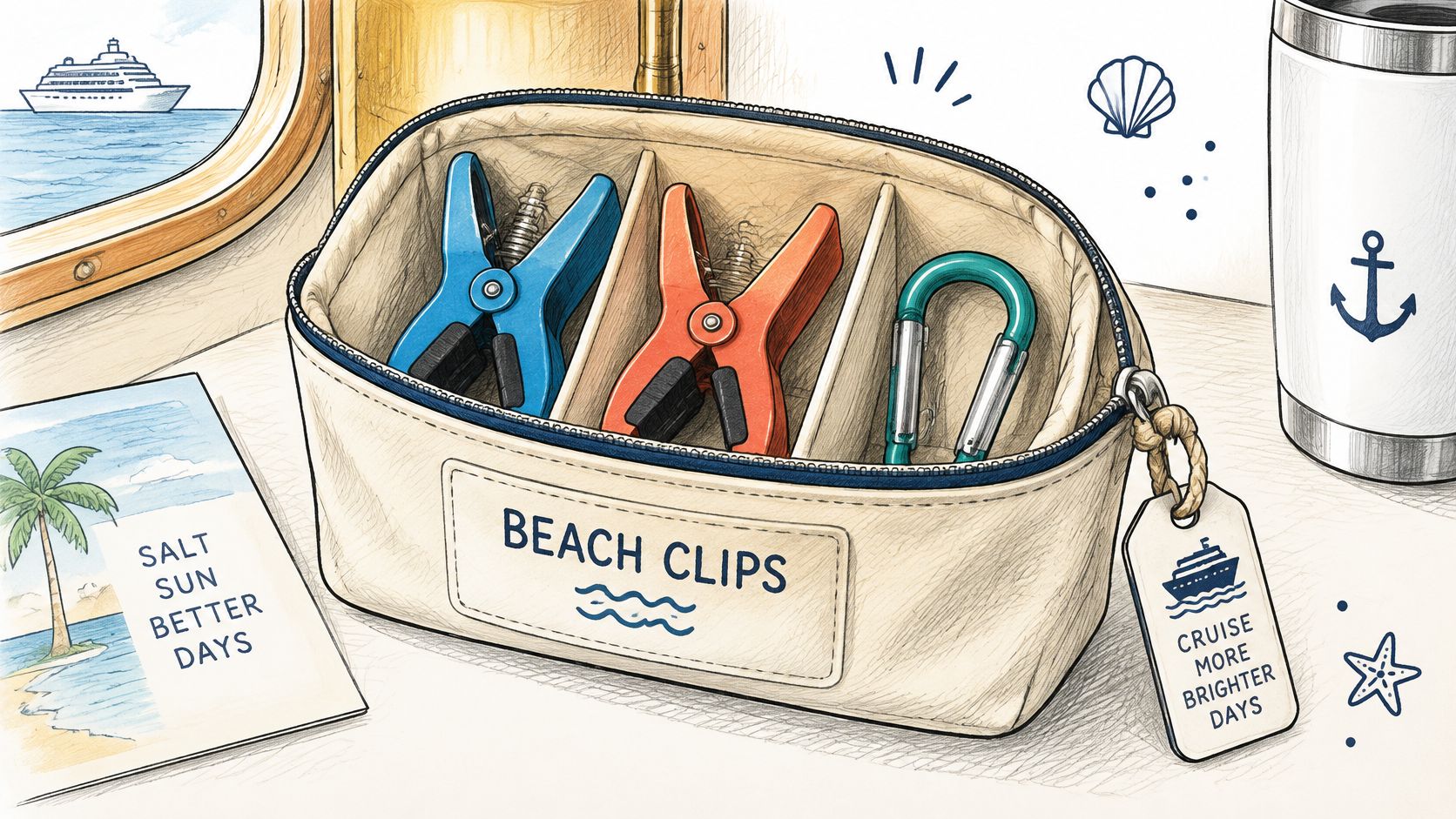
Cruise cabins punish loose small objects. A clip that disappears into a suitcase is useless on a port morning, and a wet metal hinge packed against swimwear can come home rusty or leave rust marks. Pack clips like hardware, not like an afterthought: hinges closed, jaws facing one direction, inside a small labeled pouch stored beside the beach gear they serve.
This simple kit view shows the right idea. Everything stays visible, contained, and easy to count before you leave the cabin.
Build a Fast Return Routine
After beach or pool use, shake out sand and rinse only if the location and product care guidance allow it. Dry clips fully before sealing them in the pouch, since salt trapped in a hinge is what turns a smooth spring gritty. Before the next port day, open and close each clip once. Replace at home any piece with corrosion, cracked plastic, bent arms, loose pads, or jaws that no longer meet cleanly. A weak spare is dead weight in a tight cabin.
Check chair and beach rules before assuming you can attach anything, especially to rented or loaned seating. Accessibility guidance notes that beach chairs may include seatbelts or harnesses, parking brakes, weight limits, and operating restrictions, so you should ask the operator before modifying a loaned or accessibility chair. Local placement and access rules also sit outside your control.
Pair the pouch with a packable beach tote that keeps shore-day gear contained instead of scattering pieces through the cabin. Keep the pouch in an outer pocket so you can grab it without unpacking towels. For wall storage back onboard, the Magnetic Cruise Door Organizer is a magnetic organizer sized for toiletries, sunglasses, documents, and chargers, so small items stay off the counter. That's cabin storage, not a beach-chair attachment substitute.
Use a Simple Clip Safety Checklist
Run this check before you sit down or walk away. It takes less time than rescuing a shirt from wet sand.
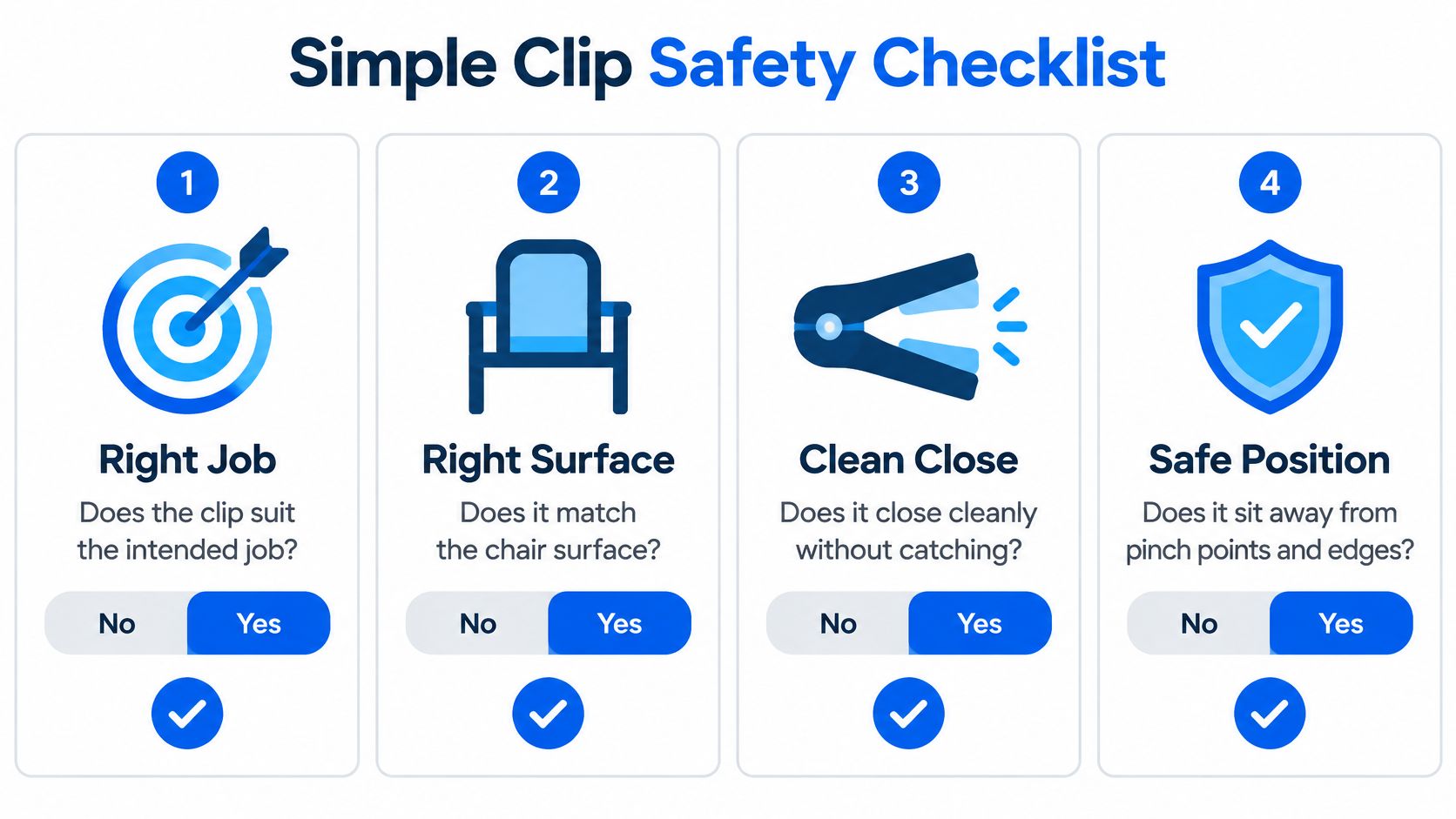
- Right job: The clip is retaining or hanging a light item, not stabilizing a canopy.
- Right surface: The chair part is supported, stationary, and clear of safety components.
- Clean close: The jaws align, open smoothly, and release with one hand.
- Gentle proof: A light pull causes no creeping, twisting, marking, or fabric distortion.
- Weather call: Wet weight, sand, and gusts won't turn the setup into a hazard.
- Aftercare: You'll inspect it after salt exposure and retire it if closure feels weak.
Add that decision to your traveling packing checklist so damaged clips don't sail with you.
Nordmoose builds compact cruise accessories for metal cabin walls, limited storage, clothes drying, airflow, and low-light movement, so your beach gear can stay organized after you leave the deck. Browse the cabin-ready organizers and travel essentials at Nordmoose before your next sailing and pack only the pieces that solve a real problem.