

Casablanca Cruise Port Guide: Terminal, Transfers and Tips
You're looking at your Casablanca arrival time, your flight booking, and a map that makes the airport-to-port journey look straightforward. Then the practical questions start: where will the driver meet you, what happens to your luggage, and how much room should you leave for delays?
Casablanca Cruise Port works best when you plan it as a transport gateway, not just a sightseeing stop. The terminal is only part of the journey. Whether you're joining a cruise, heading to the airport, or going ashore for the day, your most important decisions concern the pickup point, the luggage handover, and the deadline you can't miss.
Table of Contents
- Casablanca Cruise Terminal at a Glance
- Getting Between the Port, Airport and City
- Arrival and Disembarkation Steps at the Port
- Planning for Multi-Ship Days and Turnarounds
- Safety, Money and Tipping Norms in Casablanca
- Nearby Attractions Worth a Few Hours
- Confirm Your Port Day Before You Sail
Casablanca Cruise Terminal at a Glance
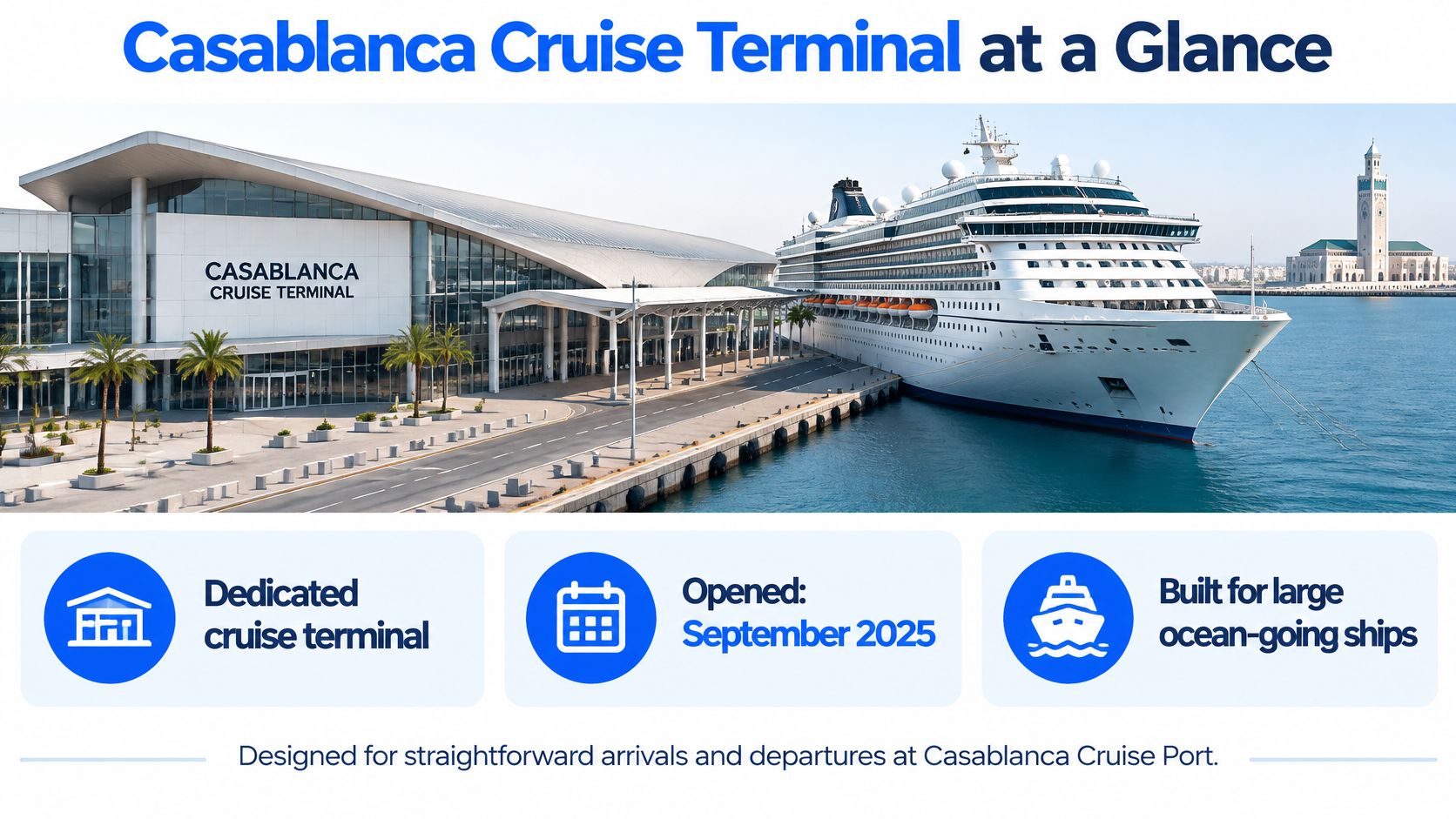
Casablanca has a dedicated, alongside-berthing cruise terminal built for large ocean-going ships, rather than a facility intended only for smaller regional vessels. Its opening marks a significant change for passengers who need an organized route between ship, terminal, and onward transport.
The illustration below summarizes the terminal's purpose and setting.
Casablanca cruise terminal key figures
The terminal was inaugurated on 18 September 2025, with its principal berth dimensions, boarding facilities, and annual capacity described by Morocco World News.
| Feature | Figure |
|---|---|
| Quay length | Approximately 650 m |
| Maximum ship length | 350 m |
| Maximum ship beam | 45 m |
| Water depth at berth | About 9 m |
| Passenger boarding bridges | 3, one fixed and two mobile |
| Coach parking | 44 coaches |
| Passenger facility | About 4,000 m² |
| Reported annual capacity | Approximately 450,000 passengers |
| Project investment | Approximately €61.5 million |
| Opening date | 18 September 2025 |
These specifications describe different capabilities. Quay length concerns berthing space; boarding bridges concern passenger access; coach parking concerns onward dispatch. None tells you how quickly your particular group will clear the terminal.
Alongside berthing means passengers normally use the assigned ship-to-shore access instead of transferring by tender boat. That removes an extra boarding stage and reduces exposure during the transfer, although staff can still change access arrangements for safety or operational reasons.
What ship size means for your visit
A ship's passenger count isn't a reliable test of whether it fits the berth. The operator publishes a large-vessel operating envelope, but length, beam, and draft must all be considered, as the Casablanca Cruise Port information page explains through its berth specifications.
Draft is the less visible constraint. A ship can fit along the quay while still requiring careful arrival planning for water depth, tide, and under-keel clearance. The cruise line and port make that operational decision, not the passenger.
Planning distinction: A terminal's annual capacity describes throughput across a year. It isn't a promise about your queue, your coach departure, or your transfer time.
For a useful pre-cruise check, find your ship's specifications in its technical information or docking notes. Match its registered dimensions against the published berth envelope, then ask the cruise line to confirm the scheduled terminal and access arrangements. If you use a wheelchair, travel with a stroller, or need assistance with steps, confirm the actual gangway arrangement rather than assuming every boarding bridge will suit your needs.
Getting Between the Port, Airport and City
Your ship docks at the new terminal on a turnaround day with two other ships. Processing inside moves in lanes. Outside the gates, 6,000 passengers call taxis, coaches and private drivers at the same hour on the same access road. Plan for that second part.
Mohammed V International Airport sits about 30 km southeast of the port, a 45 to 60 minute drive in normal traffic and longer at peak hours. Add border procedures, baggage collection, finding the driver, loading bags, and city traffic to any map estimate. The port describes a planned rail connection on its turnaround destination page. Treat it as future infrastructure until you see an operating service, station access you can use with luggage, and a timetable that fits your sailing.
Port transfer options compared
| Option | Best for | Watch for |
|---|---|---|
| Official taxi | Small groups and passengers with luggage | Agree the fare or confirm meter use before departure |
| Pre-booked hotel or ship transfer | First-time visitors and families | Confirm the pickup point in writing |
| Organized shore excursion coach | Guided day trips | Check the scheduled return against all-aboard time |
| Private car transfer | Turnaround passengers with a flight to catch | Allow for border procedures, baggage handling, and traffic |
| Planned rail connection | Future use | Not confirmed as operating; check before relying on it |
A taxi gives flexibility for short hops, but settle the destination, fare basis and luggage space before you get in. Ask for the authorized meeting area by name. Drivers cannot always collect beside the gangway.
A pre-booked transfer removes decisions on arrival when the confirmation is specific. It should name the terminal pickup point, identify the driver or representative, give a working contact number, and state the procedure for flight or ship delays.
Set the buffer around the deadline
For same-day embarkation, leave several hours rather than a tight connection. Get the cruise line's recommended flight arrival cutoff before you book flights. If a missed sailing means expensive international rebooking, I recommend arriving the previous day.
On departure day, work backward from airline check-in closing time. Wait for the release notice before heading to baggage claim.
Choose an overnight hotel around the harder leg:
- Near the port: Use this when ship check-in is the priority and you want a short morning ride.
- Near the airport: Use this after a late inbound flight, then accept a second transfer to the ship.
- Luggage arrangements: Ask whether the hotel stores bags before check-in or after checkout. Keep overnight necessities in a separate bag.
Match the transfer to your group size, bag count and deadline. A cheap option that misses the cutoff costs more than a private car that arrives with time to spare.
Arrival and Disembarkation Steps at the Port
Disembarkation runs as a chain of handovers, and each one has a failure point. The passenger facility covers about 4,000 m², and the project investment has been reported at approximately €61.5 million, according to CruiseMapper's Casablanca port profile. Dedicated processing areas help separate document checks from general circulation, which matters on turnaround days when arriving and departing groups use the building at the same time.
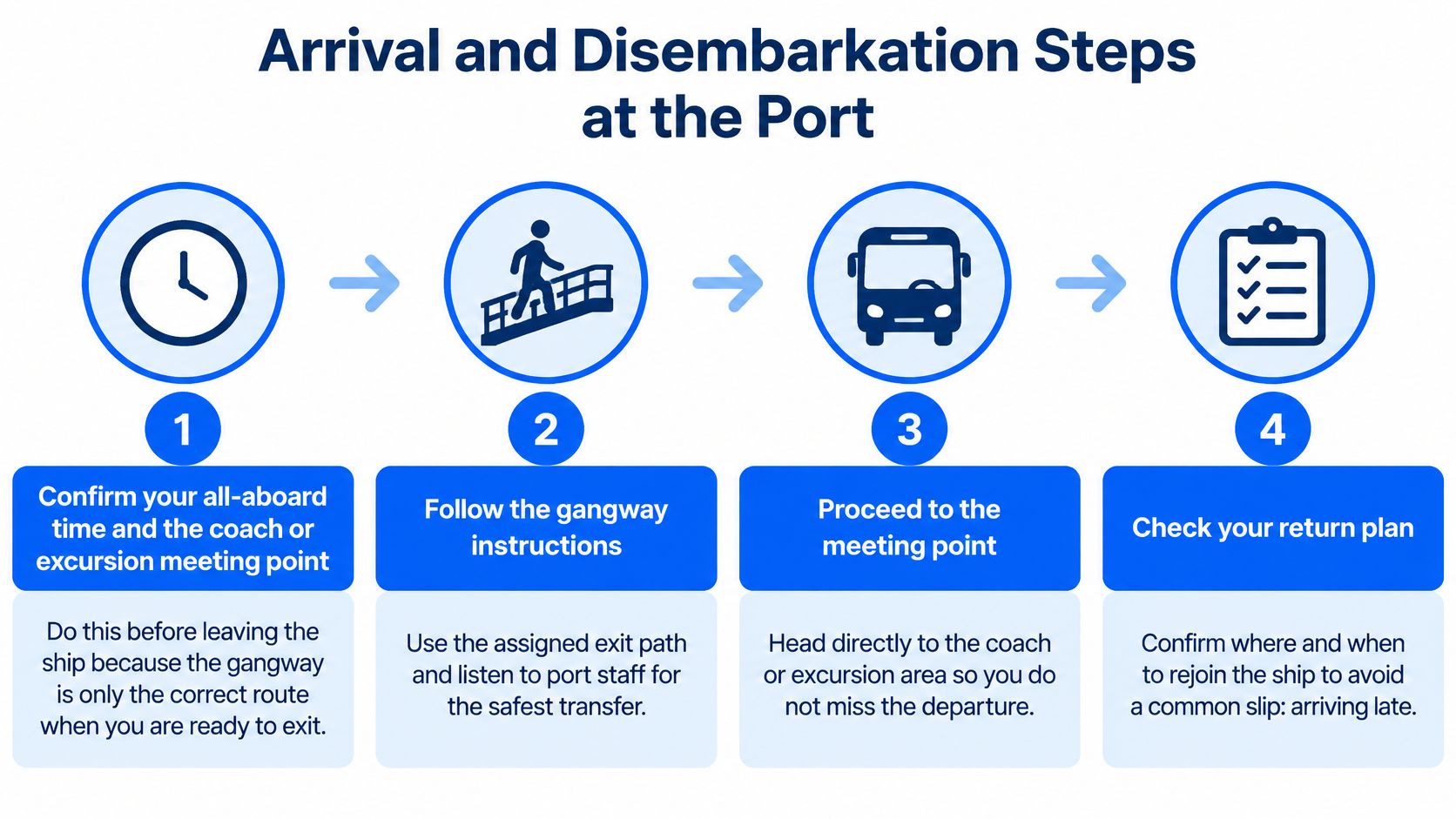
Use this visual as a reminder of the main stages, then follow the ship's instructions for your particular call.
Follow the passenger flow
- Confirm the deadline before leaving. Record the ship's all-aboard time, the meeting location, and whether your instructions use ship time or local time. The common slip is treating departure time as the deadline for reaching the gangway. This guide to cruise ship phrases helps distinguish the terminology.
- Carry the items you can't lose access to. Keep the passport or identification specified by the cruise line, boarding documents, phone, medication, and charging essentials in a small bag you control. Anything essential stays with you, even after large luggage has gone to the hold or baggage hall.
- Use the assigned gangway or boarding bridge. Follow crew and terminal directions, and move clear of the exit before checking messages or taking photographs. Stopping at the foot of the access route obstructs passengers behind you.
- Complete the required immigration and customs checks. Have documents ready, put your phone away when instructed, and answer officials directly. Document rules vary by nationality and by whether you are in transit, embarking, or ending the cruise.
- Take physical control of luggage once, then count it. Collect every checked bag in the designated hall, confirm the tags match your cabin, and keep the group together until the count is complete. Report a missing bag at the hall desk before walking to onward transport.
- Follow staff instructions when several passenger flows meet. Stay in the designated queue and ask a marshal if you're unsure which line serves your ship or transfer. A shorter line often serves a different sailing.
- Return with time for the final checks. Keep the ship's emergency contact accessible and leave room for terminal access and boarding formalities. Scheduled docking is permission to start processing, not clearance to walk straight back on board.
Make the handovers explicit
If you are ending your cruise, ask at collection exactly when the bags become your responsibility and whether porters are permitted to move them outside. If you are embarking, retain medication and documents until you are safely aboard, even when a porter accepts the main suitcases for screening and delivery.
For a visual introduction to the port setting, this video can supplement, but not replace, your sailing-specific instructions.
A smooth arrival means one named person holds the documents, one named person watches the bags, and everyone knows where those bags change hands next.
Planning for Multi-Ship Days and Turnarounds
Three ships alongside changes the math inside and outside the terminal. In March 2026, a three-ship operation required approximately 100 buses and 20 minibuses for regional transfers, according to Hespress's report on Casablanca's new cruise terminal.
That fleet does not load in a neat sequence. Excursion departures, luggage collection, and airport transfers pull separate groups to the same transport areas at similar times. A clear gangway gives no guarantee of a clear pickup zone, so read the day as a turnaround gateway where headline terminal capacity exceeds what the curbside can sort at once.
Transit passengers and embarking passengers
A transit passenger's central problem is getting back to the ship on a schedule that still works if clearance starts late. Keep the shore plan to one main objective, with a return arrangement that holds if a phone dies or a meeting point is crowded.
An embarking passenger faces a different exposure: luggage, check-in deadlines, and a ship not yet boarded. I would prioritize a confirmed transfer over sightseeing before boarding.
Passengers ending the cruise should confirm who controls checked luggage at each handover and when that responsibility transfers to the traveler or driver.
Independent travel and organized excursions
Independent travel keeps control of stops and meal breaks. It also leaves the traveler to solve transport at the hour when demand peaks.
An organized excursion supplies a defined meeting point and return arrangement, at the cost of flexibility and waiting while the group assembles. Read the actual excursion terms rather than assuming every independently sold tour carries the same protections as a cruise-line booking.
Choose the arrangement with the fewest uncertain handovers when the consequence of delay is missing embarkation or a flight.
On a busy day, judge a regional excursion by its transport plan as carefully as its attraction list. Ask how the operator identifies passengers, where vehicles wait, and how a delayed release is handled.
On multi-ship mornings the limit shows in small conflicts. Two excursion coaches assigned the same bay force one group to stand clear with signs up while marshals reassign the second vehicle, and departure slips 20 minutes while lists are rechecked. Build the port day around that kind of friction. Plan the outside journey first, with direct contacts and fixed meeting details that survive a crowded forecourt.
Safety, Money and Tipping Norms in Casablanca
Keep a secure digital copy or photocopy of your passport and cruise documents separate from the originals. Leave unnecessary valuables in the cabin safe, and carry the identification your cruise line tells you to take ashore.
Use licensed transport and settle the fare basis before departure. If someone offers unsolicited guiding or transport assistance, pause long enough to establish who they represent, what they're offering, and the full charge before accepting.
Cash habits that reduce friction
The Moroccan dirham, abbreviated MAD, is the local currency. Cards can be useful at hotels and larger businesses, but don't build a port day around universal card acceptance.
- Small purchases: Carry small dirham notes for modest purchases and situations where change may be inconvenient.
- Cash withdrawals: Prefer a bank ATM in a busy, well-lit location, and shield the keypad.
- Taxi payments: Confirm the fare basis and payment method before the vehicle moves.
- Spending money: Keep a small amount readily accessible so you don't expose your main cash supply.
Use your phone discreetly when checking directions, and step aside before opening maps. A zipped crossbody bag is more practical than balancing a wallet, phone, and cruise card separately while walking.
Tips and respectful conduct
There's no need to apply a shipboard gratuity arrangement automatically to every interaction ashore. For the distinction between onboard charges and discretionary payments, use our guide to cruise tipping.
- Porters: Offer a small discretionary tip when someone carries your bags, after confirming any service charge.
- Restaurants: Read the bill before adding a tip so you don't overlook an existing service charge.
- Guides and drivers: Consider a modest tip for helpful service, separate from the agreed fare.
- Facility attendants: Keep small change available where an attendant provides a service.
Dress modestly for religious visits and check the site's specific requirements before leaving the ship. Ask permission before photographing people, particularly when a portrait would be the main subject rather than incidental background.
A useful habit: Keep daily spending cash accessible, but keep your main funds and documents zipped away.
These are calm routines, not reasons to avoid exploring. They let you spend less time managing possessions and more time enjoying the stop.
Nearby Attractions Worth a Few Hours
Hassan II Mosque, on Casablanca's Atlantic waterfront, is a strong choice when you want a major landmark without building a complicated itinerary. Check current visitor access, guided-tour arrangements, and dress requirements before committing to a departure time.
Don't assume it's the fastest attraction from every berth or pickup point. Judge the whole outing: terminal exit, transport, admission arrangements, the visit itself, and the return.
Choose a visit you can shorten
| Place | Best reason to go | Practical test |
|---|---|---|
| Hassan II Mosque | Landmark architecture and coastal setting | Does the available visitor session fit your return deadline? |
| Old Medina | Market lanes and traditional shopping | Can you follow a defined route without losing your pickup point? |
| Habous quarter | Crafts, architecture, and browsing | Is there enough time for a separate vehicle journey? |
| Corniche | A seafront walk or relaxed stop | Is your return transport arranged before you start walking? |
| Downtown Art Deco district | Architectural details and streetscapes | Can you keep the walking route compact? |
| Rabat | A longer regional visit | Does the complete return journey leave a credible margin? |
The Old Medina and Habous aren't interchangeable stops on a single continuous walk. Treat each as a deliberate choice, particularly if browsing and shopping tend to extend your outings.
For architecture lovers, a compact downtown route may work better than attempting several distant highlights. For someone who mainly wants fresh air and a meal, a seafront stop can be more satisfying than spending the day moving between vehicles.
Keep regional ambitions proportionate
Rabat is an appealing longer outing, but a train journey adds station access, ticketing, waiting, and the trip from the arrival station to your destination. Don't use train running time alone to judge whether the excursion fits.
If you're comparing a guided option with independent travel, this guide to evaluating cruise excursions can help you assess the meeting arrangements, pace, and return commitments. Match any booking to your actual sailing rather than relying on a destination label.
For a hypothetical three-hour outing, I would choose a single main visit, arrange a fixed return pickup, and make any café or waterfront stop optional. If clearance or admission takes longer than expected, drop the optional stop first.
The test isn't how many attractions fit on a map. It's whether you can explain, before leaving the port, how you'll return and what you'll cut if the day runs late.
Confirm Your Port Day Before You Sail
Check your sailing's all-aboard time 24 hours before arrival, then work backward from that single hour. Casablanca often handles more than one ship on turnaround days, and the terminal building can process passengers faster than the curbside, taxi ranks and road exits outside. Your plan should reflect that second reality.
Terminal capacity looks reassuring on paper. Multi-ship mornings create queues for passport checks, baggage handling and vehicle pickup that extend the total port call well beyond the walk from gangway to gate. I recommend treating the published berthing schedule as confirmed only when it appears in your cruise line notice with berth number and arrival window.
Your night-before checklist
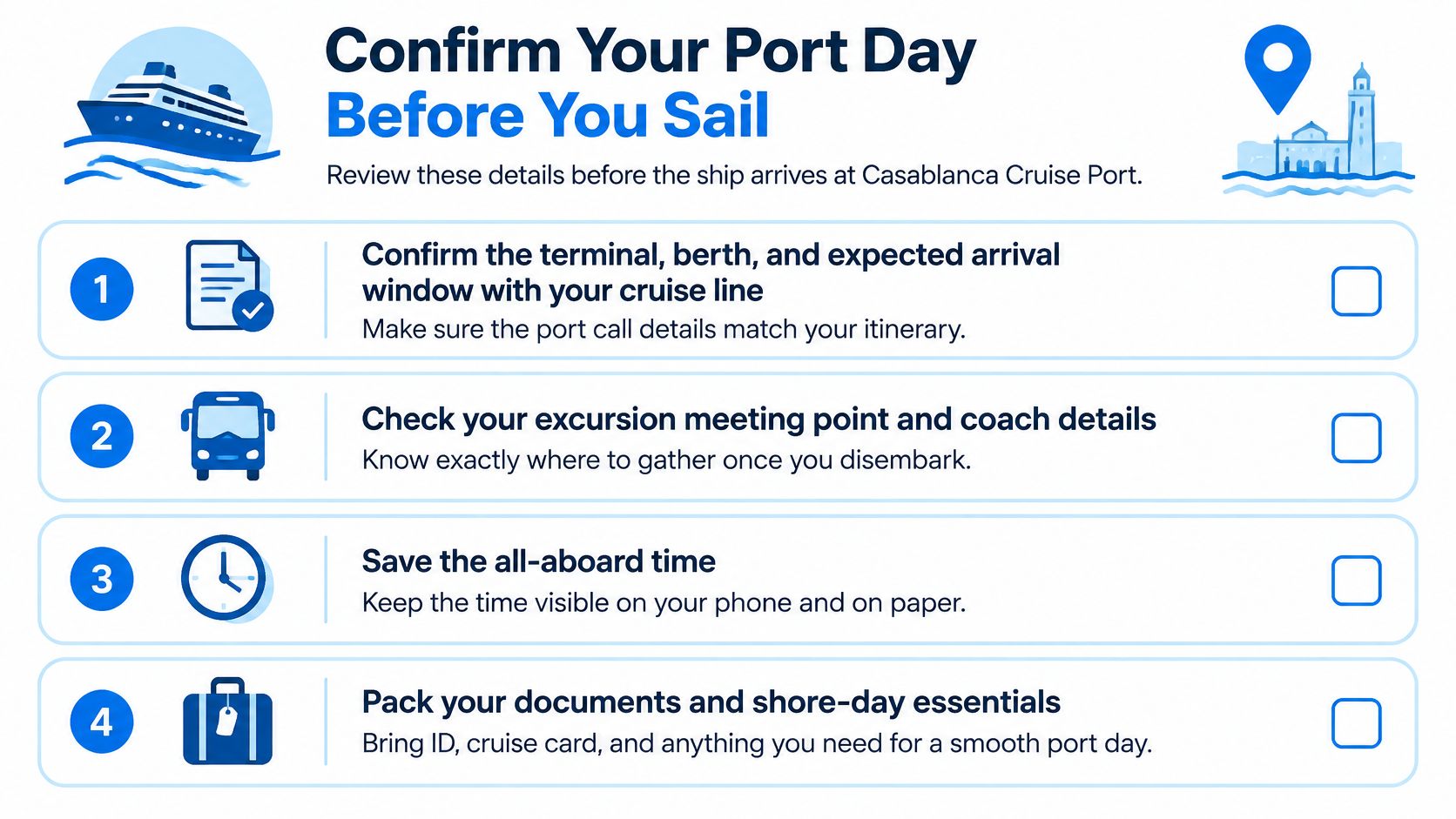
- Port assignment: Confirm the terminal, berth, expected arrival window, and any assistance request with the cruise line.
- Transport confirmation: Save the pickup instructions, operator contact, and delay procedure offline.
- Turnaround timing: Check that your airport or hotel plan allows for the complete journey, not merely the drive.
- Shore readiness: Verify that your carry bag and payment arrangements match the day you've planned.
- Offline backup: Download maps and save the cruise line's emergency contact somewhere accessible without mobile data.
- Ship access: Resolve any questions about docking, gangways, or mobility assistance before arrival.
- Return decision: Set a firm point at which you'll stop sightseeing and begin the journey back.
Share every confirmation across your group so one phone battery or lost bag does not stall the day. Agree on a fallback meeting point inside the terminal and a cutoff hour for the return leg. That written cutoff matters more than any list of options when two ships empty onto the same exit road.
Decide before sailing whether you'll self-manage transport or book a coordinated transfer. The choice sets how much waiting, walking and rebooking you absorb yourself on a busy turnaround day.
Nordmoose offers compact cruise accessories, including organizers designed to hold documents, sunglasses, chargers, toiletries, and daily essentials. Visit Nordmoose to choose practical cabin storage and travel accessories that help you keep your Casablanca departure-day items organized before the gangway opens.