

2 Prong Adapter Plug: A Cruiser’s Complete Guide
You've just returned to your cabin after a long day ashore. Your phone is nearly dead, your camera batteries need charging, and the charger in your hand has a round third pin that won't fit the two-slot outlet beside the desk. At 11 PM, with a stuffy cabin and nowhere else to plug in, that small mismatch becomes a real problem.
A 2-prong adapter plug can bridge that physical gap, but it isn't a magic safety device. It may let a modern three-prong charger connect to an older two-slot receptacle, yet it won't create grounding where the ship's wiring doesn't provide it. The right adapter, used with the right equipment, can be useful. The wrong assumption can leave you with a damaged charger, a hot connection, or a tripped cabin circuit.
Table of Contents
- The Cabin Outlet Moment
- Understanding 2-Prong vs 3-Prong Plugs
- Adapter Plugs vs Travel Adapters
- How to Use an Adapter in Cruise Outlets
- Safety Considerations for Ungrounded Plugs
- When You Need a Voltage Converter
- Choosing the Right Adapter for Your Cruise
The Cabin Outlet Moment
The first sign is usually mechanical, not electrical. You line up the charger, push gently, and the two flat blades enter the outlet while the third pin stops against the faceplate. Nothing is broken. Your charger is designed for a grounded receptacle, while the cabin outlet may be an older two-slot configuration.
Cruise ships often combine updated systems with older cabin layouts. A ship may have modern USB charging points in some areas, while a stateroom still offers a compact outlet that looks like it belongs in an older apartment. The outlet's appearance tells you what fits physically, but it doesn't tell you whether the receptacle is grounded internally.
That distinction matters in a small cabin. You're likely charging a phone, smartwatch, camera battery, tablet, or laptop while also trying to keep a fan, light, and other accessories out of the walkway. A bulky adapter can block the neighboring socket, sit at an angle, or place stress on a loose wall receptacle.
Practical rule: Solve the shape problem first, then check whether the device and outlet are electrically compatible.
A two-prong adapter is best viewed as a connection bridge for suitable low-power electronics, not as an upgrade to the ship's electrical system. It can help when your charger's third pin is the only thing preventing insertion, but it can't modernize vintage wiring or override cruise-line restrictions on particular appliances.
Before you unpack everything, inspect the outlet. Look for looseness, discoloration, cracked plastic, buzzing, heat, or a burning smell. If any of those signs appear, don't use the receptacle. Contact the cabin steward or guest services instead.
Understanding 2-Prong vs 3-Prong Plugs
A NEMA 1-15 plug has two flat blades and no grounding pin. Its North American rating is up to 125 volts and 15 amps, as documented in the NEMA connector overview. A grounded NEMA 5-15 plug adds a round pin below the blades, creating a third contact intended for the equipment-grounding path.
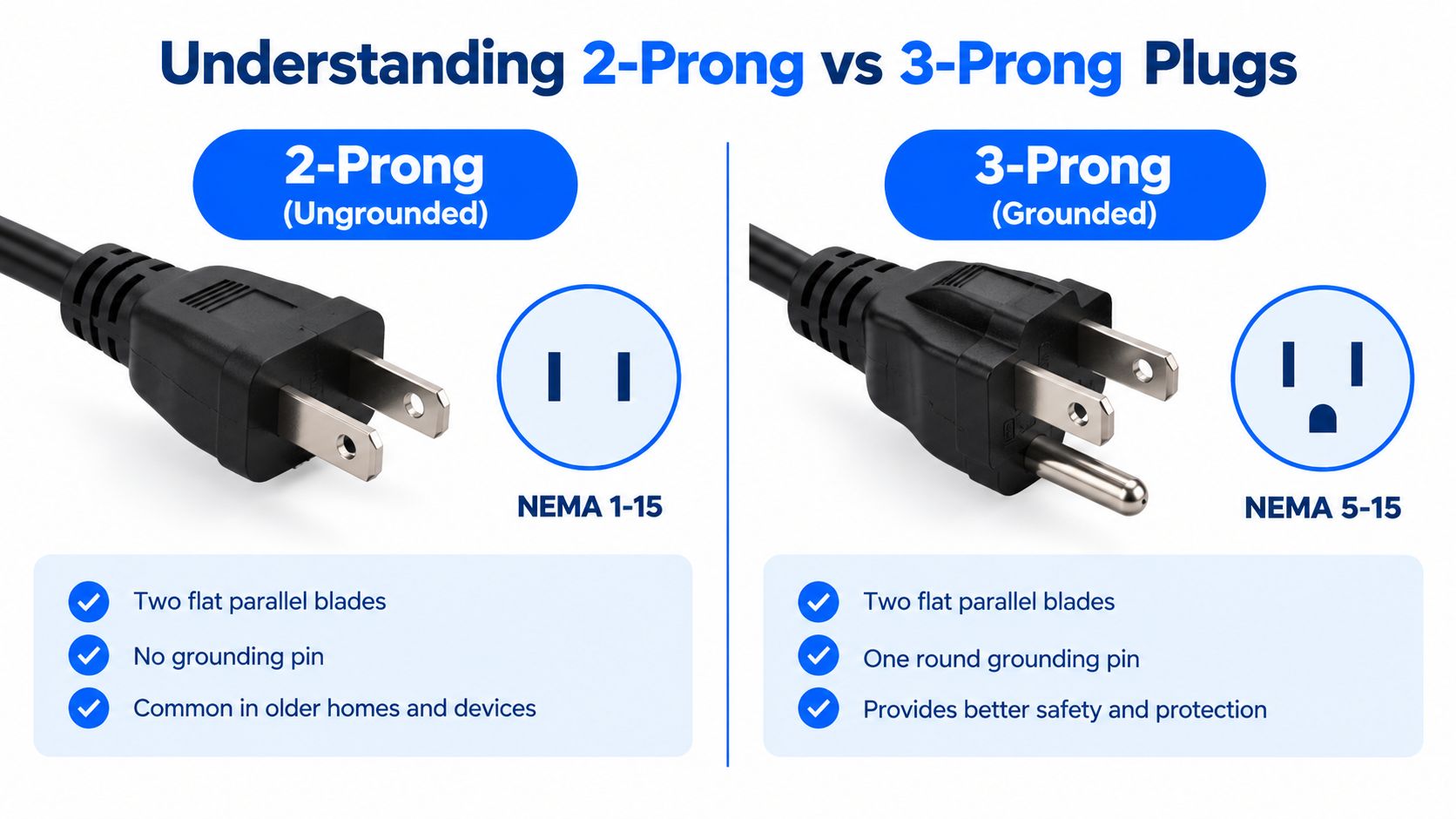
The two blades may look parallel, but they aren't always identical. A polarized two-prong plug uses one wider blade, so it can enter the receptacle in only one orientation. That preserves the intended line and neutral relationship. Chargers and appliances that depend on a known neutral reference can use this arrangement as part of their internal safety design.
The modern two-prong American plug traces back to Harvey Hubbell II's 1904 Type A design. Hubbell patented an equal-width parallel-blade version by 1913, followed by a polarized version with a wider or longer blade by 1916, according to the North American plug history from the PlugSocket Museum.
Why older outlets remain in cabins
The wiring history explains why a two-prong outlet can still appear in an accommodation built or fitted out decades ago. Grounded circuits were required in laundry rooms in 1947 and extended to most other locations in 1956. The earliest located National Electric Code reference requiring receptacles to be both grounding and polarized appears in the 1962 edition, as summarized in this historical account of polarized receptacle requirements.
That doesn't mean every two-slot outlet is unsafe, and it doesn't mean every three-slot outlet is properly grounded. It means the visible socket and the wiring behind it are separate questions. For a practical look at the outlet arrangements cruisers commonly encounter, see this guide to cruise ship electrical outlets.
Adapter Plugs vs Travel Adapters
The wording causes unnecessary packing mistakes. A travel adapter changes the physical shape of a plug so it fits a different national socket style. For example, it might let a North American flat-blade plug connect to a European round-pin outlet or a British-style socket.
A 2 prong adapter plug solves a narrower problem. It accepts a three-prong North American plug and provides two flat blades for a two-slot North American receptacle. It doesn't convert the plug for another country, and it doesn't change voltage.
| If your problem is... | You may need... | What it changes |
|---|---|---|
| A third grounding pin won't fit a two-slot outlet | A two-prong adapter | The physical connection between a three-prong plug and two-slot receptacle |
| Your plug shape doesn't match the country's socket | A travel adapter | The plug shape |
| Your device's input voltage doesn't match the supply | A voltage converter or transformer | The electrical voltage, not just the shape |
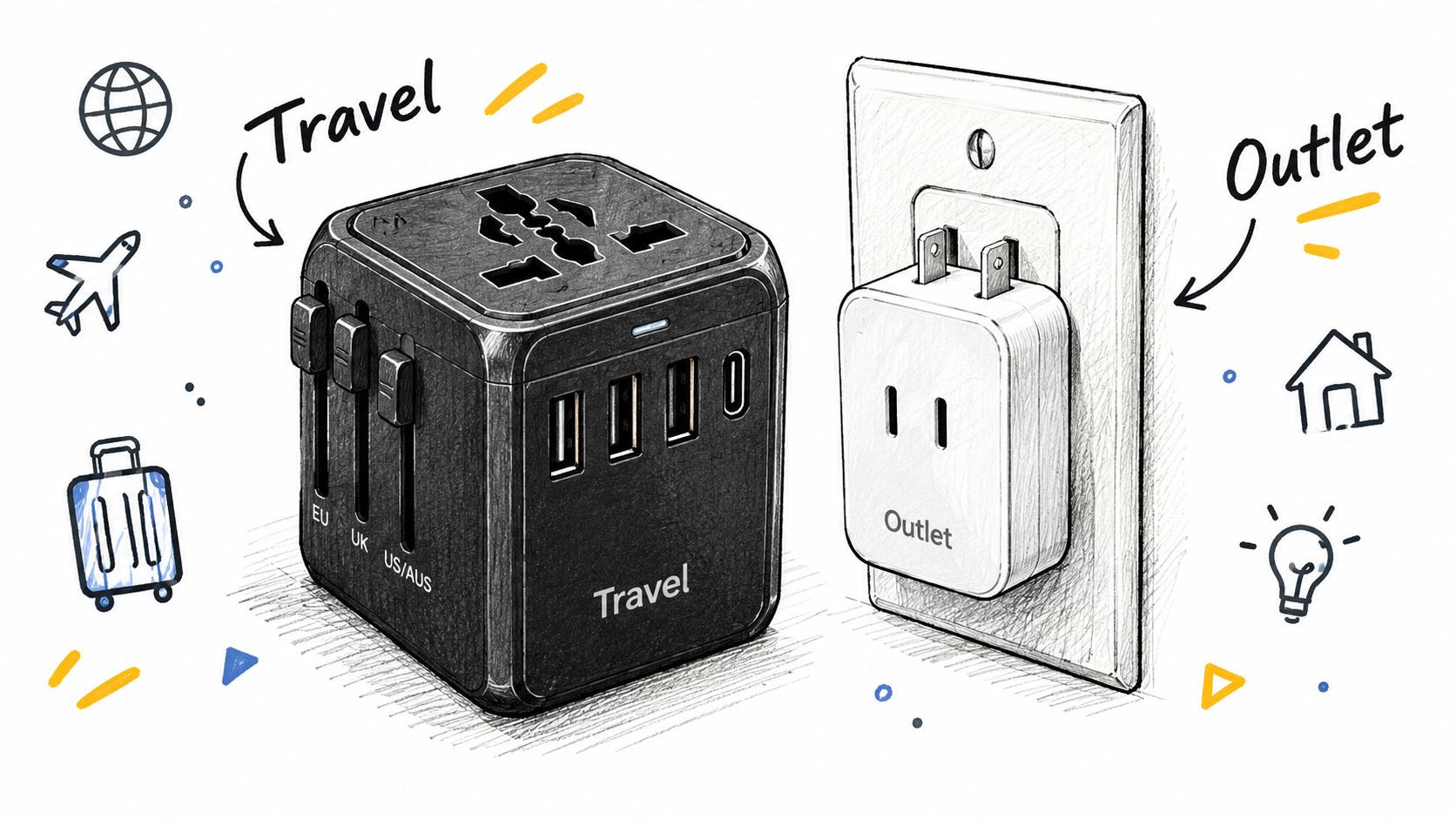
A universal travel adapter can be the wrong tool in a North American cruise cabin. Its retractable pins may not accept your charger in the way you expect, and some models add bulk without addressing the missing grounding pin. Conversely, a simple two-prong adapter won't help if your itinerary includes a socket style with round or angled pins.
Check both ends before buying. Identify the plug on your charger, identify the receptacle in the cabin or destination, and then verify voltage on the charger label. An adapter that fits is only successful if the connected device is also designed for the available supply.
How to Use an Adapter in Cruise Outlets
Start with the charger unplugged from the device. Examine the adapter for cracks, bent contacts, loose parts, or signs of overheating. If the adapter has a grounding tab or wire, don't assume it works unless the outlet box provides a grounded path.

A simple cabin setup
- Match the blades. If the adapter and plug are polarized, align the wider blade with the wider slot. Never force the connection or file down a blade.
- Seat the adapter squarely. Push it into the receptacle until it sits flush. A partial insertion can leave contacts exposed and increase the chance of heat or arcing.
- Attach one suitable charger. Begin with a phone or camera charger rather than a high-draw appliance. Confirm that the adapter remains cool during use.
- Route the cable away from traffic. Keep the cord off the walkway, away from wet sinks, and clear of bedding or other material that could trap heat.
- Disconnect by the plug body. Pull the adapter from the receptacle without yanking the cable. Remove it when you leave the cabin.
A snug fit matters because a loose connection can create resistance and heat. Cruise cabins offer little space for troubleshooting, so don't hide an adapter behind luggage or wedge it under a mattress. If the outlet wiggles in the wall, the adapter feels hot, or charging repeatedly cuts out, stop using it.
A compact rechargeable fan can sit elsewhere in the cabin rather than occupying the outlet. The Rechargeable Cruise Fan with Magnetic Hook to Hang on Cruise Walls & Ceilings is described as a portable, rechargeable option for cruise cabins and travel setups, with selected models offering timer and multiple-speed settings.
For broader guidance on adding charging capacity without introducing a surge protector to a ship cabin, read about a power strip without a surge protector.
If the outlet arrangement is unfamiliar, this short visual walkthrough can help you identify the basic hardware before connecting anything.
Safety Considerations for Ungrounded Plugs
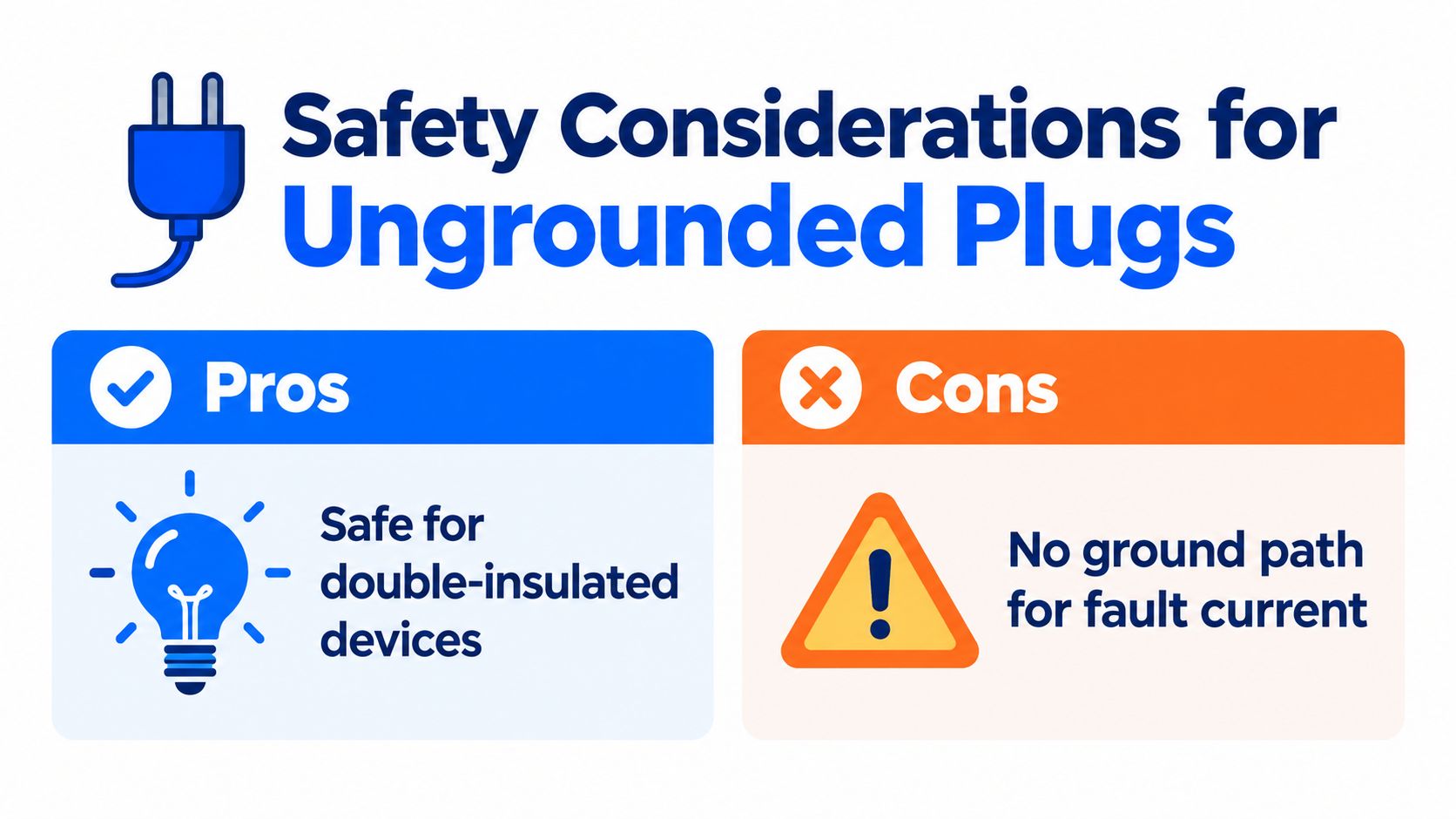
The most persistent misconception is that an adapter makes a two-slot outlet grounded. It doesn't. A two-prong adapter can preserve an existing equipment-grounding path only when its metal tab or wire is bonded to a grounded outlet-box screw. If the receptacle or box isn't actually grounded, the path is ineffective, as explained by Interpower's guidance on polarized and non-polarized NEMA 1-15 connections.
The small metal tab on some adapters isn't decorative. It's intended to connect to a grounded screw or equivalent bonding point. But you can't verify that connection merely by seeing a screw on the faceplate. In a cruise cabin, you also shouldn't remove the plate, alter wiring, or improvise a connection.
What the adapter can and can't do
For a charger marked for the available supply, a two-prong connection may be acceptable when the device is designed for non-grounded use or is double-insulated. Many compact charging bricks are built around that kind of use. The adapter still won't provide the same fault-current path as a properly grounded receptacle.
Avoid using this workaround for equipment with exposed metal housings, heating elements, motors, or substantial power demands unless the cruise line explicitly permits it and the electrical setup is appropriate. Hair dryers, irons, kettles, hot plates, and similar appliances can create both safety and policy problems.
Grounding reminder: A metal tab can carry ground only if it connects to a real ground. The adapter itself can't manufacture one.
Never use a damaged adapter, stack adapters together, cover a warm connection, or leave a questionable setup unattended. If you're unsure whether a device needs grounding, choose a different device or ask the ship's electrical or guest-services staff.
When You Need a Voltage Converter
A plug adapter changes the shape of the connection. It doesn't change the voltage supplied by the outlet. That distinction is easy to miss when a charger fits physically and begins charging.
Read the input label on every device before packing it. A modern phone or laptop charger may list a broad input range such as 100 to 240 volts, which indicates dual-voltage operation. In that case, the charger generally needs the correct physical adapter for the outlet, not a voltage converter.
Older styling tools deserve more caution. A single-voltage hair dryer or curling iron designed for one supply can overheat, fail, or trip a circuit when connected to a different supply through a simple adapter. A converter or transformer may be required, but high-power appliances can exceed what a compact travel device or cabin circuit should handle.
Use the label, not the appearance
Look for three pieces of information:
- Input voltage: Confirm that the listed range includes the outlet's supply.
- Frequency: Check whether the device accepts the local frequency where relevant.
- Wattage: Compare the device's demand with the adapter, converter, and cabin circuit ratings.
A charger that says “input 100–240V” is fundamentally different from a device that lists only one voltage. Don't infer dual-voltage capability from the fact that the appliance is new, compact, or sold for travel.
If the label is missing or unreadable, leave the appliance out rather than gambling on a late-night replacement. For high-draw grooming equipment, a dual-voltage travel model or ship-provided alternative is often more practical than carrying a heavy converter.
Choosing the Right Adapter for Your Cruise
Choose a polarized, compact adapter that matches the charger and outlet you'll use. The wider blade should align with the wider slot, and the housing should feel solid without wobbling once inserted. A low-profile body or short flexible cord is useful in a narrow cabin because it reduces strain on the receptacle and leaves nearby space usable.
Look for:
- Clear compatibility: It should accept your three-prong North American charger and fit the cabin's two-slot outlet.
- Sound construction: Avoid cracked plastic, loose contacts, and poorly finished blades.
- A stable fit: The adapter shouldn't droop or fall out under the charger's weight.
- Appropriate use: Treat it as a connection aid for suitable electronics, not as grounding or voltage protection.
- Easy packing: Small dimensions matter when chargers, cables, toiletries, and clothing already compete for space.
Pack the adapter where you can reach it during embarkation, not at the bottom of checked luggage. Before sailing, review what you can take on a cruise, since cruise-line rules can restrict appliances even when the outlet and adapter are technically compatible.
The practical kit is simple: one correctly matched adapter, certified chargers with readable input labels, short cables, and a backup charging option. Keep airflow devices and other accessories positioned so they don't pull on the outlet or cover a warm connection.
Nordmoose offers compact cruise accessories such as rechargeable magnetic fans and other cabin-focused organizers designed for limited stateroom space. Visit Nordmoose before your sailing to pair your charging setup with practical gear for a more comfortable cabin.