

Power Strip Without Surge Protector: A Cruise Travel Guide
You're unpacking for your first cruise when the charging lineup starts: your phone is nearly empty, your smartwatch is sitting on its charging puck, your camera battery is blinking, and a CPAP machine still needs a dependable outlet beside the bed. Then you find the cabin's only convenient receptacle tucked behind the nightstand.
A power strip without surge protector circuitry can solve that outlet shortage, but only if your cruise line permits it and you choose the right design. The important distinction isn't how many sockets the device has. It's whether the strip is a basic UL 1363 relocatable power tap or a UL 1449 surge protector, and those categories can lead to very different results at embarkation.
Table of Contents
- Why One Cabin Outlet Is Never Enough on a Cruise
- What a Power Strip Without Surge Protector Actually Is
- Power Strip vs Surge Protector Side by Side
- Why Cruise Lines Care About Surge Protectors
- Cruise Line Rules for Power Strips in 2026
- How to Choose a Cruise-Allowed Power Strip
- Safe Loading and Cabin Safety Practices
- Packing Checklist and Frequently Asked Questions
Why One Cabin Outlet Is Never Enough on a Cruise
Cruise cabins are designed around compact, tidy living. That works well for a lamp, a television, and a few built-in fixtures, but modern travelers carry a small collection of rechargeable devices. A phone, smartwatch, camera, e-reader, headphones, tablet, and medical equipment can all need power during the same evening.
USB ports may help, when the cabin has them, but they're not a complete solution. There may be only one or two, and a port connected to the cabin's key-card power system might stop charging when you leave for a port day. A device that seems to be charging before breakfast can therefore remain nearly empty when you return.
The practical answer is to separate outlet expansion from surge protection. A plain strip can give several low-power devices access to one receptacle. A surge protector adds voltage-clamping components, and that extra circuitry is precisely what many cruise policies restrict.
Cabin reality: The safest charging setup starts with the ship's written policy, not with the most feature-packed strip on a store shelf.
Before packing anything, check your line's prohibited-items guidance and inspect the device itself. Some products are advertised as travel strips but include surge suppression, a lighted switch, a reset button, or other features that can cause confusion during inspection. The sections below translate the technical labels into cabin decisions, explain why policies differ, and show how to keep the total load sensible once you're onboard.
What a Power Strip Without Surge Protector Actually Is
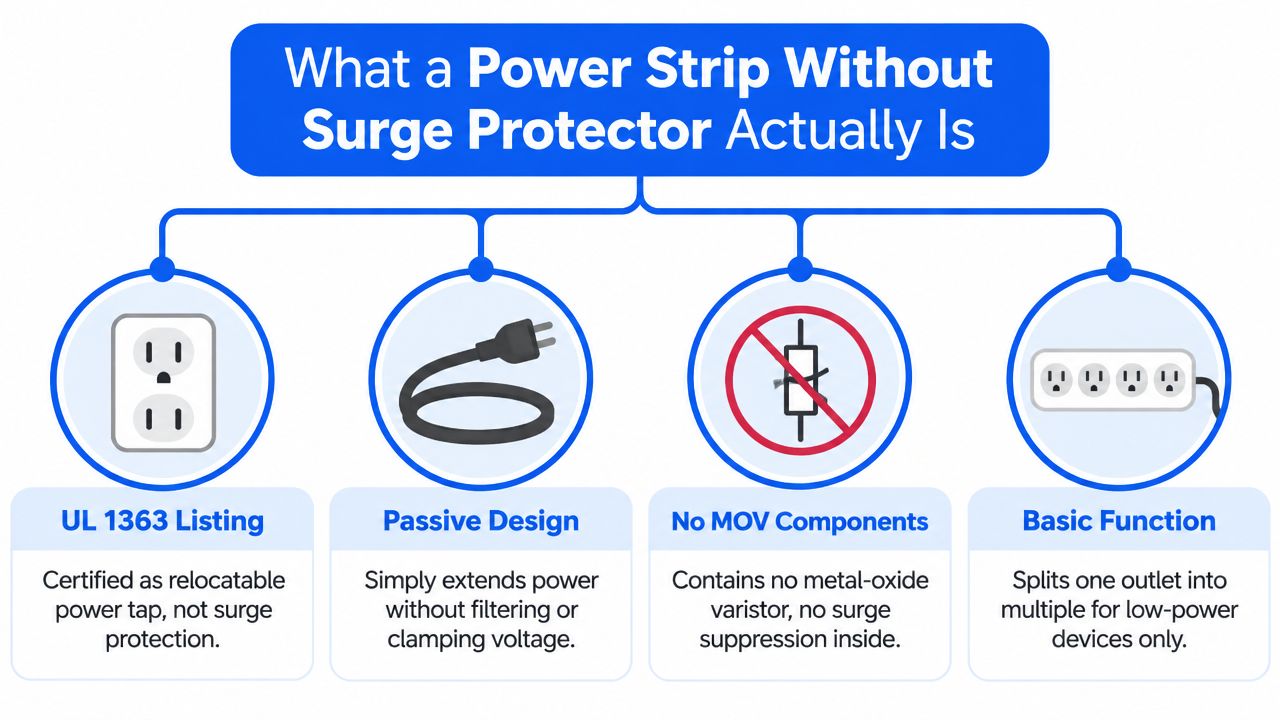
Under UL 1363, a plain strip is a relocatable power tap, often called an RPT. UL defines this category as an indoor, cord-and-plug-connected device rated at 250 V AC or less and 20 amperes or less, according to the UL 1363 standard listing. In everyday language, it takes one receptacle and makes several outlets available through a cord, housing, and internal wiring.
That device expands access. It doesn't actively manage a voltage spike. A basic strip lacks the transient-voltage clamping components used by surge protectors, so it's intended for convenience rather than electronics protection. UL's consumer guidance describes a power strip as similar to an extension cord with multiple outlets, while a surge protector adds an internal element that clamps voltage spikes. The UL guide to power strips and surge protectors explains the difference in plain safety language.
The pressure-valve analogy
Think of a standard power strip as a multi-plug adapter with a short extension cord. It routes ordinary electricity from one wall receptacle to several sockets. A surge protector is that same basic arrangement plus a tiny pressure-relief valve designed to react when voltage rises beyond a safe threshold.
The surge device belongs to a different safety category, commonly associated with UL 1449. Its internal protective components can clamp transient voltage, but the presence of those components may make the unit unacceptable in a cruise cabin. The product can look almost identical from across the room, which is why the printed markings matter more than the shape.
A non-surge strip still needs sensible use. UL 1363 guidance for relocatable power taps in North America includes direct connection to a wall receptacle and overcurrent protection, so you should evaluate the strip by its wiring, breaker behavior, and load limit, not by a surge-energy rating. It provides more places to plug in. It doesn't make unsafe appliances safe.
Power Strip vs Surge Protector Side by Side
The choice seems simple until two devices with matching outlet layouts sit next to each other in a luggage compartment. Both may provide several sockets, yet one is a convenience device and the other contains surge-suppression circuitry. For a cruise passenger, that difference matters more than extra marketing features.
| Criterion | Power Strip, UL 1363 | Surge Protector, UL 1449 |
|---|---|---|
| Outlet function | Adds multiple outlets to one receptacle | Adds multiple outlets to one receptacle |
| Protection level | No transient-voltage suppression | Clamps transient voltage spikes |
| Visible features | May have basic housing and wiring | May include protection indicators, switches, or reset controls |
| Cruise-cabin role | Suitable only where the line permits a plain strip | Often restricted or prohibited |
| Best use case | Low-power charging and outlet expansion | Sensitive electronics in settings where surge protection is allowed |
A joule rating, “protected” light, “suppression” wording, or surge-specific labeling points toward a protective device rather than a plain UL 1363 tap. Don't rely on the number of outlets or the product's name. Read the label on the housing and compare it with the packaging.
For cabin-specific background on outlet layouts and charging constraints, consult this guide to cruise ship electrical outlets. It's also important to avoid assuming that surge protection is automatically useful onboard. A ship uses its own electrical generation and distribution system, so the buying question is usually whether the product is allowed and appropriate for the cabin, not whether it offers the highest protection rating.
Reader shortcut: If the label advertises surge suppression, treat it as a surge protector. If it only expands outlets and carries the appropriate plain-strip listing, assess its load and the cruise line's policy.
Why Cruise Lines Care About Surge Protectors
Cruise lines restrict surge protectors because a cabin is a confined sleeping space on a vessel, not an open home office. Guests may push a device behind luggage, cover it with clothing, or leave it energized while they're ashore. Crew members also need to identify prohibited equipment quickly during embarkation inspections.
Four practical concerns
Heat inside a concealed device is the first concern. Surge-suppression components can heat during a fault or voltage event. If the unit is wedged behind a nightstand with fabric around it, the crew may not discover the problem immediately.
A status light can create false confidence. A lighted indicator may tell you something about the device's protection circuit, but a passenger could still assume the strip is safe after an internal component has failed. That misunderstanding is especially serious when the device remains capable of passing power.
Switches and reset controls can be bumped. A suitcase sliding against a switch could interrupt power to a CPAP machine or another device overnight. A plain strip without those controls presents fewer accidental touchpoints, although it still needs to remain visible and unobstructed.
Electrical compatibility is a shipboard concern. Cruise vessels operate specialized electrical systems, and policies are written conservatively around equipment that includes additional circuitry. Passengers don't need to diagnose electromagnetic behavior themselves. They do need to understand that “no surge protection” is often a deliberate requirement, not a missing feature.
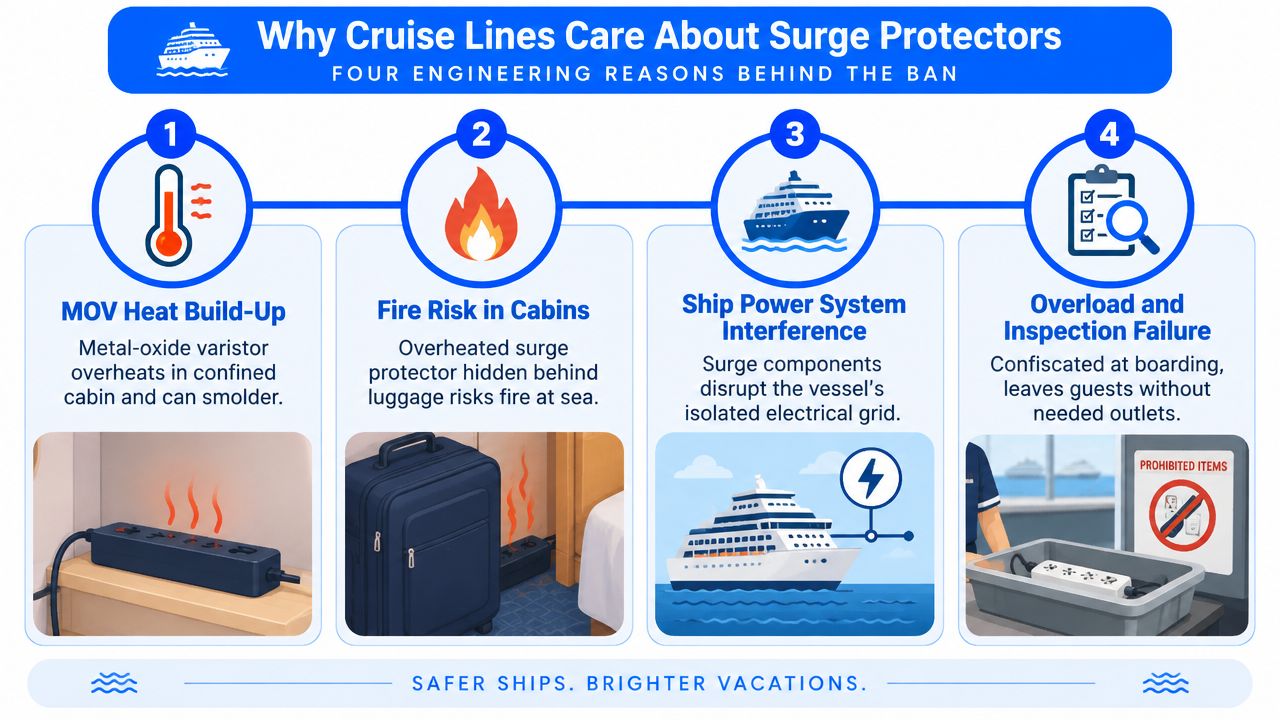
Cruise lines also care about inspection outcomes. A traveler might pack a compact unit believing that “travel” means “approved,” only to have security confiscate it because the housing includes a surge circuit, a switch, or an extension-cord configuration that violates the line's rules.
The safest interpretation is straightforward: a plain strip is not automatically allowed, and a surge protector is not made acceptable merely because it's small. Confirm the exact policy for the ship you're boarding, then match the device's physical features to that policy.
Cruise Line Rules for Power Strips in 2026
Cruise policies aren't uniform. The biggest mistake is asking only whether a “non-surge power strip” is allowed. You need to ask which line, which fleet, and what the device includes.
Royal Caribbean changed its position in 2024, according to independent policy summaries, and now bans power strips, multi-plug adapters, and extension cords across its fleet. Other major lines may permit a plain non-surge strip when it has no surge circuitry, indicator light, or on/off switch. Rules can change, so verify the current wording before departure.
| Cruise Line | Non-Surge Power Strip Allowed? | Surge Protector Allowed? | Key Restrictions | Policy Source |
|---|---|---|---|---|
| Royal Caribbean | No, under the fleet-wide rule described in current independent summaries | No | Power strips, multi-plug adapters, and extension cords are prohibited | Royal Caribbean policy summary |
| Carnival | Often allowed under stated conditions | No | Plain strip only, no surge protection, indicator light, or on/off switch, and direct wall connection | Check Carnival's current prohibited-items guidance |
| Norwegian Cruise Line | Often allowed under similar conditions | No | Confirm the current list and avoid surge circuitry or restricted controls | Check NCL's current prohibited-items guidance |
| Disney Cruise Line | Often allowed under similar conditions | No | Confirm the ship-specific wording and use a plain direct-wall strip only | Check Disney's current prohibited-items guidance |
The distinction between a plain UL 1363 relocatable power tap and a UL 1449 surge suppressor helps explain the policy pattern, but it doesn't override a line's own rules. A product can fit the technical description of a non-surge strip and still be forbidden by a particular carrier.
For a broader review of items that may be restricted during embarkation, use this cruise packing and prohibited-items guide. If you're booking multiple lines, pack according to the strictest itinerary or plan to leave the strip at home for the ship with the broadest ban.
How to Choose a Cruise-Allowed Power Strip
Treat the product label like a checklist, not a suggestion. A device that solves your charging problem at home may fail the cruise-line inspection because it includes one small feature you didn't notice.
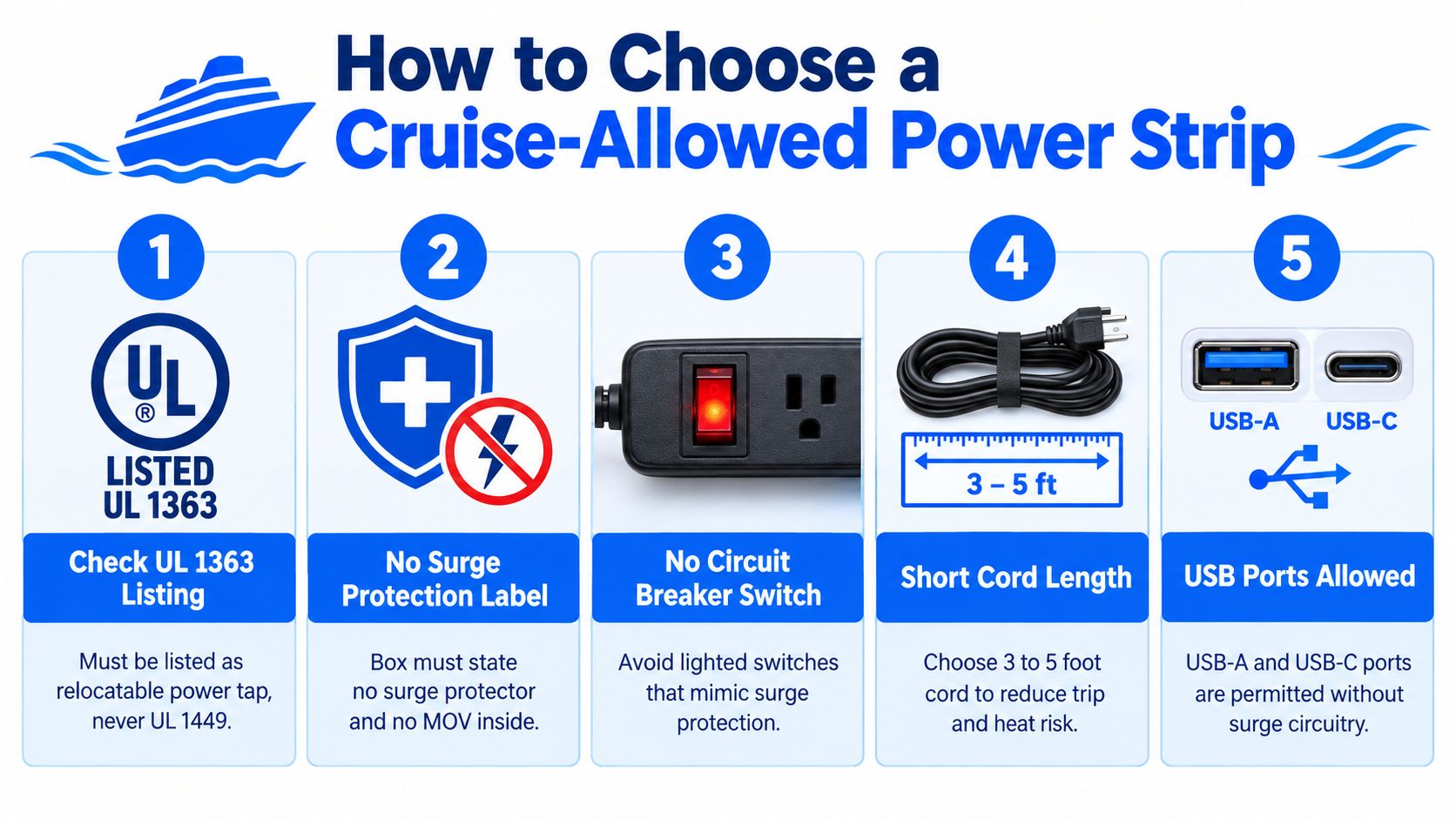
- Verify the listing. Look for a clear UL 1363 relocatable power tap designation. Don't choose a unit identified as UL 1449 or described with surge suppression, joule protection, or voltage clamping.
- Inspect the plug and cord. Choose a direct three-prong wall plug with a cord leading to the outlet housing. Avoid a thin cord that ends in a large wall block if your line treats that configuration as an adapter or extension device.
- Reject surge language. The housing and packaging shouldn't advertise “surge protector,” “protected,” “suppression,” or an MOV-based circuit. A missing claim isn't enough by itself. Look for the actual safety listing and product specifications.
- Remove control features from the decision. Skip lighted on/off switches and reset buttons when your line's rules exclude them. Plain USB-A or USB-C charging ports may be permitted by some lines, but check whether the USB section includes surge circuitry.
- Match the electrical rating. A 13-amp or 15-amp rating should correspond with the cabin receptacle and the product's instructions. Never connect one strip to another. The UNMC safety guidance for relocatable power taps emphasizes direct-wall use and attention to overcurrent protection.
A magnetic organizer can reduce the temptation to bury cords under clothing. For example, the Magnetic Cruise Door Organizer uses three magnets on suitable metal cabin surfaces and has 15 mesh pockets for items such as toiletries, shoes, sunscreen, and chargers. It also includes over-the-door hooks, but some lines restrict those hooks, so check the policy before packing them.
Safe Loading and Cabin Safety Practices
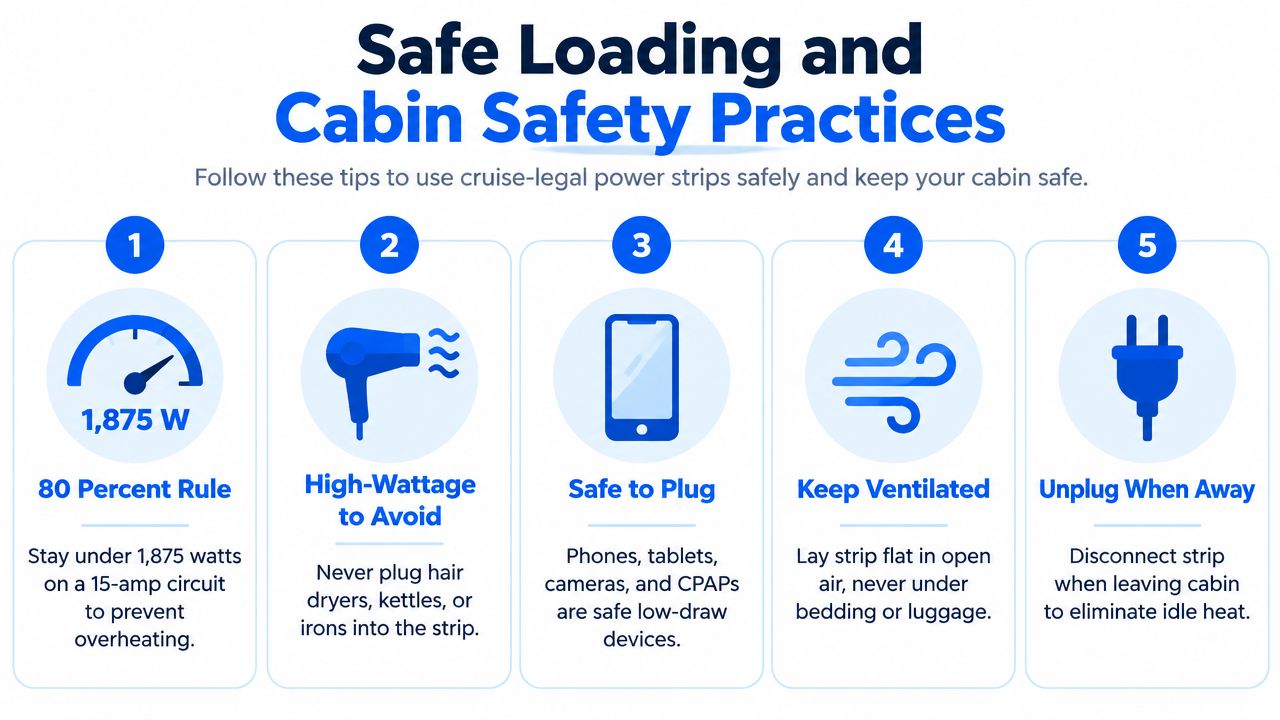
A cruise-approved strip still has a load limit. For a typical 15-amp strip, practical safety guidance sets the maximum connected load at about 1,875 W, while many institutions recommend using no more than 80% of capacity for continuous use, or about 1,500 W and 12 A at 120 V. These figures come from the load-management guidance summarized by Alibaba's electrical safety article.
Add the wattage printed on each device before connecting it. A phone charger, smartwatch puck, camera charger, tablet charger, and CPAP machine are generally low-draw examples, but the label on the actual equipment should decide. If the total approaches the continuous-use limit, move a device to another approved receptacle or charge it at a different time.
Keep high-draw appliances off the strip
Hairdryers, curling irons, clothes steamers, kettles, irons, and space heaters can draw far more power than small electronics. Plug these appliances directly into an appropriate wall outlet when the ship permits their use, and follow the line's separate rules for prohibited heating appliances.
Place the strip flat in open air, not under a pillow, blanket, suitcase, or pile of clothing. Route the cord away from the bathroom, cabin entrance, and walking path, and unplug it when you leave if your devices don't need to remain connected.
A dropped phone or e-reader behind a dresser isn't just inconvenient in a steel cabin. Retrieving it can pull the cord, trap the strip, or create a trip hazard. If you want airflow without adding another continuously plugged-in appliance, the Magnetic Cruise Fan with Remote Control has a rechargeable battery, magnetic base, remote control, timer, six speeds, adjustable airflow direction, and a dimmable LED light.
Packing Checklist and Frequently Asked Questions
Use this quick inspection before the strip goes into your suitcase:
- Amp rating: Confirm the device's rating matches the cabin receptacle and its instructions.
- Direct plug: Choose a direct-to-wall three-prong plug where the line permits a strip.
- No surge circuitry: Avoid UL 1449, joule ratings, MOV references, and suppression claims.
- No indicator light: Skip surge or status lights if the policy excludes them.
- No on/off switch: Avoid lighted switches and reset buttons when required by the line.
- Destination adapter: Pack the correct travel adapter if your itinerary uses a different receptacle standard, and confirm the ship's guidance first.
Once onboard, keep the strip visible on a hard surface, label chargers so cabinmates don't unplug the wrong device, and route cords where nobody will catch a foot. If security confiscates the strip, don't argue at the checkpoint. Ask whether it can be collected at disembarkation, then use the cabin's permitted outlets or ask guest services about approved charging options.
For more general planning, review these cruise ship essentials before you finalize your luggage.
Common questions
Does a single-plug USB hub count as a power strip?
It depends on its design and the cruise line's wording. A device that plugs into one outlet and provides several powered USB connections may still be treated as a multi-plug adapter, even if it has no conventional sockets. Check the carrier's prohibited-items list instead of relying on the product name.
Are extension cords ever allowed?
Some lines may permit limited configurations, but others prohibit extension cords outright. Don't assume a plain strip and an extension cord receive the same treatment.
What happens if security takes the strip?
The item may be held until the end of the voyage or handled under the line's confiscation process. Pack according to the strictest policy on your itinerary so you're not depending on a device that may never reach your cabin.
Do European and Asian cruise lines use the same UL logic?
Not necessarily. UL 1363 and UL 1449 are North American standards, while other markets may use different certification systems and shipboard rules. The underlying distinction between outlet expansion and surge suppression remains useful, but the local policy and receptacle requirements control.
A rechargeable fan, magnetic light, or organizer can also reduce the number of plugs competing for the cabin outlet. Planning the whole cabin setup, rather than buying the largest strip available, keeps your devices accessible and your luggage simpler.
Nordmoose offers magnetic cabin organizers and rechargeable cruise accessories designed for compact ship spaces, including a magnetic organizer for chargers and personal items and a rechargeable magnetic fan for airflow. Visit Nordmoose before your trip to review options that can improve cabin organization while reducing reliance on extra plugged-in equipment.