

Patches Sea Sickness: A Practical Guide for Cruisers
You're packing chargers, sunscreen, maybe a lanyard for your key card, and then the worry sneaks in. What if the ship starts moving and your stomach doesn't cooperate?
That's the moment a lot of first-time cruisers start searching for patches sea sickness options. Some want the strongest tool available. Others want something gentler that won't leave them foggy at dinner. Both instincts are reasonable. A motion-sickness patch can be helpful, but it isn't magic, and it isn't the right fit for everyone.
The most useful way to think about patch therapy is simple. Match the patch to your itinerary, your past motion-sickness history, and your tolerance for side effects. Once you do that, the decision gets much easier.
Table of Contents
- What Sea Sickness Patches Are and Why Cruisers Use Them
- How Transdermal Motion Sickness Patches Work
- Prescription Patches Versus Non-Drowsy OTC Options
- Safety, Side Effects, and Who Should Avoid Patches
- When and How to Apply a Patch Before Boarding
- Comparing Patches With Pills, Bands, and Natural Remedies
- Pre-Cruise Checklist and Common Cruiser Questions
What Sea Sickness Patches Are and Why Cruisers Use Them
The ship has just pulled away from port. You're standing on an open deck with a drink you barely touched, and the floor feels subtly wrong. Not dramatic. Just enough sway to make your body ask, “Are we walking, floating, or both?”
That's when motion sickness often starts. For many travelers, a patch sounds appealing because it doesn't ask you to swallow a pill after your stomach already feels unsettled. You apply it ahead of time, wear it on the skin, and let it work in the background.
Two very different kinds of patches
When cruisers talk about “seasickness patches,” they're often lumping together two separate categories:
- Prescription transdermal scopolamine patches deliver a medication through the skin. In the United States, this is the best-known FDA-approved patch for preventing nausea and vomiting from motion sickness.
- Non-prescription patches are sold as non-drowsy travel support. These may use herbal ingredients or pressure-point concepts rather than a prescription drug.
Those categories matter because they behave very differently. One is a labeled medication with a long regulatory history and specific safety warnings. The other is more of a comfort tool that some travelers prefer when they want a lower-intensity, non-drug option.
Why patches fit cruise travel so well
Cruises create a very specific problem. Motion can come and go. You may feel fine at breakfast, then run into a windy stretch at sea after lunch. A patch appeals to cruisers because it can provide ongoing support without repeated dosing.
Cruisers also like the practical side:
- Hands-free prevention: You apply it and move on with your day.
- Useful when your stomach is touchy: No swallowing a tablet while already nauseated.
- Good for changing conditions: Calm departure days can turn into rougher evenings.
Practical rule: Patches make the most sense when your goal is prevention, not rescue after symptoms are already in full swing.
That's the biggest mental shift. A patch usually works best when you think ahead. If you wait until the buffet suddenly looks impossible, you're already late for the ideal use case.
How Transdermal Motion Sickness Patches Work
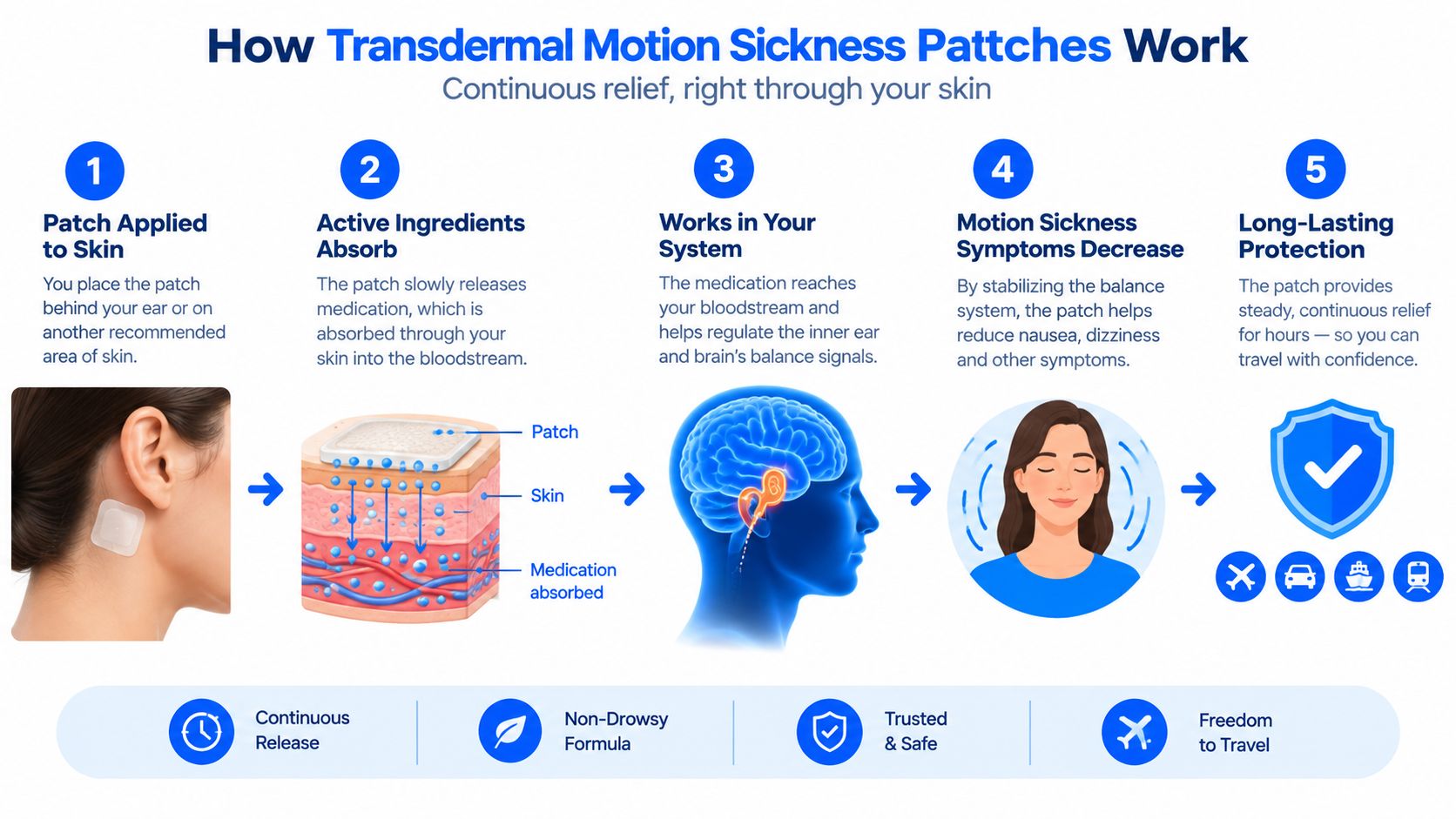
A prescription motion-sickness patch doesn't work like a mint or a wristband. It's a transdermal system, which means the medication moves through the skin and into the bloodstream in a controlled way.
The clearest example is the scopolamine patch used for motion sickness. It's designed as a 1.5 mg reservoir system that releases about 0.5 mg over 72 hours, with a priming dose in the adhesive to help early absorption, according to a review of the transdermal system on PubMed.
Why the area behind the ear matters
The patch is placed behind the ear because that skin is thin and works well for this kind of drug delivery. In simple terms, it gives the medication a reliable route through the skin.
The patch itself is built to release medication gradually rather than all at once. That's the whole point. Instead of taking a pill, peaking, and wearing off, you get a steadier delivery over time.
Why timing matters more than many people realize
Travelers often get confused. The patch isn't an instant shield.
The same PubMed review notes that the estimated protective plasma concentration is about 50 pg/mL, usually reached around 6 hours after application and then stabilizing around 8 to 12 hours after application, which is why early timing matters on boarding day when you expect motion exposure from the start.
The FDA labeling also instructs adults to apply one patch behind the ear at least 4 hours before exposure and replace it after up to 3 days, as stated in the current FDA label for Transderm Scōp.
That explains two practical truths:
- A patch is preventive.
- Late application is one of the main reasons people think it “didn't work.”
How OTC patches differ
Not every patch on the travel shelf is transdermal medication. Some over-the-counter products are marketed as non-drowsy support and use herbal ingredients. Others lean on pressure-point placement rather than drug delivery.
For example, Sea Sickness Patches for Cruise are described as sea sickness patches made for cruisers and travelers who want gentle, non-drowsy support during trips, with a waterproof design and 12 patches per box. That's a different category from prescription scopolamine and should be judged by a different expectation.
A prescription patch is a medication delivery system. A non-drowsy OTC patch is usually a gentler support option.
If you keep that distinction clear, the rest of the patch conversation becomes much less confusing.
Prescription Patches Versus Non-Drowsy OTC Options
Most cruisers are really choosing between two patch families. One comes through a clinician or pharmacy. The other is easy to buy and easy to pack.
The best choice depends less on hype and more on your trip. A short, calm itinerary calls for a different approach than a longer route with repeated sea days.
What each type is trying to do
A prescription scopolamine patch is for adults who want medication-based prevention before motion starts. The CDC's travel guidance says scopolamine is the preferred option for longer-term motion exposure greater than 6 hours, notes a duration of 72 hours, and describes onset for the U.S. patch as about 6 to 8 hours in its motion sickness guidance in the CDC Yellow Book.
A non-drowsy OTC patch is usually chosen by travelers who want a simpler, lower-commitment option. These products are often attractive for shorter sailings, car rides to the port, ferries, or travelers who'd rather avoid prescription anticholinergic side effects.
| Feature | Prescription Scopolamine Patch | Non-Drowsy OTC Patch |
|---|---|---|
| Access | Requires a prescription | Bought without a prescription |
| Main approach | Medication delivered through skin | Usually herbal or pressure-point style support |
| Best fit | Longer or more motion-heavy itineraries | Mild sensitivity or travelers who want gentler support |
| Wear pattern | Long-acting, planned ahead | Varies by product |
| Side effect profile | More meaningful trade-offs | Usually fewer medication-style trade-offs |
| Pregnancy questions | Needs careful medical review | Still worth checking ingredients and intended use |
A practical matching framework
If you've had a rough time on boats before, or you're booking a route where sea conditions can be unpredictable, the prescription route may be worth discussing with a clinician. If this is your first cruise and your motion sensitivity is uncertain, starting with a gentler option can be more comfortable.
Some travelers also want a broader comparison before deciding. This guide on a non-drowsy motion sickness patch is useful for understanding the appeal of the non-prescription side of the category.
Where people oversimplify things
The common mistake is calling scopolamine “the best patch” without naming the trade-offs. The opposite mistake is assuming every patch is basically the same.
They're not. One is built for stronger prevention and longer exposure. The other may suit travelers who care most about staying clear-headed and avoiding medication-heavy options. For many first-time cruisers, that distinction matters more than any slogan on the package.
Safety, Side Effects, and Who Should Avoid Patches
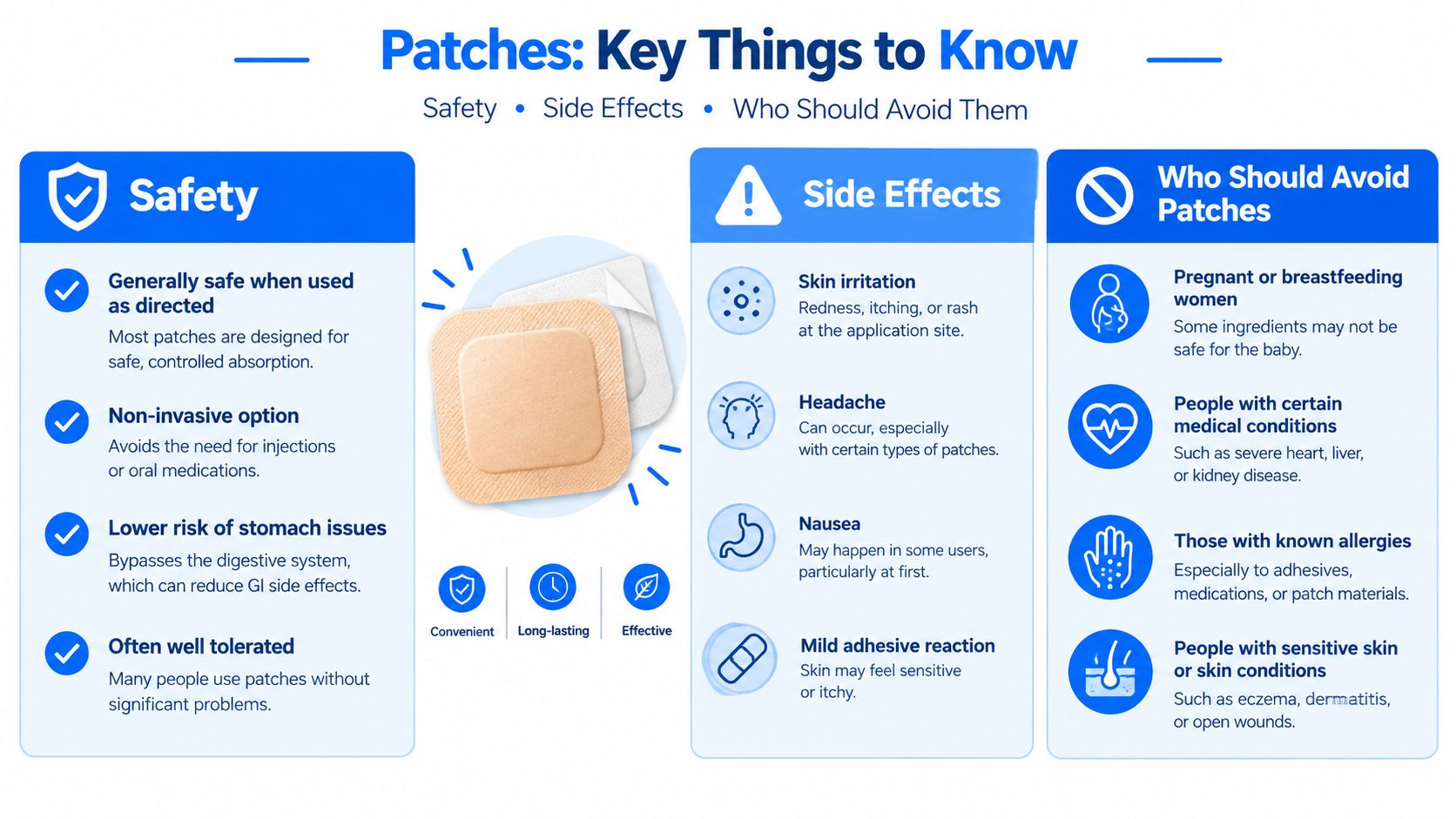
Here's the balanced truth. The prescription scopolamine patch has real evidence behind it, and it also has real cautions.
Clinical data in the product labeling report that among 195 adult subjects studied at sea or in controlled motion environments, transdermal scopolamine produced a 75% reduction in motion-induced nausea and vomiting, according to the FDA structured product labeling data. That helps explain why so many cruisers ask for it.
Common trade-offs people actually notice
The same CDC guidance discussed earlier notes that dry mouth, drowsiness, and blurred vision are among the most common adverse effects. Those aren't rare, quirky details. They're the reason some travelers love the patch while others remove it and switch strategies.
Another classic problem happens by accident. Someone touches the patch, then rubs an eye. That can lead to eye symptoms like a dilated pupil or blurred vision on one side, which is alarming if you aren't expecting it.
Wash your hands after handling a prescription patch. That small habit prevents a surprising number of problems.
The heat warning is the one many casual travel guides skip. The FDA has required a warning that the patch can raise body temperature, reduce sweating, and has been linked to heat-related complications, including hospitalization or death in some cases, as described in the FDA-approved labeling.
That matters on a cruise. Think open sun decks, humid ports, hot tubs, and warm cabins.
To make that warning easier to visualize, this short video helps frame the safety conversation:
Pregnancy deserves a more careful answer
Pregnancy questions around patches sea sickness products often get flattened into yes-or-no advice, and that's not very helpful.
The DailyMed labeling says available observational and postmarketing data in pregnancy have not identified a drug-associated risk of major birth defects or miscarriage, but it also warns to avoid transdermal scopolamine in patients with severe preeclampsia because eclamptic seizures have been reported after exposure, according to the DailyMed scopolamine labeling.
That means pregnant travelers shouldn't rely on a casual internet summary. They should ask their own clinician how to weigh the itinerary, symptoms, and alternatives.
Who should be extra cautious
People with certain medical conditions need a more careful conversation before using scopolamine. If you have eye conditions such as glaucoma concerns, urinary retention issues, or constipation-related problems, don't treat the patch like a trivial travel extra.
The patch has a long history. It was first approved by the U.S. FDA in 1979 for adults to prevent nausea and vomiting associated with motion sickness, but that long history has included ongoing safety monitoring too, as reflected in the FDA labeling already cited above.
When and How to Apply a Patch Before Boarding
Good timing makes a patch much more useful. Bad timing leads to a lot of disappointed travelers.
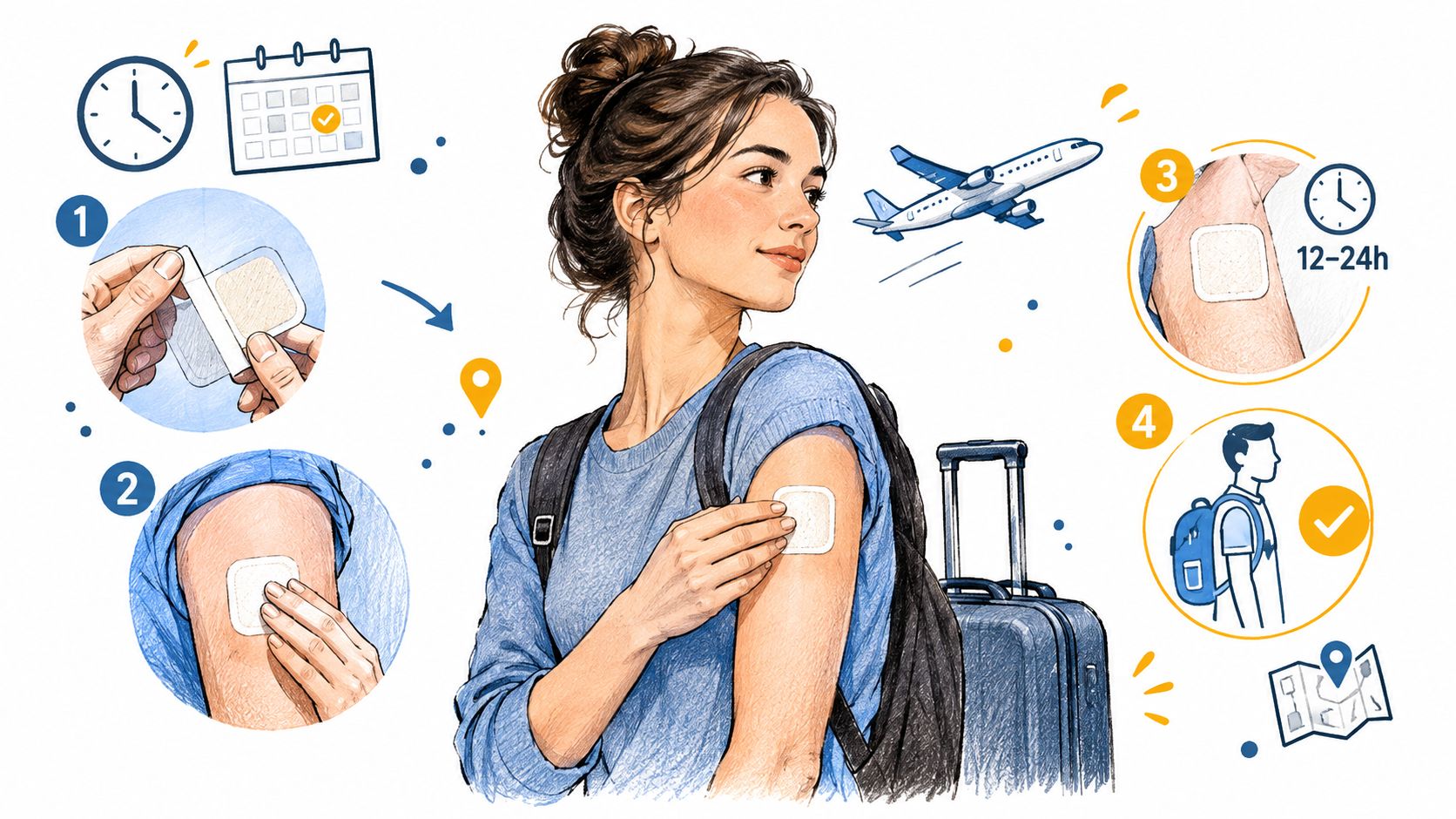
For prescription scopolamine, the FDA instruction is straightforward. Apply one patch behind the ear at least 4 hours before exposure and replace it after up to 3 days, as noted earlier in the FDA label. It's designed for prevention, so boarding-day planning matters.
A simple boarding-day routine
Use this sequence if you and your clinician have decided a prescription patch fits your trip:
- Start with clean, dry skin. The area behind the ear should be clean and free of lotions or heavy oils.
- Choose the correct location. Place it on the hairless skin behind one ear, not on the neck, arm, or shoulder.
- Press it on firmly. You want good skin contact so it stays put through embarkation and the first sea day.
- Wash your hands after application. This helps avoid getting medication into your eyes.
What to do on longer itineraries
If your cruise runs past the wear window, plan your replacement timing before you leave home. Don't wait until day three when you're trying to remember whether you applied it before the Uber ride or after breakfast at the terminal hotel.
For travelers using a gentler non-prescription option, product directions will vary. If you want to compare that category, the product page for Sea Sickness Patches for Cruise gives a straightforward example of a cruise-focused, non-drowsy patch option.
Cabin comfort matters too
Heat can make prescription patch use less forgiving, so cabin airflow is worth thinking about if you're sensitive to warmth. A Rechargeable Cruise Fan with Magnetic Hook to Hang on Cruise Walls & Ceilings is described as a portable rechargeable cruise fan for cabins and travel setups, with a magnetic hook and compact design. That can be practical if your room feels stuffy.
If side effects feel stronger than the benefit, don't just push through and hope. Talk with the ship's medical team or your prescriber about whether the patch still makes sense for you.
Also dispose of used patches carefully and keep them away from children and pets. Even after use, they aren't something you want loose in a cabin trash area.
Comparing Patches With Pills, Bands, and Natural Remedies
Most cruisers shouldn't ask, “What's the strongest thing?” A better question is, “What fits my trip and my body?”
Patches are only one lane. Pills, wristbands, and ginger all have a place. The best match depends on cruise length, how easily you get motion sick, and whether medication side effects are a dealbreaker.
How the options differ in real life
A prescription patch is useful when motion may last a long time and you want prevention that keeps working in the background. It asks for planning and a willingness to accept more side-effect trade-offs.
Pills are more flexible. Some travelers like them because they can decide day by day rather than committing to a patch on the skin. That can work well if your itinerary is mostly ports with only occasional motion-heavy stretches.
Bands and ginger appeal to travelers who want low-risk, low-drama tools. They may not feel powerful enough for someone with a history of severe seasickness, but they can fit mild or uncertain cases well.
A decision table for common cruiser profiles
| Cruiser Profile | Best Option | Why It Fits |
|---|---|---|
| First cruise, not sure how sensitive you are | Non-drowsy OTC patch or ginger | Starts gently without committing to stronger medication |
| Short itinerary with mostly calm port days | Pill or non-drowsy OTC patch | Flexible and easier to adjust day by day |
| Adult with strong motion sensitivity on a long sailing | Prescription scopolamine patch | Designed for preventive coverage during extended exposure |
| Traveler who wants to stay as clear-headed as possible | Non-drowsy OTC patch, band, or ginger | Avoids the more noticeable trade-offs of prescription scopolamine |
| Pregnant traveler | Clinician-guided non-patch plan may be safer | Pregnancy questions need individualized review |
| Traveler who likes layered backup options | Planned primary option plus a backup discussed with a clinician | Gives flexibility if conditions change |
When a simpler option is the smarter one
A lot of first-time cruisers assume they should jump straight to the prescription patch. Sometimes that's right. Sometimes it isn't.
If your itinerary is short, the seas are expected to be mild, and you've never had major issues in cars or boats, a gentler approach is reasonable. This broader guide on what to do for seasickness on a cruise can help you think through that wider toolkit.
My practical pharmacist-style take
If you already know you get miserable on moving boats, don't underprepare. If you don't know your pattern yet, don't overmedicate just because social media says everyone needs a patch.
That's the middle ground many travelers miss. Good seasickness planning isn't about picking the “toughest” option. It's about picking the one you're still happy with by dinner on day two.
Pre-Cruise Checklist and Common Cruiser Questions
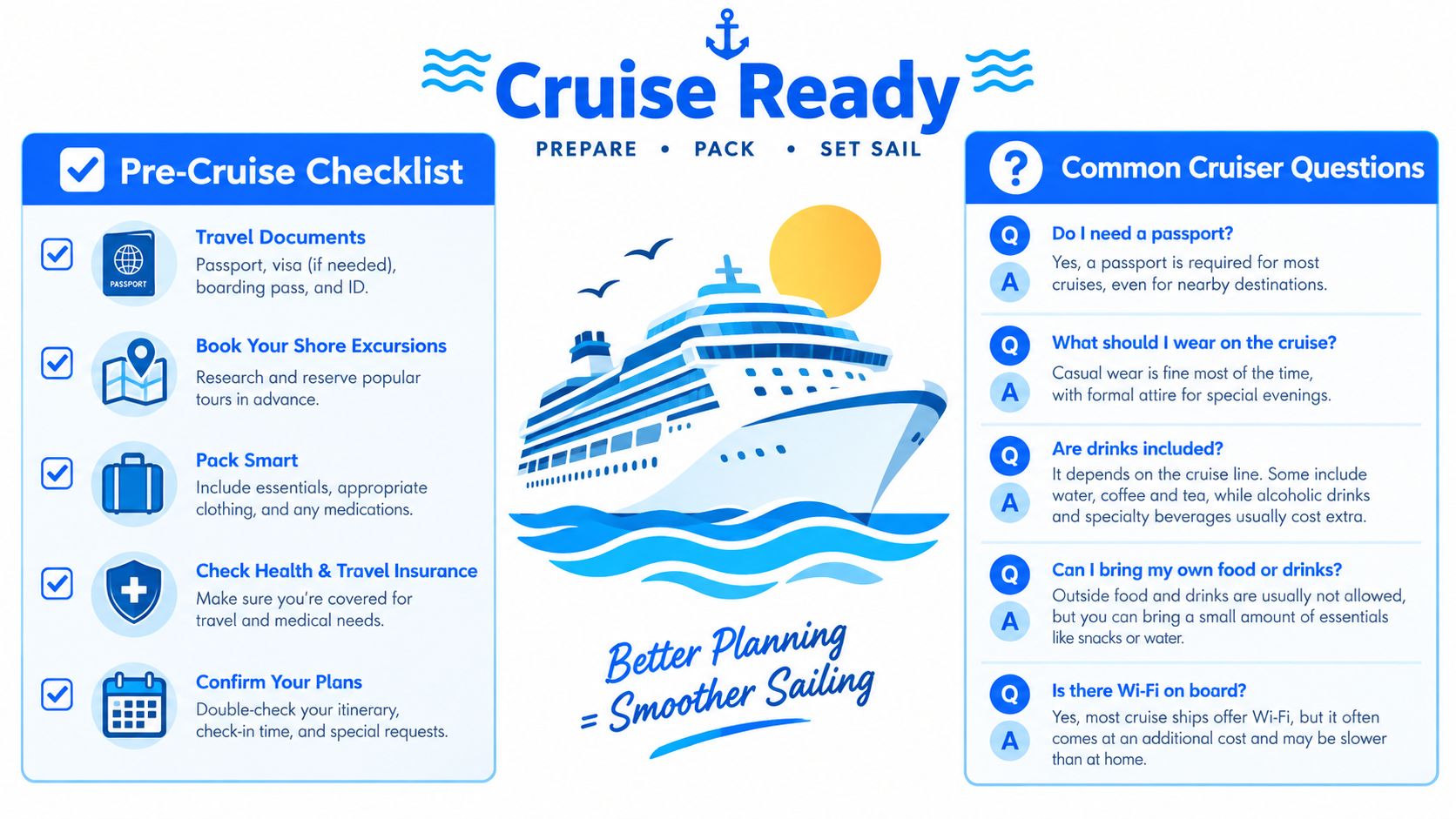
The easiest way to avoid seasickness mistakes is to decide your plan before the suitcase is zipped. Last-minute guessing on the ship usually leads to either overtreating or waiting too long.
A pre-cruise checklist that actually helps
- Choose your main strategy early: Decide whether you're using a prescription patch, an OTC patch, pills, bands, ginger, or a combination approved by your clinician.
- Test your timeline at home: Know when you'll apply or take your preventive option on embarkation day.
- Pack backups thoughtfully: If you use a patch, it can still make sense to ask your clinician what backup is appropriate if symptoms break through.
- Prepare the skin area: If you're using a behind-the-ear patch, keep that area clean and product-free on travel day.
- Think about sun and heat exposure: Long deck time, hot tubs, and warm cabins matter more if you're using scopolamine.
- Stay hydrated and eat lightly: An empty stomach can feel bad, but a heavy, greasy meal before rough water can feel bad too.
- Keep instructions with you: Don't rely on memory once the trip gets busy.
Common cruiser questions
Should I use a patch or a pill
If your motion exposure will be long or continuous, a patch can be a better preventive fit. If you want more flexibility and fewer lingering effects, a pill may feel easier to control. The right answer depends on your itinerary and how strongly you react to motion.
Can children use these patches
Be careful here. Prescription scopolamine labeling discussed in this article is for adults. For children, don't assume an adult patch strategy carries over safely. Ask a pediatric clinician before the trip.
Can I drink alcohol with a patch
That's a caution situation, not a casual yes. If you're already using something that may cause drowsiness or blurred vision, alcohol can make the experience less predictable. It's smarter to be conservative.
What if the patch falls off
Bring a backup plan. For prescription patches, ask your prescriber before travel what to do if one comes off mid-itinerary. For OTC patches, follow the product directions and carry extra units so you aren't stuck improvising at sea.
The best cruise medicine plan is the one you understand well enough to use correctly when the ship starts moving.
Nordmoose offers cruise-focused travel accessories that line up well with the problems cruisers run into, including non-drowsy seasickness support and compact cabin gear. If you want practical options built around ship travel rather than generic travel packing, visit Nordmoose.