

Cabin Packing List: A Smart Guide for Cruise Travelers
You're at the cruise terminal with a boarding pass in one hand and one nagging question in your head, what really needs to be in the bag you keep with you? That's the moment a cabin packing list stops being a generic checklist and becomes a practical system. On a cruise, the cabin isn't just a place to sleep, it's a compact space you'll enter in stages, and your gear has to work through every one of them.
Table of Contents
- Why a Cabin Packing List Works Best as a Staged System
- Setting Up Your Two-Stage Baggage Plan
- The Cabin-Arrival Kit for the First 24 Hours
- Ship Compliance and Prohibited-Item Checkpoint
- Clothing and Storage Strategy for a Small Stateroom
- Comfort, Airflow, and Motion Management Items
- Final Pre-Departure Cabin Checklist and Embarkation Tips
Why a Cabin Packing List Works Best as a Staged System
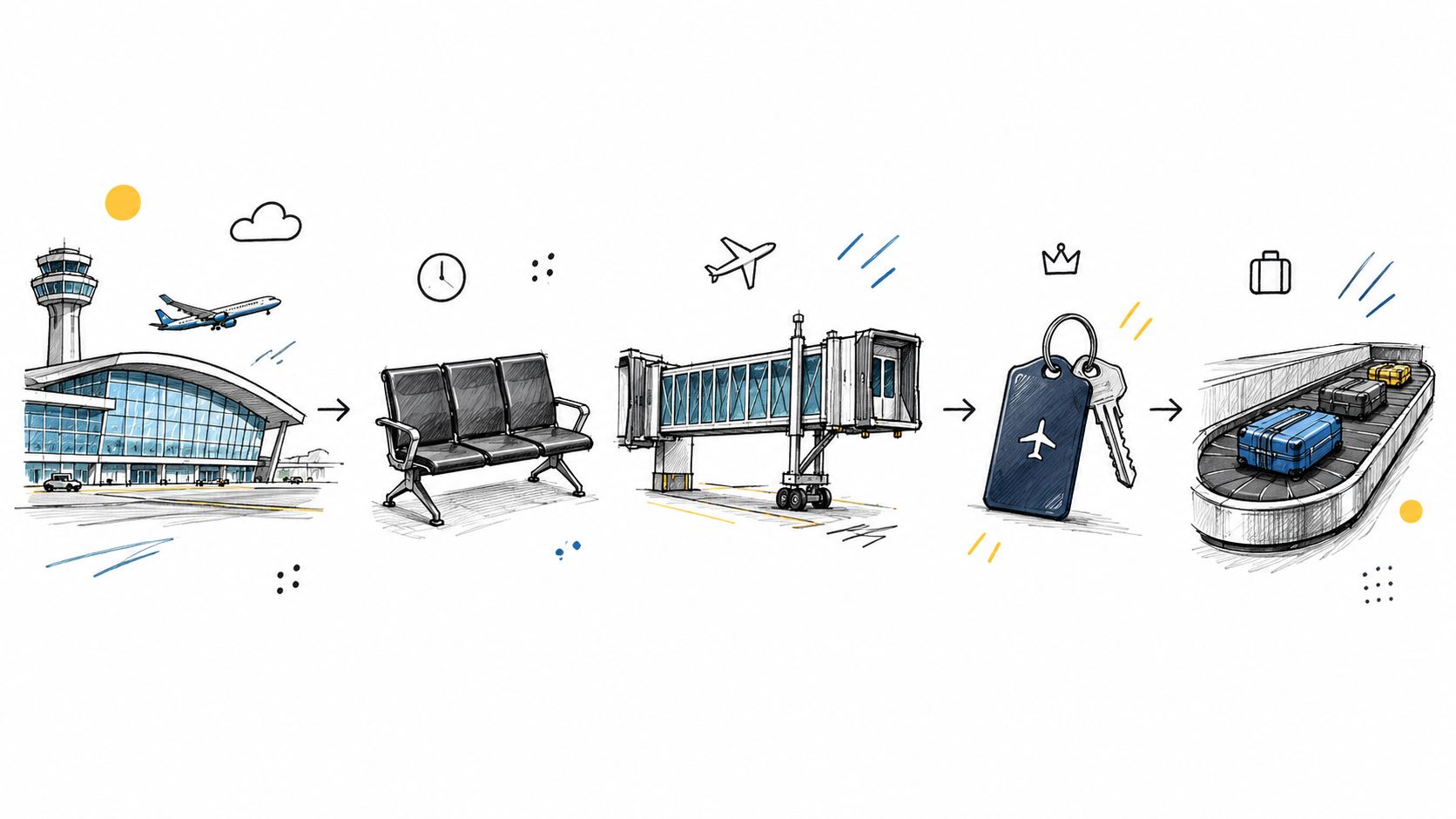
The first mistake first-timers make is packing as if every item will be available the second they board. It won't. Your day starts in the terminal, moves through screening and boarding, then stretches into the wait for cabin access and luggage delivery, which can happen hours later.
Think in three layers
A smarter cabin packing list separates the trip into three jobs. The first job is to keep you functional during embarkation. The second is to hold what belongs in checked luggage. The third is to make the cabin usable as soon as you step inside.
Practical rule: If you'd be annoyed to lose access to it for half a day, it stays with you.
That matters because a stateroom has limits that normal hotel rooms don't. Drawer space is tight, wall space is often metal, bathroom lighting can be weak, and anything bulky or awkward slows you down instead of helping you. A single “everything bag” usually turns into overpacking, and overpacking makes embarkation more stressful than it needs to be.
A staged approach fixes that. It also keeps you from mixing documents, medicine, and valuables with items that can safely wait in a checked bag. Cruise travel rewards separation, not improvisation.
Setting Up Your Two-Stage Baggage Plan
Start with a simple split. One bag follows you through the airport and terminal. The other bag goes into the checked system and can hold the bulkier parts of your trip. That clean divide is what keeps your cabin packing list from collapsing into a pile of random “just in case” items.
What stays with you
Your carry-on should hold anything mission-critical. That means travel documents, medication, chargers, a spare outfit, swimwear, and the things you'd hate to lose if luggage is delayed. It also means anything fragile, valuable, or hard to replace once you've boarded.
What goes in the main bag
The checked bag is for volume. Clothing, extra shoes, and toiletries that aren't needed immediately belong there. Cruise and airline guidance both point toward weight discipline, and IATA's baggage guidance shows why that matters, airline carry-on limits can begin at 5 kg (11 lb), while international checked-bag guidance recommends staying at or below 23 kg (50 lb), with many regions capping a single bag at 32 kg (70 lb). You don't want to discover you're over the limit at the curb.
A small luggage scale helps because cruise accessories add up faster than people expect. A fan, night light, organizer, power bank, and toiletry kit can steadily eat into the margin you thought you had left. Measure the bag after everything is inside, not before.
The safest packing habit is to leave a little room in both bags. A tight bag is harder to repack, harder to lift, and more likely to trigger a last-minute shuffle.
| Item Category | Carry-On | Checked Bag | Why |
|---|---|---|---|
| Documents | Yes | No | You need them at embarkation and often throughout the voyage |
| Medication | Yes | No | Delays happen, and replacement on board is inconvenient |
| Electronics and chargers | Yes | Sometimes | Keep essential devices accessible and protected |
| One change of clothes | Yes | No | Covers luggage delays and boarding-day spills |
| Swimwear | Yes | Optional | Useful if the pool deck opens before your room is ready |
| Bulk clothing | No | Yes | Saves space in the bag you carry through the terminal |
| Toiletries | Small kit only | Main supply | Bring just enough to get through the first hours |
| Shoes | One pair if needed | Extra pairs | Footwear takes up space fast |
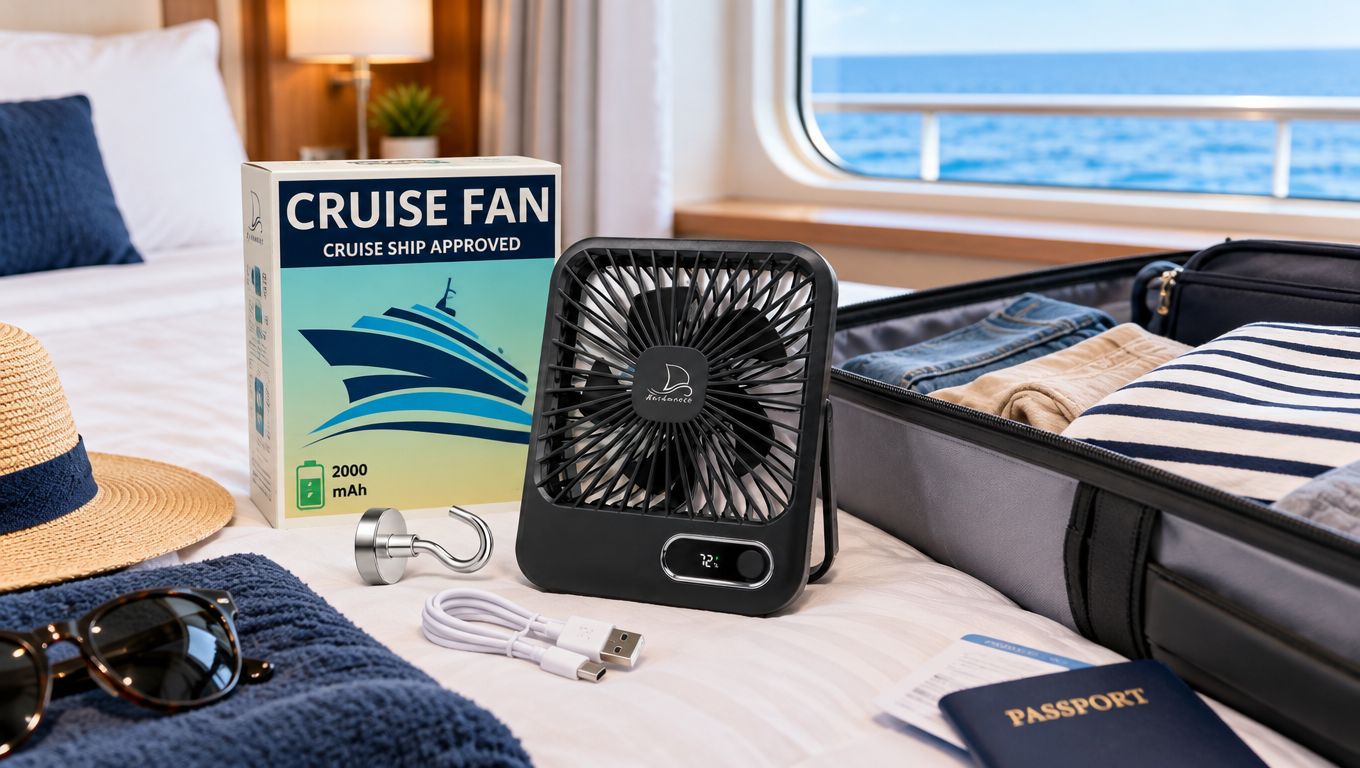
A useful example is the Rechargeable Cruise Fan with Magnetic Hook to Hang on Cruise Walls & Ceilings, which is a compact rechargeable fan with selected timer and speed settings, made to be travel-ready. It fits naturally in the main bag if you're building a comfort kit, but it shouldn't crowd out the essentials in your carry-on.
The Cabin-Arrival Kit for the First 24 Hours
The first day on board can unravel fast. You may board before your cabin is ready, and your checked bag may arrive later than you expected. The cabin-arrival kit should handle those first hours like a small carry-along kit, not a second suitcase.
Build it around real moments
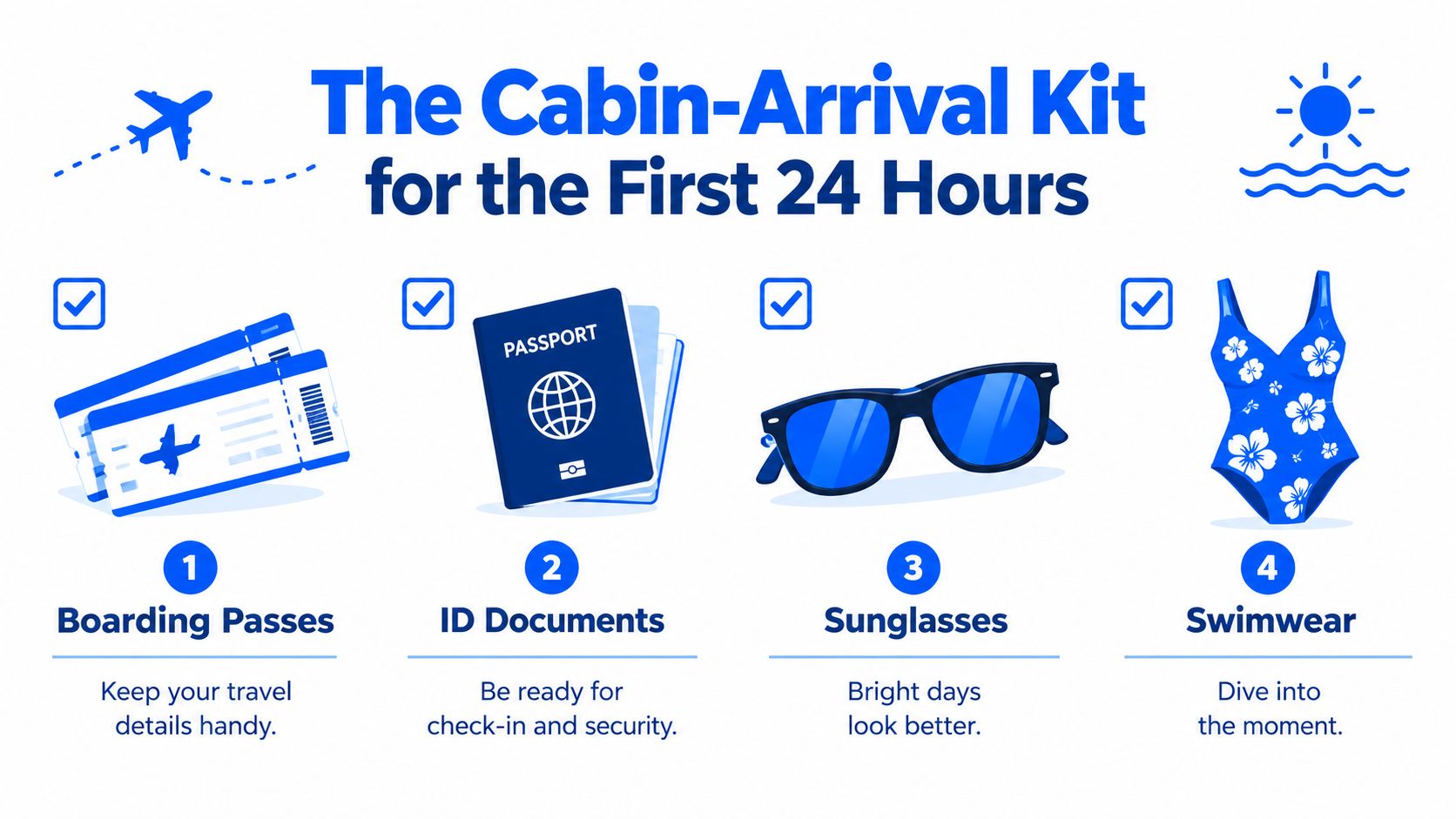
Start with the moment you leave the terminal. Keep identification and boarding paperwork within easy reach. If you head straight to lunch or the pool deck, you will want sun protection, swimwear, and a light layer. If luggage is delayed, you will also want a few small comforts that let you keep going without returning to the room.
A compact organizer can help here, especially one that uses cabin walls instead of counter space. A product like the Magnetic Cruise Organizer 14 Pockets uses magnets to attach to a metal wall or door, which makes it useful for toiletries, sunscreen, and other small items once you are in the cabin. Some lines do not allow over-the-door hooks, so a magnetic setup is often easier to fit around than a hanging organizer.
What belongs in this kit is straightforward:
- Boarding documents, so you are not digging through layers of clothing at check-in.
- ID and travel paperwork, because terminals do not stop for repacking.
- Sunglasses and sunscreen, since the pool deck and open decks do not wait for your suitcase.
- Swimwear and a cover-up, so the first afternoon is not lost.
- A light top or cardigan, because air conditioning can feel stronger than expected.
- Basic toiletries, enough to freshen up before the bag delivery window closes.
The goal is to bring the right things early, not everything early. That keeps the first hours of the cruise feeling like the start of the trip, instead of a waiting room.
Ship Compliance and Prohibited-Item Checkpoint
Cruise cabins are small, dense environments, so lines are strict about anything that can raise fire risk or create a safety issue. That includes flammable liquids, candles, incense, heating elements, irons, immersion heaters, surge-protected power strips, and even some small fans or extension cords, according to major cruise-line prohibited-item guidance from Holland America. The policy logic is straightforward, one careless device in a tightly packed stateroom creates a bigger problem than it would in a house.
Use a four-question filter
Before you pack any powered or sharp item, ask four things. Does it have a battery. How does it charge. Does it contain a heating element. Does it include surge protection. If any answer creates doubt, check the line's current rules before you leave home.
That matters because policies vary by operator and itinerary. A permitted item on one ship can be refused on another, and some confiscated items may not come back to you. That's why a generic packing guide is never enough on its own.
Quick test: If the item plugs in, heats up, or protects against surges, treat it as a policy item, not a packing certainty.
This is also where a lot of travelers make avoidable mistakes with convenience gear. A fan, a clothes steamer, a power strip, or a decorative light can look harmless and still fail screening. If you're unsure, verify before you zip the bag.
For a line-by-line decision mindset, the practical question isn't “do I want this,” it's “will security let it through, and what happens if they don't?” That's the difference between a good list and a useful one.
Later in the process, keep one more rule in mind, lithium batteries and spare power cells belong in hand luggage, not checked bags, and terminals should not be able to touch metal objects. That keeps short-circuit risk down and makes it easier to get through screening without a delay.
If you want a more detailed item-by-item breakdown of what's usually allowed, the guide on what you can take on a cruise is worth checking before you finish packing.
Clothing and Storage Strategy for a Small Stateroom
Cruise clothes work best when they're chosen for rotation, not variety. A weeklong itinerary usually doesn't need an oversized wardrobe, it needs outfits that can shift between sea days, dinners, and port stops without taking over the room. CLIA's 2025 cruise market report recorded an average cruise length of 7.0 days and noted that it was slightly down from 7.1 days the year before, which is a good anchor for planning a roughly weeklong clothing rhythm CLIA global market report.
Pack for repeat use, not one-time use
Start by matching outfits to real cruise moments. You need daytime clothes, evening clothes, swimwear, sleepwear, and one backup layer for chilly indoor spaces. If you're doing a formal dinner or a dressier evening, keep that outfit separate so it doesn't get crushed under everyday pieces.
Storage matters just as much as selection. Packing cubes help divide clean clothing from worn clothing, and vertical storage makes better use of small closets and drawer depth. Under-bed storage usually handles luggage, not loose piles of clothes.
Wet items are the biggest nuisance in a cabin because they spread clutter fast. A magnetic clothesline or similar compact drying option belongs in the checked bag, where it won't crowd your carry-on, and it gives you a place to dry swimwear without draping it over chairs or bathroom fixtures.
A small stateroom stays calmer when every category has a home. Clothes go in cubes, wet items go on a line, and anything small enough to disappear goes in an organizer.
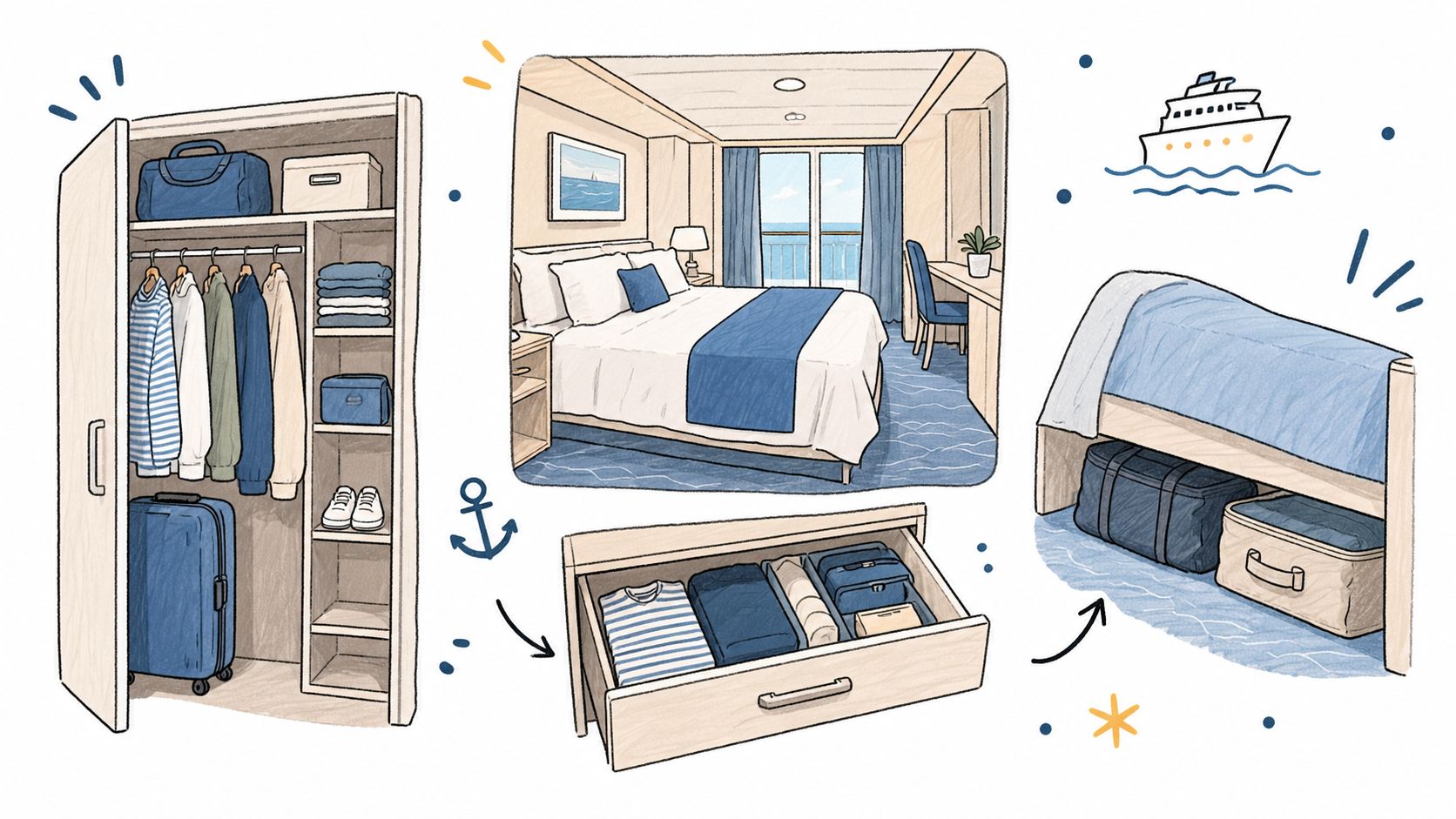
If you want a practical breakdown of how to make that work in tighter quarters, the small space storage solutions guide pairs well with this approach.
Comfort, Airflow, and Motion Management Items
Some cabin items don't feel urgent until you've spent one night at sea. Warm air, dim corners, and mild motion can all turn into small annoyances that keep repeating. That's why comfort gear deserves its own cluster inside the cabin packing list instead of getting buried in a generic “miscellaneous” pile.
Build for the cabin, not the hotel room
A rechargeable fan is a good example of the right kind of cabin gear. It solves airflow without taking up counter space, and a battery-powered design avoids the problem of dragging in a mains appliance that may not be permitted. In a ship cabin, the goal is low-profile comfort, not extra hardware.
Low-glare lighting helps too. A magnetic night light near the bathroom or pathway can reduce the need to blast overhead lights on and off after midnight. That's a small change, but on a dark ship corridor it makes moving around easier and less jarring.
Motion support belongs in the same comfort set. Non-drowsy motion patches, acupressure bands, or ginger-based options are worth packing before you need them, especially if you know you're sensitive on boats or when the ship starts moving more noticeably. The key is to treat those items as part of the trip plan, not as last-minute pharmacy purchases.
- Airflow gear: rechargeable fan, charger, and any mounting accessories.
- Low-light gear: compact night light, spare battery if needed, and a place to store it safely.
- Motion comfort items: bands, patches, or ginger options that you've already used before.
- Personal comfort extras: earplugs, eye mask, or a small item that helps you sleep better in new surroundings.
The smartest version of this category is compact and deliberate. If an item improves the cabin without making it crowded, it earns its place.
Final Pre-Departure Cabin Checklist and Embarkation Tips
The last check should happen before you leave home, not at the curb. Weigh both bags, confirm that documents and medication are in the carry-on, and do one final policy check on every powered item. That's the point where a good cabin packing list becomes a repeatable routine instead of a guess.
A simple 48-hour finish line
Look at each bag and ask whether anything important is still hiding in the wrong place. If the item is needed during embarkation, it goes in the day bag. If it can be delayed safely, it goes in the main bag. If it might get flagged by ship security, verify it before you zip it shut.
Luggage tags deserve the same attention. Put them on clearly, make sure the names match the reservation, and keep a digital or paper backup of the tag info in case a bag gets separated during transfer. For a quick refresher on why that matters, the cruise luggage tag guide is a useful companion.
Final rule: If you can't reach it, delay isn't the only risk. Confusion is, too.
The last bag to stage is the disembarkation-night bag. Think of it as the mirror image of your embarkation kit, a small set of essentials you'll want after your main luggage is put out and before you leave the ship. That keeps the final morning from becoming a scavenger hunt.
If you do these checks once, you can reuse them on every future cruise. That's the value of a good system: it gets easier the second time and calmer every time after that.
Nordmoose builds cruise-focused accessories for exactly these cabin problems, from magnetic organizers and rechargeable fans to compact comfort gear for small staterooms. If you want packing tools that fit a cruise cabin instead of fighting it, take a look at Nordmoose before your next sailing and build a carry-on and cabin setup that's ready on day one.