

Best Travel Bottles for Shampoo: A Practical Buying Guide
You're halfway through packing for a cruise when you notice the shampoo bottle has been lying sideways in your toiletry bag. The cap looks closed, so you toss the bag into the suitcase and move on. Two days later, in a cramped stateroom drawer, shampoo has seeped through the bag and coated a freshly laundered swimsuit.
That failure has little to do with the bottle's appearance on a bathroom shelf. Compression, sideways storage, rough luggage handling, pressure changes, and repeated repacking expose weak closures quickly. The best travel bottles for shampoo are the ones built for those conditions, and sometimes the smartest choice is to leave liquid shampoo at home altogether.
Table of Contents
- Why Your Shampoo Bottle Choice Matters More Than You Think
- TSA Liquid Rules and the Exact Numbers Behind 3.4 Ounces
- Comparing Sizes, Materials, and Cap Designs Side by Side
- Why Travel Bottles Leak in Transit and What Actually Stops It
- Refillable Sets vs Shampoo Bars vs Concentrates
- Matching Bottle Types to Cruise Packing Scenarios
- Your Feature Checklist and Final Decision Rule
Why Your Shampoo Bottle Choice Matters More Than You Think
A cruise creates more opportunities for a bottle to fail than a normal hotel stay. Your toiletries may begin in a checked suitcase, spend hours under clothing and shoes, move through port handling, sit in a cabin wardrobe, and then travel in a beach tote on an excursion. The bottle doesn't get one stable environment. It gets squeezed, tilted, dropped, and opened repeatedly.
A narrow silicone tube can be comfortable to squeeze in the shower but vulnerable when its cap takes pressure from a packed bag. A rigid threaded container may hold its shape better in checked luggage, yet feel awkward when you're trying to dispense thick shampoo into a tiny cabin sink. A pump may work beautifully upright but become a poor choice when the container lies on its side for hours.
Cruise cabins expose weak designs
Stateroom storage also changes the equation. Toiletry bags live in drawers, on shelves, inside closets, or in wardrobes that aren't always perfectly level. You may remove the bottle for a sea-day shower, return it to the bag, and then pack it again before a port visit. Every opening and closing gives residue another chance to interfere with the seal.
A bottle that survives a bathroom counter hasn't necessarily survived transit. Consumer guidance often reduces the solution to tightening the cap or storing the bottle upright, but that advice misses the stressors: sideways storage, compression, and repeated handling. An independent product analysis describes leakage as a common failure mode, particularly when bottles are stored horizontally or exposed to pressure and movement (transit leakage analysis).
Cruise-packing rule: Judge a shampoo bottle by how it behaves when it's sideways and compressed, not by how neat it looks standing upright.
What this guide prioritizes
I'd rather carry a slightly less elegant bottle with a dependable seal than clean conditioner out of a drawer. The recommendations below focus on cap architecture, wall strength, refill access, capacity, and actual transit scenarios. Those details tell you more than a product listing that just says “leakproof.”
For a first cruise, choose the bottle that survives your worst packing condition. If you're flying to the embarkation port, that means airline screening and checked-bag compression. If you're driving, it means vibration, heat, and a toiletry bag thrown into the cabin. Either way, the bottle should be treated as a containment device, not a decorative travel accessory.
TSA Liquid Rules and the Exact Numbers Behind 3.4 Ounces
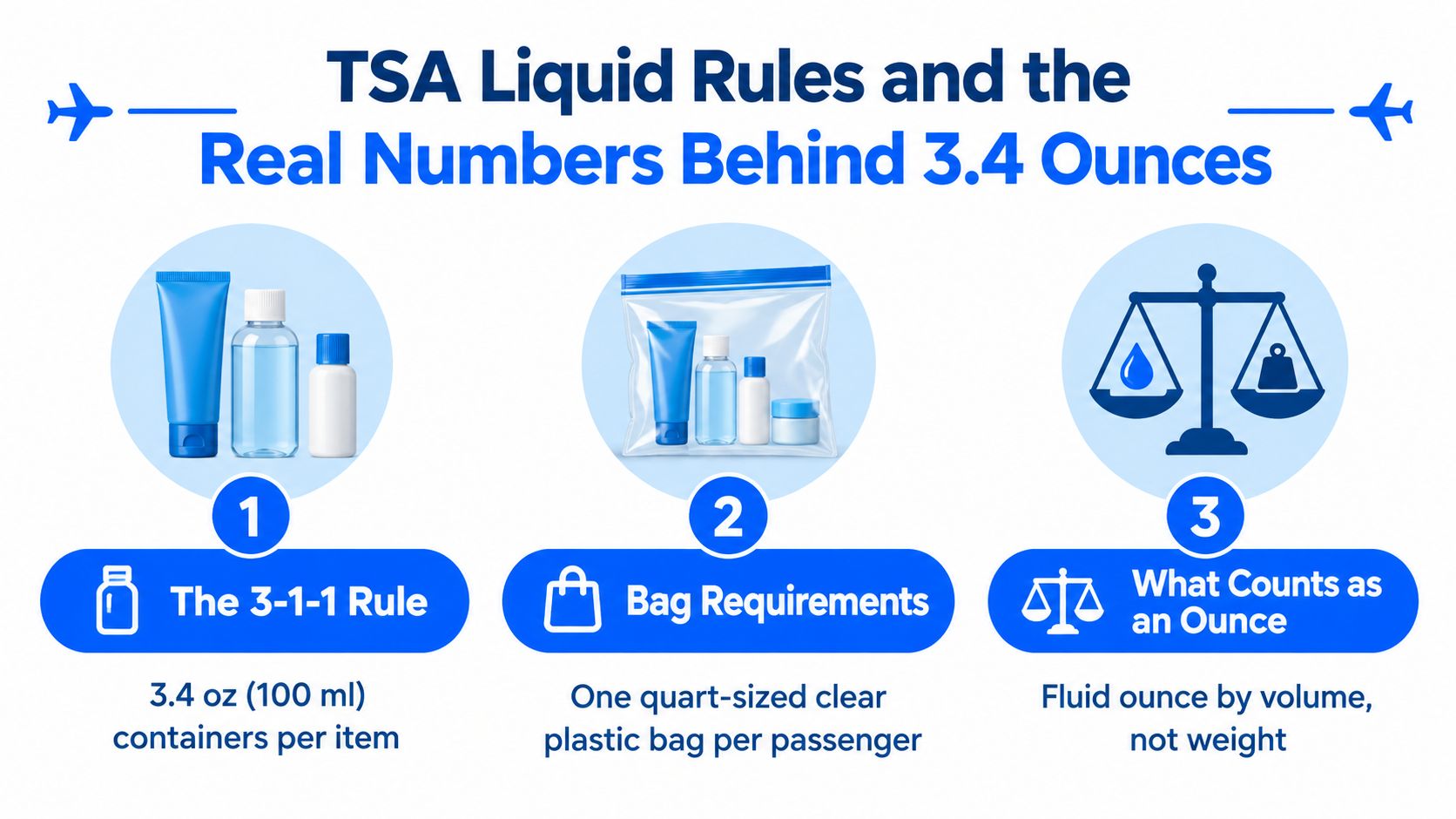
The TSA 3-1-1 rule should shape your shampoo bottle choice before you pack. Each liquid container in a carry-on must hold 3.4 fluid ounces, or 100 milliliters, or less, and every qualifying container must fit in one quart-sized resealable bag per passenger. The rule also covers gels, creams, aerosols, and pastes, not only shampoo (TSA 3-1-1 liquid rule).
Read the printed capacity, not the fill level
The number printed on the container matters. A bottle labeled 100 ml is approximately 3.38 fluid ounces, so it falls within the stated limit. A bottle labeled 4 ounces generally does not qualify, even when it contains less shampoo. Security staff assess the container's capacity, not your estimate of its contents.
Fluid ounces measure volume, while weight depends on the formula. Shampoo density varies, so a measured weight cannot reliably confirm compliance with a volume limit. Choose a bottle with a clearly printed capacity and keep it at or below 100 ml when it will enter the cabin.
A cruise ship does not create an airport screening exception. If you fly to the port, your carry-on still passes through airport security. Cruise-line or port personnel may also inspect boarding-day bags, so pack your toiletries for the full journey, not just the time onboard.
For a broader embarkation checklist, see what you can take on a cruise. A small rechargeable Magnetic Motion Sensor Night Light for Cruise is a cabin item rather than a liquid and can travel beside your toiletry kit.
Practical capacity planning
For a one-week sailing, choose capacity according to your usage and whether the ship provides a product you can use. A 50 ml bottle suits a light packer or anyone relying partly on onboard shampoo. A 100 ml bottle gives more room for a preferred formula, conditioner, or a shared product, but it occupies more space in the liquids bag.
Do not fill every bottle automatically. Carrying less reduces bulk and leaves room for the cap and expansion pressure. With several liquids competing for space, shampoo should earn its place in the quart bag.
Comparing Sizes, Materials, and Cap Designs Side by Side
Size, material, and cap design matter more than color or the number of pieces in a set. For cruise packing, select the container around the handling it will receive, then choose the material that supports that use.
| Bottle Type | Best For | Key Trade-off | Weakest Cap Type |
|---|---|---|---|
| Soft silicone squeeze bottle | Conditioner, thick shampoo, shore excursions | Dispenses nearly all the product, but flexible walls can transfer stress to the cap | Flip-top |
| PET plastic bottle | Checked luggage and visible product levels | Light and easy to inspect, but can crack or lose thread integrity | Pump |
| Aluminum bottle | Rugged packing and opaque formulas | Protects from light, but you can't see the fill level and some formulas may react with the material | Push-pull spout |
| HDPE bottle or jar | Repeated travel and tougher handling | Flexible but durable, with less easy product evacuation than soft silicone | Snap-shut disc lid |
Choose capacity by the trip, not by habit
For a weekend carry-on, 1 to 2 ounces is usually the practical range. You avoid hauling a full-size supply for a short trip and preserve space for other liquids. For a week-long cruise, 2 to 4 ounces gives more flexibility, though anything intended for a carry-on must stay within the applicable container limit.
Extended sailings or shared family bottles may justify 4 to 6 ounces, but those containers belong in checked luggage when flying. A larger bottle is not automatically better. It adds weight, occupies space, and creates more product to clean out when the trip ends.
Material changes the handling experience
Soft silicone wins when you want to squeeze out thick shampoo and the final residue. Its weakness is mechanical. Repeated squeezing can stress the neck and cap, particularly if the closure is only a thin hinged lid.
PET is light and usually lets you see what remains, but its threads and walls vary in quality. HDPE is the better hard-plastic choice when repeated handling matters, while aluminum offers rigidity and opacity at the cost of visibility and formula compatibility. Guidance comparing common travel-container materials notes that wall thickness and thread integrity affect durability and seal retention, and that polypropylene can outperform PET in creep resistance (material and wall guidance).
Cap architecture is the deciding detail
A screw-top cap with an integrated gasket is the safest starting point. Disc-top lids can work well for quick access, while push-pull spouts suit sports bags only when the valve is protected. Pumps are convenient at home but poor in luggage because their moving parts and air paths don't tolerate compression as reliably.
For a cruise, I'd choose a threaded semi-rigid bottle for checked luggage and a silicone squeeze bottle with a protected disc-top for excursions. That pairing is less convenient than buying four identical tubes, but it matches the two different jobs.
Why Travel Bottles Leak in Transit and What Actually Stops It
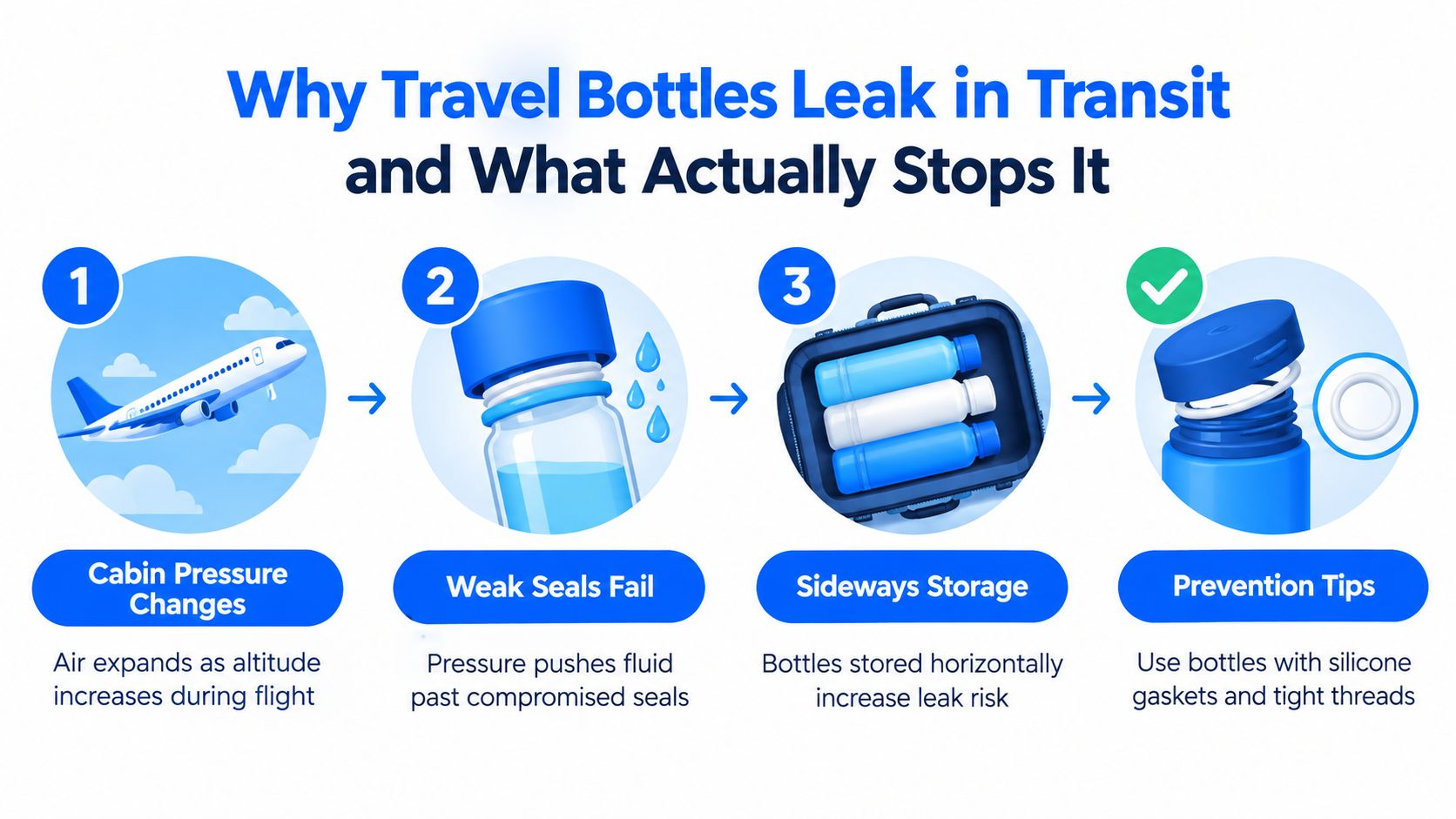
Leakage starts with pressure and movement, not with a bottle suddenly deciding to open. During a flight, air expansion can push liquid toward the closure. Store the bottle sideways and the product sits against the cap continuously. Add compression from clothing, and the trapped air looks for the easiest escape route, usually through the threads or valve.
Thick shampoo and conditioner create another problem. Their viscosity can trap air inside the bottle, and squeezing the walls forces that air and product toward the cap. A closure that appears tight may still allow a slow seep if its gasket is thin, misaligned, or contaminated with dried product.
Three barriers beat one
A tested multi-layer design combines an inner silicone gasket, a threaded locking ring, and an outer cap. An expert guide reports that this arrangement resisted leakage in checked-bag simulation and transatlantic flight testing, while single-cap variants were more likely to weep under cabin-pressure changes (multi-layer sealing guidance).
A gasket works only when the cap holds it evenly against the bottle mouth. Look for deep, clean threads and a cap that doesn't flex excessively. The best designs use separate barriers, so one imperfect contact point doesn't become the only defense between shampoo and your clothes.
Why popular closures disappoint
Flip caps fail because the hinge and snap point sit directly in the impact zone. A sideways bottle can press the lid against fabric or another container until the closure flexes. Disc-top caps generally provide a flatter, more stable contact surface, while screw caps distribute force through the threads.
Pump dispensers have their own weakness. Their internal tube and valve can allow air movement, and compression may make the pump seep or become difficult to prime. They're useful in a cabin bathroom, but I wouldn't trust an exposed pump inside a packed suitcase.
Test before packing
Don't make your first test a flight to your cruise. Fill the bottle with water, close it, wipe the outside dry, and place it sideways on a paper towel. Apply firm pressure to the walls and leave it there for several hours. Then inspect the towel and the cap threads.
Before every trip, check for:
- Dried residue: Shampoo crust around the mouth can hold the gasket slightly open.
- Cross-threading: If the cap feels tight too early or sits unevenly, remove it and start again.
- Valve damage: A no-drip valve that has split or stiffened can leak under pressure.
- Cap movement: A lid that wiggles after closure needs a second barrier, such as a leak-resistant pouch.
A bottle isn't ready for luggage until it passes a sideways test with the same product you plan to carry.
Refillable Sets vs Shampoo Bars vs Concentrates
Buying a bottle set is often the wrong first step. If your preferred shampoo is available as a bar or concentrate, removing liquid from the packing system also removes the main leak point. Refillable systems remain useful, but they shouldn't be the automatic answer.
| Format | Leak Risk | TSA Compliance | Cruise Cabin Suitability | Trip Cost per Use |
|---|---|---|---|---|
| Refillable bottle set | Depends on cap, gasket, and transit position | Fits carry-on rules when each container is within the limit | Familiar, easy to share, and simple to use in a bathroom | Higher upfront purchase, then reusable |
| Shampoo bar | No liquid leakage | Avoids liquid-container limits | Excellent for small cabins if it can dry between uses | Varies by formula and longevity |
| Concentrate | Low if sealed properly, higher after mixing | Dry formats avoid liquid limits; liquid formats still follow them | Compact, but mixing can be inconvenient in a stateroom | May reduce product volume, depending on formula |
Refillable bottles are for control
Choose refillables if you rely on a specific shampoo, manage a sensitive scalp, or don't want to gamble on hotel and ship-provided products. A wide-mouth bottle makes thick formulas easier to transfer and clean. Labels also matter when several containers look identical in a dim bathroom.
Silicone bottles are comfortable for dispensing and can evacuate thick product effectively. Semi-rigid plastic is easier to inspect and may hold its threads more consistently. Either material still needs a capable seal, because reuse doesn't fix a poor cap.
Bars remove the messiest failure mode
A shampoo bar doesn't leak through a cap, occupy space in the liquid bag, or burst across a swimsuit. It does require a ventilated case and time to dry after use. That can be inconvenient on a cruise, where you may pack quickly between a shower and an excursion.
Water conditions can also affect how a bar feels and rinses. If you've never used one, test it at home before boarding. Bringing a small backup bottle is sensible if your hair reacts badly to unfamiliar formulas.
Concentrates make sense for committed minimalists
Concentrated liquids and powder-to-foam products reduce the amount of product you carry, but they introduce preparation. You may need to mix them with water, judge the right consistency, or accept a formula you haven't used before. That trade-off is worthwhile for travelers who prioritize a small footprint over instant familiarity.
My preferred strategy is mixed: use a bar for shampoo if you already trust it, carry a small refillable bottle of conditioner, and reserve a concentrate for longer trips or repeat travelers who know the formula works. Don't carry three formats just to be prepared. Pick the one that solves your actual failure point.
Market data supports the shift toward alternatives. Refillable travel toiletry containers were estimated at USD 1.82 billion in 2025 and projected to reach USD 3.47 billion by 2034, while shampoo bars were cited as expanding at 18.4% annually in the referenced market research (refillable and waterless format research). These are projections and market estimates, not a reason to buy a format that doesn't suit your hair.
Matching Bottle Types to Cruise Packing Scenarios
The right container changes as the bottle moves through the trip. Embarkation, sea days, port excursions, and disembarkation each create different stresses, so one universal bottle set is rarely the most practical answer.
Embarkation day
If you're flying to the port, checked luggage may sit compressed for hours before you see it again. Use a threaded PET or HDPE container with a gasket, placed inside a sealed toiletry pouch. A wider base is preferable to a tall narrow tube because it resists bending when clothes and shoes press down on the bag.
Keep the most important shampoo in your carry-on if losing it would ruin your trip, but follow the liquid rules. Don't put a large bottle in your cabin bag and assume the ship's boarding process changes airport restrictions.
Sea days
Many ships provide shampoo in the cabin bathroom. The formula may not suit your hair, and the dispenser may be awkward, but you don't need to duplicate a product you're happy to use onboard.
Carry only what you need. For some travelers, that means bringing conditioner while using the ship's shampoo. For others, it means a compact bar and no liquid bottle. Fewer containers make the drawer easier to manage and reduce the number of caps you open in humid conditions.
Port excursions
A shore-excursion bag gets tossed onto tour buses, set under seats, and carried through heat and humidity. Use a disc-top silicone bottle with a protective outer cap or a compact semi-rigid bottle with a secure loop. Avoid exposed pumps and flimsy snap lids.
Don't fill an excursion bottle to the brim. Leave enough room to squeeze the product without forcing it into the closure. Put it in a small waterproof pouch even if the bottle has passed your home test.
Disembarkation morning
This is when wide-mouth containers earn their keep. You're packing quickly, often before breakfast, and thick shampoo left in a narrow neck creates a sticky cleanup problem. A bottle that pours cleanly and closes without residue saves more time than a clever dispenser.
Store the toiletry pouch where you can reach it without unpacking the whole suitcase. The cabin's limited storage makes this a good time to use vertical organization, and small-space cruise storage solutions can help keep bottles visible instead of buried under clothing.
For families, separate products by person or use distinct colors. That prevents repeated opening and closing while someone searches for the right bottle, which is a small habit that protects the seals.
Your Feature Checklist and Final Decision Rule
Ignore listings that lead with color, accessory counts, or vague “spillproof” language. Start with the closure and work outward. A reliable travel shampoo bottle should answer how it handles pressure, sideways storage, refilling, and cleaning.
The buying checklist
- Threaded cap and silicone gasket: This creates a more dependable barrier than a bare snap lid. The threads should engage evenly, and the gasket should sit flat.
- Rigid or semi-rigid walls: Firm walls resist deformation under packed clothing. Soft silicone is still useful, but pair it with a strong neck and protected closure.
- Volume under 100 ml: This keeps the container within the TSA carry-on limit when the printed capacity is no more than 100 ml.
- Wide-mouth opening: Thick shampoo goes in without a funnel fight, and the bottle is easier to rinse and dry after the sailing.
- Label-ready surface: Color coding helps, but a writable label prevents confusion when several products have similar packaging.
- Opaque or UV-protected material: Choose this when light sensitivity matters for your formula. Otherwise, visibility may be more useful than opacity.
- Dishwasher-safe construction: Only rely on this if the manufacturer states it. Heat can distort seals and soft materials, so inspect the cap afterward.
Use the cruise ship essentials checklist to place the bottle alongside the rest of your cabin gear, but keep the selection rule simple: choose the smallest container that holds enough product, then prioritize the strongest seal.
The decision rule
For a trip under four days, take one or two 60 ml bottles if you're carrying liquid shampoo and conditioner. That gives a short itinerary a compact setup without filling your liquids bag with unnecessary product.
For four to eight days, use a coordinated set in a zip pouch. A silicone squeeze bottle suits thick shampoo, while a semi-rigid threaded bottle gives you a sturdier option for checked luggage. Test every container sideways before packing.
For eight or more days, stage larger refills in checked luggage when flying, or switch to a shampoo bar or concentrate if the format already works for you. A longer cruise doesn't justify carrying maximum-capacity bottles by default. It just gives you more reason to choose a system that refills cleanly and survives repeated handling.
The best travel bottles for shampoo aren't the ones with the flashiest listing. They're the ones with a tested seal, suitable capacity, accessible opening, and material matched to the way you'll travel.
Nordmoose offers practical cruise accessories designed around compact staterooms, including magnetic organizers, rechargeable cabin lighting, fans, clotheslines, and travel-comfort items. Visit Nordmoose before you pack, and build the rest of your cabin setup around the same principle as your shampoo bottle, less clutter and fewer avoidable failures.